A&P EXAMN 3 [FULL]
 Call Kai
 Learn
 Practice Test
 Spaced Repetition
 Match
 Flashcards
 Knowt Play
1/91

There's no tags or description
Looks like no tags are added yet.
92 Terms
Which of the following correctly describes the structural and functional characteristics of skeletal muscle tissue?
Non-striated, involuntary, and composed of spindle-shaped cells
Striated, voluntary, and composed of long, multinucleated cylindrical cells
Striated, involuntary, and composed of branching cells with centrally located nuclei
Non-striated, voluntary, and composed of cells with a single central nucleus
Striated, voluntary, and composed of long, multinucleated cylindrical cells
Which of the following muscle tissue types is responsible for involuntary contractions of hollow organs, such as the urinary bladder and gastrointestinal tract?
Skeletal muscle
Cardiac muscle
Smooth muscle
Skeletal and cardiac muscle
Smooth muscle
Which of the following muscle tissue types is responsible for involuntary, rhythmic contractions of the heart, allowing it to continuously pump blood throughout the body?
Skeletal muscle
Cardiac muscle
Smooth muscle
Skeletal and cardiac muscle
Cardiac muscle
Which of the following connective tissue layers surrounds an individual skeletal muscle fiber?
Epimysium
Perimysium
Endomysium
Deep fascia
Endomysium
Which of the following connective tissue layers surrounds an individual muscle fascicle?
Epimysium
Perimysium
Endomysium
Sarcolemma
Perimysium
Match each specialized structure or organelle of a skeletal muscle fiber with its correct function.
1. | Specialized plasma membrane surrounding a skeletal muscle fiber that conducts electrical impulses. |
2. | Specialized cytoplasm of a muscle fiber containing organelles, glycogen, and myoglobin. |
3. | Specialized smooth endoplasmic reticulum that stores and releases calcium ions (Ca²⁺) during muscle contraction |
4. | Invaginations of the plasma membrane that conduct action potentials deep into the muscle fiber. |
5. | Enlarged regions of the sarcoplasmic reticulum that store and release calcium ions during muscle contraction. |
6. | Long, cylindrical contractile structures composed of repeating sarcomeres containing actin and myosin filaments. |
7. | Oxygen-binding protein that stores oxygen within muscle fibers for aerobic ATP production. |
8. | Granules containing stored glycogen that can be broken down to provide glucose for ATP production. |
9. | Functional arrangement consisting of one T-tubule positioned between two terminal cisternae. |
Sarcolemma
Sarcoplasm
Sarcoplasmic Reticulum
T-Tubules
Terminal Cisternae
Myofibrils
Myoglobin
Glycosomes
Triad
Which of the following proteins binds calcium ions during skeletal muscle contraction, allowing myosin-binding sites on actin to become accessible?
Tropomyosin
Myosin
Troponin
Titin
Troponin
Which of the following correctly describes the sequence of events during skeletal muscle depolarization and excitation-contraction coupling?
Acetylcholine release → Calcium enters the muscle fiber → Sodium enters the muscle fiber → Action potential travels through T-tubules → Cross-bridge formation
Acetylcholine release → Sodium enters the muscle fiber, initiating depolarization → Action potential travels along the sarcolemma and through T-tubules → Calcium is released from the sarcoplasmic reticulum → Cross-bridge formation
Sodium enters the muscle fiber → Calcium is released from the sarcoplasmic reticulum → Acetylcholine release → Action potential travels through T-tubules → Cross-bridge formation
Acetylcholine release → Action potential travels through T-tubules → Calcium is released from the sarcoplasmic reticulum → Sodium enters the muscle fiber → Cross-bridge formation
Acetylcholine release → Sodium enters the muscle fiber, initiating depolarization → Action potential travels along the sarcolemma and through T-tubules → Calcium is released from the sarcoplasmic reticulum → Cross-bridge formation(?)
Which of the following correctly describes the role of ATP during the cross-bridge cycle?
ATP binds to actin, exposing the myosin-binding sites.
ATP binds to troponin, causing calcium ions to enter the sarcoplasm.
ATP binds to myosin, allowing the myosin head to detach from actin.
ATP binds to tropomyosin, initiating the power stroke.
ATP binds to myosin, allowing the myosin head to detach from actin.(?)
Which of the following represents the correct sequence of events during the cross-bridge cycle?
ATP binding → Power stroke → Calcium binding → Cross-bridge formation
Calcium binding to troponin → Cross-bridge formation → Power stroke → ATP binding and detachment
Power stroke → Calcium reabsorption → Cross-bridge formation → ATP hydrolysis
Cross-bridge detachment → Calcium binding to myosin → ATP release → Power stroke
Calcium binding to troponin → Cross-bridge formation → Power stroke → ATP binding and detachment(?)
During the cross-bridge cycle, which of the following events is directly responsible for the power stroke?
ATP binds to myosin, causing the myosin head to detach from actin.
Calcium binds to tropomyosin, causing actin filaments to shorten.
The myosin head releases inorganic phosphate and pivots, pulling actin toward the M line.
ATP is hydrolyzed, causing myosin to detach from actin.
The myosin head releases inorganic phosphate and pivots, pulling actin toward the M line.(?)
A student begins a new resistance-training program that includes slowly lowering heavy weights. Approximately 24–48 hours later, the student develops muscle soreness and stiffness. Which of the following best explains the development of delayed-onset muscle soreness (DOMS)?
Accumulation of lactic acid that remains in muscle fibers for several days
Permanent detachment of myosin heads from actin filaments
Microscopic muscle and connective tissue damage associated with eccentric contractions
Complete depletion of acetylcholine receptors at the neuromuscular junction
Microscopic muscle and connective tissue damage associated with eccentric contractions(?)
A marathon runner experiences progressive muscle fatigue toward the end of a race. Despite continued nervous stimulation, the athlete's muscles become less capable of generating force. Which of the following factors can contribute to the development of muscle fatigue during prolonged exercise?
Complete elimination of calcium ions from the body
Permanent shortening of thick and thin myofilaments
Depletion of energy reserves required to sustain muscular contractions
Increased availability of ATP and glycogen reserves
Increased availability of ATP and glycogen reserves
Several hours after death, skeletal muscles become stiff and resistant to movement. This condition, known as rigor mortis, occurs when ATP production stops. Which of the following best explains why the muscles remain contracted?
Calcium ions permanently bind to acetylcholine receptors
Myosin heads cannot detach from actin because ATP is unavailable
Troponin continuously breaks down ATP, causing muscle shortenin
Tropomyosin permanently prevents actin-myosin interactions
Myosin heads cannot detach from actin because ATP is unavailable(?)
Which of the following terms describes a muscle that is primarily responsible for producing a specific movement?
Antagonist
Synergist
Agonist
Fixator
Agonist
Why are Type I skeletal muscle fibers particularly well suited for prolonged physical activities?
They generate maximal force rapidly but fatigue quickly.
They rely primarily on anaerobic glycolysis for energy production.
They have a high capacity for aerobic energy production and resist fatigue.
They contract faster than Type II fibers during intense exercise.
They have a high capacity for aerobic energy production and resist fatigue.
Two athletes participate in different training programs. Athlete A performs long-distance endurance running, while Athlete B performs repeated high-intensity sprinting. Which of the following adaptations would most likely distinguish Athlete A from Athlete B?
Both athletes would develop identical muscle adaptations regardless of training intensity.
Athlete A would develop fewer mitochondria, whereas Athlete B would develop greater aerobic capacity.
Athlete A would transition all Type I fibers into Type II fibers, whereas Athlete B would lose Type II fibers.
Athlete A would develop increased mitochondrial and capillary density, whereas Athlete B would develop greater adaptations supporting anaerobic energy production.
Athlete A would develop increased mitochondrial and capillary density, whereas Athlete B would develop greater adaptations supporting anaerobic energy production.
Which of the following structures of a neuron is primarily responsible for receiving incoming signals from other neurons?
Axon terminal
Dendrites
Axon hillock
Myelin sheath
Dendrites
Which of the following ion channels opens in response to the binding of a neurotransmitter?
Voltage-gated sodium channel
Potassium leakage channel
Ligand-gated ion channel
Voltage-gated calcium channel
Ligand-gated ion channel
Which of the following structures is considered the trigger zone where an action potential is typically initiated
Dendrite
Axon hillock
Axon terminal
Soma
Axon hillock
Which of the following structures of a neuron is responsible for transmitting signals to a target cell through the release of neurotransmitters?
Dendrite
Axon hillock
Axon terminal
Soma
Axon terminal
Which of the following best explains why the inside of a neuron becomes more positive during depolarization?
Potassium ions leave the neuron through voltage-gated potassium channels.
Sodium ions enter the neuron through voltage-gated sodium channels.
Chloride ions enter the neuron through ligand-gated chloride channels.
Calcium ions are actively transported out of the neuron.
Sodium ions enter the neuron through voltage-gated sodium channels.
A researcher applies a chemical that selectively blocks voltage-gated sodium channels in a neuron. Which of the following effects would most likely occur?
The neuron would experience prolonged depolarization due to increased sodium influx.
The neuron would be unable to generate normal action potentials despite receiving excitatory stimuli.
The neuron would repolarize more rapidly because potassium channels would remain open.
The neuron would continuously release neurotransmitters due to increased calcium influx.
The neuron would be unable to generate normal action potentials despite receiving excitatory stimuli.
During an experiment, a neuron has a resting membrane potential of −70 mV. Following stimulation, its membrane potential changes to −80 mV. Which of the following processes has occurred?
Depolarization
Repolarization
Hyperpolarization
Threshold activation
Hyperpolarization
Synaptic potentials that do not depolarize membrane potential enough to reach threshold are known as ______.
threshold potentials
suprathreshold potentials
subthreshold potentials
None of the above
subthreshold potentials
Compared to action potentials, graded potentials __________.
are produced in the axon
get stronger over time or distance
result in weaker changes in membrane potential the further from the point of origin they extend
are produced only at the axon hillock
result in weaker changes in membrane potential the further from the point of origin they extend
Which of the following best describes the mechanism by which ligand-gated ion channels operate?
They are gated by a chemical messenger that binds to the channel on the inside or outside of the cell.
They operate based on the relative distribution of charges in their local environment.
They respond only to changes in conformation caused by charged amino acid residues.
They're open or closed based on the depolarization of the cell membrane.
They are gated by a chemical messenger that binds to the channel on the inside or outside of the cell.
What triggers the opening of the voltage-gated sodium (Na+) channels?
when threshold is reached
when membrane potential becomes more negative
when resting potential is restored as membrane potential hyperpolarizes
as resting potential becomes more negative
when threshold is reached
Which of the following is true during the relative refractory period?
Potassium permeability is lower than at resting membrane potential.
The activation gates of the voltage-gated sodium channels are open.
The inactivation gates of the voltage-gated sodium channels are closed.
A larger than normal stimulus is required to generate an action potential.
A larger than normal stimulus is required to generate an action potential.
Membrane potential is created by __________.
the equal distribution of ions across the membrane
excitable membranes
the uneven distribution of ions across the membrane
the movement of only potassium
the uneven distribution of ions across the membrane
How do Excitatory Post-Synaptic Potentials (EPSPs) differ from Inhibitory Post-Synaptic Potentials (IPSPs)?
EPSPs have a hyperpolarizing effect on membrane potential.
EPSPs have a depolarizing effect on membrane potential.
IPSPs have no effect on membrane potential.
IPSPs have a depolarizing effect on membrane potential.
EPSPs have a depolarizing effect on membrane potential.

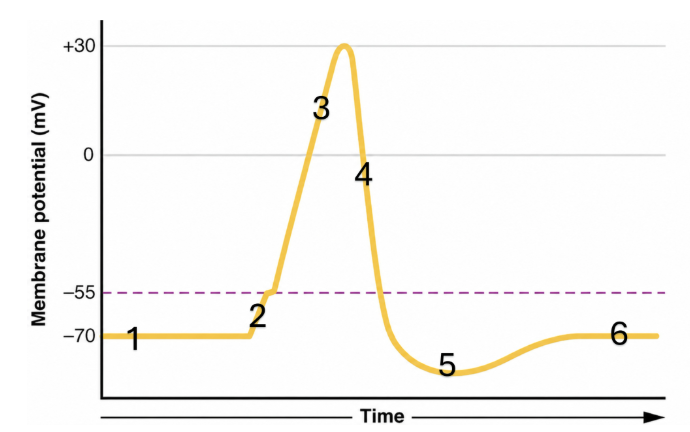
Identify the phases of the action potential labeled below
Resting membrane potential
Depolarization Subthreshold
Depolarization Suprathreshold
Repolarization
Hyperpolarization
Resting membrane potential
What is a primary function of cerebrospinal fluid (CSF)?
Hormone production
Oxygen transport
Cushioning and buoyancy
Electrical conduction
Cushioning and buoyancy
Which meningeal layer is directly attached to the surface of the brain?
Dura mater
Epidural layer
Pia mater
Arachnoid mater
Pia mater
Which major commissural fiber tract, connects the left and right cerebral hemispheres and allows communication between them?
Fornix
Medulla
Corpus callosum
Thalamus
Corpus callosum
White matter in the CNS primarily consists of:
Myelinated axons
Unmyelinated dendrites
Neuron cell bodies
Synaptic vesicles
Myelinated axons
Which of the following best describes the primary purpose of the Circle of Willis?
To regulate cerebrospinal fluid circulation between ventricles
To control autonomic functions such as heart rate and breathing
To filter toxins from the blood before reaching the brain
To provide redundant blood flow pathways to maintain cerebral perfusion
To provide redundant blood flow pathways to maintain cerebral perfusion
Ascending or descending spinal cord tracts are named for ______.
solely for the region of the cord that they pass through
solely the area in the brain where they terminate or begin
regions of the brainstem through which they pass
the region within the CNS where they begin and end
the anatomists who first characterized them
the region within the CNS where they begin and end
A patient has expressive aphasia, causing speech production deficits, while they are able to understand speech; Which brain region is most likely directly affected?
Wernicke's area
Auditory cortex
Occipital cortex
Broca's area
Broca's area
A patient has receptive aphasia, difficulty understanding language but can still speak fluently; Which brain region is most likely directly affected?
Auditory cortex
Wernicke's area
Broca's area
Occipital cortex
Wernicke's area
Which structure acts as the major relay station for sensory information to the cortex?
Hypothalamus
Thalamus
Epithalamus
Cerebellum
Thalamus
____ refers to the cerebral hemispheres receives and controls of the opposite side of the body respectively. (Hint: left side cerebral hemispheres controls right side of the body)
Laterization
Contralateral
Division of labor
Hemispatial neglect
Contralateral
Skeletal muscle is not responsible for
Digestion and childbirth
Muscle fiber utilized to maintain normal body posture
Type 1 fibers
Usain bolt is able to run 100 meters in under 10 seconds. At the tail end of his run where is ATP being derived from
Creatine phosphate and ADP
Concentrations of potassium ions inside and outside the neuron?
Potassium is more concentrated inside the cell
Type iia muscles have all the following characteristics except for
High endurance capacity
A man develops calf pain while walking which involves rest. The cause is reduced oxygen delivery to the muscle during activity. Which energy pathway is used during the painful phase?
Anaerobic glycolysis
Which part of the neuron is primarily responsible for receiving incoming signals from other neurons?
Dendrites
At high levels of muscular activity, when oxygen is used faster than it can be replaced, pyruvic acid is broken down without oxygen through glycolysis (i.e. anaerobic metabolism) which accumulates which of the following
Lactic acid
A body is found 10 hours after death, and the muscles are rigid due to the inability to detach myosin heads from actin and are in Rigor Mortis. Which of the following is the direct cause?
Lack of ATP to break cross bridge
A cross-bridge occurs when
The myosin head binds to actin
What is occurring at the phase 4 of the action potential below?
Hyperpolarization
What triggers the opening of the voltage-gated sodium (Na+) channels?
When threshold is reached
Acetylcholinesterase is an important molecule at the neuromuscular junction because it
Actively degrades acetylcholine
Predict what will happen to skeletal muscle over time in inactive people.
Skeletal muscle atrophies shrinks and eventually disappears
Compare the functioning of tropomyosin to troponin in skeletal muscle contraction.
One portion of troponin binds Ca+ moving tropomyosin out of the way for actin and myosin to form a cross bridge
What happens at the peak phase of the action potential (Phase 3 on the chart below)?
Voltage gated K+ channels are opening
Muscle motor unit
A single motor neuron plus all the muscle fibers it innervates
Which of the following describes the relative concentrations of sodium ions inside and outside the neuron?
Sodium is more concentrated outside the cell
Phase 3 of action potential ?
Repolarization
True statement regarding muscle atrophy
Atrophy is caused by consistent inactivation of muscle fibers
Which of the following is true during the relative refractory period?
A larger than normal stimulus is required to generate an action potential
Based on your knowledge of the concentration gradients of sodium, potassium, chloride, and calcium, predict the direction these ions will move across the membrane through open channels.
Sodium, chloride, and calcium enter the cell. Potassium exits the cell
Which of the following best describes the mechanism, by which ligand gated ion channels operate?
They are gated by a chemical messenger that binds to the channel on the inside or outside of the cell
At rest which ion is in a higher concentration inside the neuron?
Potassium
Long distance runners would be expected to have a higher percentage of which muscle fiber type?
Type 1
A skeletal muscle cell is depolarized when
Na enters the cell
The blocking of voltage gated sodium channels. What would occur?
Neurons cannot depolarize and fail to generate action potentials
Phase 2 of action potential
Depolarization
Resting membrane potential is depended on
Different distribution of ions across the axon membrane and The active transport of ions across the membrane through Na+/K+ ATPase
System primarily used to generate energy during weight training
Anaerobic system
The axon hillock of a neuron is important because it
Is the site where the action potentials are initiated
A marathon runner's leg biopsy reveals predominantly Type I muscle fibers. Which of the following is true about these fibers?
High myoglobin content, high mitochondrial density, high fatigue resistance
The two major contractile proteins in a muscle cell include
Actin and myosin
Channels responsible for maintaining the neurons resting ion gradient?
Sodium potassium pump
Hypothesize how the addition of tetrodotoxin (TTX), which specifically blocks voltage-gated Na channels, would affect neurons
TTX would decrease formation of the action potential
The role of actin in skeletal muscle tension development
Actin will bind to myosin, causing myosin to ratchet, causing cross bridges to form and tension development
Excitatory post synaptic vs. Inhibitory post synaptic potentials
EPSPs have a depolarizing effect on membrane potential
According to the length tension relationship of a skeletal muscle
Tension is highest with moderate actin myosin filament overlap
While characterizing the effects of medical marijuana, researchers have discovered a new type of channel that contains a binding site for the active ingredient, THC, on the outside of the cell. This new receptor could be classified as
A ligand gated channel
During depolarization which ion effluxes moves into the neuron to make the inside more positive
Sodium, potassium, chloride, and calcium
Synaptic potential that do not depolarize the membrane potential enough to reach the threshold are known as
Subthreshold potentials
What causes soreness?
Microtears in the muscle
The role of ATP in skeletal muscle contraction?
ATP causes the myosin head to enter a high energy state when hydrolyzed
How do isotonic and isometric muscle contractions differ in terms of muscle length during contraction?
Isotonic contractions change muscle length while isometric contractions do not
The myelin sheaths main function is to?
Increase the speed of electrical conduction
Release of acetylcholine into the synaptic cleft is dependent on the presence of what ion?
Calcium
Membrane potential is created by?
The uneven distribution of ions across the membrane
Low potassium in blood affects the neurons by?
Resting membrane potential becomes more negative. making it harder to fire an action potential
Graded potentials?
Result in weaker changes in membrane potential the further from the point of origin they extend
The disassociation of the myosin cross bridge is directly activated by?
The attachment of ATP to myosin heads