Bisc366 Final
 Call Kai
 Learn
 Practice Test
 Spaced Repetition
 Match
 Flashcards
 Knowt Play
1/161

There's no tags or description
Looks like no tags are added yet.
162 Terms
lec19
small RNAs
21-24 nt long
works as a guide in gene silencing
sits inside an ARGONAUTE (Ago) protein to form RNA-induced silencing complex (RISC)

small RNA as a homing guide
small RNA base pairing to target leads RISC to a matching mRNA
the mRNA gets sliced
gene is silenced
types of small RNAs
two families:
miRNA
siRNA
micro RNA (miRNA)
come from a single gene whose RNA folds into a hairpin
one RNA per gene
used to block or destroy the mRNAs of other genes

short interfering RNA (siRNA)
come from long ds RNA (genes that aren’t translated)
gets cut by DICER
many RNAs per one source
often used to silence their own source —> viruses, transposons, etc.

small RNA length
the length of the small RNA tells you what it does
21nt —> most miRNAs; cut or block mRNAs
22nt —> special miRNAs; start a chain rxn of new siRNAs
24nt —> siRNAs; methylate DNA and silence transposons
three proteins involved in silencing
DICER
ARGONAUTE
RDR (RNA-dependent RNAP)
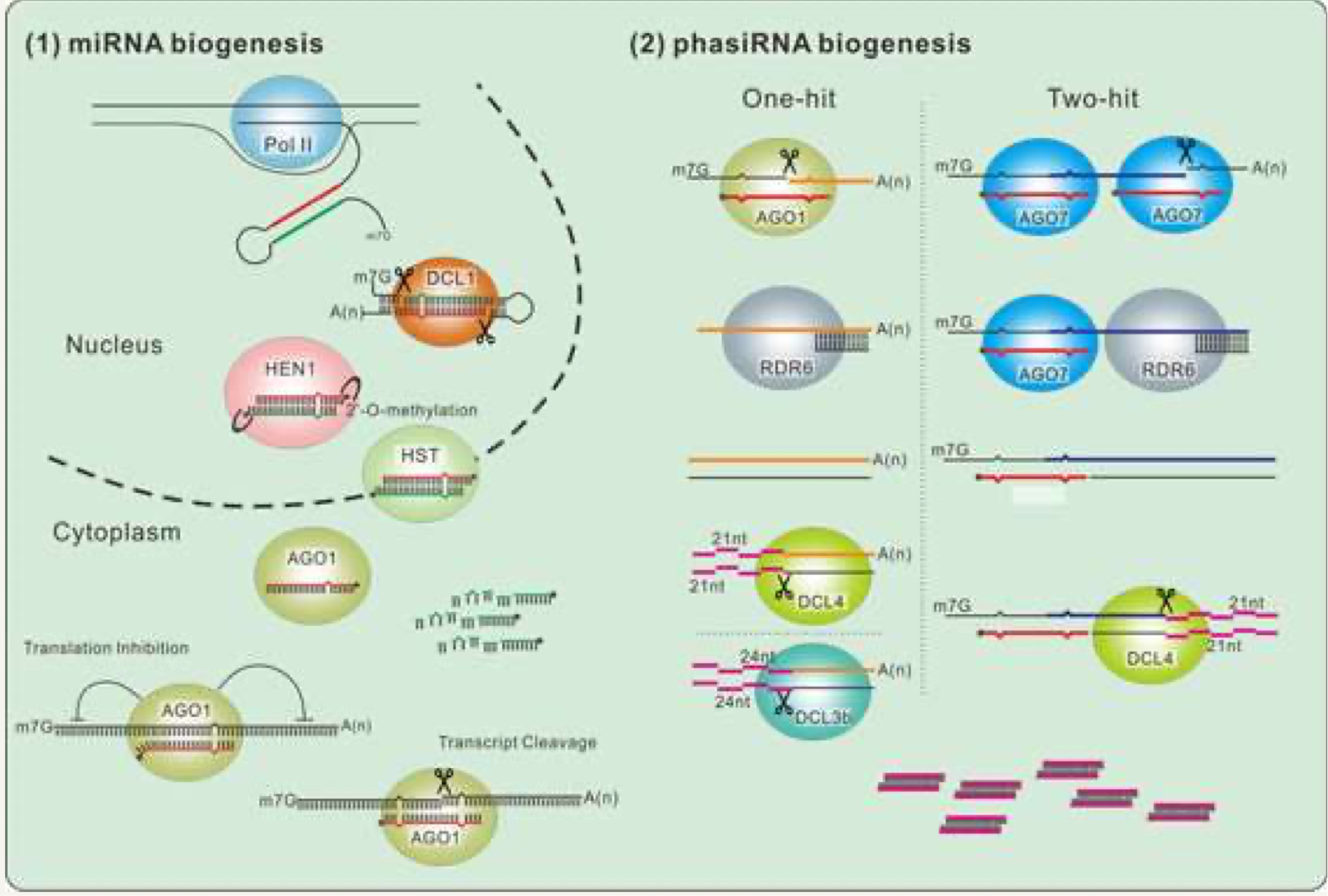
DICER
acts as scissors
cuts ds RNA into small pieces
ARGONAUTE
acts as an effector
holds the small RNA and acts on the target
(a key part of RISC)
RDR
acts as a copier
RNA-dependent RNA pol
turns ssRNA into dsRNA and amplifies the signal
how miRNA is made
an mRNA (MIR) gene is transcribed into RNA that folds into a hairpin
DICER-LIKE1 cuts out a short ds piece
producing a short duplex that gets recognized by AGO1
one strand is randomly selected by Ago (ideally antisense)
the other strand is thrown away
Ago uses miRNA as a guide and leaves the nucleus to find its target mRNA

how miRNAs work
2 methods: cutting or blocking the message:
cut: a near perfect match between miRNA and target mRNA allows AGO1 to slice the mRNA
mRNA is then destroyed
block: AGO1 binds and stays bound, stopping ribosomes from translating target mRNA
—> end result is reduction in activity of a gene/less protein product
transposons
a mobile DNA sequence that can change its position within a genome
AKA “jumping genes”
gene flanked by repeated
typically encode just one protein
can move and propagate within genome
silencing transposons
involves RNA-directed DNA methylation (RdDM)
RNAP IV transcribes transposon
RDR2 copies the RNa into dsRNA
DCL3 cuts it into 24nt siRNAs
siRNAs guide AGO4 back to the target transposon DNA, pairs with RNA made by RNAP IV
note: does not trigger cutting, but methylation
enzyme DRM2 adds methyl groups to DNA and silences the transposon

RNA-directed DNA methylation (RdDM)
a plant-specific epigenetic pathway where small RNA molecules guide DNA methyltransferases to specific genomic sequences, causing transcriptional gene silencing
how miRNAs start chain rxns
a 22nt miRNA in AGO1 cuts RNA made from a TAS or PHAS gene
RDR6 copes ssRNA into dsRNA
DCL4 cuts the dsRNA into 21nt fragments —> phased siRNAs
siRNAs get loaded into AGO and bind to target genes and silence them (acting like miRNAs)
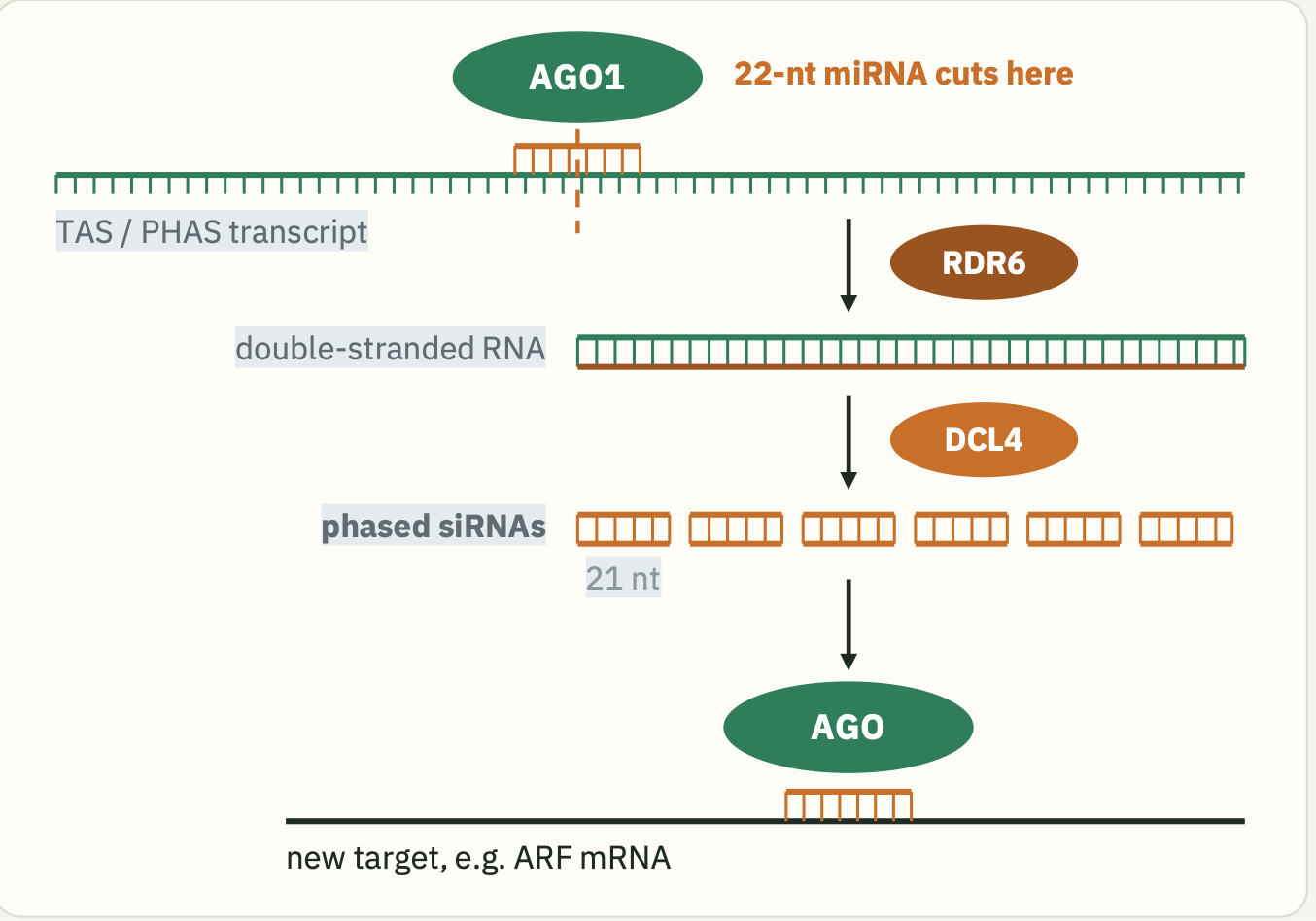
two genes that encode functional RNAs
these RNAs are not translated into proteins, and exist to be cut into siRNAs
TAS = trans-acting siRNA gene
PHAS = phased-siRNA gene
any dsRNA can be fed into DICER
note: the length of the dsRNA doesn’t matter
viruses —> viral dsRNA gets cut into antiviral siRNAs
overlapping genes —> sense and antisense RNAs pair up (dsRNA), and gets cut by DICER
ex. siRNAs that can help with salt stress
reawakened transposons —> can make extra siRNAs when DNA methylation is lost
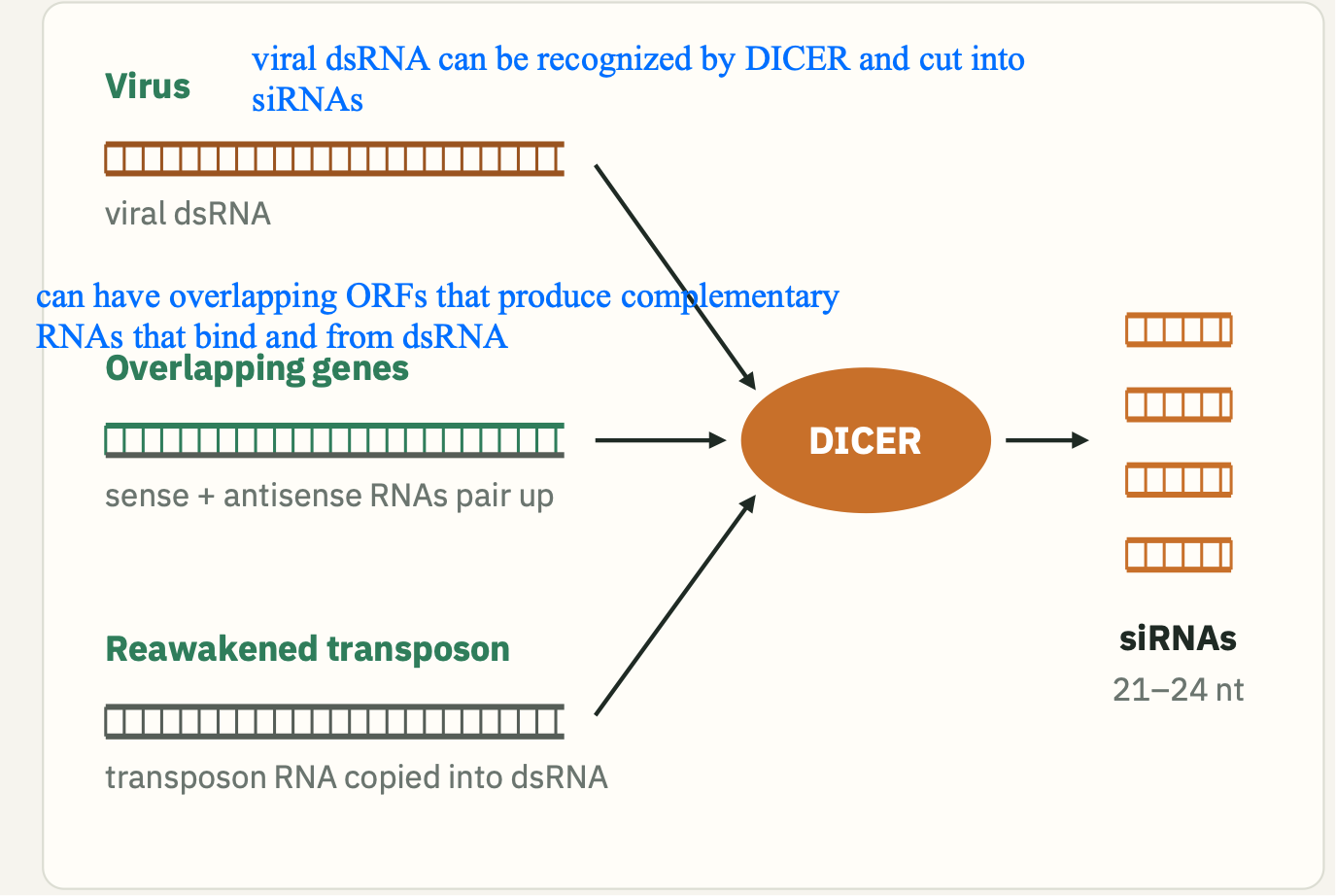
how small RNAs travel
small RNAs are signals that can travel short and long distances
cell to cell —> miR165/166 forms a gradient that patterns root and leaf tissues during early development
shoot to root —> miR399 moves in the phloem to report plant phosphate status
plant to pathogen —> sRNAs cross into fungi, fungal sRNAs cross into plants

miRNAs and plant age
an miRNA clock can tell a plant its age during development
—> this is regulated by 2 miRNAs: 156 & 172
young plants —> lots of miR156 keeps SPL gene off (needed to provide competence for flowering)
with age —> miR156 falls, SPL proteins rise and switch on miR172 (inhibits the inhibitor of flowering competence)
adult plants —> miR172 switches off AP2-like proteins (inhibitors of flowering) so that the plant can fllower

how miRNAs help plants find phosphate
many plants are short on phosphate and need to sense it
low phosphate causes the shoot to make miR399
miR399 travels to the root through the phloem
in the root, miR399 silences PHO2 & inhibits phosphate transporters (Pht)
causes the root to take up more phosphate
the xylem carries the phosphate to the shoot
note: same logic for sulfur (miR395) and copper (miR398)

miRNA and rice yield
a single bp change can result in greater yield
miR156 normally limits OsSPL14
in the ipa1 allele, a single base change (C —> A) in the miR156 site lets OsSPL14 escape silencing
result: more grains, heavier grains, higher yield
how phased siRNAs inhibit rice reproduction
phased siRNAs can switch off production of rice pollen
—> breeders use this to make hybrid rice
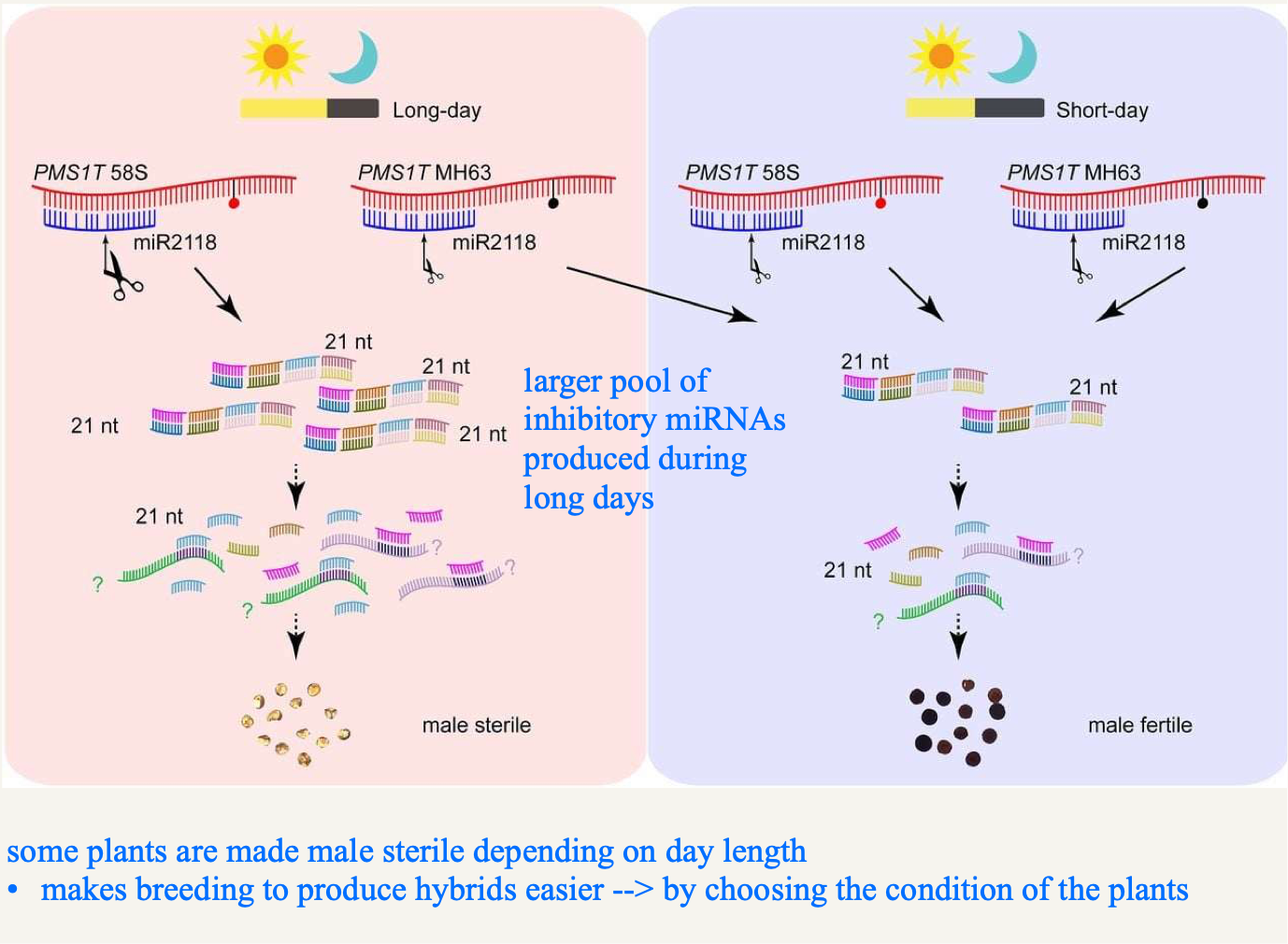
in rice anthers, miR2118 cuts long non-coding RNA PMS1T into 21nt fragments
a single base change in PMS1T boosts production of these phased siRNAs during long days —> pollen fails to form and males are sterile
under short days, fewer phased siRNAs are made —> pollen is made and males are fertile
note: normal rice is fertile under both long and short days
lec20
why do viruses matter?
their economic impact costs more than ppl realize
they are hard to measure —> losses are chronic rather than dramatic —> over 30billion is lost each year
there is no curative treatment
trade costs —> can also contribute to direct crop yield loss
virus characteristics
tiny —> most plant viral genomes are 4-20kb and encode 4-12 proteins
are obligate parasites —> can’t survive without a host, all machinery is borrowed from the host
most plant virus genomes are RNA, which gets translated once the virus is uncoated

types of plant viruses
most plant viruses are RNA viruses
types:
+ssRNA
-ssRNA
dsRNA
ssDNA
dsDNA-FT

why do positive sense RNA viruses dominate?
~68% of all described plant virus genera have +ssRNA genomes
this is because a +ssRNA genome is ready-made mRNA —> once uncoated, translation begins
no nuclear step needed
no transcription machinery needed
how RNA viruses replicate
—> Solving the Multi-Gene Reading Problem on a Single RNA
problem:
a ribosome normally translates only the first ORF it meets
a virus genome containing more than one gene on the same RNA needs a way around this
Solutions:
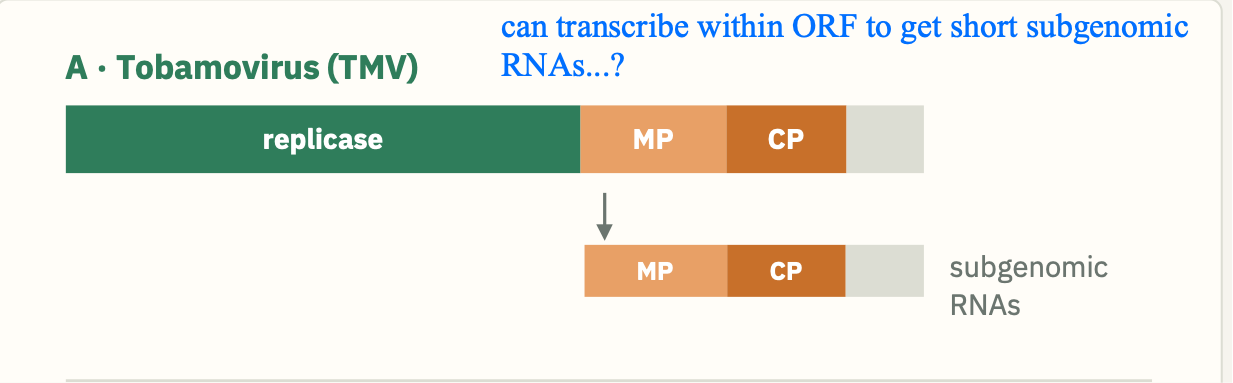
a) subgenomic RNAs
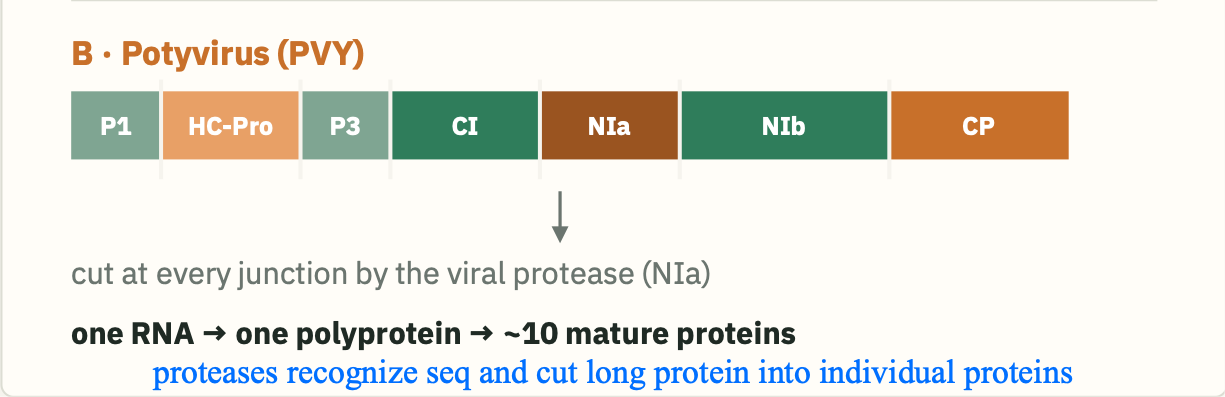
b) one polyprotein
subgenomic RNAs
one virus genome reading strategy
the replicase makes shorter RNAs starting at internal promoters, each presenting a diff gene first
one polyprotein
one virus genome reading strategy
translate everything as a single chain and then cut it up with virus encoded proteases
how DNA viruses replicate
viral DNA goes to the nucleus and replicate via rolling circle replication using host polymerases
since mature plants dont have active DNAP, the virus forces it to reenter the cell cycle, which can cause plant host symptoms
ex. geminiviruses (ssDNA)
how do dsDNA viruses replicate
replicate through an RNA intermediate and reverse transcription
similar to a retrovirus but without integration
ex. caulimoviruses
rolling circle replication
a process in which a circular DNA molecule is replicated by the continuous synthesis of the leading strand and subsequent conversion to double-strand DNA

Universal viral toolkit
Every plant virus genome encodes proteins for four core tasks (names vary by family):
replicase
coat protein
movement protein
silencing suppressor
virus replicase
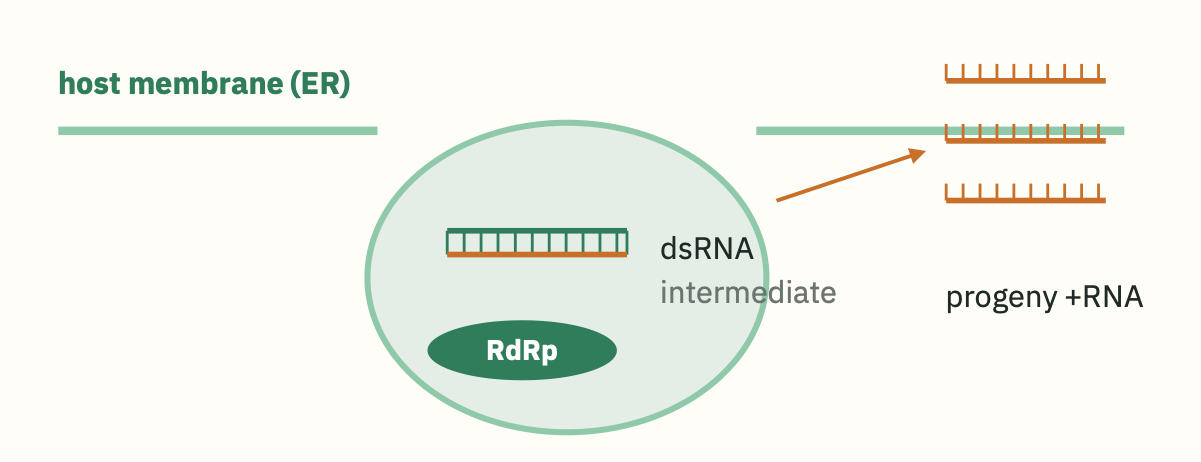
Replicase (RdRp or Rep)
Copies the genome
Highly error-prone (~1 error per 10,000 nucleotides), creating dynamic populations of variants
Replication occurs inside protective ER, tonoplast, or chloroplast membrane invaginations to hide dsRNA intermediates from host surveillance
virus coat protein
Coat Protein (CP)
Encapsidates and protects the genome outside the host
self assembles around the genome spontaneously
is usually what the vector recognizes
virus movement protein
Movement Protein (MP)
Binds the genome
targets plasmodesmata bc that is the only route to the next cell (can’t get through the cell wall)
MP protein dilates the plasmodesmata sub-1 kDa size exclusion limit, and escorts genomes as thin ribonucleoprotein (RNP) complexes through plant cell walls.

virus silencing suppressor
Silencing Suppressor (VSR)
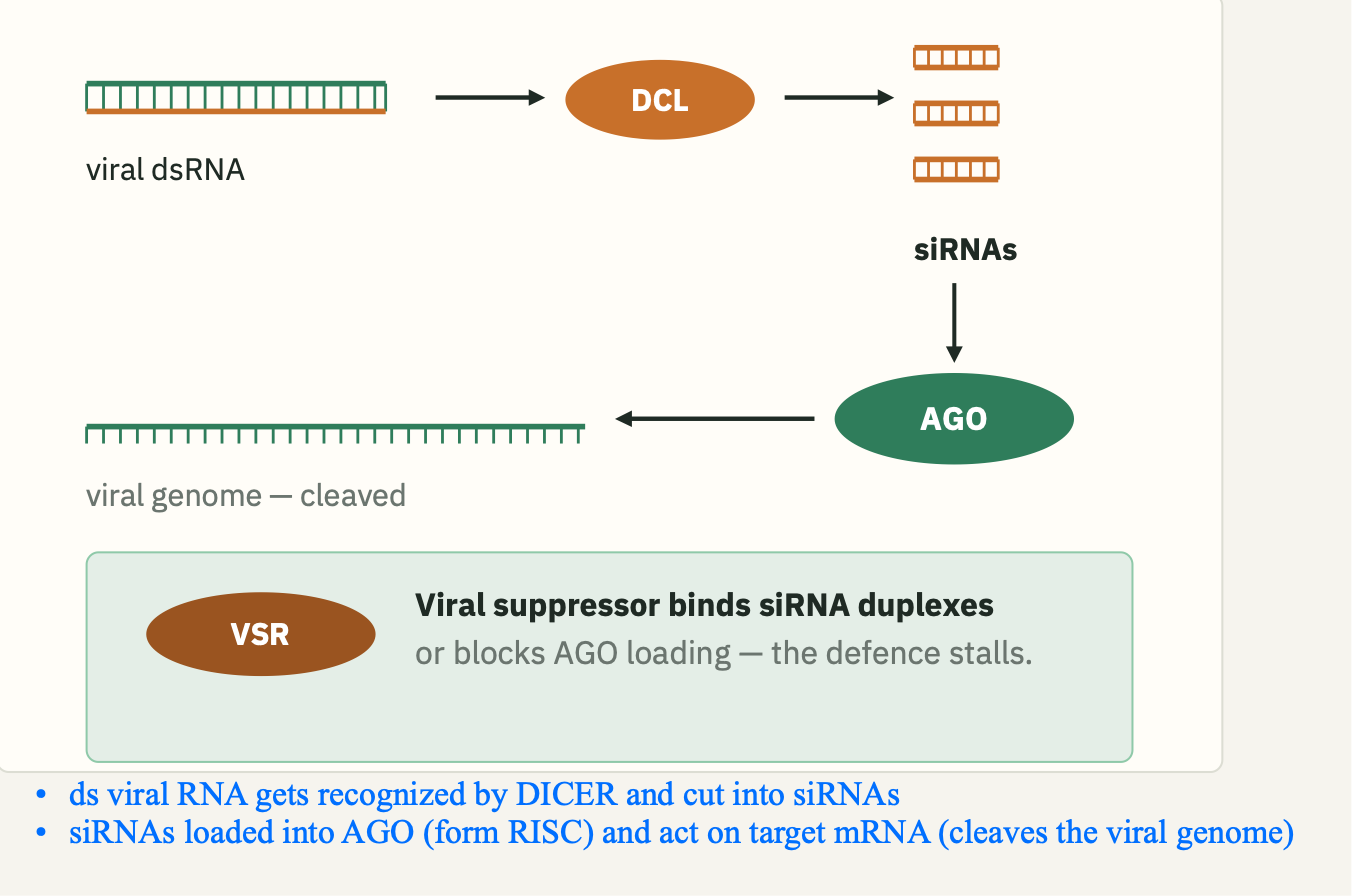
Disables the host RNA silencing defense by sequestering siRNAs or blocking AGO loading (is unspecific)
are the main cause of developmental symptoms bc they interfere with the plant’s miRNA
Frequently multifunctions as a protease or transmission helper (e.g., potyviral HC-Pro).
virus infection cycle
transmission between plants (no native mobility)
cell entry (passive)
intracellular replication
systemic movement through plant
how viruses infect hosts
Step 1
virions have no mobility and cant breach an intact cuticle and cell wall
they need something else to help enter a host
each new infection depends on smt else to make the breach
Insect Vectors (~75%):
Aphids, whiteflies, thrips, and leafhoppers deliver viruses directly via stylets.
Seed & Pollen:
Vertical transmission enabling global spread via trade
Vegetative Propagation:
Cuttings, tubers, grafts, and runners carry the virus with 100% efficiency
this is the dominant route in cloned crops
Mechanical Contact:
Tools, hands, and plant rubbing (only efficient for stable, high-titre viruses)
virus cell entry
Step 2
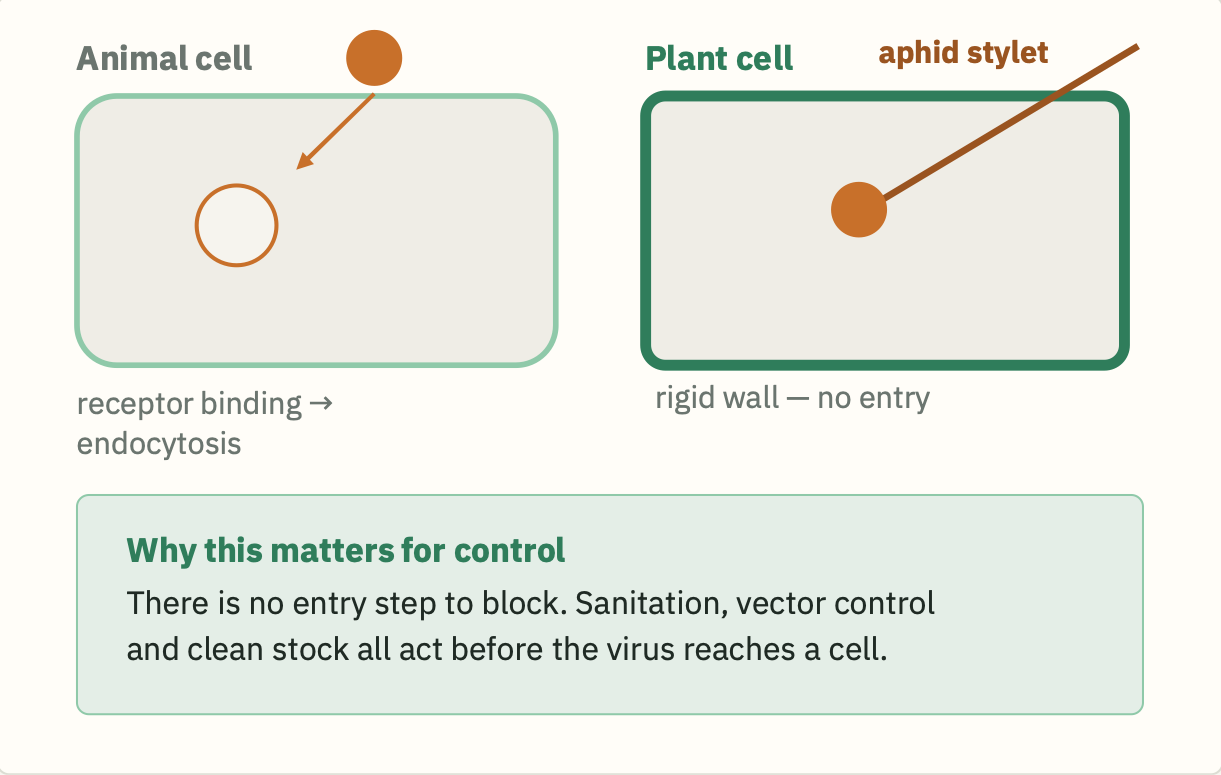
Plant viruses lack specific surface receptors and endocytosis pathways due to host plant rigid cell walls
entry is passive (via wounds) —> relies entirely on physical breaches (aphid stylets, feeding sites, abrasions, pruning cuts).
Host range is thus determined post-entry by replication and movement capacity
virus infection: insect vectors
~75% of plant viruses
Aphids, whiteflies, thrips, and leafhoppers deliver viruses directly via stylets.
virus infection: seed and pollen
Seed & Pollen:
Vertical transmission enabling global spread via trade
virus infection: vegetative propagation
Vegetative Propagation:
Cuttings, tubers, grafts, and runners carry the virus with 100% efficiency
this is the dominant route in cloned crops
virus infection: mechanical contact
Mechanical Contact:
Tools, hands, and plant rubbing (only efficient for stable, high-titre viruses)
virus intracellular replication
—> viruses typically don’t contain proteins needed for infection, so they need to be translated inside the host
—> (for +sense RNA viruses) the genome is translated before it is copied bc the needed enzyme doesn’t exist yet
Step 3: Intracellular Replication Steps:
Uncoat: CP subunits dissociate, releasing genome into the cytoplasm.
Transle: Host ribosomes read +RNA directly to synthesize replicase.
Build a factory: Replicase remodels host membranes into protected compartments.
-RNA synthesis: Full-length complementary - RNA strand made as a template.
amplify +RNA (asymmetric amplification): many +RNA strands are made from each - RNA strand
Package: Genomes are encapsidated or moved as RNP complexes (into other cells)
virus systemic movement through plant host
Step 4: Systemic Movement Through the Plant:
Virus moves cell-to-Cell via plasmodesmata, then moves into the phloem
short range movement is slow —> MP-dependent movement through plasmodesmata, a few cells per day
long range movement is fast —> via the phloem (metres per hour) following sugar flow from source leaves to sinks (accumulating in growing tips, young leaves, tubers, and fruit).

symptom development: why do plants look sick?
viruses do not secrete toxins or lyse cells
Symptoms stem from host physiological disruption rather than direct cellular lysis or toxins:
Stunting / Low Yield: Resource diversion for viral replication (nucleotides and ATP).
Mosaic / Chlorosis: viral proteins disrupt chloroplast function.
Distortion / Curling: Disrupted hormone/miRNA signaling via viral VSR sequestration.
Necrosis / Local Lesions: the plant overshooting hypersensitive defense responses kills infected cells.
note: tolerance is possible: a cultivar can carry a high virus titre and still yield well
plant defense: antiviral defense mechanisms
2 Antiviral Defense Mechanisms
—> RNA silencing (adaptive immunity)
—> 2 kinds of resistance genes:
dominant R genes
recessive resistance
note: sometimes tolerance counts as defense
antiviral defense mechanisms: dominant R genes
Dominant R Genes (NLR receptors)
Detect specific viral proteins to trigger the hypersensitive response (HR)
sacrificing infected cells to isolate the virus.
weakness: a few mutations in the virus protein can allow it to go undetected by the plant

antiviral defense mechanisms: RNA silencing
RNA Silencing is sequence specific and a mobile response
Dicer-like enzymes (DCL) cleave viral dsRNA into siRNAs guided by Argonaute (AGO) to target viral genomes.
siRNA also move systemically through plasmodesmata and phloem as mobile immune signal to prime tissue the virus hasnt reached yet
Countered directly by viral VSRs
antiviral defense mechanisms: recessive resistance
viruses need plant machinery for translation, but in order to trigger it, the virus requires its own proteins to bind its RNA
VPg binds RNA and guides binding of plant eIF4E for translation
Recessive Resistance
Alteration of essential host susceptibility factors (e.g., variant eIF4E translation factors failing to bind potyviral (VPg).
if the plant eIF4F can’t bindm the virus can’t infect the plant
Highly durable as the virus must evolve new binding partners HOWEVER, this eIF4E mutation is recessive, so the plant needs to be homozygous

antiviral defense mechanisms: tolerance
Tolerance:
The plant maintains high virus titres while keeping defense responses measured
preserving overall yield without triggering severe tissue damage.
virus case study: potato virus Y
Potato Virus Y (PVY) Recombinants:
PVY is the leading cause of seed potato rejection in NA
it used to be easy to visibly detect symptoms, but recombination bt viruses has made it more difficult
recombinants are the main reason seed potato lots fail
two Recombinant strains (PVY-N-Wi & PVY-NTNa) overtook ordinary strains (PVY-O)
Recombinants produce milder, harder-to-detect foliar symptoms while still inducing severe internal tuber necrosis.
virus case study: tomato brown rugose fruit virus
Tomato Brown Rugose Fruit Virus (ToBRFV):
a tobamovirus of tomato and pepper
A highly stable tobamovirus of tomato and pepper
spread globally via international seed lots and mechanical greenhouse contact.
is seed borne (carried in and on tomato seeds
is mechanically transmitted by hands, tools, clothing, plant-to-plant contact
is extremely stable virus
virus case study: ToBRFV detection
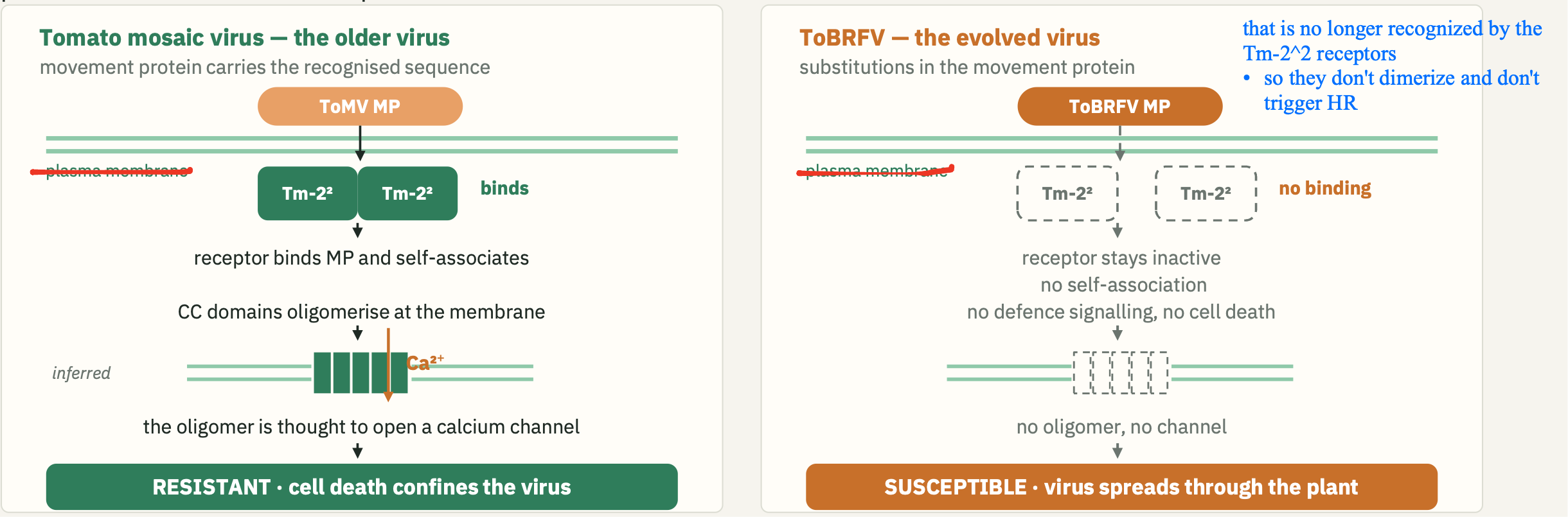
Tm-2² is an intracellular NLR receptor that detects the MP of ToBRFV makes to spread
tomatoes used to be quite resistance to the older parent virus Tomato mosaic virus
its MP is recognized by host plant NLR receptors, triggering oligomerization, calcium channel activation, and cell death defense
evolved ToBRFV contains substitutions in the MP that prevent NLR receptor binding
so there is no trigger of HR
allows the virus to spread through the plant
lec21
first agricultural revolution
was domestication
humans transitioned from a hunter-gatherer lifestyle to settled farming
rise of civilizations is closely tied to development of agriculture
major crops were domesticated ~4,000-11,000 ya starting in the fertile crescent
domestication of crops
cultivating or taming organisms to accentuate traits that humans find desirable
ex. seeds that don’t shatter, larger grains, reduced dormancy
essentially is artificial selection
the Green Revolution
was a movement to increase yields by intentionally combining:
high yield varieties (HYVs) of wheat, rice, maize
irrigation
more than one harvest per yeat
synthetic fertilizers (especially N2)
pesticides
mechanization
note: this only works as a package —> HYVs only out-yield traditional varieties when coupled with fertilizer and water
historical origins of green revolution..?

Green revolution timeline

Key people involved in the green revolution
Norman Borlaug (1914–2009):
the father of the green revolution
used "shuttle breeding" across two Mexican sites for two generations/year and day-neutral (photoperiod-insensitive) adaptation of plants
others:
M.S. Swaminathan in India
IRRI breeders: Peter Jennings & Henry Beachell (IR8)
Gurdev Khush (IR36, IR64)
Green revolution plant breeding
Resulted in dramatically higher yields from the same area of land
1960s–1980s: high-yielding, semi-dwarf, disease-resistant wheat and rice
Wheat: dwarfing genes from the Japanese variety Norin 10 (Rht-B1b, Rht-D1b), bred into Mexican varieties (Lerma Rojo 64 and Sonora 64)
Rice: IR8 “miracle rice” (IRRI, 1966) — a cross of Peta (Indonesia) × Dee-geo-woo-gen (Taiwan), which carries the semi-dwarf sd1 gene
Short, stiff stems resist lodging, more of the plant’s biomass goes into grain —> harvest index rose from ~0.3 to ~0.5
increasing yield by planting at higher density
goal: to increase the yield by increasing the number of plants grown per square meter
fertilizers and irrigation allowed sowing at higher densities (simple way to increase seed yield per hectare)
problem with planting at higher density
problems:
resulted in a lot of straw biomass instead of more larger seeds
plants shaded e/o, resulting in excess elongation (recall shade avoidance response)
plants fell over in wind and rain, resulting in crop loss
solution:
development of semi-dwarf rice and wheat
semi-dwarf rice and wheat
Semi-dwarf wheat and rice solved the problems that came with planting at higher densities to increase yeidl/hectare
with shorter, stiffer stems
raised harvest index from ~0.3 to ~0.5.
where green revolution genes act: GA biosynthesis
Normal GA Pathway:
bioactive gibberellin (GA) is synthesized from GGDP via ent-kaurene and GA12 using GA 20-oxidase (GA20ox) and GA 3-oxidase.
Rice Semi-Dwarf:
Recessive loss-of-function mutation in homozygous diploid rice that knocks out GA20ox2, reducing bioactive GA synthesis and stem elongation.
produces shorter plants

where green revolution genes act: GA signalling
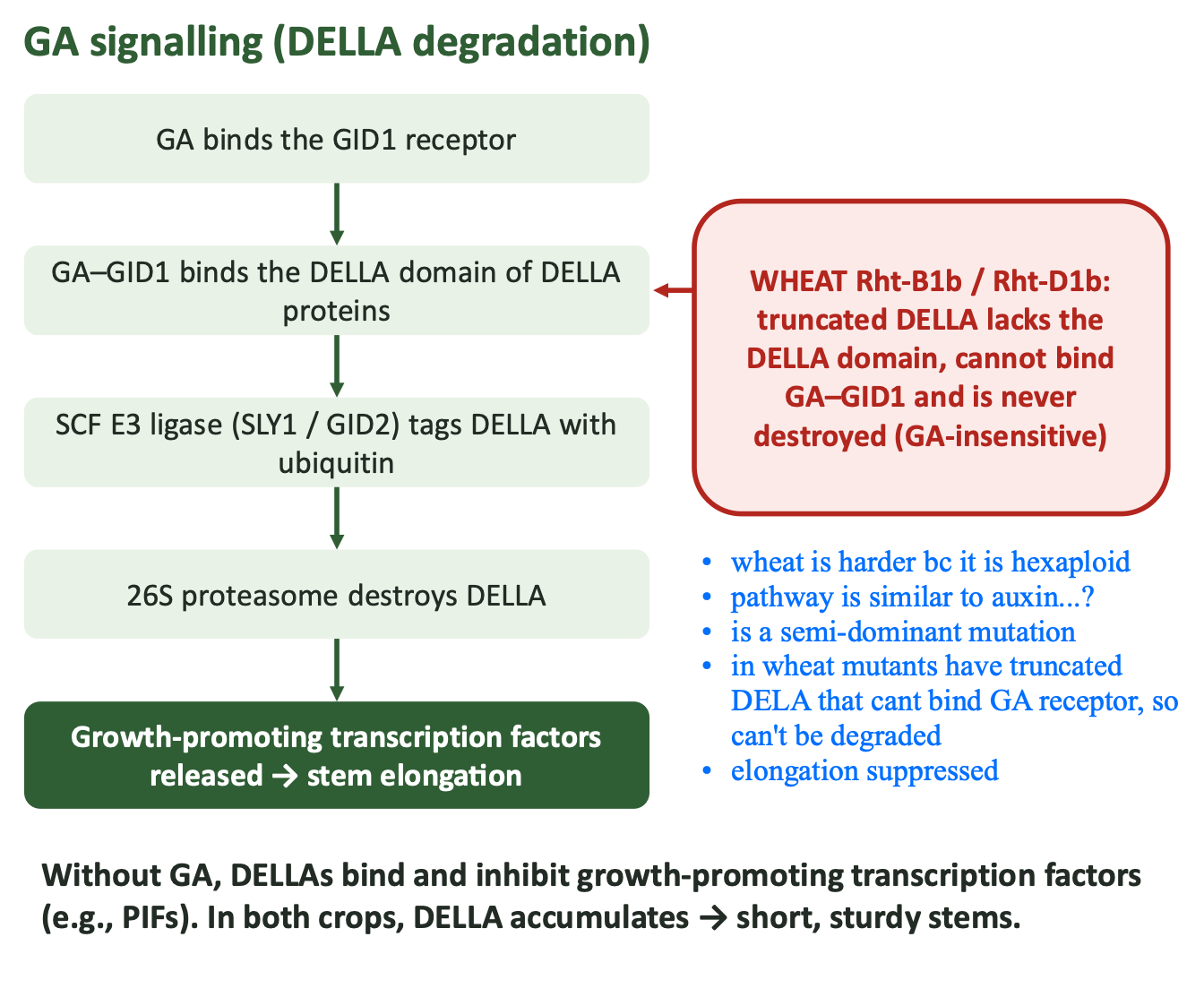
Normal GA signalling (DELLA degradation):
Without GA, DELLA proteins bind and inhibit growth-promoting transcription factors (such as PIFs).
When GA binds the GID1 receptor, the GA–GID1 complex binds the DELLA domain of DELLA proteins
recruiting an SCF E3 ligase (SLY1/GID2) to ubiquitinylate DELLA for 26S proteasome destruction
releasing transcription factors for stem elongation.
Wheat Semi-Dwarfs
Semi-dominant gain-of-function mutations acting in hexaploid wheat produce a truncated DELLA lacking the DELLA domain.
Cannot bind GA–GID1 or undergo GA-triggered degradation (GA-insensitive),
DELLA accumulates and produces short, sturdy stems
outcomes and trade-offs to semi-dwarf wheat and rice
outcomes:
shorter, stiffer stems that resist lodging under heavy fertilizer
more grain per plant
trade-offs:
lower nitrogen use efficiency
Rht wheat has shorter coleoptiles (a problem ofr deep sowing)
Green revolution has led to:
3x more cereal crop production in developing countries
increase from 12 —> 20 million tonnes of wheat harvest in India
18-27 million hectares of natural land saved from conversion to farming land
increase of 2.8%/yr growth in cereal crop output in developing countries
environmental impacts of crop improvements
pollution from fertilizers and pesticides
groundwater depletion for irrigation
fossil fuels for fertilizer and pumping
soil degradation and micronutrient depletion
loss of crop diversity
social and nutritional impacts of green revolution
benefits —> cheaper staple foods helped poor consumers; rural incomes and employment rose in adopting regions
Uneven reach —> gains concentrated in irrigated, favourable areas and in a few crops (wheat, rice, maize); rain-fed and marginal regions gained far less
Equity —> farmers with land, credit and water adopted first — fuelling debate over effects on smallholders and inequality
Nutrition —> cereals displaced pulses and other crops, reducing dietary diversity; micronutrient deficiencies (“hidden hunger”) persisted
Sub-Saharan Africa largely missed out —> diverse staples (cassava, sorghum, millet), little irrigation, weak seed and fertilizer markets
breeding after the green revolution
Marker-assisted selection
ex. SUB1A, an ERF transcription factor from a flood-tolerant landrace, was bred into mega-varieties:
Swarna-Sub1 survives up to ~2 weeks underwater
Randomised trials in India: higher yields in flood years and no penalty in normal years
Stress-tolerant varieties for Africa: e.g., CIMMYT/IITA drought-tolerant maize
Biofortification (HarvestPlus): vitamin A orange-fleshed sweet potato, iron beans and pearl millet, zinc wheat and rice
Shift in goals: from yield alone to yield stability, nutrition and climate resilience
biotech and genome editing after the green revolution
GM crops
ex. Bt cotton now covers most of India’s cotton area;
ex. Golden Rice approved in the Philippines (2021), though a 2024 court ruling halted planting
Genome editing (CRISPR–Cas) makes precise changes, often without foreign DNA
ex. rice with broad-spectrum resistance to bacterial blight from edits to SWEET gene promoters
Speed breeding (up to 6 generations a year in wheat) and genomic selection shorten breeding cycles (Watson et al. 2018)
Regulation differs: Argentina, Japan, the USA, Canada and England treat some edited crops like conventional varieties; the EU is revising its rules
fixing the green revolution’s legacy
nitrogen use efficiency
DELLA accumulation in semi-dwarfs also restrains nitrogen uptake, so they need heavy fertilizer.
Raising GRF4 levels rebalances GRF4–DELLA, improving nitrogen-use efficiency and yield in semi-dwarf rice and wheat
A chromosome segment from the wild grass Leymus racemosus reduces nitrogen loss from wheat fields
2024 food insecurity
in 2024 ~673million ppl faced hunger
~5million children die before their 5th birthday each year
undernutrition contributes to nearly half of these deaths
food price inflation problem
food price inflation rises
staple prices fell for decades, but the 2007-2008 and 2022 food price spikes suggest the trend has ended
growth rate of world popn is rising, but yield gains for staple cereal crops (maize, rice, wheat, soybean) are below the needed quota (2.4%) per year needed to double production by 2050
global meat consumption vs production
global meat consumption has increased due to popn and per person consumption growth
global meat consumption is predicted to increase by 70% by 2050
this increase will require more land, water, and feed
leading to further deforestations and resource depletion
what is a major cause of crop yield loss
drought and heat
global warming makes it even worse
objective of plant science
a major objective is to increase food production
confounding factors:
the problem isnt not having enough food, but distribution of food —> is only partly true
reality: as prices go up, the poor will be hit the hardest
prices also need to go up to provide higher returns to farmers and allow for higher investments
problems with increasing crop production and yield
big increases in production will be hard to achieve because:
Little unfarmed land is left without clearing forests
Irrigation water is increasingly scarce
Extra fertilizer gives diminishing returns where use is high
The easiest breeding targets have been achieved
Africa is the exception: the Green Revolution never fully reached it
green revolution summary

lec 22
what makes ornamentals different?
novelty: ornamentals sell novelty with rapid seasonal turnover
clonal propagation: most of these plants are mass propagated by cuttings, bulbs, tissue culture
global supply chains: breeding in Europe, North America, Japan, or Israel; mother plants and cut-flower production in Africa, Latin America, and Asia; worldwide retail
intellectual property protection: many plant patents and plant breeders' rights allow companies to fund ongoing breeding programs.
Luther Burbank
Largely self-taught breeder in Santa Rosa and Sebastopol, California,
inspired by Darwin's observations on variation in domesticated plants;
developed >800 varieties over 55 years after early success with the Burbank potato.
Burbank’s approach to breeding
collect —> cross —> grow —> select —> repeat
Collected plants worldwide, hybridized species/varieties, grew thousands of seedlings (sometimes using grafting onto mature plants to speed flowering),
selected a tiny fraction by eye, nose, and taste while culling the rest, and repeated over years (e.g., keeping 3 varieties from ~10,000–15,000 rose seedlings)

case study: the shasta daisy
one of Burbank’s notable creations
Shasta daisy (Leucanthemum superbum):
A 17-year, four-species hybrid involving oxeye daisy (L. vulgare) crossed to: English field daisy (L. maximum), Portuguese field daisy (L. lacustre), and Japanese field daisy (Nipponanthemum nipponicum),
released in 1901 with later strains ('Alaska', 'California', 'Westralia') and fluted, quilled, or fringed forms.

Case study: Burbank’s other flowers
Burbank also made other ornamental creations
Fixed a crimson California poppy by selection alone without crossing
bred double amaryllis (~19 years of crossing and selection to perfect)
bred roses (hundreds of hybrid seedlings); one Burbank rose received U.S. Plant Patent No. 267 in 1938).
Burbank plant catalogues
Marketing & Limitations:
Burbank sold plants through catalogues (New Creations in Fruits and Flowers, 1893), trade lists, the short-lived Luther Burbank Company, and a 12-volume subscription set (Luther Burbank: His Methods and Discoveries, 1914–15).
His empirical methods lacked systematic records, statistics, Mendelian genetics, and plant-health controls (contributing to the Carnegie Institution ending funding).
Burbank’s legacy: plant patent act
Plant Patent Act of 1930
Passed four years after Burbank's death as the first U.S. patent protection for living organisms (new varieties of asexually propagated plants, excluding tubers), enabling ongoing royalties;
16 of Burbank's creations were later patented, and roses accounted for nearly half of the 3,010 plant patents granted from 1931–1970.
What we learned from Burbank
what we inherited:
Breeding at scale
worldwide collecting of germplasm
wide crosses between species
marketing novelty to the public
what was missing:
Mendelian genetics
systematic records
statistics
plant-health controls
—> all central to breeding today.
modern breeding and production of ornamentals
companies still cross, select, and sell novelty
this is now done with genomics, laboratories, and farms on 4 continents
how a new flower reaches markets today
breeding —> clean stock —> mother plants —> cuttings and seed —> growers —> retail
ex. dummen orange, syngenta flowers, ball panamerican seed

modern plant breeding methods
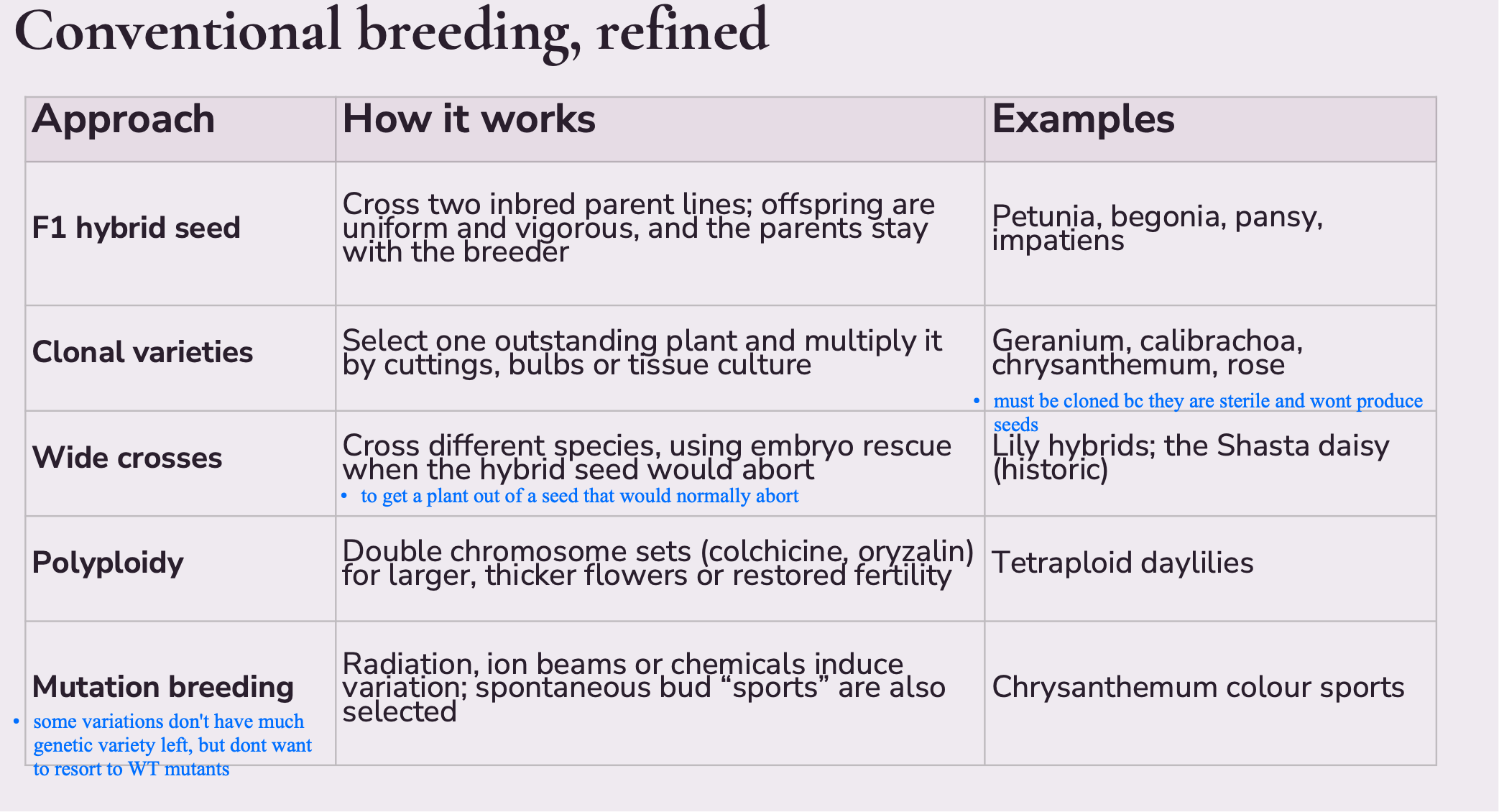
F1 hybrid seed
clonal varieties
wide crosses
polyploidy
mutation breeding
molecular and data-driven breeding
genetic engineering
genome editing
modern plant breeding: F1 hybrid seed
Cross two inbred parent lines
offspring are uniform and vigorous
the parents stay with the breeder
ex. petunia, begonia, pansy, impatiens
modern plant breeding: clonal varieties
these must be cloned bc they are sterile and won’t produce seeds
select one outstanding plant
multiply it by cuttings, bulbs, or tissue culture
ex. geranium, calibrachoa, chrysanthemum, rose
modern plant breeding: wide crosses
crossing different species to combine traits like novel colours, compact habit, heat tolerance, or disease resistance:
cross different species, using embryo rescue when the hybrid seed would normally abort
ex. lily hybrids, the shasta daisy