Lecture 4 - Intangible Non-current Assets
 Call Kai
 Learn
 Practice Test
 Spaced Repetition
 Match
 Flashcards
 Knowt Play
1/23

There's no tags or description
Looks like no tags are added yet.
24 Terms
Describe the history of intangible assets in accounting
19th and early 20th century: Industry dominated by tangible assets
1990s growth of internet and telecommunications businesses
From end of 20th century economic growth of many businesses driven by investments in non-physical items such as:
Intellectual capital/knowledge
Organisational structures/corporate values
Reputation/brand names
Today, products are increasingly intangible ⇒ services and assets used to produce them are increasingly intangible
What is an intangible assets?
An intangible asset is a non-current asset in the SOFP, therefore it will be used in the business for more than one accounting period
An intangible asset is an identifiable, non-monetary asset without physical substance
An intangible asset is identifiable if it falls in either of these categories:
It is separate - the asset can be bought/sold separately from the rest of the business
It arises from legal/contractual rights - the asset will arise as part of purchasing an entire company
What are examples of intangible assets?
Computer software
Licensing and franchises
Copyrights
Patents
Trademarks (ie. logos)
Assets under development
To be recognised in the FS, an intangible asset…
Must satisfy the definition of the asset (control, past events)
Must satisfy the definition of an element (reliable measurement)
Must be identifiable, non-monetary and without physical substance
Describe the initial measurement of intangible assets (depends on how the asset has arisen)
Separate acquisition
Recognise at cost
Purchase price + directly attributable costs
Acquired as part of a business combination
Fair value at the date of acquisition
Internally developed intangibles
Developed and cultivated by a company through its own efforts and resources rather than acquired
Not separate - cannot be distinguished from the cost of developing a business as a whole
No reliable measurement - no initial recognition
But separate rules for R&D
What are the rules for research and development?
Internally developed with potential to be capitalised
Research is always an expense
Development assets that satisfy specific criteria may be capitalised
Capitalise development is PIRATE is true:
Probable economic benefits
Intention to complete the project
Resources available to complete the project
Ability to use or sell the item
Technologically feasible
Expenses on the project can be identified
What is the subsequent measurement of intangible assets?
Cost model
Carrying amount cost less accumulated amortisation and impairment losses
Revaluation model
Carrying amount of fair value less accumulated amortisation and impairment losses
Adjust the revaluation surplus
Must apply to whole class of assets
Fair value is the price that would be received to sell an asset or paid to transfer a liability in an orderly transaction between market participants at the measurement date (IFRS 13)
Describe the cost model
Finite life (eg. patent) ⇒ amortise
Over useful economic life
On a systematic basis (straight line)
Commences when the asset is available for use
Residual is usually zero unless there is an active market
Review amortisation period at least annually
Infinite life (eg. trademark) ⇒ don’t amortise
Review annually for impairment
Describe the revaluation model
Market value (fair value) of the asset
Determined by reference to an active market
Unlikely for intangible assets - many of them are unique (except freely traded taxi licences)
Where no active market exists, use the cost model
Review revaluations regularly
How are revaluation increases/decreases recognised on the FS?

Describe de-recognition
An intangible asset shall be de-recognised either on disposal or when no future economic benefits are expected from its use or disposal
The gain or loss arising from the de-recognition of an intangible asset shall be:
Determined as the difference between the net disposal proceeds and the carrying amount of the asset
Recognised in the IS when the asset is de-recognised (not to be classified as revenue)
Is an internally generated brand an intangible assets on the entity’s SOFP?
NO! An intangible asset is:
A present economic resource controlled by the enterprise
A result of past events with future economic benefits
Is separable
“Internally generated brands, mastheads, publishing titles, customer lists and items similar in substance shall not be recognised as intangible assets
“Expenditure on internally generated brands (…) cannot be distinguished from the cost of developing the business as a whole. Therefore, such items are not recognised as intangible assets”

What are the intangible non-current assets here?
Trademarks with indefinite lives - trademarks are identifiable legal rights with value but no physical substance
Goodwill - is considered an intangible asset because it represents non-physical benefits a business has, such as its reputation, customer loyalty and strong relationships. It arises when a company acquires another business for more than the fair value of its identifiable net assets
Other non-current assets - don’t know enough info but some may be intangible
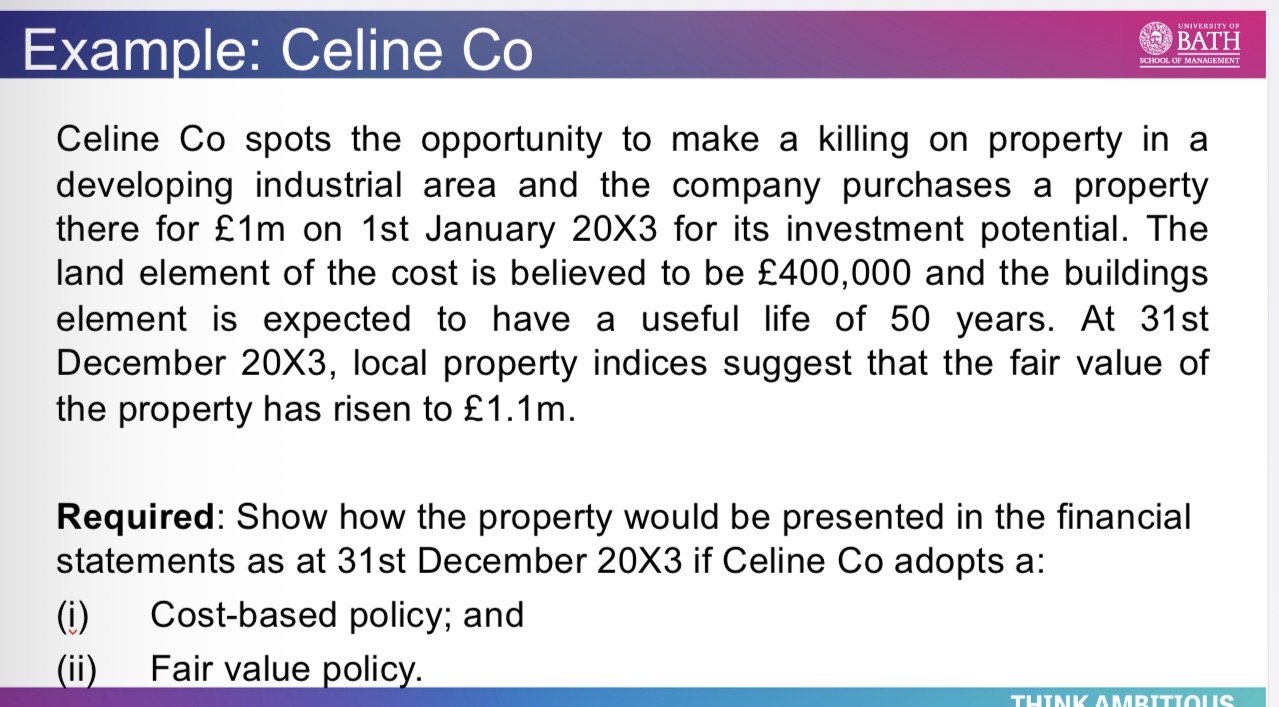
What is the definition of Investment Property (IAS 40)?
Land or building or both
Held to earn rentals or for capital appreciation (to increase the value over time)
Give some examples of investment property
Land held for long-term capital appreciation
Land held for a currently undetermined future use
A building owned by the entity leased to a third party under an operating lease
A building which is vacant but is to be leased out under an operating lease
A property which is being constructed or developed for future use as an investment property
What doesn’t count as investment property?
Owner occupied property (property being used by the entity)
In the production or supply of goods and services or for administration (IAS 16 PPE)
Property for sale in the ordinary course of business (IAS 2)
Property being constructed or developed on behalf of someone else (IFRS 15 Revenue from Contracts with Customers)
How is investment property recognised?
The property satisfied the definitions in IAS 40
It it probable that economic benefit will flow to the company
The cost can be reliably measured
Describe the measurement of investment property
Initially at cost
Purchase price + directly attributable costs
Subsequently
Cost model (same as IAS 16 PPE)
Fair value model
Include in SOFP at fair value
Review annually: Changes in fair value should be recognised in the FS for the period in which they arise
No depreciation/impairment

What conditions must be met for an intangible non-current asset to be classified as “held for sale” under IFRS 5?
The asset is available for immediate sale
Management is committed to a plan to sell
An active programme to locate a buyer is initiated
The asset is being actively marketed for sale at a reasonable price in relation to its fair value
The sale is expected within 12 months
The sale is highly probable
Actions required to complete the plan indicate that it is unlikely that the plan will be significantly changed or withdrawn
How are these assets measured?
Immediately before the initial classification of the asset as “held for sale” recognise:
The carrying amount - measured in accordance with applicable IFRS (cost model, revaluation model)
Non-current assets classified as “held for sale”:
Measure at the lower of:
The carrying amount
Fair value less costs to sell
Presented separately on the SOFP (IFRS 5)
Do not depreciate
How are these assets shown in the SOFP?
Non-current assets classified as held for sale and the assets of a disposal group classified as held for sale must be disclosed separately from other assets in the SOFP ⇒ shown in ‘current assets’ but below the ‘other current assets’ section
The liabilities of a disposal group classified as held for sale must also be disclosed separately from other liabilities in the SOFP
What is a discontinued operation and the criteria for one?
A discontinued operation is a component of an entity that has been disposed of or is classified as held for sale
Discontinued operation criteria:
Represents a separate major line of business or geographical area
Part of a single coordinated plan to dispose of a major line of business or area
A subsidiary acquired exclusively for resale (IFRS 5)
Describe the disclosure for discontinued operations
An entity must disclose a single amount on the IS, comprising the total of
The post-tax profit or loss of discontinued operations
The post-tax gain or loss recognised on the measurement to fair value less cost to sell or on disposal of the asset continuing the discontinued operations
Analysis must be presented in the notes or in the face of the IS
The revenue, expenses and pre-tax profit or loss of discontinued operations
The relative income tax expense
The gain or loss recognised on the measurement to fair value less cost to sell or on the disposal of the asset constituting the discontinued operation