Biology review- Cell Energy Quiz
 Call Kai
 Learn
Learn Practice Test
 Spaced Repetition
 Match
Match Flashcards
 Knowt Play
1/26

There's no tags or description
Looks like no tags are added yet.
Name | Mastery | Learn | Test | Matching | Spaced | Call with Kai | Chat |
|---|
No analytics yet
Send a link to your students to track their progress
27 Terms
Determine if the statements below describe photosynthesis or cellular respiration:
a) Energy is required for carbon dioxide molecules to form glucose.
b) The energy in the bonds of glucose is transferred to the phosphate bonds in ATP.
c) Energy from organic molecules is stored in ATP.
a)P
b)CR
c)CR
When would a plant produce oxygen?
During photosynthesis, when converting carbon dioxide and water into glucose and oxygen using sunlight.
What would cause a plant to produce carbon dioxide?
Plants produce carbon dioxide during cellular respiration, especially at night when photosynthesis is not occurring.
What is the formula for Photosynthesis?

What is the formula for Cellular Respiration?

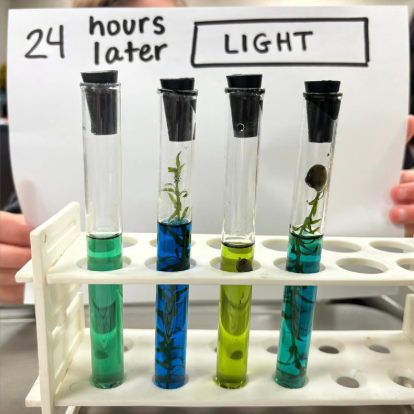
Name the gases present for each tube
1-Balanced
2-Oxygen
3-Carbon Dioxide
4-Oxygen and a little carbon dioxide

What processes are happening?
1- none
2-photosynthesis
3-cellular respiration
4-Both

What gases are present?
1-none
2-Carbon dioxide
3-Carbon dioxide
4-Carbon dioxide
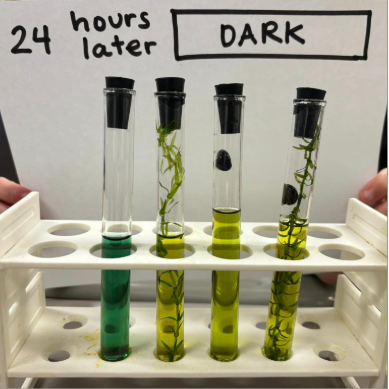
which processes are happening?
1-none
2-CR
3-CR
4-CR
What are enzymes?
Enzymes are proteins that speed up chemical reactions
Explain how enzymes affect reaction rate and activation energy.
Enzymes help increase the reaction rate and lower the activation energy required for
What does it mean to denature and how?
Denature means to change the natural shape, structure, or basic qualities of a substance—usually a protein or DNA—so that it loses its original function

What is the red shape and the yellow called?
Red is enzyme, Yellow is substrate

What are the yellow shapes called? And what is the circled area called?
Yellow shapes are the products, the circled area is the active site
Was the enzyme altered by the reaction?
No, enzymes remain unchanged
How would the following things affect the rate (speed) of a chemical reaction?
Adding more substrate
Lowering the temperature
Altering the pH of the solution (denaturing the enzyme)
Raising the temperature to above boiling (denaturing the enzyme)
a-Increases the rate until all enzyme active sites are fully saturated.
b-Decreases the rate because molecules move slower and collide less frequently.
c-Decreases or stops the rate because the active site loses its shape.
d-Stops the rate completely because extreme heat permanently destroys the enzyme's structure.
Name the molecules moved for diffusion, facilitated transport, osmosis, and active transport
D-small molecules
FT- Large molecules
O-small water molecules
AT-Molecules moved on a gradient
Name the part of the membrane used for diffusion, facilitated transport, osmosis, and active transport
D-Phospholipid Bilayer
FT-Transport Proteins
O-Phospholipid Bilayer
AT-Protein Pumps
Which transport requires energy to move?
Active Transport
What direction do they move in?
D-High to low
FT-High to low
O-High water to low water
AT-Low to high
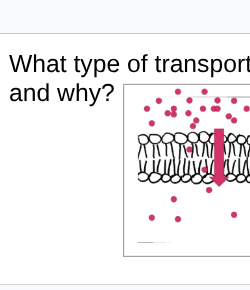
this is Diffusion because its small molecules moving from high to low through the bilayer

This is Facilitated transport bc Large molecules are moving high to low through the transport proteins
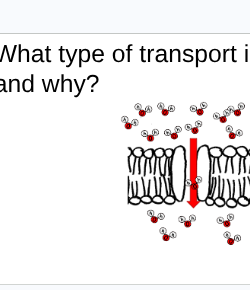
this is osmosis bc the water molecules are moving high to low through the bilayer

Active Transport bc the molecules are moving from low to high through the protein pump using ATP
Define endocytosis and what it does to help the cell
Endocytosis moves in the cell. It lets cells take in nutrients, destroy bacteria, and clear out debris
What is exocytosis? Why might this be important for cells?
Exocytosis moves out of the cell. It lets the cell release waste products, vital proteins, and hormones/ neurotransmitters
Are these examples of passive or active transport?
Both because they require cellular energy to release and take in different substances