Biology - Hereditary
 Call Kai
 Learn
 Practice Test
 Spaced Repetition
 Match
 Flashcards
 Knowt Play
1/66

Earn XP
Description and Tags
Module 5, Reproduction, Cell Replication, DNA and Polypeptide Synthesis, Genetic Variation, Inheritance Patterns in a Population
67 Terms
What is external fertilisation?
Fertilisation where a male organism's sperm fertilising a female organism's egg outside of the female's body.
Where does external fertilisation usually occur?
In aquatic or moist terrestrial environments, to prevent the dehydration of gametes.
What effect does internal fertilisation have on an organism?
A significant energy investment and risk.
What is sexual reproduction
Usually involves two parents who produce offspring that have a mix of the parents' genes and therefore differ from each other and from the parents.
What is asexual reproduction?
Involves only one parent and gives rise to offspring that are genetically identical to each other and to the original parent.
Binary Fission
The term means splitting into two where a newly divided cell grows to twice its size, replicates its genetic material (DNA) and then splits into two cells with identical genetic material. Only for prokaryotic Cells
Which hormone is released to promote childbirth?
Oxytocin, promotes the contractions.
Mitosis interphase
DNA replication complete. Chromosomes replicate to become double-stranded.
Mitosis prophase
Chromosomes condense, become visible and spindle apparatus forms
Mitosis metaphase
Double-stranded chromosomes align along the equator of the cell.
Mitosis anaphase
Sister chromatids (single chromosomes) separate to opposite poles of cell.
Mitosis telophase
Nuclear membranes assemble around the two nuclei. Each nuclei with the same number of chromosomes as the parent cell. Diploid.
Mitosis cytokinesis
Division of cytoplasm into two cells
Mitosis
Leads to the formation of two identical daughter cells that contribute to the growth and repair of the organism.
Chromosome
A thread-like structure of nucleic acids (DNA or RNA) and protein found in the nucleus of most living cells, carrying genetic information in the form of genes.
Gametes
Sex cells
Centromere
A point where two chromosomes join
Homologous chromosomes
Are the same length, have the centromere in the same position and carry genes for particular characteristics at the same location along their length.
Total number of chormosomes in a diploid
Number: 46
Meiosis
Gives rise to gametes that transmit genetic material from one generation to the next during sexual reproduction.
Meiosis early prophase
Chromosomes separate into homologous pairs.
Meiosis late prophase
-Nuclear membrane breaks down.
-Chromosomes split into chromatids.
-Crossing over occurs: genetic variation occurs.
Meiosis metaphase 1
-Chromosomes align in pairs in the middle of the cell.
-Random segregation
Meiosis anaphase I
-Chromosome pairs separate and each chromosome moves to the opposite end of the cell.
Meiosis telophase
-Two daughter cells form.
-Chromosome number is halved.
-Chromosome combinations in cells differ.
Meiosis cytokinesis 1
-Daughter cells are not identical to each other and have half the original number of chromosomes.
Meiosis metaphase II
-Chromosomes align at the equator.
Meiosis anaphase II
-Daughter chromosomes move apart, to opposite poles.
Meiosis cytokinesis II
-Four resulting daughter cells are not genetically identical to each other and have half the original chromosome number.
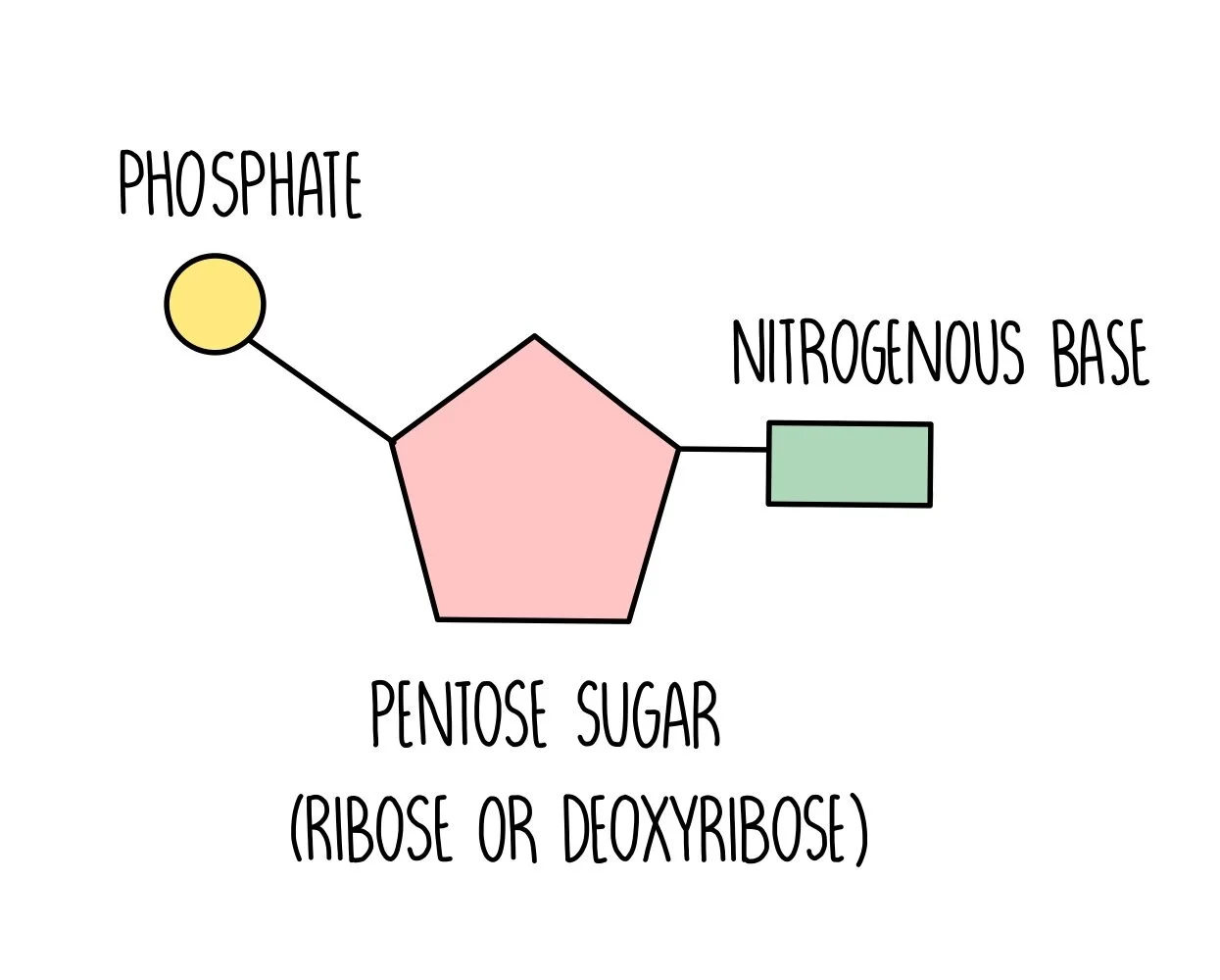
Nucleotide
Consists of three parts - a phosphate, a sugar and a nitrogenous base.
RNA
Single-stranded molecule made of nucleotides, with a ribose sugar attached to each phosphate to form the backbone; on the other end it attaches to a base, either A, uracil (U), C or G.
Purine base
Nitrogenous bases adenine and guanine.
Pyrimidine base
Nitrogenous bases thymine and cytosine
Eukaryote
Cells that have a membrane-bound nucleus and membrane-bound organelles. Examples include: animals and plants.
Prokaryotic
Cells that exist as single cells and have no membrane nucleus or organelles. Examples include: bacteria and archaea kingdom.
Eukaryotic DNA
-Nuclear DNA
-Some non-nuclear DNA (mitochondrial)
-Many chromosomes
-Contains non-coding DNA
-DNA is packaged in linear form
Prokaryotic DNA
-Non-nuclear DNA
-Circular (looped DNA)
-Contains non-chromosomes DNA called plasmids
-Contains 1 circular chromosomal DNA.

Amino acid
Often referred to as the building blocks of proteins, are compounds that play many critical roles in your body. Is a chemical building block of polypeptides.
Polypeptides
Are chains of amino acids. Proteins are made up of one or more polypeptide molecules. Peptide bonds hold the amino acids together.
Protein
A large molecule made up of polypeptides chains, formed by sequences of amino acids linked together by peptide bonds and which contain other chemical elements
DNA
Consists of long chains of nucleotides wound into a double helix. The sequence of nucleotide bases determines the meaning of the message.
Messenger RNA (mRNA)
Is a copy of one side of an unzipped DNA double helix except the nucleotide Thymine is replaced with Uracil. Plays an important role in the production of proteins.
Transfer RNA (tRNA)
An RNA molecule that functions as an interpreter picking up specific amino acids and recognising the appropriate codons to attach to on the mRNA.
Gene
A segment of DNA on a chromosome that codes for a specific trait.
Genome
The complete set of genetic material within a cell or that an organism has in each of its cells.
Alleles
Different forms of the same gene
Phenotype
Includes the structure, behaviour and physiology of an organism.
Epigenetic
Chemical modifications of DNA that do not involve a change in the sequence of nucleotides. Usually environmental.
Genotype
an organism’s complete set of genetic material or the specific combination of alleles it carries at a particular gene or locus
Locus (Pl. Loci)
A segment of DNA; the position of a gene on a chromosome.
Genetic variation
Differences in genetic material between individuals of the same species, arising from mutation, crossing over, independent assortment and random fertilisation.
Mutation
A random change in the nucleotide sequence of DNA that can create new alleles.
Independent assortment
The random orientation of homologous pairs during metaphase I, so each gamete receives a different mix of maternal and paternal chromosomes.
Crossing over
The exchange of segments between non-sister chromatids of homologous chromosomes during prophase I, creating new combinations of alleles.
Random fertilisation
Any sperm can fuse with any egg, so offspring receive a unique combination of genes.
Transcription
The process in which a DNA sequence is copied into a single-stranded mRNA molecule in the nucleus.
Translation
The process in which ribosomes read the codons of mRNA and link amino acids, brought by tRNA, into a polypeptide chain.
Codon
A sequence of three nucleotides on mRNA that specifies one amino acid.
Anticodon
A sequence of three bases on tRNA that is complementary to a codon on mRNA.
Gene pool
The total collection of alleles present in a population at a given time.
Allele frequency
The proportion of a particular allele among all copies of that gene in a population.
Hardy-Weinberg principle
States that allele and genotype frequencies in a large, randomly mating population remain constant from generation to generation unless evolutionary forces act on it.
Dominant allele
An allele whose trait is expressed in the phenotype of a heterozygote.
Recessive allele
An allele whose trait is only expressed in the phenotype when two copies are present (homozygous).
Codominance
A situation in which both alleles in a heterozygote are fully expressed, so the phenotype shows both traits.
Polygenic inheritance
A trait controlled by two or more genes, producing a range of continuous phenotypes.