Bio 103 - Chapters 5 & 9
 Call Kai
 Learn
 Practice Test
 Spaced Repetition
 Match
 Flashcards
 Knowt Play
1/62

63 Terms
Plasma Membrane
A selectively permeable boundary formed around ALL cells, comprised of a phospholipid bilayer
Fluid Mosaic Model
describes the arrangement and movement of the molecules that make up a cell membrane
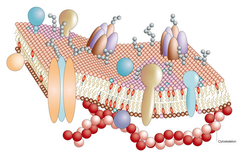
integral proteins
partially or wholly embedded
(transmembrane) in the membrane.

peripheral proteins
proteins that sit on the outside of the phospholipid bilayer
polar end of transmembrane proteins
pokes out of the plasma membrane

nonpolar end of transmembrane proteins
embedded within plasma membrane
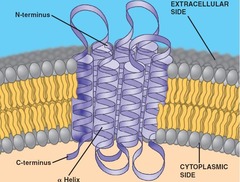
molecule that determines rigidity of cell membrane
cholesterol
three components of the plasma membrane
1. phospholipid bilayer
2. integral/peripheral proteins
3. cholesterol
channel proteins
Allow passage of molecules through membrane via a tunnel in the protein

specific type of channel protein that transports water
aquaporin
carrier proteins
Combines with the substance to be transported to assist in passage through membrane

cell recognition proteins
Glycoproteins that help the body recognize foreign
substances

receptor proteins
bind and respond to ions or hormones that it is specialized for

enzymatic proteins
Carry out a specific metabolic reaction

glycoproteins
CHO (carbohydrate) chains with attached proteins
glycolipids
CHO (carbohydrate) chains with attached lipids
where carbohydrate chains (glycolipids and glycoproteins) ONLY exist
on the outside of the membrane
junction proteins
Join adjacent cells so that a tissue can fulfill a function

Diffusion
Movement of molecules from an area of higher concentration to an area of lower concentration.

two types of passive transport
diffusion and facilitated diffusion
facilitated transport
Movement of molecules across a membrane with the help of a protein
passive transport
Movement of molecules without energy input
active transport
Movement of molecules against concentration gradient via carrier protein, requiring energy (ATP)
the type of transport lungs use to transport oxygen and CO2
passive transport / diffusion
osmosis
diffusion of water through a selectively permeable membrane
osmotic pressure
pressure that develops due to osmosis

what form of transport is the sodium-potassium pump
active transport
bulk transport
vesicles are used to move large molecules through the cell membrane via endo- or exocytosis
endocytosis
Vesicle fuses with plasma membrane to move particles INTO the cell
exocytosis
Vesicle fuses with plasma membrane to move particles OUT of the cell
how exocytosis is used in plants
exports cell wall material
how exocytosis is used in animals
secretes hormones, neurotransmitters, digestive enzymes, and waste
phagocytosis
A type of endocytosis in which a cell engulfs solid particles
pinocytosis
A type of endocytosis in which the cell ingests extracellular fluid and its dissolved solutes.
signaling molecules
molecules that allow cells to communicate with one another
signal transduction pathway
The process by which a signal on a cell's surface is converted into a specific cellular response
local regulators
a substance that influences cells in its vicinity
paracrine signaling
Signal released from a cell has an effect on neighboring cells.
familial hypercholesterolemia
Genetic disease where LDL receptor tails are missing, preventing vesicle formation and causing cholesterol to accumulate in arteries.
solvent
The liquid portion of a solution.
solute
The dissolved solid portion of a solution.
factors affecting rate of diffusion
Temperature, pressure, electrical currents, and molecular size.
MHC glycoproteins
glycoproteins that are different for each person and act as cell recognition proteins
a cell's "fingerprint"
glycoproteins and glycolipids
which of the six types of proteins are glycoproteins
cell recognition proteins
Equilibrium
when the net movement stops and the solute concentration is uniform
hypotonic
a solution with a LOWER concentration of solutes than the cell
hypertonic
a solution with a HIGHER concentration of solutes than the cell
isotonic
A solution that has an equal concentration of solutes as the cell
what happens to a cell when it is in a hypotonic solution
the cell will swell (cytolysis)
what happens to a cell when it is in a hypertonic solution
The cell will shrink (plasmolysis)
what happens to a cell when it is in an isotonic solution
the cell stays the same size
sodium a potassium pump
a carrier protein that uses ATP to move sodium ions out of a cell and potassium ions into the cell against their concentration gradients
what differentiates passive transport from active transport
passive transport follows the concentration gradient which does not require energy
active transport goes against concentration gradient, therefore uses energy
Synaptic signaling
Nerve cells release neurotransmitters that bind to receptors on nearby cells across a chemical synapse.
Endocrine signaling
Hormones produced by one organ or tissue travel through the circulatory system to affect other tissues.
Autocrine signaling
Release of chemicals by a cell to influence its own activity.
Direct contact signaling
Communication via contact between receptors of neighboring cells or through gap junctions.
cAMP Signaling Pathway
A common second messenger system used in signal transduction.
the plasma membrane allows ___ molecules to freely pass through it
nonpolar
the plasma membrane does NOT allow ___ molecules to freely pass through it
polar
the type of protein that causes some forms of dwarfism when faulty
receptor protein
two molecules that cannot pass unaided
through the membrane lipids
glucose and amino acids