HS300: Study Design II
 Call Kai
 Learn
 Practice Test
 Spaced Repetition
 Match
 Flashcards
 Knowt Play
1/33

There's no tags or description
Looks like no tags are added yet.
34 Terms
Why conduct studies?
The valid and precise measurement of the association between an exposure and a disease or between a treatment and an outcome
What can case control studies tell us?
Better understand the causes of disease by establishing risk factors for a disease
Or in clinical trial to establish whether a treatment is effective
Logical flow chart
Who was exposed to the disease and who was not?
Compare them to those who do not have the risk factor
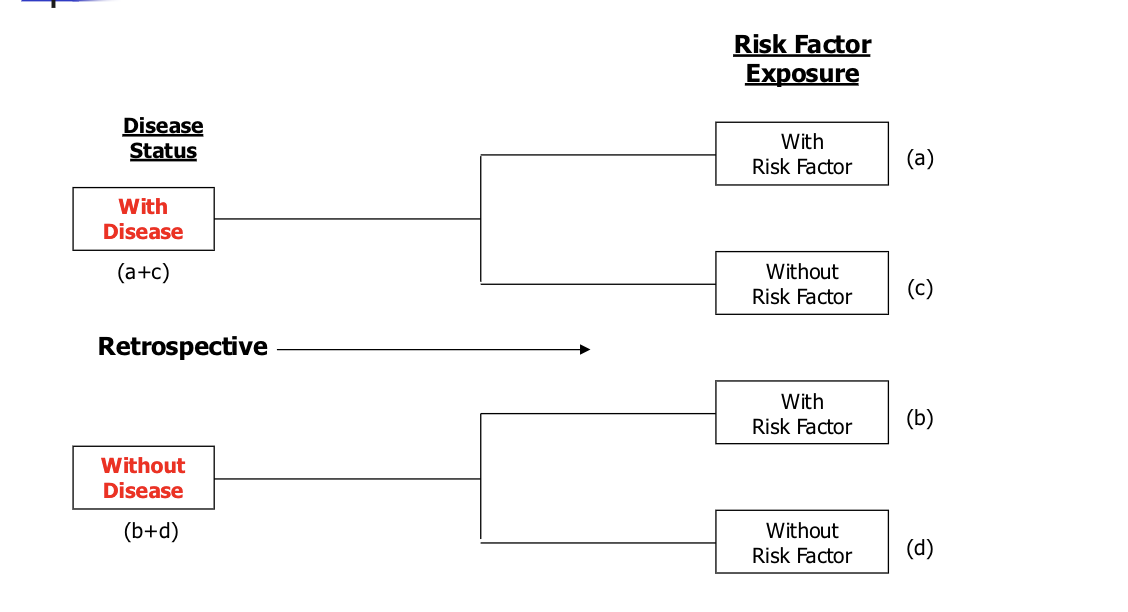
Sequence in case control
Initial classification of subjects is Disease Status
Disease is always determined before Exposure/Risk factor
Individual Cases (with disease) and Controls (without the disease) are always selected first, at the start of the study
Exposure is determined later
Case control studies
Analytical – basic premise: disease does not occur randomly, but rather in describable pattern that reflect an underlying etiology/cause.
Retrospective Exposure ← Disease
2 groups of subjects
One group in which everyone has the disease (Cases), and
Second group in which everyone is free of the disease (Controls)
Characteristics of case-control studies
Initial classification of subjects by disease status.
A single point of observation.
Exposure is determined retrospectively.
Selection of cases
2 broad steps:
Identifying a case operationally – “all true cases have equal opportunity of entering study, and no false cases”
Avoid misclassification of subjects
Case definitions
Defining a case/disease – broad(inclusive) versus narrow (restrictive)
Example…cases – myocardial infarction or arthritis?
Better to be restrictive → avoid ‘misclassification’
Sources of cases
Need to define a case conceptually.
Ideally, identify and enroll all new (incident) cases in a defined population in a specified time period.
A tumor registry may provide a complete listing of all cases.
Medical facilities also may be a source of cases, but not always incident cases.
Why incident cases?
Prevalent disease is a function of disease incidence and disease duration (P ~ I X D)
Select incident cases because we are interested in factors that lead to developing the disease rather than factors that affect the duration (survival factors) of the disease
e.g. Diabetes, heart attack
Prevalent vs. incident cases
Prevalent cases make it difficult to separate
characteristics that are causal versus
characteristics that are consequential
Case definition is influenced by:
Standard diagnostic criteria
Stage or Severity of the disease
Whether the diagnostic criteria are subjective or objective
Example: ADHD versus breast cancer
Concern is: Misclassification (see below)
Goal for selection of cases
ensure that all true cases have an equal opportunity of entering the study and that no false cases enter
Ideally new cases – but not always possible – use prevalent cases
Controls
A sample of the population that produced the cases, but they do not have the disease
i.e. same base population for cases and controls
Selection of controls
Controls should be the same as the cases in every respect except the outcome (disease) under study
Controls must have the potential to become case
Selection of controls example
How many control subjects? => statistical power
Case : Control ratio
1:1 -> 1:4 (statistical power max at 4:1)
There is no statistical advantage in exceeding 4:1 ratio
Sources of controls
Population
Hospital/Clinic
Family/Friend
Population controls
Population-based controls (e.g drivers license) – same community
Advantages:
same source population
Disadvantages:
time & $$$
low participation rates
Relatives or associates based controls
Relatives of cases?? → ???
Friends of cases → ???
Advantages
Complex SES variable (income, race, education)
First degree relative—genetic
Hospital based controls
Patients from the same hospital as the cases
Who can be included?
Decide which disease events among controls are appropriate to allow as controls
Hospital based controls rules
Illness of control must be unrelated to the exposure under study
Controls should have the potential to become a case
Hospital based controls advantages and disadvantages
Advantages:
cheap, quick
same source population
good recall
Disadvantages:
sick
Measures of association
Strength of association between the exposure and the disease (outcome)
Is there an association between exposure and a specific disease? Is the exposure disproportionately distributed between the cases and the controls?
The exposure may be a
risk factor for the disease …or
not associated …or a
protective factor
Case Control / Odds Ratio
(odds of exposure among disease group (cases))/(odds of exposure among control group)
Case control odds ratio table

Guiding principle of case control studies
to determine how much more likely or less likely the cases are to be exposed compared with the controls
Expression of the odds ratio
Start your statement with “the odds of…” and “Subjects with disease X”
Interpreting an odds ratio
O.R. = 1:
The odds of exposure are equal among cases and controls
O.R. = 2:
The cases were twice as likely as controls to be exposed
Not all risk factors increase risk.
O.R. = 0.5:
The cases were half as likely as controls to be exposed (lower risk, protective factor).
Caution in interpretation of odds ratio
Retrospective
Only one period of observation
Not a direct determination of risk because of the way the groups are assembled. Groups do not represent population exposed and non exposed to the risk factor (no appropriate denominator for population at risk).
An OR provides a good approximation of risk when
Controls are representative of a target population.
Cases are representative of all cases.
Strengths: case control studies
Small study size
Quick, Inexpensive
Most efficient design to study etiology of rare diseases
Study diseases with long induction period
Evaluate multiple exposures - useful when little is known about the disease
Limitations of case control studies
Provide indirect estimate of risk.
Timing of exposure-disease relationship difficult to determine.
Subject to misclassifaction of exposure data inaccuracy because retrospective (misclassification)
Greater chance of bias than cohort study (because
retrospective)Not efficient for rare exposures (needs large # cases and controls to detect rare exposures)