Bio II-Survey of Cell and Molecular Biology UNIT 2
 Call Kai
 Learn
Learn Practice Test
 Spaced Repetition
 Match
Match Flashcards
 Knowt Play
1/99

There's no tags or description
Looks like no tags are added yet.
Name | Mastery | Learn | Test | Matching | Spaced | Call with Kai | Chat |
|---|
No analytics yet
Send a link to your students to track their progress
100 Terms
What is energy?
The capacity to do work
Ex: our body uses energy to move your muscles
What is potential energy?
Stored energy, such as energy stored in chemical bonds
Ex: Glucose contains stored chemical energy
What is kinetic energy?
The energy of motion or movement
Ex: A cyclist moving down a road has kinetic energy
What is heat?
Energy associated with the random movement of molecules or atoms
Ex: Some energy from food is released as heat when your body uses it
What is the first law of thermodynamics?
Energy cannot be created or destroyed; it can only change forms
Ex: Light energy can be converted into chemical energy during photosynthesis
Why is energy transformation inefficient?
Some energy is released as heat during each transformation
Ex: A person uses some energy from food for movement, while some is released as heat
What is photosynthesis?
The process by which plants and other autotrophs capture sunlight to make energy-rich molecules.
Ex: A plant uses sunlight to produce sugar
What is an autotroph?
An organism that captures energy and produces its own organic molecules
Ex: Plants and algae use photosynthesis
What is a heterotroph?
An organism that obtains energy and organic molecules by eating other organisms
Ex: Humans get energy from the food they eat
What is a photon?
A packet of light energy
Ex: Chlorophyll absorbs photons from sunlight
What is chlorophyll?
A pigment that absorbs light energy, reflecting mostly green light
Ex: Chlorophyll helps leaves capture sunlight
What are the inputs of photosynthesis?
Carbon dioxide, water, and light energy
Ex: A plant receives CO₂ from the air, water from its surroundings, and sunlight
What are the outputs of photosynthesis?
Sugar and oxygen
Ex: A plant produces energy-rich organic molecules and releases oxygen
Where does photosynthesis occur?
In chloroplasts, organelles found in plant and algal cells
Ex: Leaf cells contain chloroplasts that carry out photosynthesis
What is the difference between the chloroplast envelope and the thylakoid membrane?
The envelope surrounds the chloroplast; the thylakoid membrane surrounds the internal thylakoid space
Ex: Light-dependent reactions occur in the thylakoid membrane, not the envelope
Where do the light-dependent reactions occur?
In the thylakoid membranes of chloroplasts
Ex: Chlorophyll in these membranes absorbs light
What are the main inputs of the light-dependent reactions?
Light, water, ADP and phosphate, and NADP
Ex: The reactions use light and water to help produce ATP and NADPH
What are the main outputs of the light-dependent reactions?
Oxygen, ATP, and NADPH
Ex: ATP and NADPH are used to help power the Calvin cycle
What is the Calvin cycle?
A series of reactions that uses CO₂, ATP, and NADPH to produce organic molecules used to build sugars
Ex: A plant incorporates carbon from CO₂ into carbon-containing molecules
Where does the Calvin cycle occur?
In the stroma of the chloroplast
Ex: The Calvin cycle occurs in the fluid surrounding the thylakoids
What is carbon fixation?
Incorporating inorganic carbon dioxide into an organic molecule
Ex: Carbon from atmospheric CO₂ becomes part of a molecule in a plant
How do the light-dependent reactions differ from the Calvin cycle?
Light reactions capture light energy and make ATP and NADPH; the Calvin cycle uses them to fix CO₂.
Ex: ATP and NADPH produced by the light reactions help power the Calvin cycle
Where do the electrons used in photosynthesis come from?
From water, which is split during the light-dependent reactions
Ex: Splitting water supplies electrons and releases oxygen.
What is an electron transport chain (ETC)?
A series of molecules that transfer electrons and help convert energy into a usable form
Ex: Excited electrons leave a photosystem and enter an electron transport chain
What is an electron carrier?
A molecule that carries electrons from one reaction or location to another
Ex: NADPH carries electrons to the Calvin cycle
Trace the flow of electrons in photosynthesis
Water supplies electrons → light excites electrons in photosystems → electron transport and NADPH formation → electrons help reduce carbon compounds used to build sugars
What is a concentration gradient?
A difference in the concentration of a substance between two areas.
Ex: H⁺ concentration is higher inside the thylakoid space than in the stroma
How does an H⁺ gradient help produce ATP?
H⁺ flows down its gradient through ATP synthase, which uses the energy to make ATP
Ex: H⁺ moves from the thylakoid space into the stroma through ATP synthase
What are active transport and facilitated diffusion?
Active transport uses energy to move substances against a gradient; facilitated diffusion moves substances down a gradient through a protein
Ex: Energy-driven transport helps establish an H⁺ gradient, while H⁺ moves through ATP synthase by facilitated diffusion
What happens if the H⁺ concentration gradient is disrupted?
ATP production through ATP synthase decreases because the driving force is lost
Ex: If H⁺ cannot build up on one side of the thylakoid membrane, less ATP can be produced this way
What is aerobic cellular respiration?
A series of reactions that converts stored food energy into ATP in the presence of oxygen
Ex: Your cells use glucose and oxygen to produce ATP
What is the overall equation for aerobic respiration?
Glucose + oxygen → carbon dioxide + water + energy captured in ATP
Ex: Cells break down glucose from food and use oxygen to help release its stored energy
How does the body use macromolecules in food?
It digests them into smaller building blocks used to make new molecules or obtain energy
How much energy do carbohydrates, proteins, and fats provide per gram?
Carbohydrates: 4 Calories; proteins: 4 Calories; fats: 9 Calories per gram
Ex: A gram of fat provides more than twice the energy of a gram of carbohydrate
What is the difference between a calorie and a Calorie?
One capital-C Calorie equals 1,000 lowercase-c calories, or 1 kilocalorie
Ex: Food labels usually report energy in Calories
What influences how much energy a person uses?
Activity level, genetics, muscle mass, and other individual factors
Ex: Two people can burn different amounts of energy performing the same activity
What causes long-term weight gain or weight loss?
An imbalance between energy intake and energy expenditure over time.
Ex: Consistently taking in more energy than the body uses can lead to weight gain
How does the body store excess energy?
As glycogen in liver and muscle cells and as triglycerides in fat cells
Ex: After a meal, excess energy may be stored for later use
What is glycogen, and what is its function?
A chain of glucose molecules used for short-term energy storage
Ex: The liver can break down glycogen to help supply glucose when needed.
What are triglycerides, and what is their function?
Lipids are used for long-term energy storage in fat cells
Ex: The body can convert excess sugars, fats, and amino acids into triglycerides
What are the three stages of aerobic respiration?
Glycolysis, the citric acid cycle, and the electron transport chain
Ex: These stages work together to extract energy from glucose
Where does glycolysis occur?
In the cytoplasm
Ex: Glucose begins breaking down outside the mitochondria
What happens during glycolysis?
Glucose is broken down into two smaller molecules called pyruvate
Ex: One six-carbon glucose molecule produces two three-carbon pyruvate molecules
What are the main outputs of glycolysis?
Two pyruvates, a net gain of 2 ATP, and 2 NADH per glucose
Ex: Glycolysis produces a small amount of ATP before the later stages occur
What happens to pyruvate before the citric acid cycle?
It is converted into acetyl-CoA, releasing CO₂ and producing NADH
Ex: pyruvate produced by glycolysis is processed before entering the cycle
Where does the citric acid cycle occur in eukaryotic cells?
In the mitochondrial matrix
Ex: Acetyl-CoA enters reactions inside the mitochondrial matrix
What is the purpose of the citric acid cycle?
To extract energy from food and transfer high-energy electrons to carriers
Ex: NAD⁺ picks up electrons and becomes NADH
What are the main outputs of the citric acid cycle per glucose?
CO₂, NADH, FADH₂, and a small amount of ATP or GTP
Ex: The cycle produces electron carriers that deliver electrons to the ETC
Where does the electron transport chain occur in eukaryotic cells?
In the inner mitochondrial membrane
Ex: Electrons pass along molecules located in the membrane's folds
What do NADH and FADH₂ do in respiration?
They deliver high-energy electrons to the electron transport chain
Ex: NADH carries electrons collected during earlier stages of respiration.
What is the role of oxygen in the ETC?
Oxygen accepts electrons at the end of the chain and combines with hydrogen to form water
Ex: Without oxygen, electrons cannot pass through the ETC normally
How does the ETC help produce ATP?
Electron transfer creates an H⁺ gradient that powers ATP synthase
Ex: H⁺ accumulates in the intermembrane space and flows back into the mitochondrial matrix through ATP synthase
What does ATP synthase do during respiration?
It uses the energy of H⁺ flowing down its gradient to produce ATP from ADP and phosphate.
Ex: H⁺ passing through ATP synthase helps power ATP formation
Which stage produces most ATP during aerobic respiration?
The electron transport chain and oxidative phosphorylation
Ex: Most ATP is made using the proton gradient rather than directly during glycolysis
Where do the three stages of respiration occur in eukaryotes?
Glycolysis: cytoplasm; citric acid cycle: mitochondrial matrix; ETC: inner mitochondrial membrane
Ex: If asked where glycolysis occurs, the answer is the cytoplasm
Where do the stages of respiration occur in prokaryotes?
Glycolysis and the citric acid cycle occur in the cytoplasm; the ETC occurs in the cell membrane
Ex: Bacteria do not need mitochondria to carry out electron transport
How are mitochondria and chloroplasts similar?
Both have multiple membranes, their own DNA, and electron transport systems involved in energy conversion.
Ex: Mitochondria produce ATP during respiration, while chloroplasts produce ATP during photosynthesis
What is the endosymbiosis theory?
The theory is that mitochondria and chloroplasts evolved from prokaryotes that were engulfed by ancestral cells.
The organelles' own DNA supports this theory
What evidence supports the endosymbiosis theory?
Mitochondria and chloroplasts have their own DNA and multiple membranes
Their DNA is evidence of a possible origin from once-independent prokaryotes
What is fermentation?
An anaerobic process that regenerates NAD⁺ so glycolysis can continue
Ex: Muscle cells can rely more on fermentation when oxygen availability is limited
What happens to aerobic respiration when oxygen is unavailable?
The ETC stops, and fermentation allows glycolysis to continue
Ex: Cells can still obtain a small amount of ATP through glycolysis
What are the products of fermentation in animal cells?
Lactate, while glycolysis provides a small amount of ATP
Ex: Human muscle cells can produce lactate during intense exercise
What are the products of alcoholic fermentation?
Ethanol and carbon dioxide, with a small amount of ATP from glycolysis
Ex: Yeast produces ethanol and CO₂ when fermenting sugar
How does fermentation differ from aerobic respiration?
Fermentation does not use the ETC and produces far less ATP than aerobic respiration
Ex: Fermentation allows glycolysis to continue without oxygen, but it extracts much less energy from glucose
How do photosynthesis and cellular respiration form a cycle?
Photosynthesis uses CO₂ and water to make sugar and oxygen; respiration uses sugar and oxygen and releases CO₂ and water
Ex: Glucose made by a plant can be used by an animal for respiration
What is DNA, and what is its function?
DNA (deoxyribonucleic acid) is the hereditary molecule that stores instructions for building an organism and is passed from parents to offspring
What is a nucleotide, and what are its three parts?
A nucleotide is the basic building block of DNA. It contains a sugar, a phosphate group, and a nitrogenous base
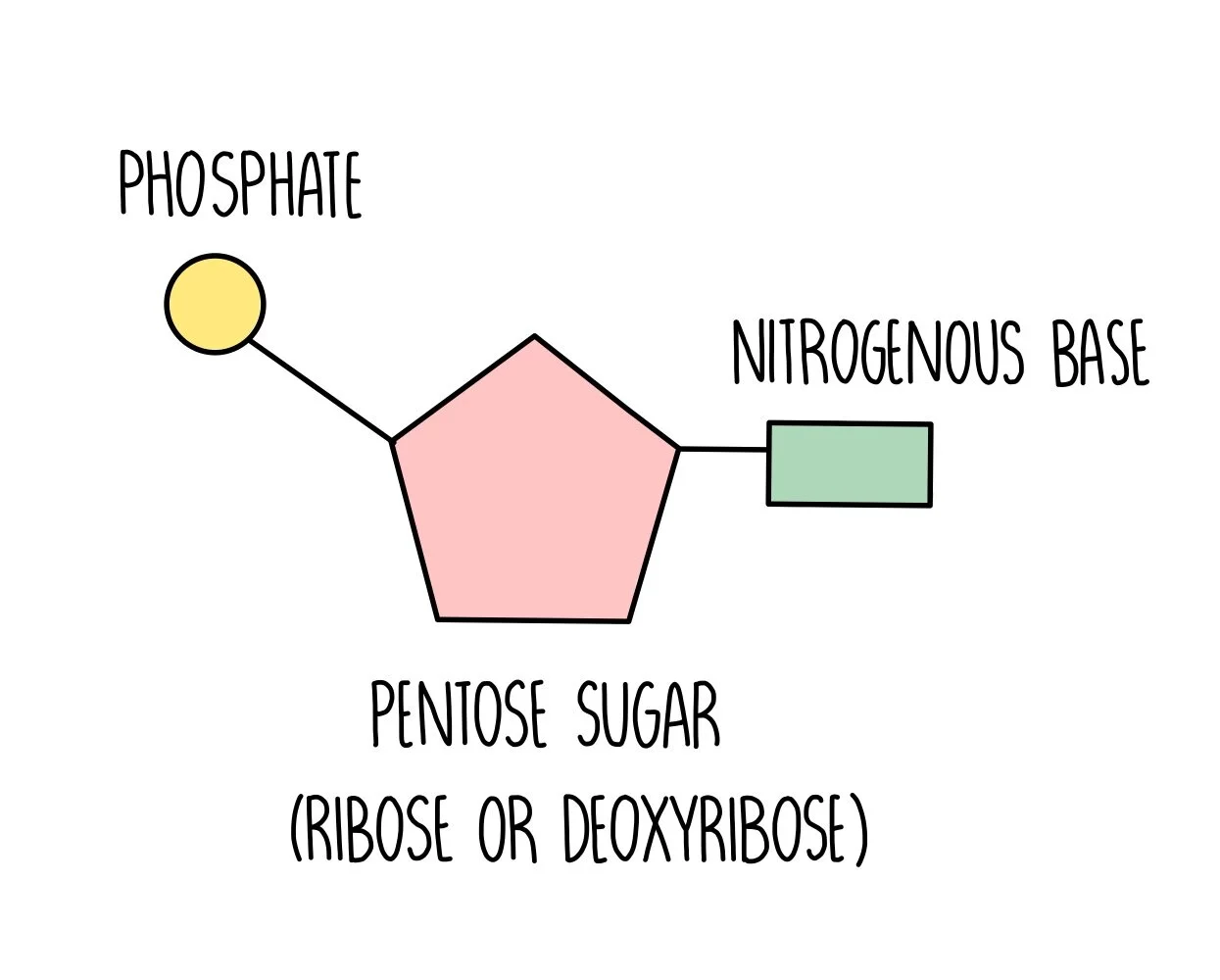
What are the four nitrogenous bases in DNA?
Adenine (A), thymine (T), cytosine (C), and guanine (G)
What is the difference between purines and pyrimidines?
Purines have two rings: adenine and guanine. Pyrimidines have one ring: cytosine and thymine
Ex: If a question asks which bases are purines, choose A and G

What are the complementary base-pairing rules?
Adenine pairs with thymine (A–T), and cytosine pairs with guanine (C–G)
Ex: the complementary strand of A–C–G–T is T–G–C–A
How many hydrogen bonds connect each DNA base pair?
A–T has two hydrogen bonds; C–G has three
Ex: A DNA region rich in C–G pairs has more hydrogen bonds between its bases than an equal-length region rich in A–T pairs
What is the difference between hydrogen bonds and phosphodiester bonds?
Hydrogen bonds hold complementary bases together; phosphodiester bonds connect nucleotides along the sugar-phosphate backbone
Ex: Hydrogen bonds allow DNA strands to separate, while phosphodiester bonds hold each strand together

What is the structure of DNA?
DNA is a double helix made of two complementary strands with sugar-phosphate backbones and paired bases inside
Ex: DNA resembles a twisted ladder, with base pairs as the rungs

What did Chargaff's experiments reveal?
Chargaff found that A and T occur in approximately equal amounts, as do C and G
Ex: If DNA contains 25% A, it contains approximately 25% T
What were the contributions of Franklin, Wilkins, Watson, and Crick?
Franklin and Wilkins contributed X-ray diffraction evidence; Watson and Crick proposed the double-helix model in 1953
Ex: Franklin's X-ray images helped reveal DNA's helical structure
What is a genome?
The complete set of genetic instructions encoded in an organism's chromosomes
How is DNA organized in eukaryotic cells?
DNA is packaged into chromosomes in the nucleus, with DNA wrapped around proteins
Ex: Human body cells typically contain 46 chromosomes arranged in 23 pairs
What is DNA replication, and when does it occur?
DNA replication copies DNA during the S phase of the cell cycle, before cell division
Ex: A cell copies its DNA so each daughter cell can receive genetic information
What does semiconservative replication mean?
Each new DNA molecule contains one original strand and one newly made strand
Ex: After replication, each of the two DNA molecules has one parental strand and one new strand
Why is semiconservative replication important?
Each original strand acts as a template for building a complementary strand
Ex: A strand containing A–T–G–C guides the formation of T–A–C–G
What does helicase do during DNA replication?
Helicase unwinds the double helix and separates the parental strands by breaking hydrogen bonds between base pairs.
Ex: Helicase opens DNA so the strands can be copied
What is a replication fork?
A region where DNA strands have separated and new strands are being synthesized
Ex: As helicase opens DNA, replication forks form where DNA polymerase can build new strands

What does DNA polymerase do?
DNA polymerase builds new DNA strands by adding complementary nucleotides to a template
Ex: When the template contains A, polymerase adds T to the new strand
What do the 5′ and 3′ ends of DNA mean?
They refer to numbered positions on the DNA sugar-phosphate backbone. New nucleotides are added to the 3′ end.
Ex: DNA polymerase extends a new strand by adding a nucleotide to its free 3′ OH group
Why are the two new DNA strands made differently?
The original strands run in opposite directions, but DNA polymerase can only add nucleotides to the 3′ end
Ex: One new strand is made continuously, while the other is made in separate pieces
What is the difference between continuous and discontinuous DNA synthesis?
The leading strand is synthesized continuously; the lagging strand is synthesized discontinuously in short pieces
Ex: At a replication fork, one new strand grows smoothly while the other is built in sections
How does complementary base pairing help DNA replication?
It ensures the correct nucleotide is added opposite each base on the template strand
Ex: A template sequence of G–A–T–C produces a complementary strand of C–T–A–G
What is PCR, and why is it used?
Polymerase chain reaction is a laboratory technique that amplifies a specific DNA segment, producing many copies
Ex: A forensic scientist uses PCR to copy DNA from a small biological sample
What ingredients are needed for PCR?
DNA template, free nucleotides, DNA polymerase, and primers
Ex: Primers mark the DNA region that the scientist wants to copy
What are the three main steps of PCR?
Denaturation separates strands, annealing allows primers to bind, and extension copies DNA
Ex: PCR repeatedly heats and cools a sample so the target region can be amplified
What happens during denaturation?
Heating separates the two DNA strands by disrupting the hydrogen bonds between bases
Ex: Double-stranded DNA separates into single strands
What happens during primer annealing?
Cooling allows primers to bind to complementary sequences on the DNA templates
Ex: A primer attaches near the beginning of the region being copied
What happens during extension?
DNA polymerase adds nucleotides to the primers, creating new DNA strands
Ex: Polymerase uses each original strand as a template to copy the target region
How is PCR similar to normal cellular DNA replication?
Both use templates, complementary base pairing, primers or starting points, and DNA polymerase to make DNA
Ex: Cells copy DNA before division, while a lab uses PCR to copy a selected region
Why is DNA different between individuals?
Individuals can have differences in their DNA base sequences, creating genetic variation
Ex: Two people may have different numbers of repeated DNA sequences at the same chromosome location
What are short tandem repeats (STRs)?
STRs are short DNA sequences repeated several times in a row at particular chromosome locations
Ex: The sequence AGC might repeat eight times in one person and twelve times in another
Why are STRs useful for DNA profiling?
The number of repeats can vary between individuals, creating distinguishable DNA patterns
Ex: Two people may have different STR fragment lengths at the same location
How are DNA samples prepared for STR profiling?
Scientists collect cells, extract DNA, and use PCR to amplify selected STR regions
Ex: A lab copies STR regions from DNA collected at a crime scene
What is gel electrophoresis, and how does it help DNA profiling?
It separates DNA fragments by size. Smaller fragments travel farther through the gel than larger fragments
Ex: STR fragments form bands that can be compared between samples
How do scientists compare DNA profiles, and why do they examine multiple STR regions?
They compare banding patterns across multiple STR regions. More regions make profiles more discriminating
Ex: If evidence and a reference sample match across many STR regions, that supports a possible common source, but the match must be interpreted statistically