Quiz 6 - Language
 Call Kai
 Learn
 Practice Test
 Spaced Repetition
 Match
 Flashcards
 Knowt Play
1/63

There's no tags or description
Looks like no tags are added yet.
Name | Mastery | Learn | Test | Matching | Spaced | Call with Kai | Chat |
|---|
No analytics yet
Send a link to your students to track their progress
64 Terms
Phonology
studying the production and perception of sounds found for a particular language.
Prosody
the rhythm and stress (emphasis) found in speech
Syntax (Grammer)
studying the structure and rules of constructing well formed sentences
Discourse comprehension
understanding the context of how sentences are related to each other and their relation to semantic memory.
The Competition model (MacWhinney & Bates, 1989, MacWhinney, 1987)
A theoretical framework describing cross-linguistic performance of different syntactic and semantic features.
Different languages use different sets of syntactic and semantic features that guide the sentence comprehension.
Cue validity refers to the reliability of a given syntactic or semantic form in guiding comprehension.
Children can become sensitive to these syntactic and semantic cues early in language acquisition
Cue validity
refers to the reliability of a given syntactic or semantic form in guiding comprehension.
MacWhinney, Bates & Kliegl (1984)
Participants heard a set of two nouns and a verb, in any order (VNN, NVN, NNV) in some combination of animate and inanimate items.
Ex. (The boy ate the apple, ate the boy the apple, the apple ate the boy, the wall ate the apple)
Participants were asked to decide which of the nouns is performing the action. (English, Italian, German):
English speakers relied on word order
Italian speakers relied on the animacy of the nouns
German speakers relied on animacy and a case marker.
Order of importance of cues to actor assignment by adult speakers across languages (from MacWhinney & Bates, 1989)
English - word order > animacy, agreement > stress
Italian - subject-verb agreement > clitic agreement > animacy > word order > stress
German - case marker > agreement > animacy > word order
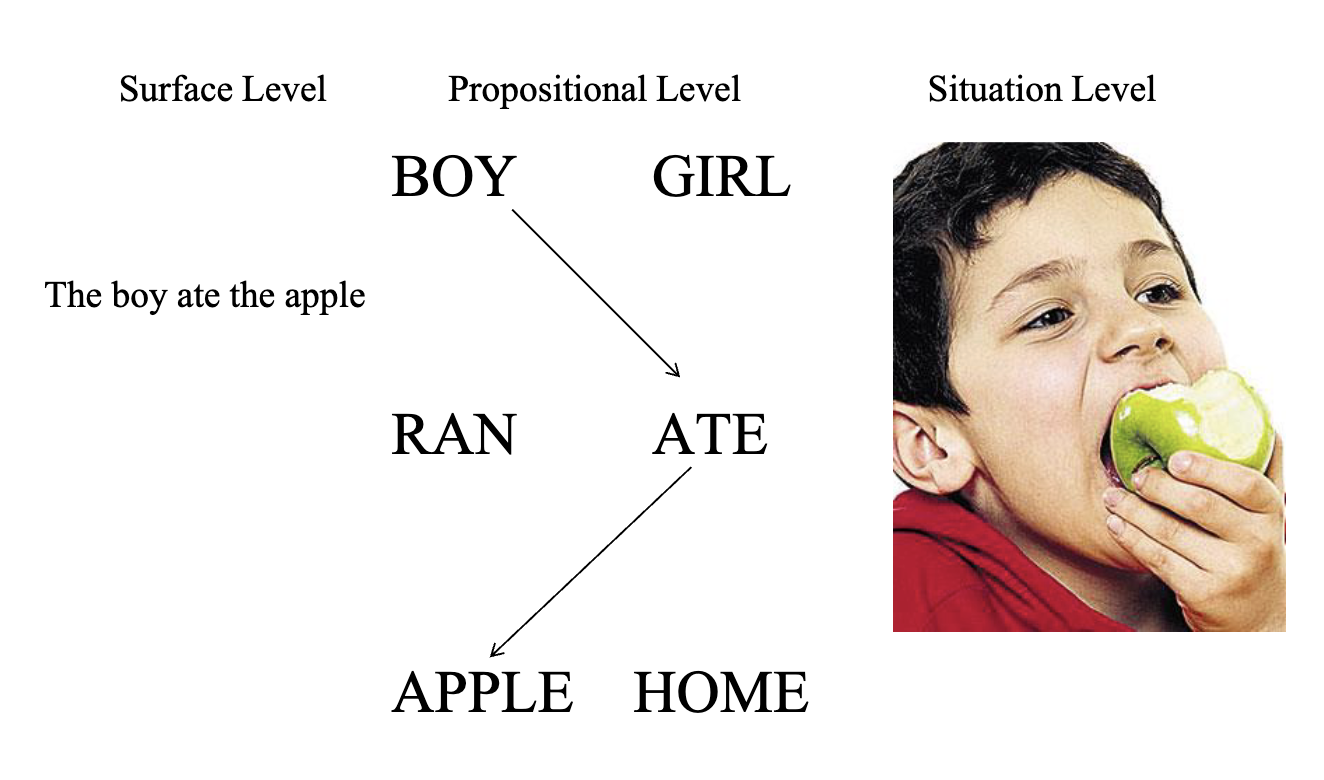
Surface Level Representation
The word-for-word and briefly activated form captures the exact syntax, semantics, and pragmatics for a sentence or series of sentences.
Propositional Level Representation
the summary meaning of a discourse is captured by a richly interconnected network of propositions in a semantic network
or
A set of nodes are activated in a semantic network to represent the gist of sentences without surface representation. A series of sentences can be linked with each other based on common nodes activated.
Situation Level Representation
the long-term level of representation similar to the representation that results from direct experience with the situation described by a discourse (Walter Kintsch, 1988, 1993).
Examples for the Levels of Representation
Surface level is the “statement”: the boy ate the apple
Propositional level is the “key concepts”: boy, ate, apple
Situation level is seeing it (seeing a boy eating an apple)
Evidence for Short-Term Surface level memory: Jarvella (1971)
The researcher interrupted a spoken story and tested surface memory in participants for the last three clauses under two conditions:
A) The confidence of Kofach was not unfounded. To stack the meeting for McDonald the union had even brought in outsiders.
B) Kofach had been persuaded by the international to stack the meeting for McDonald. The union had even brought in outsiders.
People were asked to free-recall the clauses they were listening.
The researcher found poor memory for clauses BEFORE the sentence boundary. Therefore, the Surface form is held in STM/WM until a sentence boundary is reached, then removed to make room for the next sentence. Only sentence meaning (or the gist) is stored in LTM.
Evidence for Long-term Surface Level Memory: Bates, Kintsch, Fletcher & Giuliani (1980)
Using an “in context" Recognition Test can help researchers differentiate Reconstructive Memory versus Reproductive Memory.
"Mary told me she saw John/him at the basketball game."
Embedding the Recognition Test in the context of a discourse or paragraph. Any difference between participants with and without prior exposure to the discourse can be attributed to "real" surface memory.
Studies using this procedure (e.g., Bates, Kintsch, Fletcher & Giuliani, 1980) provide strong support for long-term surface memory.
Further evidence for Long-term Surface memory
Re-reading times are slower when the surface form is changed
sentence verification times are slower when the surface form is changed
Distinctiveness (Kintsch& Bates, 1977)
Sentences that are different in some way (e.g., jokes and announcements) produce stronger surface memor
Interactive Content (Keenan, MacWhinney & Mayhew 1977)
sentences that tell us about the relationship between the speaker and listener produce more surface memory
Cognitive Effort (Bates, Kintsh, Fletcher & Giuliani, 1977)
Sentences that require more processing effort produce more surface memory.
Crossmodality Integration
How do we combine the information from verbal directions (auditory) and a map (visual)? (interaction between analogical and propositional representations?)
Individual Differences in Comprehension
Two people can agree on what was said but disagree on its meaning
(ex. Visiting relatives can be annoying, can be interpreted in two ways: relatives visiting ME is annoying/ME visiting relatives is annoying
The lady hit the man with an umbrella, can be interpreted in two ways: The lady with the umbrella hit the man/The lady hit the man who was holding an umbrella)
Learning
Learning from a text is not the same as remembering a text.
Schmalhoffer & Glavanov (1986) conducted a study where participants were instructed to study a computer programming text
for (a) later recall or (b) programming a computer.
Participants asked to study a text for programming computer were able to create a program for the computer, but they had poor performance on surface and propositional recall and vice versa.
Perceptual and Sensory Qualities:
Some texts (or listening to stories) give rise to perceptual and sensory properties that are not well captured by propositions
Reading stories can “transport” you to another place and time. In addition, there can be a suspension of disbelief (i.e. reading fantasy and science fiction). (Suggestibility, Empathy)
Updating
Where and how is information from related sentences combined?
Causal Structure Model of Discourse Comprehension (Trabasso, van den Broek, & Suh, 1989)
Readers generate a causal network representation of the states and events in a story that lead towards goals.
Events with more causal connections are better remembered than events with few causal connections. (Trabasso, van den Broek, & Suh, 1989)
Reading stories to children helps them start understanding the foundation of the causal connections of events in stories.
Children and adults watching TV programs understand the story based on the causal structure of events. (van den Broek, Lorch, Thurlow, 1996)
Pragmatics
studying the ability of speakers to communicate more than that which is explicitly stated.
Pragmatics are an important component of conversations: Can you open the door? - Can you please open the door?
Maxim of Quality
Truth (do not say what you believe to be false, don’t lie, and don’t exaggerate)
Maxim of Quantity
Information (don’t say more or less than you know, do not make your contribution more informative than is required, and don’t be too informative)
Maxim of Relation
relevence (stick to the topic of conversation, rather than shifting topics; don't say what others are not interested in the conversation
Maxim of Manner and Tone
Clarity (avoid obscurity of expressions ("Eschew obfuscation"), avoid ambiguity, be brief, and be orderly.
Violations of the Conversational Maxims between speakers results
in an uncoordinated conversation and confusion.
Aphasia
Difficulty in producing or understanding speech caused by brain damage, and not due to deafness or a simple motor deficit.
Most of what researchers know about the neural circuits devoted to language is
through brain damage and its effects on language behavior.
Broca’s area (Broca, 1860)
found on the inferior left frontal lobe; Damage to this area causes disruption of fluent speech, but with intact meaning. (Syntax (Grammar) module)
Not a bunch of grammar going on but gets to the point although with hesitation
Wernike’s area (Wernike, 1874)
found on the superior temporal lobe gyrus; Damage to this area causes a disruption of speech production and comprehension, but with intact grammatical sentences. (Semantics (Meaning) module)
Symptoms of Broca’s Aphasia
Slow, laborious and non-fluent speech.
Agrammatism: difficulty in using grammatical constructions
They have difficulty saying function words (words that specify a grammatical structure such as articles and prepositions) (ex. a, the, some, in, on, about)
They have difficulty with word order
Anomia:
Difficulty with articulation: Words are mispronounced by patients.
Agrammatism (Symptoms of Broca’s Aphasia)
difficulty in using grammatical constructions
Anomia (Symptoms of Broca’s Aphasia)
Difficulty in finding or remembering the correct word to describe an object, action, or feature
Difficulty with articulation (Symptoms of Broca’s Aphasia)
Words are mispronounced by patients.
Symptoms of damage to Wernike’s area
Fluent speech with the use of function words and forming grammatical sentences.
Poor word and sentence comprehension.
Difficulty in converting thoughts into words
Neologisms: creating new words that lack meaning
Word deafness: inability to understand the meaning of speech, but ability to hear non-speech sounds, to recognize prosody, to speak and (usually) reading and writing are intact. • They are often unaware of their language deficits.
Word deafness (Symptoms of damage to Wernike’s area)
inability to understand the meaning of speech, but ability to hear non-speech sounds, to recognize prosody, to speak and (usually) reading and writing are intact.
Neologism (Symptoms of damage to Wernike’s area)
creating new words that lack meaning (making up words that already have a label - comb to → have you seen my gabaga
Right cerebral cortex and Language
Right cerebral cortex helps organize a discourse by selecting and assembling what to say.
Right cerebral cortex is specialized for holistic processing of information about the world (geometic shapes, navigation, analysis of space).
Right cerebral cortex is specialized to detect emotions of speakers.
Right cerebral cortex controls prosody in spoken language.