B7: Back Muscles
 Call Kai
 Learn
Learn Practice Test
 Spaced Repetition
 Match
Match Flashcards
 Knowt Play
1/84

There's no tags or description
Looks like no tags are added yet.
Name | Mastery | Learn | Test | Matching | Spaced | Call with Kai | Chat |
|---|
No analytics yet
Send a link to your students to track their progress
85 Terms
Bones involved in back muscle attachment
occipital bone of skull
vertebrae
sacrum
hip bone
clavicle
scapula
humerus
origin
attachment of a muscle that remains relatively fixed during muscular contraction
Insertion
moveable point of attachment
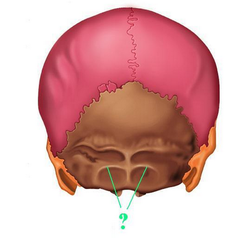
bones involved in back muscle attachments: occipital bone
Bone that protrudes at the base of the skull
occiput = back of skull
*do not need to know this latin term*
external occipital protuberance
Bump in the back of the head on occipital bone
origin for trapezius

superior nuchal line
runs horizontally from external occipital protuberance
splenius capitis muscle, the trapezius muscle, and the occipitalis attaches here (not too sure if we need to know this)

inferior nuchal line
occipital bone
obliquus capitis superior muscle, rectus capitis posterior major muscle, and rectus capitis posterior minor muscle. attaches here (not too sure if we need to know this)
bones involved in back muscle attachments: vertebrae
cervical, thoracic, lumbar
the spine or spinous process is a single posterior projection from the junction of the two laminae
the transverse process is a lateral projection from the junction of a pedicle and a lamina. It is paired.
bones involved in back muscle attachments: sacrum
os = bone
sacer = sacred (part of animals that were offered in sacrifices)
*do not need to know this latin term*

bones involved in back muscle attachments: hip bone
iliac crest
iliacus = flank, side, entrails
crest= creste, to come over the top of
*do not need to know this latin term*

bones involved in back muscle attachments: clavicle
clavicula = small key, bolt
*do not need to know this latin term*
medially articulates with sternum
laterally articulates with scapula

bones involved in back muscle attachments: scapula
acromion ledge that overlies the shoulder joint
scapular spine is prominent ridge continuous laterally with acromion. Posterior surface is its crest, the edges of which are the upper lip and lower lip
medial border parallels the vertebral column
scapula= shoulder, shoulder blade
*do not need to know this latin term*

acromion
Outward extension of the shoulder blade forming the point of the shoulder.
akro = highest topmost
omos=shoulder
*do not need to know this latin term*

scapular spine
ridge that crosses the posterior surface of the scapular body before ending at the medial border
spina= thorn, prickle
*do not need to know this latin term*

medial border of scapula
parallels the vertebral column

coracoid process of scapula
not needed for insertion of back muscles
coracoid means crows feet and this appears to look like a crows feet

inferior angle of scapula
bottom point of scapula

bones involved in back muscle attachments: humerus
an intertubercular groove is found between the greater tubercle and lesser tubercule
umerus = bone of upper arm
intertubercular (inter=between, tuberculum = small swelling lump)
*do not need to know this latin term*

tubercle
small rounded projection
intertubercular groove/sulcus
bicipital groove; narrow groove located between the greater and lesser tubercles of the humerus

superficial muscles of the back
1.trapezius,
2.latissimus dorsi,
3.rhomboid major,
4.rhomboid minor,
5.levator scapulae

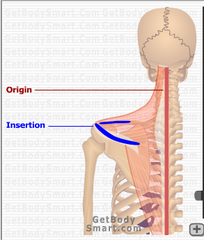
trapezius: origin
posterior skull (occipital bone)
spinous processes of all cervical vertebrae via ligament (ligamentum nuchae)
spinous process of all thoracic vertebrae

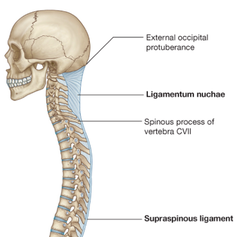
ligamentum nuchae
where trapezius origin is
ligamentum = band, tie
nuchae- nucha= pertaining to spinal cord
*do not need to know this latin term*

trapezius: insertion
Spine of scapula
Acromion
Clavicle (lateral third)
SAC
embraces the origin of the deltoid
trapezius: action
upward rotation of the scapula in which the inferior angle moves laterally
elevation of the scapula and lateral clavicle (upper fibers)
depression of the scapula and lateral clavicle
upward rotation of scapula
trapezius action

elevation AND depression of the scapula and later clavicle
trapezius action

trapezius: innervation
CN XI (cranial nerve 11) accessory nerve
ventral rami of c3 and c4
*one of the 12 cranial nerves
trapezius: SUMMARY
trapezion= irregular quadrilateral
*do not need to know this latin term*

latissimus dorsi: origin
lower 3 or 4 ribs
spinous processes of lower 6 thoracic vertebrae
spinous process of lumbar and sacral vertebrae via aponeurosis
iliac crest

aponeurosis
A broad, flat tendon
latissimus dorsi: insertion
intertubercular groove/sulcus of humerus

latissimus dorsi: action
ADduction of the arm at shoulder joint
extension of the arm at shoulder joint
medial rotation of arm at shoulder joint
adduction of arm at shoulder
latissimus dorsi action

extension of arm at shoulder
latissimus dorsi action

medial rotation at shoulder joint
latissimus dosri action

latissimus dorsi: innervation
thoracodorsal nerve
latissimus dorsi: summary
latus = wide
dorsi = back
*do not need to know this latin term*

under the trapezius is 3 more superficial back muscles
levator scapulae
rhomboid minor
rhomboid major
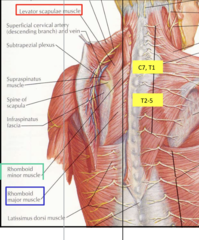
levator scapulae: origin
transverse processes of CV1-CV4

levator scapulae: insertion
medial border of scapula superior to the scapular spine

levator scapulae: action
elevates scapula

elevation of scapula
trapezius, levator scapulae

levator scapulae: innervation
ventral rami of C3 and C4
levator scapulae: summary
levatus = to raise
scapulae = shoulders, shoulder blades
*do not need to know this latin term*

rhomboid minor: origin
spinous processes of CV7-TV1

rhomboid minor: insertion
medial border of scapula at the scapular spine

rhomboid minor: action
ADducts scapula
adduction of scapula
trapezius, rhomboid major, rhomboid minor

rhomboid minor: innervation
dorsal scapular nerve

rhomboid minor: summary
rhombos = rhombus
oeides = form

rhomboid major: origin
spinous processes of TV2-TV5

rhomboid major: insertion
medial border of scapula inferior to the scapular spine

rhomboid major: action
ADduction of scapula

rhomboid major: innervation
dorsal scapular nerve

rhomboid major: summary

Summary of superficial back muscles

levator scapulae, rhomboid minor and rhomboid major relative to the spine of scapula
levator scapulae inserts into medial border ABOVE spine (purple)
rhomboid major inserts into medial border AT spine (blue)
rhomboid major inserts at medial border BELOW spine (green)

muscles of the deep back `
1. erector spinae (sacrospinalis)
a. spinalis
b. longissimus
c. iliocostalis
2. splenius
a. splenius capitis
b. splenius cervicis
3. Transversospinal group
a. semispinalis (semispinalis capitis, semispinalis cervicis, semispinalis thoracis)
b. Multifidus
c. Rotatores (rotatores longus and rotatores brevis)
4. Suboccipital muscles
a. Rectus capitis posterior major
b. Rectus capitis posterior minor
c. obliquus capitis inferior
d. obliquus capitis superior
erector spinae (sacrospinalis)
1. three longitudinally coursing muscles, largest muscular mass of the back
2. above the 12th rib it separates into 3 muscles from lateral to medial
-iliocostalis
-longissimus
-spinalis
3. important postural muscle that holds spine erect by extending vertebral column
4. innervation is segmental form of dorsal rami
erectus = upright
*do not need to know this latin term*

3 columns of erector spinae
from lateral to medial
iliocostalis
Longissimus
Spinalis
how to remember
i
Love
Spaghetti

spinalis
most medial of erector spinae
centimeter wide along the spinous processes, 1cm from the spine
spinalis = pertaining to a thorn or spine
*do not need to know this latin term*

longissimus [long-jis-e-miss]
intermediate erector spinae
extends all the way to skull (inserts into skull)
longest column
lang= that extends considerably from end to end
*do not need to know this latin term*
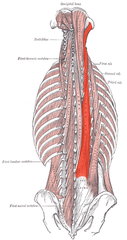
Iliocostalis
most lateral of erector spinae
ilio= origin at iliac crest
costal = insertion at ribs
extending from ilium to ribs

splenius
1. deep back muscle located in the neck
2. two parts
-splenius capitis
-spenius cervicis
-the two parts are continous at their origin, separable only at their insertion
3. when one side acts, the head and cervical column rotate toward that same side; when both act together the head and cervical column extend (looking up)
4. Innervation is segmental form of dosal rami
5. Action: extension of the neck (don't need to know this)
splenius means bandage
*do not need to know this latin term*

ligamentum nuchae
an elastic ligament that connects the vertebrae of the neck to the skull
splenius inserts into this
splenius capitis
upper, attaches to the skull
origin at ligamentum nuchae and CV7-TV4 and inserts into the skull
capitis = of the head
*do not need to know this latin term*

splenius cervicis
lower
origin at TV3 to TV6 and inserts at CV1-CV3
cervix = neck
*do not need to know this latin term*

dorsal rami and intercostal level
each intercostal level a dorsal ramus will come out and head on out to supply the muscles
transversospinal group
semispinalis, multifidus, rotatores
all muscles origin from transverse process and insert into a spinous process of a certain vertebrae above it
transversus = lying across
spinalis = pertaining to the spine
*do not need to know this latin term*

semispinalis
course 4-6 vertebrae
deep back muscle that occupies upper half of vertebral column
3 parts: semispinalis capitis, semispinalis cervicis, semispinalis thoracis
innervation is segmental from the dorsal rami

semispinalis capitis
aka biventer cervicis (tendinous band near neck creates two bellies of muscle)
extends the head and rotates toward the same side
insert into skull
capitis means head

semispinalis cervicis
deep to semispinalis capitis (cant see it)
works with semispinalis thoracis to rotate vertebrae toward the oppsite side
cervicis = neck
*do not need to know this latin term*

semispinalis thoracis
inferior to semispinalis capitis in thoracic region
works with semispinalis cervicis to rotate vertebrae toward the opposite side
semi = half
spinalis = pertaining to spine
*do not need to know this latin term*

Multifidus (plural: multifidi)
courses 2-4 vertebral segments
deep back muscles that are most developed in the lumbar region deep to erector spinae
rotate vertebral column toward the opposite side (opposite side rotation)
innervation is segmental from the dorsal rami
does not have attachment to the head
multi = many
-fidus = split
*do not need to know this latin term*

Opposite side rotation
rotation away from the contracting muscle
Rotatores
courses 1-2 vertebral segments
deep back muscles best developed in the thoracic region deep to semispinalis thoracis
lie directly on the laminae in the groove between the spines and the transverse processes
deepest back muscle
two types:
1.rotatores longus
2. rotatores brevis
they rotate the vertebral colum toward the opposite side
innervation is segmental from the dorsi rami
rotare= turn
*do not need to know this latin term*

rotatores longus
crosses 2 vertebrae
longi= long
*do not need to know this latin term*

rotatores brevis
This muscle spans 1 spinal segment
brevis = short, little, low
*do not need to know this latin term*

transversospinal muscles summary chart

suboccipital muscles
deep in the neck
Rectus capitis posterior major (not in the triangle)
Rectus capitis posterior minor (triangle)
Obliquus capitis inferior (triangle)
Obliquus capitis superior (triangle)
sub = below
occiput = back of skull
*do not need to know this latin term*
dont worry about origin or insertion, just names and region

Rectus Capitis Posterior Major
part of triangle
A
rectus= straight
*do not need to know this latin term*

Rectus Capitis Posterior Minor
NOT part of triangle
B
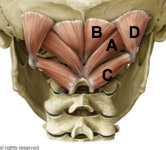
Obliquus capitis inferior
part of triangle
C

Obliquus capitis superior
part of triangle
D
