Business driven first midterm
 Call Kai
 Learn
Learn Practice Test
 Spaced Repetition
 Match
Match Flashcards
 Knowt Play
1/63

There's no tags or description
Looks like no tags are added yet.
Name | Mastery | Learn | Test | Matching | Spaced | Call with Kai | Chat |
|---|
No analytics yet
Send a link to your students to track their progress
64 Terms
What is Customer Relationship Management (CRM)?
An enterprise system designed to manage customer interactions, enhance customer experiences, and build long-term customer relationships.
In the DIKW framework, how is connectedness defined?
The requirement of connecting raw data elements together to provide context and meaning, turning data into information.
What touchpoint activities typically drive the 'Awareness' phase in the Customer Lifecycle?
Social media ads, email marketing, search engines, public relations (PR), radio/TV, print ads, outdoor ads, and word-of-mouth.
What are four typical management tasks performed at the Tactical/Management Level of Information Systems?
Sales Region Analysis
Inventory Control
Production Scheduling
Annual Budgeting
What are the two primary categories of software in an Information System?
Systems software and Application software.
What happened to lead qualification time and sales cycle length after deploying the CRM hubs in the case study?
Lead qualification time was reduced, and the overall sales cycle length was significantly shortened.
What are the four systemic cognitive actions on the right side of the DIKW pyramid?
Researching & Absorbing (Data)
Doing (Information)
Interacting (Knowledge)
Reflecting (Wisdom)
What is the primary function of a Collaborative CRM?
It connects front-end departments and external partners to share customer data and enhance multi-channel customer interactions.

Examine the DIKW structural transitions below:
What structural transition occurs between Data and Information on the DIKW pyramid?
Transitioning from 'Gathering of Parts' (Data) to 'Connection of Parts' (Information).
What is an Information System (IS)?
An organized combination of hardware, software, infrastructure, data, and people used to accomplish a specified organizational or personal objective.
How does the Hierarchical Perspective view Enterprise Systems?
It evaluates systems based on how they meet the distinct decision-making needs of specific management levels (Strategic, Tactical, Operational).
What is master and reference data?
Shared, non-transactional data used across multiple enterprise applications, such as customer profiles, product items, store locations, countries, and charts of accounts.
How do context and time orientation shift as one ascends the DIKW hierarchy?
Context increases with each higher level, transitioning the temporal perspective from past-oriented facts (Data/Information) to future-oriented understanding (Knowledge/Wisdom).
In the DIKW framework, how does usefulness transform information into knowledge?
When information is interpreted, applied, and acted upon, it becomes useful and manifests as knowledge.
What is SWIFT, and what category of Information System does it represent?
SWIFT (Society for Worldwide Interbank Financial Telecommunication) is a Global Information System operating across national boundaries for financial transactions.
What is an Interorganizational System (IOS)?
An information system that spans organizational boundaries to link companies with their external suppliers, partners, and customers.
What is the primary function of an Operational CRM?
It streamlines day-to-day marketing, sales, customer service, and field service operations to improve operational efficiency.
What is the general definition of a system?
A set of interacting, interrelated components working together as a complex, integrated whole to achieve a specific goal by processing inputs to produce outputs.
What are the three primary strategic goals of a Customer Relationship Management (CRM) system?
Manage multiple interaction channels with customers
Provide a unified view of each customer across the enterprise
Analyze customer information to drive strategy
Self-service ordering kiosks in fast-food restaurants are an example of which type of Information System?
Transaction Processing System (TPS).

Examine the logical architecture diagram below:
Which customer touchpoints feed data directly into Operational CRM systems?
Call Centre, E-mail, Web Access, Usage monitoring, and Direct Sales.
What touchpoint activities occur during the 'Advocacy' phase of the Customer Lifecycle?
Forums, social media mentions, customer surveys, reviews, and testimonials.
What key CRM capability enabled sales representatives to dramatically sharpen their deal strategies in the case study?
Automated workflows and pipeline visualization that focused reps on high-quality leads instead of low-quality prospects.
What are four typical business tasks performed at the Strategic Level of Information Systems?
5-Year Sales Trend Forecasting
5-Year Operating Planning
Profit Planning
Personnel Planning
How did deal close ratio improve in the sales process overhaul case study after implementing CRM?
The deal close ratio improved from 1 in 50 before CRM to 1 in 7 after CRM implementation.
What core functions are integrated into Enterprise Resource Planning (ERP) modules?
CRM, HRMS, Manufacturing, Sales, Purchasing, Accounting, and Inventory Management.
What key characteristics define Strategic Information Systems?
They serve general/top management, operate on long-term time horizons, are externally focused, and address highly unstructured decisions.
What is Supply Chain Management (SCM)?
An enterprise system that optimizes operations across the supply chain to ensure products are procured, manufactured, and delivered quickly and cost-effectively.
What is a primary organizational consequence of poor information literacy?
It leads to information asymmetries across stakeholders and decision-makers.
In CRM architecture, which underlying business databases feed into Integrated Databases for Business Intelligence analysis?
Billing, Provisioning, Sales, and Accounts databases.

Examine the IS Pyramid below:
Which two types of Information Systems belong to the Management Level of the pyramid?
Management Information Systems (MIS) and Decision-Support Systems (DSS).
What key characteristics define Operational Information Systems?
They serve operations management and front-line employees, operate on short-term time horizons, handle highly structured processes, and are transaction-focused.
What four levels make up the DIKW pyramid hierarchy?
Data, Information, Knowledge, and Wisdom (from base to apex).
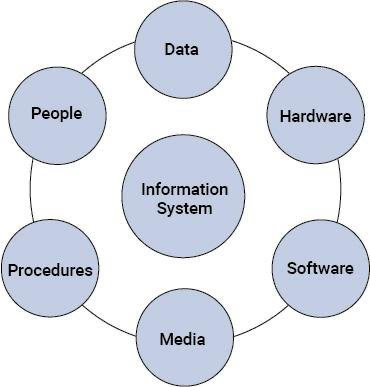
Examine the Information System elements below:
Which six core elements surround and constitute an Information System?
Data
Hardware
Software
Media
Procedures
People
What defines an Integrated Enterprise System?
An enterprise-wide system that connects and impacts multiple functional areas simultaneously.
In enterprise data categories, what constitutes document data?
Structured and unstructured files such as drawings, memos, presentations, spreadsheets, and word processing documents.
What type of system sits at the top (Strategic Level) of the Information Systems pyramid?
Executive Support Systems (ESS).
In the functional perspective, what is an HRIS?
Human Resource Information System, designed specifically to support HR processes such as recordkeeping, benefits, and payroll.
What is an On-premise CRM?
A CRM system acquired, leased, or developed by an organization and hosted locally on its own servers.
What is Information Technology (IT)?
The hardware, software, and media used to store, organize, retrieve, and communicate information.
What is On-demand CRM (SaaS CRM)?
A cloud-based CRM solution accessed remotely over the Internet from a third-party service provider.
What are the five consecutive stages of the Customer Lifecycle?
Awareness
Consideration
Purchase
Loyalty
Advocacy
What key characteristics define Tactical Information Systems?
They serve middle management, operate on mid-term time horizons, deal with semi-structured decisions, and handle recurrent tasks.
In enterprise data classification, what is transactional data?
Operational business data generated by day-to-day business transactions within operational applications and data storage systems.
In the functional perspective, what is an AIS?
Accounting Information System, designed to collect, store, and process financial and accounting data.
What constitutes content data in enterprise data classification?
Communication assets like messages, emails, web data, images, audio, and video streams that can be integrated with other information assets.
What is reporting data in an enterprise context?
Original and processed data stored in reporting data systems used for analysis, business intelligence, and reporting.
What are the three main analytical perspectives used to study Enterprise Information Systems?
Hierarchical Perspective
Functional Perspective
Process Perspective
How does the Functional Perspective view Enterprise Systems?
It categorizes systems by the specific business department or functional area they support (e.g., HR, Finance, Marketing).
What is the primary function of an Analytical CRM?
It collects and analyzes customer data to enhance business decisions, customer satisfaction, and profitability outcomes.
What is metadata?
Data about data, describing its meaning, business context, structure, format, coding, flow, and storage location.
How does the Process Perspective view Enterprise Systems?
It focuses on supporting cross-functional business processes end-to-end rather than isolated departments.
What are the key advantages and trade-offs of On-premise CRM deployment?
It offers high customization and control, but involves high upfront costs and ongoing maintenance expenses.
What are the main operational benefits of On-demand (SaaS) CRM solutions?
Lower upfront capital costs, automatic updates, reduced local maintenance overhead, and rapid deployment.
In general systems theory, what is equifinality?
The concept that a system can reach the same final outcome through many different potential paths or methods.
What is information literacy?
The ability to recognize when information is needed and to locate, evaluate, and effectively use that information.
What is the primary goal of Strategic CRM?
It shapes and enhances a core customer-centric business strategy to optimize customer retention and long-term business outcomes.
How does data-driven sustainability benefit enterprise operations?
It enables enterprise leaders to enhance customer service, lower energy consumption/carbon emissions, conserve resources by minimizing waste, and measure sustainability performance.
What are four common operational tasks handled by Transaction Processing Systems (TPS)?
Order Processing
Material Movement Control
Payroll / Accounts Payable
Employee Recordkeeping
How does an Information System (IS) differ fundamentally from Information Technology (IT)?
IT refers to the technology components alone (hardware, software, media), whereas an IS integrates technology with data, people, and business processes.
What is a Transaction Processing System (TPS)?
An information system that collects, monitors, processes, and stores large volumes of transaction data generated by routine business processes.
What are Functional and Management Information Systems?
Systems focused on specific functional departments within an organization, such as sales force automation, financial management, or human resources administration.
What are the four recognized types of CRM systems?
Collaborative CRM
Operational CRM
Analytical CRM
Strategic CRM
What is the difference between informational metadata and operational/administrative metadata?
Informational metadata explains what data means in a business context, while operational/administrative metadata specifies technical structure, formatting, data flows, and storage locations.