BIOL 220: CH. 2 - THE CHEMISTRY OF LIFE
 Call Kai
 Learn
Learn Practice Test
 Spaced Repetition
 Match
Match Flashcards
 Knowt Play
1/165

There's no tags or description
Looks like no tags are added yet.
Name | Mastery | Learn | Test | Matching | Spaced | Call with Kai | Chat |
|---|
No analytics yet
Send a link to your students to track their progress
166 Terms
There are how many naturally-occurring chemical elements?
91.
How many chemical elements have physiological roles?
24.
What chemical elements make up 98.5% of body weight?
Oxygen
Carbon
Hydrogen
Nitrogen
Calcium
Phosphorus
What are the top 4 chemical elements?
Carbon
Hydrogen
Nitrogen
Oxygen
96% of an organism’s mass
99% of the atoms
Radically different from
that of the Earth’s crust
Hydrogen makes up what percentage of the atoms in the human body?
~ 63% of the atoms in the human body, but 10% of the mass.
Oxygen is?
65% of the mass, but 24% of the atoms in a human body.
Minerals are?
Inorganic.
Lack Carbon & C-H bonds
What are elements that are minerals?
Calcium
Phosphorus
Magnesium
Potassium
Sodium
Sulfur
Minerals are extracted from?
Soil by plants.
Minerals are important for?
Enzyme structure and function.
Electrolytes
Mineral salts needed for muscle and nerve function.
Ca2+
Mg2+
K+
Na+
Cl-
Ion
An atom or molecule that has gained or lost one or more electrons.
Cations
Have a net positive charge (+).
Anions
Have a net negative charge (−).
Ionic bonds are?
Electrostatic attractions between cations and anions.
Na+ + Cl- —> NaCl
Ionic compounds are called?
Salts.
Example: NaCl, KCl, CaCl2
Ionic bonds break in?
Water and separate into ions, which gives hydration spheres.
Ionic bonds are?
Weak in water —> ionize in water —> hydration spheres
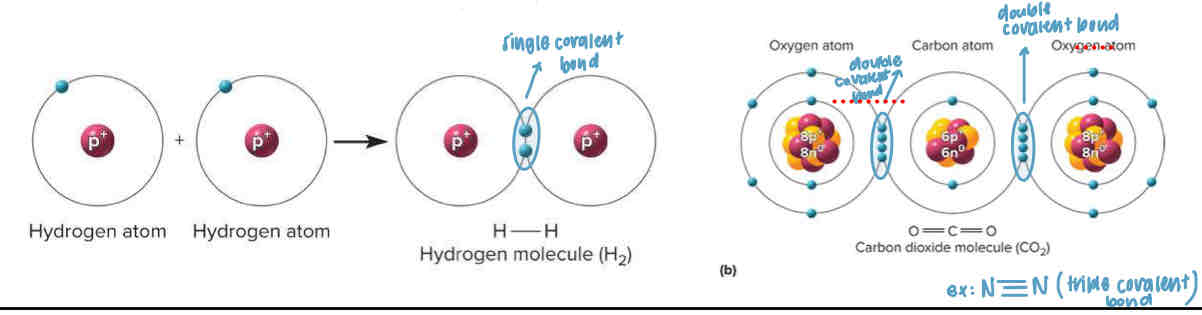
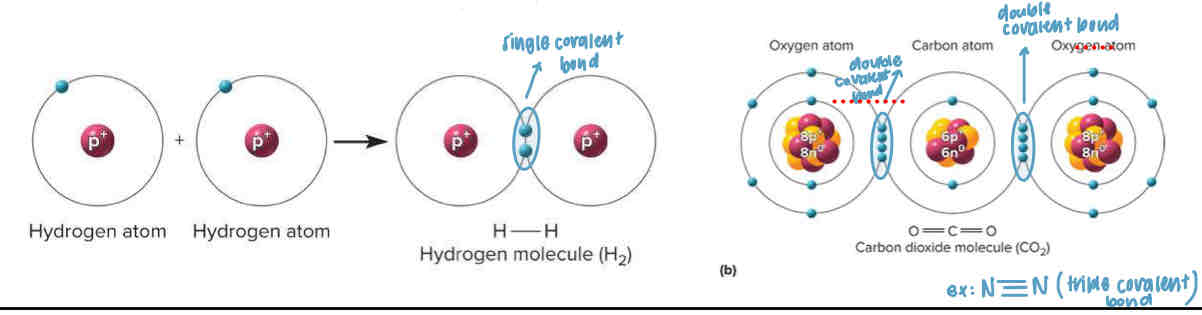
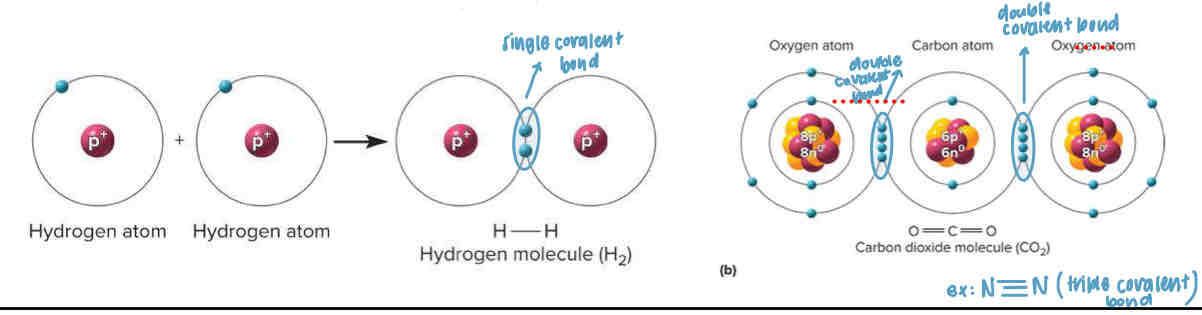
Covalent bonds
Sharing (not transfer) of electrons —> molecules.
Can have single to triple covalent bonds.
Based on # of shared electron pairs.
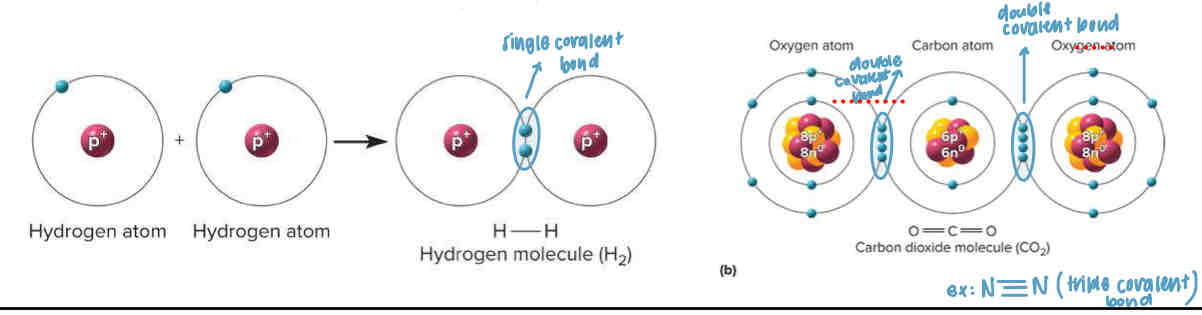
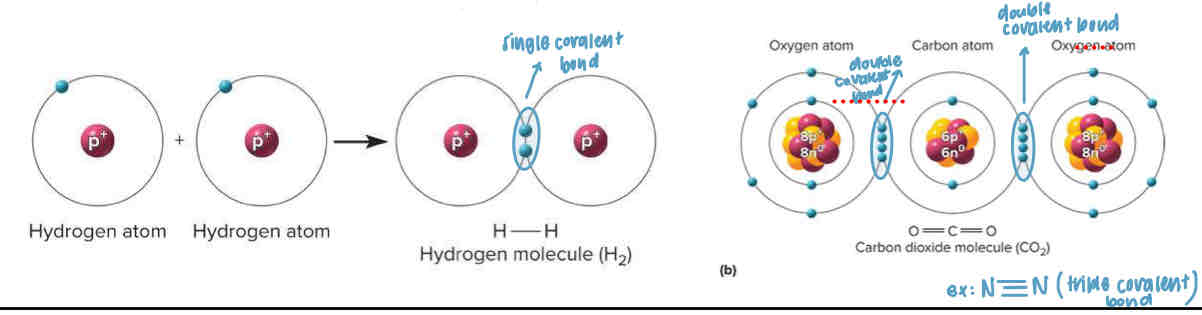
Covalent bonds do what?
Create molecules.
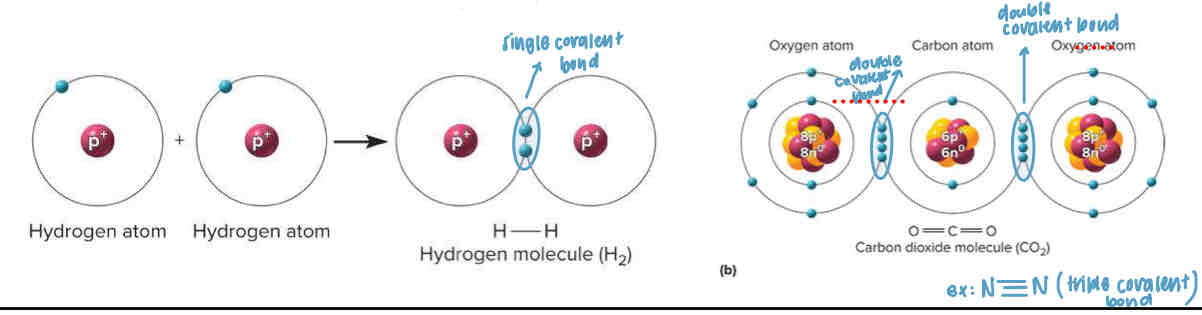
Filing the outer electron shell leads to?
The molecule becoming more stable.
Nonpolar covalent bond
Atoms have similar electron affinity.
Polar covalent bond
Atoms have dissimilar electron affinity which leads to partial charges.
What are the types of covalent bonds?
Single bond
Double bond
Single bonds
Allows rotation, bending.
Allows for changes in shape.
Double bonds
Shorter and stronger.
More rigid.
Less flexible.
Hydrogen bonds
Attraction between slightly positive (+) Hydrogen and negative (–) Oxygen or Nitrogen charges.
Hydrogen bonds are?
Individually weak, but if there’s a ton of hydrogen bonds they’re strong.
Where are hydrogen bonds used?
Water.
DNA.
Proteins.
Which type(s) of chemical bonds create molecules?
Covalent bonds.
What is the strongest of all chemical bond types?
Covalent bonds.
What types of bonds within and between atoms of water?
Hydrogen bonds.
Single polar covalent bonds.
Mixture
Blended but not chemically combined, and each substance maintains its own chemical properties.
What is an example of mixtures?
Body fluids.
What is percentage of body weight is water?
50% - 75%, and it depends on your age, sex, fat content, etc.
What is water?
A polar molecule.
Water has?
Polar covalent molecules.
What is a property of water?
It has the ability to support life.
Water is a?
Universal solvent meaning it dissolves molecules that have polar covalent bonds.
Dissolves hydrophilic substances/molecules.
Water is important for?
Metabolism.
Hydrolysis reactions.
Dehydration reactions.
Water has adhesional properties meaning?
It can cling to membranes.
It reduces friction around organs.
Solute
Particles mixed within solvent.
Can be gas, solid, liquid.
Solution
Particles under 1 nm.
Do not scatter light.
Pass through most membranes.
Will not separate on standing.
What is an example of a solution?
Sugar in water.
Colloids
Mixtures of protein and water.
Can convert to gel state.
Particles 1-100 nm.
Scatter light, usually cloudy.
Particles can’t pass through membrane.
Particles remain permanently mixed when
standing.
What are some examples of colloids?
Milk.
Albumin in blood.
Suspension
Usually large particles.
Particles > 100 nm.
Can’t pass through membranes.
Cloudy – opaque.
Separates on standing.
What is an example of a suspension?
RBCs in blood.
Emulsion
Liquid within another liquid.
What is an example of an emulsion?
Oil in water.
Fat in breast milk.
Acids
Donates proton (H+ ions in water).
Bases
Proton acceptor.
Can release OH- (hydroxide ions).
pH
Molarity of H+ (log scale).
7.0 pH is?
Neutral (H+ = OH-).
A pH of less than 7.0 is?
Acidic (H+ > OH-).
Has more hydroxide ions.
A pH of more than 7.0 is?
Basic (H+ < OH-).
Has less hydroxide ions.
Buffers help to?
Maintain a constant pH.
An acid-base buffer system can?
Shift to generate or release H+ to adjust for changes in pH.
An acid-base buffer system contains?
A weak acid and its corresponding base.
What is an example of an acid-base buffer system?
Carbonic acid is a buffer that contributes to pH stability in human blood.
H2CO3 (H+ donor: acid) ⇌ (response to a rise or drop in pH) HCO3-(H+ acceptor: base) + H+ (hydrogen ion).
Hydrolysis
Uses water to break bonds.
“water and unbind”
Dehydration synthesis
Forms large macromolecules.
Removes water to form bonds.
Opposite of hydrolysis (adding water)
Each carbon atom can form covalent bonds with up to?
Four atoms.
Organic compounds contain?
Carbon bound to hydrogen and possibly other elements.
Methane
The simplest of all organic molecules.
Chemical groups
Atoms or clusters of atoms that are covalently bonded to carbon backbone.
Chemical groups give?
Organic compounds their different properties.
Each type of functional group exhibits?
The same properties in all molecules in which it occurs.
Amino (-NH2)
Found in amino acids (proteins).
Weakly basic (can accept H+)
Polar
Forms part of peptide bonds
Carboxyl (-COOH)
Found in amino acids, fatty acids.
Acidic (gives up H+ in water)
Forms part of peptide bonds
Hydroxyl (-OH)
Found in steroids, alcohol, carbohydrates, some amino acids.
Used in dehydration and hydrolysis
Polar
Forms hydrogen bonds with water
Methyl (-CH3)
May be attached to DNA, proteins, and carbohydrates.
Nonpolar - cannot mix with H2O
Phosphate (-PO42-)
Found in sugar-phosphate backbone, nucleic acids, ATP, phospholipids.
Polar
Weakly acidic
Negatively charged at typical pH of living organisms
What are the four main families of small organic molecules synthesized in cells?
These are the small organix building blocks of the cell:
Sugars
Fatty acids
Amino acids
Nucleotides
What are the larger organic molecules (macromolecules) of the cell?
Polysaccharides, glycogen (in our bodies), and starch (in plants)
Fats and membrane lipids
Proteins (polypeptides)
Nucleic acids
Proteins are?
The most diverse structurally and functionally.
Nucleic acids are found in?
RNA and DNA.
Macromolecules are?
Abundant.
What makes their wide-ranging functions possible?
Each one is different from the other and can be linked differently.
Ex: 20 different amino acids
Sugars
Made up of Carbon, Hydrogen & Oxygen.
(CH2O)n
Sugars are?
Polar; can be mixed with water.
What are the functions of carbohydrates (sugar)?
Energy sources (can be broken down)
Structural materials
Signaling and recognition (important for cell to cell communication)
Monosaccharides are the simplest?
Carbohydrates (simple sugars).
Monosaccharides consist of?
Only one sugar molecule.
Monosaccharides are subunits of?
Macromolecules.
What are some examples of monosaccharides?
Glucose
Galactose
Mannose
What is the most abundant of all monosaccharides?
Glucose.
Disaccharides
Short chains of 2 monosaccharides linked covalently.
Disaccharides are formed by?
Condensation reactions, forming glycosidic (sugar) bonds covalently.
What are some examples of disaccharides?
Sucrose
Lactose
Polysaccharides
Polymers of many glucose units (multiple monosaccharides).
Polysaccharides are used for?
Long term energy storage.
What are some examples of polysaccharides?
Glycogen
Starch
Where is glycogen found?
Muscle cells
Cardiac cells
Skeletal
Liver
Starch is?
Glucose storage in plants.
Lipids
Nonpolar (no partial charges) hydrocarbons (C, H, and O).
Hydrocarbons
Have mostly C-C and C-H bonds.
Lipids are?
Hydrophobic - don’t dissolve in water.
Greasy to the touch
One example of lipids are?
Cholesterol.
What are some functions of lipids?
Major sources of energy (because of C-H bonds)
Structural materials
Used in cell membranes
Cell communication (hormones) (steroids)