Recursion(not finished) & Recursive Data Structures(deffo not finished) & Recurrence Relation (finished)
 Call Kai
 Learn
 Practice Test
 Spaced Repetition
 Match
 Flashcards
 Knowt Play
1/15

There's no tags or description
Looks like no tags are added yet.
16 Terms
What is recursion?
defining a function (or problem) in terms of itself
(solving a problem by solving a smaller version of the same problem)
What 2 things does every recursive definition need?
Base case
simplest input, answered directly, so the recursion stops
Recursive case
reduces the problem to a smaller version of itself
What is “divide and conquer”?
divide problem into smaller problems that are easier to solve
combine solutions of small problems = solution to big problem
Towers of Hanoi
3 stages
move top n-1 disks from start peg to spare peg
move largest disk froms start peg to destination peg
move n-1 disks from spare peg to destination peg
Recurrence relation:
two recursive calls: T(n-1)
one disk movement O(1)
therefore reccurrence relation: T(n) = 2T(n-1) + O(1)
recurrence produces exponential growth therefore time complexity is O(2^n)
What is the general structure of a recursive function

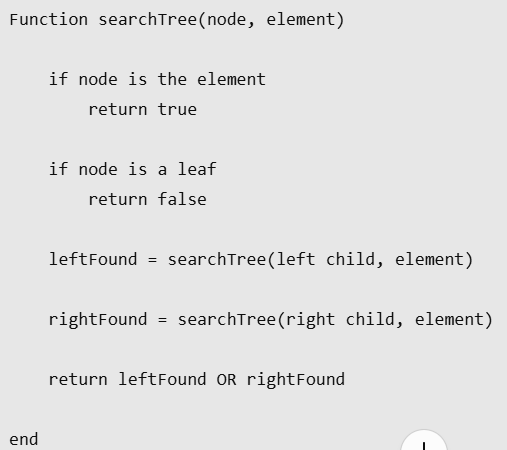
How would a binary tree search be written as a recursive function?
What is recurrence relation?
mathemetical equation
describes running time of a recursive algorithm in terms of the running time of its smaller recursive calls
tells us how much time an algorithm takes by looking at:
time taken by recursive calls
additional work performed outside those calls

In recurrence relation what is the additional work represented as in big O notation?
O(1) - constant time
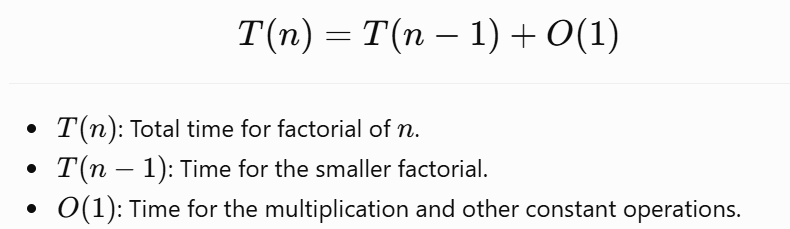
How would you calculate the recurrence relation for working out a factorial?
factorial algorithm performs:
one recursive call : factorial(n-1)
takes T(n-1)
one multiplication
takes O(1)
contstant amount of additional work
takes O(1)
therefore the running time is T(n) = O(n)
When looking at normal and efficicent exponentiation why is the efficient version better?
dividing the input by 2 reduces number of recursive calls mcuh faster than subtracting one each time
How do you derive the recurrence relation in an exam?
Count the recursive calls
how many times does the function call itself?
Identify size of each recursive input
look at how the input changes
does it decrease by 1 (n-1)? decrease by half (n/2)?
Calculate additional work
what happens outside recursive calls
e.g. O(1) when multiplication/comparison/loop through all n elements
Write recurrence
put recursive calls & additional work together