12 and 13 mix biol 1510 study
 Call Kai
 Learn
 Practice Test
 Spaced Repetition
 Match
 Flashcards
 Knowt Play
1/56

There's no tags or description
Looks like no tags are added yet.
57 Terms
Yellow (G) pea color is dominant over green (g). Round peas (R) are dominant over wrinkled (r). If two heterozygous individuals are crossed what are the possible offspring?
GgRr x GgRr
Meiosis produces sex cells with ___
Half the genetic information
Each sex cell must have an ___ for each trait
allele
DNA
the genetic material
Where does genetic diversity come from?
Meiosis
how many combinations of possible sex cells are there?
70 trillion
Chromosomes
in eukaryotes it consist of a single linear DNA molecule and associated proteins condenses, splits and ends up in daughter cells of both mitosis and meiosis, 23 pairs in humans
Genes
sections of DNA that code for a specific trait EX: tumor suppressor protein p53 gene, BRCA1, Env
Loci
the specific location of a gene on a chromosome
Gregor mendel
the “founder of genetics”, Austrian monk, used pea plants to understand genetics
Allele
alternate forms of a gene
Allele example: Dominant A
if present always expressed
Reccessive a
Must be present 2x to be expressed
AA
Homozygous dominant
aa
homozygous recessive
Aa
Heterozygous
Attached earlobes (E) is dominant over detached earlobes (e).
Johnny has detached earlobes. What two alleles does he have?
ee – homozygous recessive
Johnny has attached earlobes. What two allele combinations could he have?
Attached earlobes (E) is dominant over detached earlobes (e).
EE – homozygous dominant
Ee – heterozygous
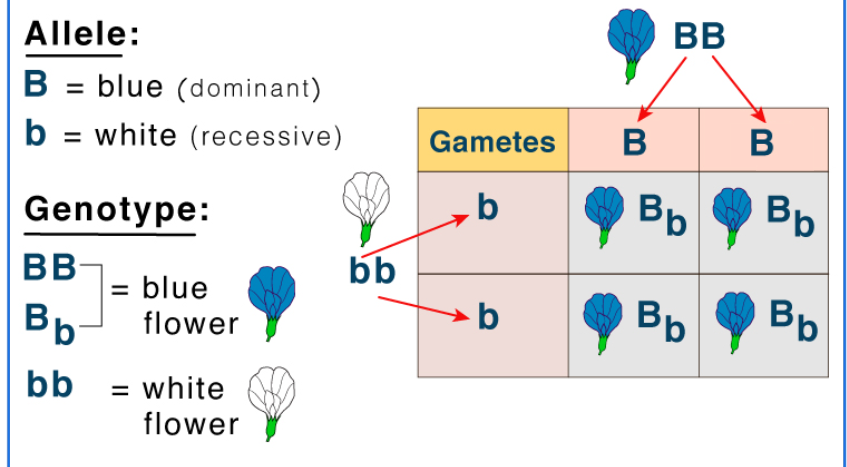
Monohybrid
1 trait
Dihybrid
two traits
Genotype
an organism’s genetic information (ex: BB homozygous, Bb heterozygous, bb homozygous recessive)
Phenotype
the set of observable physical traits (ex: purple, white)
Yellow (G) pea color is dominant over green (g). If a heterozygous individual and a homozygous dominant individual are crossed, what is the phenotypic ratio of the offspring?
Gg x GG
G & g and G & G

How many are green? how many are yellow?
Green - 0 , yellow 100%

Yellow (G) pea color is dominant over green (g). If a heterozygous individual and a homozygous dominant individual are crossed, what is the chance of producing a heterozygous offspring?
50% chance of a heterozygous off spring. (25% GG, 50% Gg, 25% gg)
Mendel’s 1st Law / Law of Segregation
For every trait there are two alleles and they separate during meiosis and recombine randomly during fertilization
What does a monohybrid cross consist of?
1 trait, 1 letter, 4 boxes

What does a dihybrid cross consist of?
2 traits, 2 letters, 16 boxes
Mendel’s 2nd Law / Law of Independent Assortment
During meiosis, the segregation of alleles for one gene does not influence the genes for another trait
Polygenic inhertiance
More than one gene can affect a single trait
Pleintropy
A single gene can affect more than one trait
Multiple alleles for one gene
Genes may have more than two alleles
Dominance not always complete
In incomplete dominance the heterozygote is intermediate, in codominance no single allele is dominant, and the heterozygote shows some aspect of both homozygotes
Environmental factors
genes may be affected by the environment
Gene interaction
Products of genes can interact to alter genetic ratios
Non-mendelian trait
characteristics whose inheritance does not follow Mendel’s laws of segregation and independent assortment, often involving mechanisms such as incomplete dominance, codominance, multiple alleles, polygenic inheritance, gene linkage, or extranuclear inheritance.
Polygenic traits
multiple genes affect 1 trait ( eye color, hair color, skin color)
Pleiotropy
one gene has multiple effects on the phenotype (ex: marfan syndrome, cystic fibrosis
Genes w/ more than 2 alleles
Each individual can only carry up to 2 alleles (due to only having 2 parents to contribute their DNA)
Incomplete dominance
genetic pattern in which a heterozygous organism shows an intermediate (blended) phenotype because neither allele fully masks the other, such as pink flowers resulting from red × white crosses in four‑o’clock plants.
Codominance
genetic pattern in which two different alleles of a gene are fully and simultaneously expressed, producing a phenotype that shows both traits at once, such as AB blood type or roan cattle.
Epistasis
genetic phenomenon where one gene (the epistatic gene) masks or modifies the phenotypic expression of another gene (the hypostatic gene), affecting traits in ways that cannot be predicted by simple Mendelian inheritance.
Human inhertiance on sex chromosomes
Chromosomal sex determination
Via 23rd pair of chromosomes
XX = female and XY = male
XX- females
2x as many x chromosomes
dosage compensation allows for equal level of expression
Inactivation of one of the X chromosomes early in embryonic development in females
Condenses the X chromosome
Known as a Barr body
Y chromosomes have
< 100 genes, very few linked disorders
X chromosomes have
More than 100 genes,
Duchenne muscular dystrophy
Mutant allele of gene encoding dystrophin
fragile x syndrome
unstable region of X chromosome has unusually high number of CCG repeats
Hemophilia A
mutant allelle of gene encoding blood-clotting protein (factor VIII)
Red- green color blindness
Mutant alleles of genes encoding receptors for red or green wavelengths of light
Rett syndrome
Mutant allele of gene encoding DNA-binding protein expressed in nerve cells

If colorblindness is the recessive trait and a woman who is heterozygous for the X linked gene associated with colorblindness marries a man who is color blind, what are the chances of their offspring being a son and colorblind?
25%
If hemophilia is recessive and a woman who is heterozygous for the X linked gene associated with hemophilia marries a man who is healthy, what are the chances of producing an offspring without hemophilia?
Healthy daughter / son > 75%
Pedigree
family tree used to study the inheritance of genes and traits
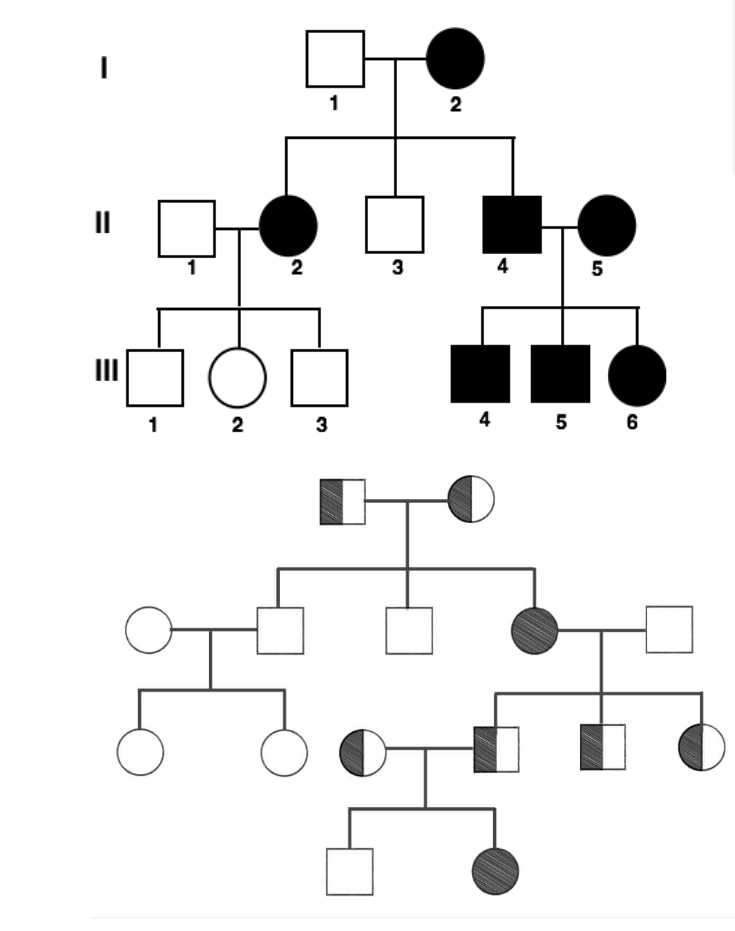
What do the colored or shaded shapes of a pedigree represent?
“affected” individual, half shaded box = carrier

Dominant pedigree
Typically affects every generation, always have a parent that is affected
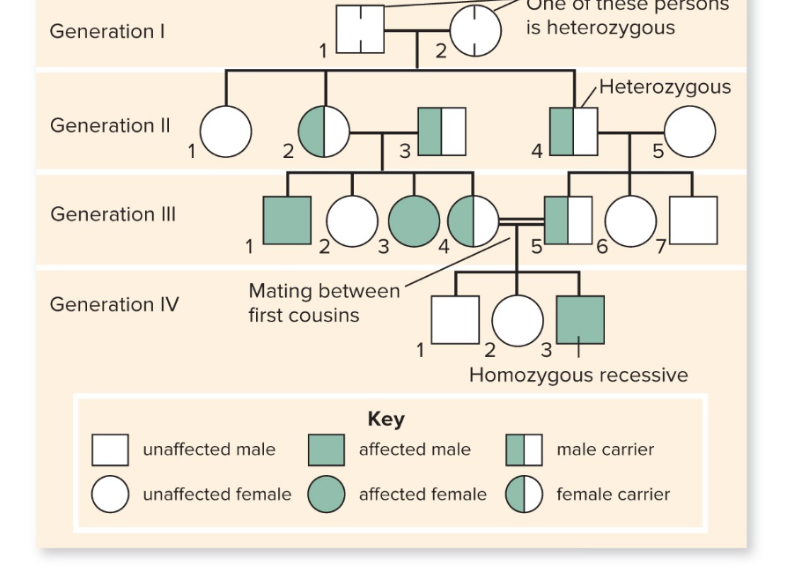
Recessive pedigree
affected individuals can resulkt from two unaffected parents,Two heterozygous parents, who are carriers, can produce a homozygous recessive individual