MLT 209 Mycology Identification
 Call Kai
 Learn
 Practice Test
 Spaced Repetition
 Match
 Flashcards
 Knowt Play
1/21

Earn XP
Description and Tags
Practice flashcards for identifying common clinically significant molds and yeasts in human disease based on patient history, geographic distribution, and microscopic morphology.
22 Terms
What is the primary objective of MLT 209 Mycology Identification, and in what patient population do the discussed molds and yeasts predominantly cause disease?
The objective is to identify common molds and yeasts causing disease in humans; these organisms are present in the environment and predominantly cause disease in persons who are immunocompromised.
A female patient presents with an itchy vaginal discharge after completing antibiotic therapy for an upper respiratory infection. What offending organism is responsible?
Candida albicans

Based on the microscopic image showing budding yeast cells and pseudohyphae from a patient with itchy vaginal discharge, what offending organism is identified?
Candida albicans

Which organism is identified by the positive germ tube test shown in this image?
Candida albicans
An India Ink test is performed on cerebrospinal fluid (CSF) from an HIV patient. What offending organism is identified?
Cryptococcus neoformans

What encapsulated organism is demonstrated in this India Ink preparation of cerebrospinal fluid (CSF) from an HIV patient?
Cryptococcus neoformans
What offending organism is responsible for a lower respiratory infection in an HIV patient whose specimen is evaluated via a sputum gram stain?
Pneumocystis jiroveci

What organism is shown in this microscopic preparation from an HIV patient presenting with a lower respiratory infection?
Pneumocystis jiroveci
What offending organism is identified from a respiratory specimen taken from a patient living in the California desert area?
Coccidioides immitis

What organism is identified by this large endospore-filled spherule observed in a respiratory specimen from a patient living in the California desert area?
Coccidioides immitis
A patient presents with an itchy scalp. What is the likely offending organism?
Malassezzi furfur

What organism causing an itchy scalp is shown in this microscopic preparation?
Malassezzi furfur
A patient living on a chicken farm in central Ohio develops a lung infection and becomes septic due to their illness. What is the offending organism?
Histoplasma capsulatum

What organism is shown inside host cells (indicated by the arrows) from a septic patient who lives on a chicken farm in central Ohio?
Histoplasma capsulatum

What organism produces the characteristic tuberculate macroconidia depicted in this lactophenol cotton blue mount?
Histoplasma capsulatum
Which organism is often confused with Histoplasma capsulatum, causes respiratory granuloma formation as well as skin infections, and is often encountered in the southeastern United States?
Blastomyces dermititis

What organism encountered in the southeastern United States that causes respiratory granulomas and skin infections is shown in this microscopic mount?
Blastomyces dermititis
Which organism caused pneumonia in a transplant patient and is prepared using a lactophenol cotton blue prep?
Aspergillus fumigatus

What organism is demonstrated in this lactophenol cotton blue prep from a transplant patient with pneumonia?
Aspergillus fumigatus

What offending species is this and what form is it in?
Blastomyces dermititis in mold form at RT or 30 degrees C
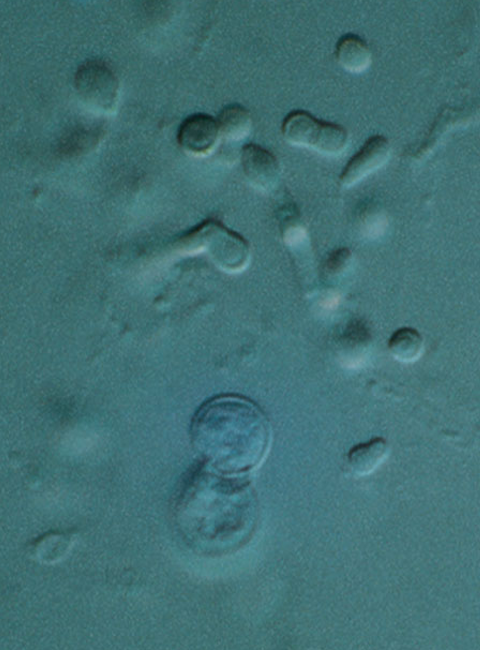
What offending species is this and what form is it in?
Blastomyces dermititis in yeast form at 37 degrees C

What offending species is this at Direct Examination?
Blastomyces dermititis