1.3 Collision Theory
 Call Kai
 Learn
 Practice Test
 Spaced Repetition
 Match
 Flashcards
 Knowt Play
1/13

There's no tags or description
Looks like no tags are added yet.
14 Terms
What does collision theory state?
Reaction rates depend upon:
the number of collisions per unit of time
the fraction of these collisions which succeds in producing products
How are collisions distributed?
Some particles move quickly, transferring a lot of energy
Others barely move and dont make the correct angle
How many molecules in a given sample can succesfully react and why?
Only a small percentage have enough kinetic energy to react
What is activation energy, or Ea?
The minimum kinetic energy a reactant species must have to react.
Why do the collisions between particles which have enough Ea result in a reaction?
Because the have enough kinetic energy to overcome:
-the repulsive forces of electron clouds and,
-they can weaken or break bonds.
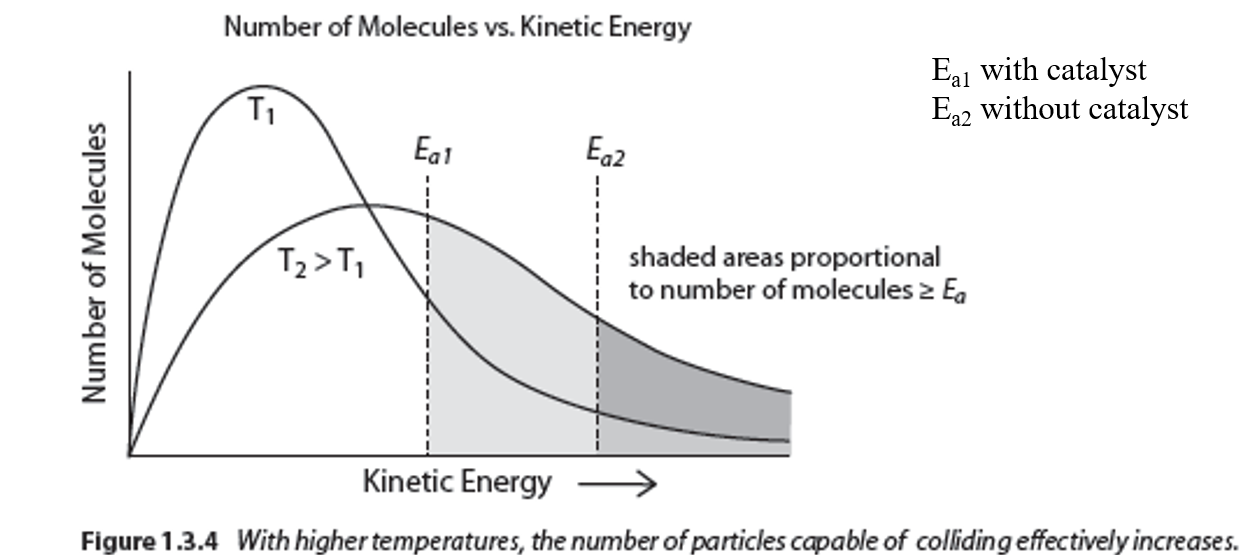
Explain the following graph.
The x axis represents kinetic energy, while the y axis represents the number of molecules. For the first reaction, it is at a lower temperature than the second reaction. This means that most of the particles will be gathered on the left side, representing little kinetic energy, and a small percentage of particles will surpass Ea2 on the right side.
For the second reaction, the temperature has been raised. This means that particles will now have more kinetic energy, meaning a larger percentage of particles are now surpassing Ea2 on the right side, creating a flatter look to the curve. This will result in more succesful collisions.
Going back to the first reaction with a lower temperature, we have now added a catalyst, which lowers the activation energy. Even though no energy has been added, with the activation energy threshold being lower, it means that a larger percentage of particles now surpass E2. This results in more successful collisions.
When both our temperature has been raised and a catalyst has been added, we have lowered our Ea threhold and given particle more energy. This means that most of the particles have sufficent energy to react, resulting in a higher number of succesful collisions.

In addition to activation energy, what is another requirement for a succesful collision to occur?
Correct geometry/orientation of particles
What factors only increase the FREQUENCY of collisions?
Increased Surface area
Increased Concentration
Increased Temperature
What factors increase both the FREQUENCY of collisions and the FRACTION OF COLLISIONS which are sucessful?
Addition of a catalyst
Temperature
True or false: Temperature can lower activation energy.
Trick q: False
True or false: a catalyst can lower the activation energy
True
What is the ONE and ONLY way activation energy can be decreased?
Through the addition of a catalyst
Give two examples of catalysts.
Enzymes in living things
allows reactions to take place at lower temps (37degrees)
Many different metal surfaces can act as catalysts
E.g paladium and platinum in catalytic converters (they speed up complete combustion of hydrocarbons)
Nickels speeds up the hydrogenation of unsaturated fats to make them solid
As reactant particles approach each other, what happens to the PE and KE and why?
KE decreases, PE increases
This is because as the reacting particles encounter the repulsive forces of electron clouds, they slow down. If kinetic energy decreases, it must be converted to potential energy, which increases as the reactants climb towards the activated complex.