Psych Exam Ch 9–12
 Call Kai
 Learn
 Practice Test
 Spaced Repetition
 Match
 Flashcards
 Knowt Play
1/229

There's no tags or description
Looks like no tags are added yet.
230 Terms
LIFESPAN DEVELOPMENT
Studies how you change as well as how you remain the same over the course of your life.
WHAT IS LIFESPAN DEVELOPMENT?
Developmental psychologists study lifelong development across three domains:
1. Physical development – growth and changes in the body and brain, senses, motor skills, and health and wellness.
2. Cognitive development – learning, attention, memory, language, thinking, reasoning and creativity.
3. Psychosocial development – emotions, personality and social relationships.
Physical development
growth and changes in the body and brain, senses, motor skills, and health and wellness.
Cognitive development
learning, attention, memory, language, thinking, reasoning and creativity.
Psychosocial development
emotions, personality and social relationships
What is “normal” development?”
Normative psychologists have studied large numbers of children to determine norms (average ages) of when most children reach specific developmental milestones (e.g. crawling, walking, speaking in sentences, starting puberty).
Biological milestones such as starting puberty are universal.
Social milestones such as starting school vary across cultures
Developmental psychologists have different views on the process of lifespan development:
Continuous development – views development as a cumulative process, gradually improving on existing skills.
E.g. Adding inches to height each year.
Discontinuous development – views development as occurring in unique stages (specific times or ages).
Continuous development
views development as a cumulative process, gradually improving on existing skills.
E.g. Adding inches to height each year.
Discontinuous development
views development as occurring in unique stages (specific times or ages).
Stage theories
believe that the process of development is universal.
Evidence for one course of development
Studies show that children from all around the world reach language milestones in a similar sequence
Evidence for many courses
Cultural differences in child care practices – different practices can accelerate or inhibit achievement of developmental milestones.
Nature vs. Nurture
Biology and genetics vs. environment and culture
Use twin and adoption studies
THEORIES OF DEVELOPMENT
PSYCHOSEXUAL THEORY
PYCHOSOCIAL THEORY
COGNITIVE THEORY
THEORY OF MORAL DEVELOPMENT
PSYCHOSEXUAL THEORY (Sigmund Freud)
Believed that childhood experiences shape our personalities and behavior as adults.
• Viewed development as discontinuous.
• Developed stages of psychosexual development.
• Believed lack of proper nurturance and parenting during a stage could lead to a child becoming stuck/fixated in that stage.
• Claimed that children’s pleasure-seeking urges are focused on different erogenous zones at each of the 5 stages of development.
1. Oral
2. Anal
3. Phallic
4. Latency
5. Genital
5 stages of development in PSYCHOSEXUAL THEORY
1. Oral - mouth (sucking/swallowing) *ego
2. Anal - anus (withholding or expelling feces)
3. Phallic - penis or clitoris (masturbation) *superego
4. Latency - No sexual motivation
5. Genital - penis or vagina (sex)
PSYCHOSOCIAL THEORY (Erik Erikson)
Emphasizes the social nature of development.
• Argues that personality development takes place across the lifespan, not just in childhood.
• Based on his belief that social interactions affect our sense of self (ego identity).
In each stage of Erikson’s theory, there is a psychosocial task that we must master in order to feel a sense of competence.
• 8 Stages.
ERIKSON’S PSYCHOSOCIAL STAGES OF DEVELOPMENT
Trust vs. mistrust (0-1) *basic needs, such as nourishment and affection, will be met.
Autonomy vs shame & doubt (1-3) *Develop a sense of independence in many tasks.
Initiative vs guilt (3-6) *Take initiative on some activities - may develop guilt when unsuccessful or boundaries overstepped.
Industry vs inferiority (7-11) *Develop self-confidence in abilities when competent or sense of inferiority when not.
Identity vs role confusion (12-18) *Experiment with and develop identity and roles.
Intimacy vs isolation (19-29) *Establish intimacy and relationships with others.
Generativity vs stagnation (30-64) *Contribute to society and be part of a family.
Integrity vs despair (65+) *Assess and make sense of life and meaning of contributions.

COGNITIVE THEORY (PIAGET)
Piaget
• Focused on children’s cognitive growth and theorized that cognitive abilities develop through specific stages.
• Piaget believed children develop schemata (concepts used to categorize and interpret information) to help
them understand the world.
• When children learn new information they adjust their schemata through assimilation and accommodation.
Assimilation
Incorporates information into existing schemata.
Accommodation
Change schemata based on new information.
PIAGET’S STAGES OF COGNITIVE DEVELOPMENT
Sensorimotor: World experienced through senses and actions. (0-2) *Object permanence + Stranger anxiety
Preoperational: Use words and images to represent things, but lack logical reasoning (2-6) *Pretend play Egocentrism + Language development
Concrete operational: Understand concrete events and analogies logically; perform arithmetical operations. (7-11) * Conversation + Mathematical transformations
Formal operational: Utilize abstract reasoning. (12+) *Abstract logic + Moral reasoning

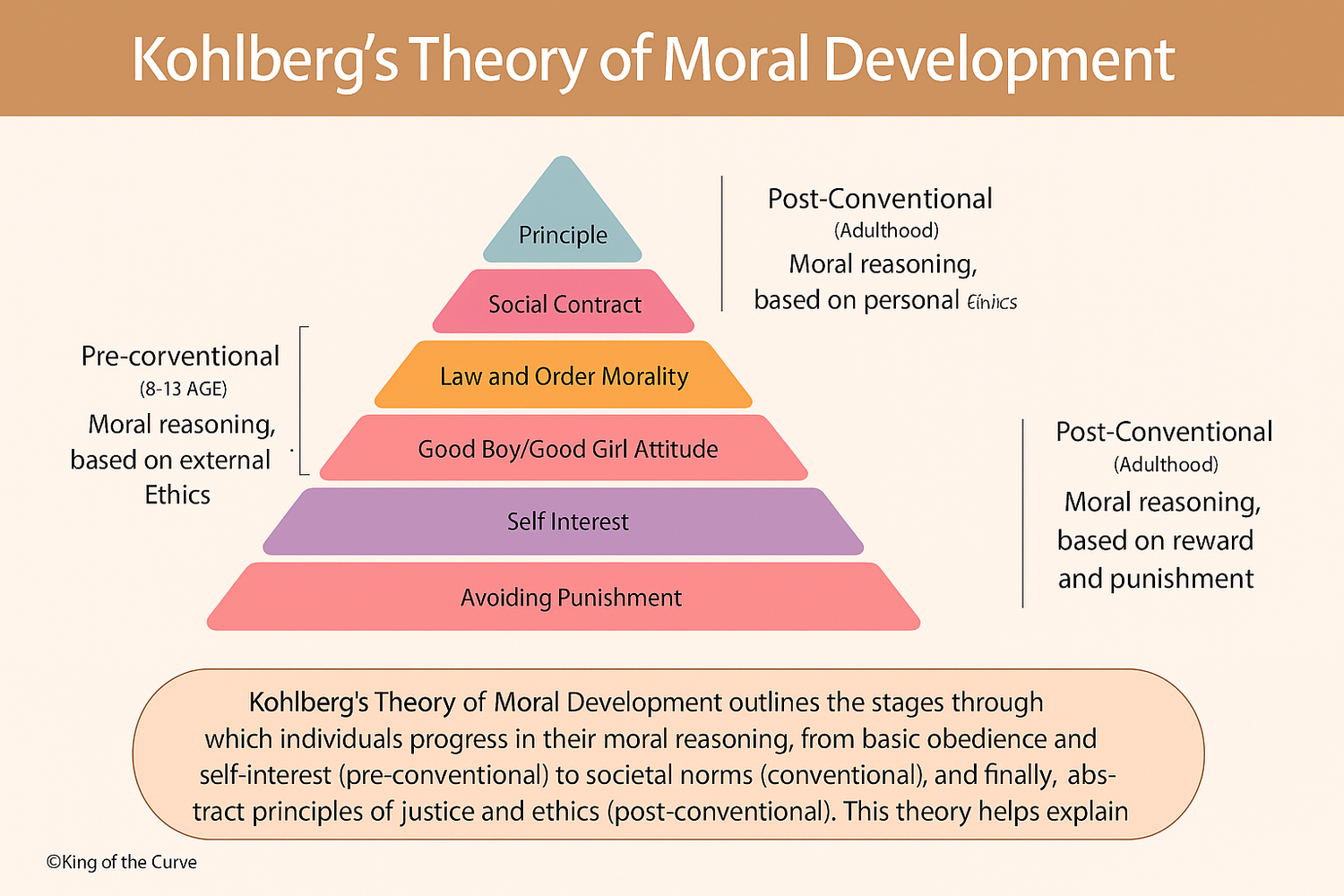
THEORY OF MORAL DEVELOPMENT (KOHLBERG)
Level 1: Pre-conversation morality
Stage 1: Behavior driven by avoiding punishment
Stage 2: Behavior driven by self interest and rewards
Level 2: Conventional morality
Stage 3: Behavior driven by social approval
Stage 4: Driven by authority and conforming
Level 3: Post-conventional morality
Stage 5: Driven by both social order and individual rights
Stage 6: Driven by internal moral principles
STAGES OF DEVELOPMENT
PRENATAL
INFANCY THROUGH CHILDHOOD
ADOLESCENCE
EMERGING ADULTHOOD
ADULTHOOD
PRENATAL DEVELOPMENT
Germinal Stage (Weeks 1-2)
Conception occurs when sperm fertilizes an egg and forms a zygote (one-cell structure).
Mitosis – process of cell division.
The zygote divides and cells become more specialized, forming organs and body parts.
Embryonic Stage (Weeks 3-8)
After the zygote has 150 cells it travels down the fallopian tubes and implants itself in the lining of the uterus.
The zygote is now an embryo (multi-cellular organism).
Organs begin to function (heart begins to beat).
Basic structures develop that will become the head, chest and abdomen.
Placenta – structure connected to the uterus that provides nourishment and oxygen from the mother to the embryo via the umbilical cord.
Fetal Stage (Weeks 9-40)
During the fetal stage, the baby's brain develops and the body adds size and weight, until the fetus reaches full-term development.
PRENATAL INFLUENCES
Genetic and environmental factors can affect development during each prenatal stage.
Teratogen – any environmental agent (biological, chemical, or physical) that causes damage to the developing embryo or fetus.
Alcohol – can cause fetal-alcohol syndrome.
Smoking – can result in premature birth, low- birth weight, stillbirths, sudden infant death syndrome.
Drugs – heroine, cocaine, methamphetamine as well as prescription drugs.
Radiation, viruses (e.g., HIV, Herpes, Rubella).
PRENATAL INFLUENCES: FETAL-ALCOHOL SYNDROME
Collection of birth defects associated with heavy consumption of alcohol during pregnancy.
Physical:
Small head size.
Abnormal facial features.
Cognitive:
Poor judgement.
Poor impulse control.
Higher rates of ADHD.
Learning issues.
Lower IQ scores.
NEWBORNS (INFANCY THROUGH CHILDHOOD)
Newborn reflexes – inborn automatic responses to particular forms of stimulation (help the newborn survive).
Rooting reflex – baby turns its head towards something that touches its cheek.
Sucking reflex – suck on objects placed by the mouth.
Grasping reflex – cling to objects placed in hands.
Moro reflex – baby spreads arms and pulls them back in when they are startled/feel like they are falling.
Sensory abilities:
Not yet fully developed at birth.
Vision is the least developed sense.
Prefer human voices, specifically their mothers over a stranger’s.
Can distinguish between the smell of their mother and others.
PHYSICAL DEVELOPMENT in INFANCY THROUGH CHILDHOOD
Growth
Occurs rapidly during infancy.
Slows down at around ages 4-6.
Girls have a growth spurt at age 8/9 – about 12.
Nervous System
Blooming period - neural pathways form thousands of new connections during infancy and toddlerhood.
Pruning period – neural connections are reduced during childhood and adolescence to allow the brain to function more efficiently.
Size of the brain increases rapidly (especially frontal lobe ages 3-6). *55% of adult size at 2, 90% of size at age 6.
Motor Development
Motor skills – ability to move our bodies and manipulate objects.
Occurs in an orderly sequence – becomes more advanced.
Fine motor skills – focus on the muscles in our fingers, toes, and eyes, and enable coordination of small actions (e.g., gripping a pencil).
Gross motor skills – focus on large muscle groups that control arms and legs and involve larger movements (e.g., balancing, running).
COGNITIVE DEVELOPMENT in INFANCY THROUGH CHILDHOOD
Piaget thought that children’s ability to understand objects developed slowly as a child matures and interacts with the environment.
Today, developmental psychologists think Piaget was incorrect.
Baillargeon (1987):
Very young children understand objects and how they work long before they have experience with those objects.
In Baillargeon’s study, infants observed a truck (a) roll down an unobstructed track, (b) roll down an unobstructed track with an obstruction (box) beside it, and (c) roll down and pass through what appeared to be an obstruction.
Infants spent more time looking at (c) suggesting that they knew solid objects cannot pass through each other.
COGNITIVE DEVELOPMENT: MILESTONES in INFANCY THROUGH CHILDHOOD
Cognitive Milestones
6-9 months – can shake their head “no”.
9-12 months – respond to verbal requests (e.g., wave bye-bye).
8 months - understand object permanence.
Toddlers – understand someone will come back when they leave the room, will look in appropriate places when asked to find objects.
3-5 years – learn to count, name colors, know their name and age, can make small decisions, understand basic time concepts and sequencing, enjoy pretend play (can think symbolically), become more curious (always asking ”why?”), develop theory of mind.
6-11 years – Thinking becomes more logical and organized, understand past, present, and future, can plan and work towards goals, understand cause-and-effect relationships, basic math skills.
Attention span is limited until approximately age 11.
PSYCHOSOCIAL DEVELOPMENT: ATTACHMENT in INFANCY THROUGH CHILDHOOD
Psychosocial development occurs as children form relationships, interact with others, and
understand and manage their feelings.
Attachment – a long-standing connection or bond with others.
Forming health attachments is one of the main psychosocial milestones of infancy.
The most influential studies conducted to answer these questions were by Harry Harlow, John Bowlby and Mary Ainsworth.
PSYCHOSOCIAL DEVELOPMENT: ATTACHMENT: HARLOW in INFANCY THROUGH CHILDHOOD
Harlow
Separated newborn monkeys from their mothers and presented them with two surrogate mothers.
One made out of wire mesh, could dispense milk.
One made from cloth, did not dispense milk.
Monkeys spent time clinging to the cloth monkey and only went to the wire monkey for food.
Results suggest that feelings of comfort and security are the critical components to maternal-infant bonding
PSYCHOSOCIAL DEVELOPMENT: ATTACHMENT: BOWLBY in INFANCY THROUGH CHILDHOOD
Bowlby (Attachment Theory)
Defined attachment as the affectional bond/tie that an infant forms with the mother.
Bond must be made with primary care giver in order to have normal social and emotional development.
Saw attachment as an all-or-nothing process.
Secure base – parental presence that gives the child a sense of safety as he explores his surroundings.
Requirements for a healthy attachment:
1. Caregiver must be responsive to the child’s physical, social, and emotional needs.
2. The caregiver and child must engage in mutually enjoyable interactions.
PSYCHOSOCIAL DEVELOPMENT: ATTACHMENT” AINSWORTH in INFANCY THROUGH CHILDHOOD
Mary Ainsworth (1970)
Strange Situation:
• Mother (caregiver) and infant are placed in a room together, with toys.
• Stranger enters the room and mother leaves.
• After a few minutes, mother returns to the room to comfort the child.
Through the Strange Situation, Ainsworth identified 3 styles of attachment. A fourth was later identified.
1. Secure
2. Avoidant
3. Resistant
4. Disorganized
4 styles of attachment AINSWORTH
Secure – child uses the parent as a secure base from which to explore.
Child was distressed when mother left, happy to see them when they returned.
Common when caregivers are sensitive and responsive to needs.
2. Avoidant – unresponsive to parent, does not use the parent as a secure base, and does not care if parent leaves.
Child was slow to show positive reaction when mother returned.
Common when caregivers are insensitive and inattentive to needs.
3. Resistant – show clingy behavior, but then reject mothers attempts to interact with them.
Child did not explore the toys, became extremely disturbed and angry when mother left, were difficult to comfort when mother returned.
Common when caregiver is inconsistent with level of response.
4. Disorganized – show odd behavior around caregiver.
Behaved oddly when mother left (froze/ran around erratically), tried to run away when mother returned.
Common when child has been abused.
PSYCHOSOCIAL DEVELOPMENT: SELF-CONCEPT in INFANCY THROUGH CHILDHOOD
Self-Concept (Self-Awareness)
Development of a positive sense of self is the main psychosocial milestone of childhood.
Children with a positive self-concept tend to be more confident, more independent, do better in school and are more willing to try new activities.
By 18 months a baby can recognize themselves in the mirror.
By 24-46 months they can recognize themselves in a photo.
Self-Concept & Social Behavior: Children display increased social behavior after establishing a self-concept.
Age 2-4:
Enjoy playing with other children.
Can label themselves as boy or girl - through play, children explore and come to understand gender roles
Age 4:
Can cooperate and share.
Can initiate tasks and carry out plans.
Age 6:
Can identify themselves in terms of group membership.
PSYCHOSOCIAL DEVELOPMENT: PARENTING STYLES in INFANCY THROUGH CHILDHOOD
The development of a healthy self-concept can depend on parenting styles.
Baumrind (1971)
Authoritative style – parents give children reasonable demands and consistent limits, express warmth and affection, and listen to the child’s point of view.
Authoritarian style – parents place a high value on conformity and obedience, are often rigid, and express little warmth to the child.
Permissive style – parents make few demands and rarely use punishment.
Uninvolved style – parents are indifferent, uninvolved, and sometimes referred to as neglectful; they don’t respond to the child’s needs and make relatively few demands.
PSYCHOSOCIAL DEVELOPMENT: TEMPERAMENT in INFANCY THROUGH CHILDHOOD
Parenting style can depend on the temperament of a child.
Temperament – innate traits that influence how one thinks, behaves, and reacts with the environment.
Easy temperament – positive emotions, adapt well to change, and capable of regulating emotions.
More likely to elicit warm and responsive parenting.
Difficult temperament – negative emotions, difficulty adapting to change and regulating emotions.
More likely to evoke irritation and cause parents to withdraw.
PHYSICAL DEVELOPMENT: PUBERTY in Adolescence
Puberty
Adrenarche – maturing of the adrenal glands.
Gonadarche – maturing of the sex glands.
Secondary sexual characteristics develop.
Breasts and hips in girls.
Facial hair and deepened voice in boys.
Menarche – beginning of menstrual periods (usually around 12-13 years old).
Spermarche – first ejaculation (around 13-14 years old).
Growth spurts in both sexes.
Girls reach their adult height by 16.
Boys reach their adult height by 17.
PHYSICAL DEVELOPMENT: PUBERTY in Adolescence
Brain growth continues into the early 20s. The development of the frontal lobe, in particular, is important during this stage.
May explain why adolescents engage in increased risk-taking behaviors and emotional outbursts.
COGNITIVE DEVELOPMEN in Adolescence
Teenage thinking is characterized by the ability to reason logically and solve hypothetical problems such as how to design, plan, and build a structure.
Some researchers believe this is due to an increase in mental capacity (development of new skills).
Some researchers believe this is due to increases in processing speed and efficiency (improvements to existing skills).
Cognitive Empathy (theory of mind) – the ability to take the perspective of others and feel concern for others.
Increases in adolescence.
An important part of social problem solving and conflict avoidance.
PSYCHOSOCIAL DEVELOPMENT in Adolescence
Adolescents refine their sense of self as they relate to others.
Who am I?
Who do I want to be?
May adopt the values and roles that parents expect for them.
May develop identities that are in opposition to their parents but align with a peer group.
Peer relationships become a central focus in adolescents’ lives.
According to Erikson, adolescents are in the identity vs role confusion stage. Teens may experiment while they figure out their identity.
Parent-Child Relationships
Warm, healthy parent-child relationships have been associated with:
Better grades.
Fewer school behavior problems.
EMERGING ADULTHOOD
18 years to mid 20s.
Identity exploration is focused on work and love
Why are people taking longer to grow up?
Product of Western culture and current times.
People are living longer allowing them extra time to start a career and family.
Higher levels of education are required for careers.
Higher cultural value placed on taking time to explore options
ADULTHOOD: PHYSICAL DEVELOPMENT
Early Adulthood (20s-40s): Physical abilities are at their peak.
Middle Adulthood (40s-60s):
Physical decline is gradual.
Skin loses elasticity (wrinkles form).
Visual acuity decreases.
Women experience menopause.
Men and women both tend to gain weight.
Hair begins to thin and turn gray.
Late Adulthood (60s +):
Skin continues to lose elasticity.
Reaction time slows further.
Muscle strength diminishes.
Smell, taste, hearing, vision decline.
*Physical declines of middle and late adulthood can be minimized with proper exercise, nutrition, and an active lifestyle
COGNITIVE DEVELOPMENT: MIDDLE ADULTHOOD
Cognitive abilities remain steady throughout early and middle adulthood.
Crystalized intelligence: (information, skills, and strategies gathered through experience) remains steady or improves.
Fluid intelligence: (information processing abilities, reasoning, and memory) begins to decline.
PSYCHOSOCIAL DEVELOPMENT in ADULTHOOD
Theorists believe that as we age we need to continue to have meaning in our lives. Many adults define themselves by their job, or relationships with family.
Employment and Well-Being (Job satisfaction is closely tied to work that):
Involves contact with other people.
Is interesting.
Provides opportunities for advancement.
Allows some independence.
Relationships and Well-Being (Positive influences on well-being include):
Having a stable marriage.
Having children (initially stressful but rewarding later).
Socioemotional selectivity theory – as we get older, our social support and friendships dwindle in number, but remain as close, if not more close than in our earlier years.
DEATH AND DYING in ADULTHOOD
Culture and individual backgrounds influence how we view death.
Elizabeth Kubler-Ross (1969) 5 stages of grief:
Denial
Anger
Bargaining
Depression
Acceptance
- Originally described patients understanding their own relationship with terminal illness
- Non-linear
5 stages of grief:
1. Denial
Patient: Questioning a doctor’s beliefs, refusing to discuss a prognosis, blaming faulty equipment
Grieving: Feel numb, ”hard to believe they’re really gone.”
2. Anger
Patient: “Why me?”, blaming others for the illness, anxiety
Grieving: Angry towards the person who died or the situation, “fate is a cruel mistress”
3. Bargaining
Patient: “If me, then not like this,”, trying to receive ‘good karma’, regrets
Grieving: Regrets, compulsions, ”what if”
4. Depression
Patient: Self-pity, retreating, fatigue and exacerbation of physical symptoms,
Grieving: Sadness, longing, losing meaning
5. Acceptance
Patient: Making hospice and death care plans, beginning to look ahead to death positively, looking for opportunities to honor self
Grieving: Learning to live again and supporting memories
Motivation
the wants or needs that direct behavior toward a goal.
Intrinsic motivation:
Arises from internal factors.
Behaviors are performed because they bring a sense of personal satisfaction.
Extrinsic motivation:
Arises from external factors.
Behaviors are performed in order to receive something from others.
Overjustification effect
Intrinsic motivation is diminished when extrinsic motivation is given.
Research suggests that when something we love to do, like icing cakes, becomes our job, our intrinsic and extrinsic motivations to do it may change. Once we are receiving an extrinsic motivation (like being paid) we may lose the motivation to do it just for enjoyment.
Other research suggests the opposite, that certain types of reinforcement, such as praise, can increase intrinsic motivation).
Expectation of extrinsic reward
Intrinsic motivation is more likely to decrease if extrinsic reward or tangible reward is expected.
INSTINCT THEORY OF MOTIVATION
William James
• Proposed that behavior is driven by instincts (which aid survival).
• Proposed instincts included a mother’s protection of her baby, the urge to lick sugar, and hunting prey.
• The theory received criticism for ignoring the role of learning in shaping human behavior.
DRIVE THEORY OF MOTIVATION
Maintenance of homeostasis is important in directing behavior.
• Deviations from homeostasis create physiological needs resulting in psychological drive states that direct behavior to meet the need and bring the system back to homeostasis.
• Emphasizes the role that habits (pattern of behavior in which we regularly engage) play in behavioral responses → If a behavior successfully reduces a drive, we are more likely to engage in that behavior in future.
• Hunger and subsequent eating are the result of complex physiological processes that maintain
AROUSAL THEORY OF MOTIVATION
Arousal theories assert that there is an optimal level of arousal that we all try to maintain.
Underaroused →Become bored, seek stimulation.
Overaroused → Engage in behaviors to reduce arousal.
Optimal arousal level for performance is moderate arousal.
Yerkes and Dodson (1908)
The optimal arousal level depends on the complexity and difficulty of the task to be performed.
Yerkes-Dodson Law – task performance is best when arousal levels are in a middle range, with difficult tasks best performed under lower levels of arousal and simple tasks best performed under higher levels of arousal
Self-Efficacy
An individual’s belief in her own capability to complete a task.
Bandura: Theorized that self-efficacy plays a role in motivating behavior.
Argues that motivation derives from expectations held about the consequences of behaviors.
Beliefs about our abilities will determine what we do and goals we set for ourselves.
Social Motives
Need for achievement – drives accomplishment and performance.
Need for affiliation – encourages positive interactions with others.
Need for intimacy – causes us to seek deep, meaningful relationships.
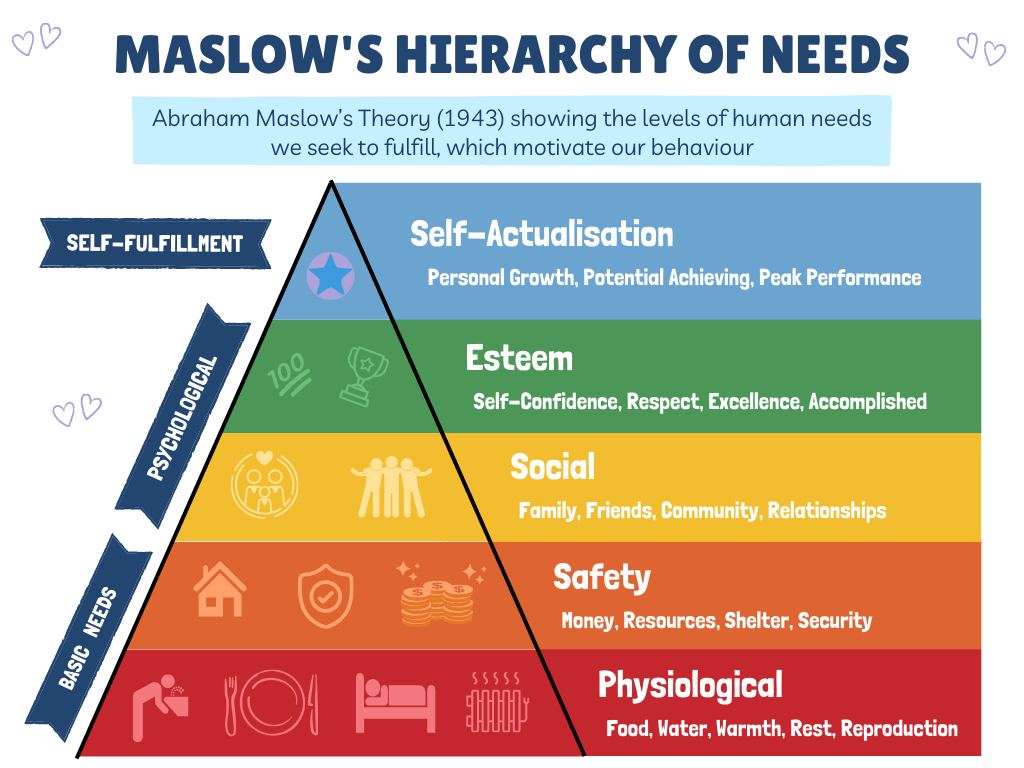
MASLOW’S HIERARCHY OF NEEDS
Abraham Maslow (1943):
Proposed a theory of motivation that spans the spectrum of motives including biological, individual and social.
One must satisfy lower-level needs before addressing the needs in higher levels.
A person without food, water and shelter is unlikely to be focused on relationships or what people think of them.
Physiological Needs: Basic requirements necessary for survival, such as food, water, shelter, and warmth
Security & Safety Needs: Needs for physical safety, employment, stability, and financial assets
Social Needs (Belonging & Love): Desires for friendship, family, intimacy, and a sense of belonging
Esteem Needs: Desires for self-worth, confidence, respect, and personal accomplishment
Self-Actualization: The top tier, defined as achieving one's full potential and inner fulfillment
HUNGER & EATING
PHYSIOLOGICAL MECHANISMS
METABOLISM & BODY WEIGHT
OBESITY
EATING DISORDERS
PHYSIOLOGICAL MECHANISMS
Hunger and eating are regulated by a complex interplay of hunger and satiety signals that are integrated in the brain.
Before Eating
Empty stomach → stomach contracts → hunger pangs and secretion of chemical messages that travel to the brain as a signal to initiation feeding behavior.
Low blood glucose levels → pancreas and liver generate chemical signals that induce hunger to initiate feeding behavior.
After Eating
Satiation – feeling of fullness and satisfaction causing eating behavior to stop.
Increase in blood glucose levels → pancreas and liver send signals to shut off hunger and eating.
Food passes through gastrointestinal tract → satiety signals are sent to the brain.
Fat cells release leptin (satiety hormone).
Factors Affecting Body Weight
Gene-environment interactions.
Number of calories consumed versus number of calories burned in daily activity.
Metabolic rate
Metabolic rate
The amount of energy that is expended in a given period of time.
Various between individuals.
People with a high metabolic rate burn off calories more easily than those with lower rates of metabolism.
Regulation of Body Weight - Set-Point theory
Each individual has an ideal body weight/set point, which is resistant to change.
Set point is genetically determined.
Efforts to move weight significantly from the set-point are resisted by compensatory changes in energy intake/expenditure.
Based on the observation that people’s weight generally fluctuates within a narrow margin.
Fails to account for the influences of social and environmental factors.
OBESITY
2/3 U.S. adults struggle with issues related to being overweight.
This chart shows how adult BMI is calculated. Individuals find their height on the y-axis and their weight on the x-axis to determine their BMI.
25 - 29.9 = overweight
Over 30 = obese
Over 40 = morbidly obese

Environmental Factors of Obesity
As well as factors such as genetics and energy intake/expenditure, socioeconomic status and the physical environment can
contribute to obesity.
May not feel comfortable walking or biking in a neighborhood with high crime rates which limits physical activity.
May not be able to afford healthy food options.
OBESITY Health Risks
Arthritis
Liver disease
Sleep apnea
Colon cancer
Cardiovascular disease
Stroke
Type 2 diabetes
Breast cancer
Infertility
Weight Reduction
A combination of diet and exercise.
Bariatric Surgery: Gastric banding surgery creates a small pouch of stomach, reducing the size of the stomach that can be used for
digestion.
Bulimia Nervosa
Involves engaging in binge eating behavior, followed by attempts to compensate for the large amount of food consumed.
Compensation - includes vomiting, laxatives, excessive exercise.
Health consequences - can include kidney failure, heart failure, and tooth decay.
Psychological problems – depression, anxiety, increased risk for substance abuse.
Anorexia Nervosa
Maintenance of body weight below average through starvation and/or exercise.
Distorted body image - view themselves as fat even though they are not.
Health consequences – can include bone loss, heart failure, kidney failure, amenorrhea (cessation of menstrual period), reduced function of the gonads, in some cases death.
Psychological problems – anxiety disorders, mood disorders, substance abuse
Binge Eating Disorder (BED)
Involves engaging in frequent and recurrent binging episodes without the compensation seen in bulimia
Binging in both BED and bulimia typically follows a cyclical pattern where a trigger event

Contributing Factors for EATING DISORDERS
Caucasian females, ages 15-19, from Western societies are the most at-risk population.
Many blame the media for its messages of a thin ideal.
Genetics may also predispose people to these disorders.
Low self-esteem, other mental illnesses.
Life transitions, stress.
Experiences such as abuse and bullying.
Personality types (perfectionism).
Family issues.
SEXUAL BEHAVIOR
PHYSIOLOGICAL MECHANISMS
KINSEY’S RESEARCH
MASTER’S & JOHNSON’S RESEARCH
SEXUAL ORIENTATION
GENDER IDENTIY
Hypothalamus in SEXUAL BEHAVIOR
The hypothalamus plays an important role in motivated behavior, including sex.
Lesions to the medial preoptic area of the hypothalamus completely disrupt a male rat’s ability to engage in sexual behavior, but does not affect sexual motivation (he will still seek to gain access to sexually receptive females).
Suggests that the ability to engage in sexual behavior and the motivation to do so are mediated by different systems in the brain.
In humans:
Disorders that involve abnormal hypothalamic function are often associated with hypogonadism (reduced function of the gonads) and reduced sexual function.
Hormones secreted by endocrine glands (testosterone) influence sexual motivation and behavior.
Amygdala and Nucleus Accumbens in SEXUAL BEHAVIOR
Involved in motivation for sexual behavior, but do not affect the ability to engage in it.
• Damage in rats results in a decreased motivation to engage in sexual behavior, while ability to do so is still intact.
KINSEY’S RESEARCH
In response to the lack of empirically-based information on sex during the late 1940’s, Dr. Alfred Kinsey initiated a large scale survey.
Behaviors thought to be rare were revealed to be much more common that previously thought.
Influential in shaping future research on human sexual behavior and motivation.
Findings:
Women are as interested and experienced in sex as men.
Both males and females masturbate, without negative health consequences.
Homosexual acts are fairly common.
Kinsey Scale
used to categorize an individuals sexual orientation

MASTERS AND JOHNSON’S RESEARCH
Conducted a study of physiological responses during sexual behavior.
Observed people engaging in sexual behaviors.
Measured physiological variables (e.g., blood pressure and respiration rate).
Measured sexual arousal (e.g. vaginal lubrication and penile tumescence)
Sexual Response Cycle
Excitement – arousal phase (erection, lubrication).
Plateau – Increased swelling and blood flow to labia minora, pre-ejaculatory fluid.
Orgasm – rhythmic contractions, ejaculation.
Resolution – return to unaroused state.

Sexual orientation
Emotional and erotic attraction toward another individual.
A relatively stable characteristic of a person (not a choice).
Between 3% and 10% of the adult population identifies as homosexual.
What makes someone heterosexual vs homosexual?
Previously thought to be caused by different socialization and familial experiences but research shows that those experiences can be very similar in homosexuals and heterosexuals.
Genetic and biological mechanisms - research has found differences in brain structure and function between heterosexuals and homosexuals.
Gender identity
One’s sense of being male or female.
In most cases, our gender identities correspond to our biological sex but not always.
Gender dysphoria
Diagnosis describing individuals who do not identify as the gender that most people would assume they are.
Must persist for at least six months.
Must result in significant distress or dysfunction to meet diagnosis criteria.
Transgender hormone therapy
Use of hormones to make one’s body look more like the opposite-sex.
CHAZ BONO
Chaz Bono, a transgender male, is a well-known person who transitioned from female to male.
In the 1970s, the world knew Chaz as Chastity Bono, the daughter of the famous entertaining duo Sonny and Cher; here young Chastity is pictured with Sonny.
Later in life, Chaz transitioned to align his physical body with his gender identity.
GENDER IDENTITY: LAVERNE COX
Actress Laverne Cox, who is openly transgender, is the first transgender actress to portray a transgender character on a regular television series. She is also an advocate for LGBTQ+ issues outside of her career, such as in this "Ain't I a Woman?" speaking tour
EMOTION
THEORIES OF EMOTION
THE BIOLOGY OF EMOTIONS
FACIAL EXPRESSION & RECOGNITION OF EMOTIONS
Mood
Prolonged, less intense, affective state.
Does not occur in response to something we experience.
May not be consciously recognized or intentional.
Emotion
A subjective state of being that we often use to describe our feelings.
Relatively intense and occurs in response to an experience,
Consciously experienced and intentional.
James-Lange Theory
Emotions arise from physiological arousal.
See snake → heart and respiration rate increase (physiological arousal) → feeling of fear.
Cannon-Bard Theory
Physiological arousal and emotional experience occur simultaneously, yet independently.
Occur at the same time but are independent of each other.
See snake → physiological arousal AND feel fear.
Empirical Findings
Individuals with spinal cord injuries (incapable of receiving autonomic feedback) could still experience emotion but in some it was less intense.
Suppression of facial expression of emotion lowered the intensity of emotions experienced.
These findings suggest that physiological arousal is not necessary to experience emotion but increases the intensity.
Schachter-Singer Two-Factor Theory
Emotions are composed of two factors: physiological and cognitive.
Physiological arousal is interpreted in context leading to the emotional experience.
See snake → physiological arousal and cognitive assessment of situation labels arousal as fear → experience fear.
• Believed physiological arousal is very similar across the different types of emotion, making cognitive assessment important.
Palms sweating, heart racing, increased respiration rate (could be scared or nervous).
Lazarus’ Cognitive-Mediational Theory
Emotions are determined by our appraisal of the stimulus.
Unlike the Schachter-Singer model, the appraisal occurs before the label.
Appraisal is immediate and unconscious.
THE BIOLOGY OF EMOTIONS
The Limbic System: Involved in mediating emotional response and memory.
Hypothalamus – involved in activation of the sympathetic nervous system (part of an emotional reaction).
Thalamus – sensory relay center, neurons project to both the amygdala and higher cortical regions for further processing.
Amygdala – plays a role in processing emotional information and sending it on to cortical structures.
Hippocampus – integrates emotional experience with cognition.
AMYGDALA in Emotion
Primary target of research concerning the biological basis for emotions, especially fear and anxiety.
The amygdala is composed of various subnuclei including the basolateral complex and central nucleus.
Basolateral Complex
Has dense connections with a different sensory areas of the brain.
Critical for classical conditioning and attaching emotional value to learning processes and memory.
Central Nucleus
Involved in attention.
Has connections with the hypothalamus and various brain stem areas to regulate the autonomic nervous system and endocrine systems’ activities.