09 Oral mucosa
 Call Kai
 Learn
Learn Practice Test
 Spaced Repetition
 Match
Match Flashcards
 Knowt Play
1/110

There's no tags or description
Looks like no tags are added yet.
Name | Mastery | Learn | Test | Matching | Spaced | Call with Kai | Chat |
|---|
No analytics yet
Send a link to your students to track their progress
111 Terms
stratified squamous epithelium overlying a connective tissue proper or lamina propria
Oral mucosa is composed of ?
Basement membrane
What lies between the epithelial tissue and connective tissue in the oral mucosa
lining mucosa
masticatory mucosa
and specialized mucosa.
What are the three main types of oral mucosa in the oral cavity?
Lining mucosa
A type of mucosa noted for its softer surface texture, moist surface and ability to stretch and be compressed, acting as a cushion for the underlying structures.
the buccal mucosa,
the labial mucosa,
the alveolar mucosa
the ventral surface of the tongue
and the soft palate
Lining mucosa includes?
nonkeratinized stratified squamous epithelium.
lining mucosa is ?
smoother, with fewer and less pronounced rete ridges/pegs and connective tissue papillae
In lining mucosa, the interface between the epithelium and the lamina propria is generally ?
submucosa
compression
A ____________ deep to the lamina propria in lining mucosa is usually present, overlying muscle and it allows for the _______________ of the superficial tissue.
movable base
speech, mastication and swallowing.
The features of lining mucosa allow it to serve in regions in the oral cavity where a ______________ is needed, such as during ______________, ___________________, & ________________
Fordyce granules
In many areas of lining mucosa, especially the labial and buccal mucosa, there are ___________________. These appear as small, yellowish elevations on the surface of the mucosa. These are sebaceous glands.

Masticatory mucosa
______________________ is noted for its rubbery surface texture and resiliency.

the gingiva,
the hard palate
and the dorsal surface of the tongue.
Masticatory mucosa includes?
keratinized stratified squamous epithelium
Histologically, masticatory mucosa is associated with _______________ ______________ ____________________ epithelium.
rete ridges (rete pegs) and connective tissue papillae
Unlike lining mucosa the interface between the epithelium and lamina propria in masticatory mucosa is highly interdigitated with numerous and more pronounced ______________ & __________________, giving it a firm base.
Top layer is keratinized
The projections are rete ridges
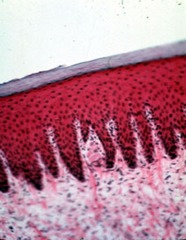
submucosa
In Masticatory mucosa, the _______________ is a very thin layer or is absent.
firmness
mastication and speech.
When masticatory mucosa overlies bone, it increases the _____________ of the tissue.
These features allow this mucosa to function in the regions that need a firm base during ______________ & _________________
dorsal and lateral surface of the tongue
lingual papillae
Specialized mucosa is found on the ___________ & ____________ surface of the ___________ in the form of the ____________, which are discrete structures composed of epithelium and lamina propria.
nonkeratinized
Orthokeratinized
Parakeratinized.
Three types of stratified squamous epithelium are found within the oral cavity, which are?
Nonkeratinized
____________________ epithelium is associated with the lining mucosa.
Lining mucosa

Orthokeratinized and parakeratinized
___________________ & ___________________epithelium are associated with masticatory mucosa.
Masticatory mucosa

A basal layer
An intermediate layer or stratum intermedium
A superficial layer or stratum superficiale
Lining mucosal tissues have three layers of epithelium, which are?
labial mucosa
buccal mucosa
alveolar mucosa
mucosa lining the floor of the mouth,
the ventral surface of the tongue
the soft palate.
The nonkeratinized stratified squamous epithelium superficial layers lining mucosa include?
basal layer
The ______________ is the deepest of the three layers.
cuboidal epithelial cells
The basal layer is a single layer of _______________ epithelial cells overlying the basement membrane.
mitosis
The basal layer is where __________ occurs for cell replacement
larger, polyhedral-shaped cells
Cannot under go mitosis
The intermediate layer is composed of _______, ________________ cells, which are larger than the basal cells.
These cells cannot undergo ?
stratum superficiale
polyhedral-shaped
squames
squames
The most superficial layer in nonkeratinized epithelium is termed the superficial layer or __________________. This layer shows even larger ________________ cells with the outer layer flattening into __________.
The ___________ show shedding or loss as they age.
masticatory mucosa.
specialized mucosa of the lingual papillae on the dorsal surface of the tongue.
Orthokeratinized epithelium is associated with the _____________________ & _________________
keratinization
superficial layers
Orthokeratinized stratified squamous epithelium shows _____________________ of the epithelial cells throughout its most ______________ layers.
Orthokeratinized epithelium
__________________________ is the least common form of epithelium found in the oral cavity.
basal
Four
Unlike nonkeratinized epithelium, orthokeratinized epithelium has more layers superficial to the _______ layer - ______ separate layers
prickle cell layer or stratum spinosum
mitosis
The second layer of orthokeratinized epithelium, superficial to the basal cell layer is the ______________ layer or _______________
The cells in this layer are not able to undergo ___________.
Prickle cell layer
This makes up the bulk of orthokeratinized epithelium
granular layer or stratum granulosum
flat and stacked in a layer three to five cells thick.
The third layer of orthokeratinized epithelium, superficial to the prickle cell layer is the ______________ or ___________________. The epithelial cells in this layer are _____ and _________ in a layer _________ to ____ cells thick.
keratin granules
keratin
These cells in the granular layer of orthokeratinized epithelium contain prominent _________ ____________ in their cytoplasm, which are precursors to the _________ found at the more superficial layer.
keratin layer or stratum corneum
Flat
And NO NUCLEUS
Cytoplasm filled with keratin
The most superficial layer in orthokeratinized epithelium is the _____________ or __________________. The cells in the keratin layer are ______ and have no ________ and their cytoplasm is filled with _________.
flattening
shed since they are no longer alive.
The outer cells of the keratin layer, or squames, show increased ________ and these cells are ?
masticatory mucosa of the attached gingiva
tongue's dorsal surface.
Parakeratinized stratified squamous epithelium is associated with the _______________ of the _______________ and the __________________
In parakeratinized epithelium, the superficial cells still contain their nuclei.
The main difference between parakeratinized and orthokeratinized epithelium is in the cells of the keratin layer is?
nuclei
In parakeratinized epithelium, the superficial cells still contain their _________.
collagen fibers
elastic fibers
The main fiber group in the lamina propria is _______________, but ____________ are also present in many areas.
The papillary and dense connective tissue
The lamina propria has two layers, the __________ and ________________________ tissue.
superficial
loose connective tissue, blood vessels and nerves
The papillary layer of the lamina propria is the more ___________ layer and consists of ___________________, ______________, & _____________
deeper
dense connective tissue with a lot of fibers
The dense layer is the ___________ portion of the lamina propria and consists of ______________________ with a lot of _________.
submucosa
A ______________ in lamina propria may or may not be present deep to this layer, depending on the region of the oral mucosa.
bacteria
mechanical irritation and
protect against dryness.
All forms of epithelium act as a barrier to ? (3)
The labial & buccal mucosa
Both of these regions appear clinically as an opaque pink, shiny, moist, compressible tissue that stretches easily.
lining mucosa.
The mucosa of the lips and cheeks is classified as _____________
nonkeratinized
Very thick
lamina propria
vascular
pinkish
Histological features
The _______________ epithelium of the labial mucosa and buccal mucosa is ________ and overlies a ______________ with an extensive __________ supply, giving the mucosa a __________ appearance.
adipose tissue and minor salivary glands
The lamina propria overlies a submucosa that contains _____________ and __________________, giving the tissue its compressibility and moisture.
reddish-pink
vascular
vestibules
The alveolar mucosa is a ______________ tissue with blue ___________ areas.
The tissue is shiny and moist and lines the _____________ of the oral cavity.
Alveolar mucosa

lining mucosa
Alveolar mucosa is classified as a ______________.
superficial
Nonkeratinized stratified squamous epithelium is located on the _____________ layers of lining mucosa
thin nonkeratinized epithelium
Histological features
The epithelium of the alveolar mucosa is very ______ __________________ ______________ that overlies an extensive vascular supply in the lamina propria.
Connective tissue papillae
elastic fibers
mobility
Histological features
In Alveolar mucosa , ___________________ are sometimes not present and there are many _____________ present in the lamina propria allowing __________ of the tissue.
minor salivary glands
elastic fibers
loose connective tissue
The submucosa in Alveolar musical has minor ______________ and many ________ fibers in a _____________________ tissue.
reddish-pink tissue
vascular blue
moist, shiny and compressible
lining mucosa
Both the floor of the mouth and ventral surface of the tongue appear as a ___________ tissue with __________ areas of veins. The tissue is __________, __________, &_______________.
Both of these tissues are classified as _______________.
nonkeratinized
Both the floor of the mouth and ventral surface of the tongue have a very thin __________________ epithelium overlying a lamina propria with an extensive vascular supply therefore making the tissue red in appearance
connective tissue papillae
Histological features
The ______________________ of the lamina propria, are broad in the tissue of the floor of the mouth.
loose connective tissue with adipose tissue
submandibular and sublingual salivary glands.
The submucosa deep to the lamina propria of the floor of the mouth consists of ____________________ with _________ tissue and includes the __________________ and _____________ salivary glands.
connective tissue papillae
elastic fibers
minor salivary glands
Histological features
The _____________________ of the lamina propria of the tongue's ventral surface are numerous. Some _________ fibers and a few minor _______________ provide elasticity and moisture.
deep pink with a moist surface
speech and swallowing.
Clinical appearance
The posterior portion of the palate, the soft palate, is ___________ with a _______ surface. The tissue is compressible and very elastic to allow for __________ and ______________.
lining mucosa.
The mucosa of the soft palate is classified as ________________
nonkeratinized
The soft palate has a thin __________________ epithelium overlying a thick lamina propria.
connective tissue papillae
And elastic fibers
adipose tissue and minor salivary glands.
The soft palate has numerous __________________ and ________ fibers for increased mobility. The submucosa contains _________ tissue and minor _____________
masticatory
The attached gingiva that covers the alveolar bone is classified as a ________________ type of mucosa
pink, firm and immobile
Healthy attached gingiva is _______,__________, & ___________.
Stippling
_____________ may be observed clinically and are little depressions giving the surface of attached gingiva an "orange peel" appearance
mucogingival junction
the _________________, a sharply defined scalloped junction between the pinker attached gingiva and the redder alveolar mucosa.
parakeratinized epithelium
lamina propria
The attached gingiva has a thick layer of mainly __________________ epithelium overlying an extensive vascular supply in the ___________ making the tissue pink in color.
connective tissue papillae
stippling
The lamina propria of the attached gingiva has a tall, narrow ___________________, giving the tissue its ___________ due to a strong attachment or pull of the epithelium toward the lamina propria.
parakeratinized epithelium
lamina propria
The attached gingiva has a thick layer of mainly __________________ epithelium overlying an extensive vascular supply in the ___________ making the tissue pink in color.
connective tissue papillae
stippling
The lamina propria of the attached gingiva has a tall, narrow ___________________, giving the tissue its ___________ due to a strong attachment or pull of the epithelium toward the lamina propria.
Attached gingiva
No submucosa is present in the?
alveolar bone
The lamina propria of the attached gingiva is directly attached to the underlying _____________, making the attached gingiva firm and immobile
periosteum
mucoperiosteum
The lamina propria acts as a _______________ to the underlying jawbones and is termed the __________________.
keratinized
nonkeratinized
The mucogingival junction can be seen as a dividing zone between the _____________ attached gingiva and the ___________ alveolar mucosa.
hard palate
The _______________, appears pink and is immobile and firm. There is a cushioned feeling in the lateral portions and a firmer feeling in the medial portion.
adipose tissue
minor salivary glands
The submucosa in the anterior part of the lateral portion of the hard palate contains ______________.
The submucosa in the posterior part of the hard palate contains ____________________
Submucosa
mucoperiosteum
Histologic features
__________________ is absent in the medial portion of the hard palate and the lamina propria is firmly attached to the underlying bone and serves as a ___________________.
masticatory mucosa and specialized type of mucosa
The dorsal surface of the tongue has both a ________________ mucosa and _______________ type of mucosa present
ortho or parakeratinized
stratified squamous epithelium
The masticatory mucosa on the dorsal surface of the tongue is an _____________________ ______________ ________________ epithelium
lingual papillae.
The specialized type of oral mucosa found on the dorsal and lateral surfaces of the tongue are the________________?
keratinized
The lingual papillae are discrete structures of _______________ epithelium and lamina propria.
filiform
fungiform
foliate and
circumvallate papillae.
The four types of lingual papillae are ?
fungiform
foliate and
circumvallate
Three types of lingual papillae are associated with taste buds are the?
30 to 80
basement membrane to the epithelial surface
Taste buds are composed of ___ to ___ spindle-shaped cells that extend from the ___________________ to the _________________ of the lingual papilla.
taste pore
Dissolved molecules of food contact the taste receptors at the ___________, which is an opening in the most superficial portion of the taste bud
sweet, sour, salty and bitter
The four fundamental taste sensations - ?
filiform lingual papillae
2 to 3 mm
The _________________________ are the most numerous lingual papillae.
They are shaped like fine-pointed cones of __ to __ mm, with the tips turned toward the pharynx.
keratinized
The filiform papilla is a pointed structure with a thick layer of ________________ epithelium overlying a core of lamina propria.
Filiform
No tastebuds are located in which lingual papilla ?
guiding food toward the pharynx for swallowing.
The filiform papillae are thought to aid in ?
fungiform lingual papillae
The ________________________ are found in lesser numbers than the filiform on the body of the dorsal surface of the tongue.
reddish dots
mushroom
1 mm diameter
The fungiform appear as _____________ that are slightly raised and ___________ shaped and have a __ mm diameter.
keratinized
The fungiform lingual papillae is a mushroom-shaped structure with a thin layer of ______________ epithelium overlying a very vascularized core of lamina propria