Inorganic Chemistry Exam 3 Terms
 Call Kai
 Learn
 Practice Test
 Spaced Repetition
 Match
 Flashcards
 Knowt Play
1/24

There's no tags or description
Looks like no tags are added yet.
25 Terms
Transition metal
One in which the atom has an incomplete d-subshell, or gives rise to a cation that has an incomplete d-subshell.
Note: group 12 (Zn, Cd, Hg) are NOT transition metals
Triad
A three membered group of d-block metals in which they share relatively similar chemical properties

Heavier d-block metals
Transition metals of the second and third rows

Platinum-group metals
Noble Transition Metals: Arranged in Periods 5 & 6 in Groups 8, 9, and 10
Their reactivity and some of their properties are somewhat the same
Platinum-group metals/Noble transition metals:
Ru (Ruthenium)
Os (Osmium)
Rh (Rhodium)
Ir (Iridium)
Pd (Palladium)
Pt (Platinum)

Binary compounds
d-block metal + heated with dioxygen (O2), or sulfur (S), or Halogens (X)
Charge transfer complex
The weak interaction between an electron donor and acceptor, involving some transfer (partial electron transfer) of electronic charge, usually facilitated by the acceptor.
Paramagnetism
A form of magnetism where materials are weakly attracted to an externally applied magnetic field (typically arises from the presence of unpaired electrons in d-orbitals).
Complex formation
The process where a central metal atom or ion (acting as a Lewis acid) bonds with surrounding molecules or ions called ligands (acting as Lewis bases) to form a coordination compound or complex ion.
Complex formation often results in a change of color
Variable Oxidation State
The ability of an element to exhibit more than one positive or negative charge (oxidation number) in its chemical compounds
ROT!!
Maximum number of electrons removed leads to noble gas configuration, and that’s the maximum oxidation state.

Pauling’s Electroneutrality Principle
It states that the distribution of a charge in a molecule or ion such thatthe charge on any single atom is within the range of +1 to -1 (ideally close to zero)
Purpose of Pauling’s Electroneutrality Principal:
It’s an approximate method of estimating charge distribution in molecules and complex ions
Mononuclear
A coordination complex with only one metal center
Coordination numbers in relation to geometries
In practice, ideal geometries are often distorted due to steric effects of ligand molecules coordinated to a molecule
The more bulk there is, the more steric effects there are, which causes deviation in ideal geometry
Where energy difference between possible structures is small, fluxional behavior in solution may be observed
The Kepert Model
Rationalizes the shape of d-block metal complexes [MLn], [MLn]+, or [MLn]- by considering the repulsions between groups L.
Coordination Number
The number of atoms directly bonded to it through donor–acceptor (coordinate) bonds. This is typically the number of sigma-bonded donor atoms from ligands.
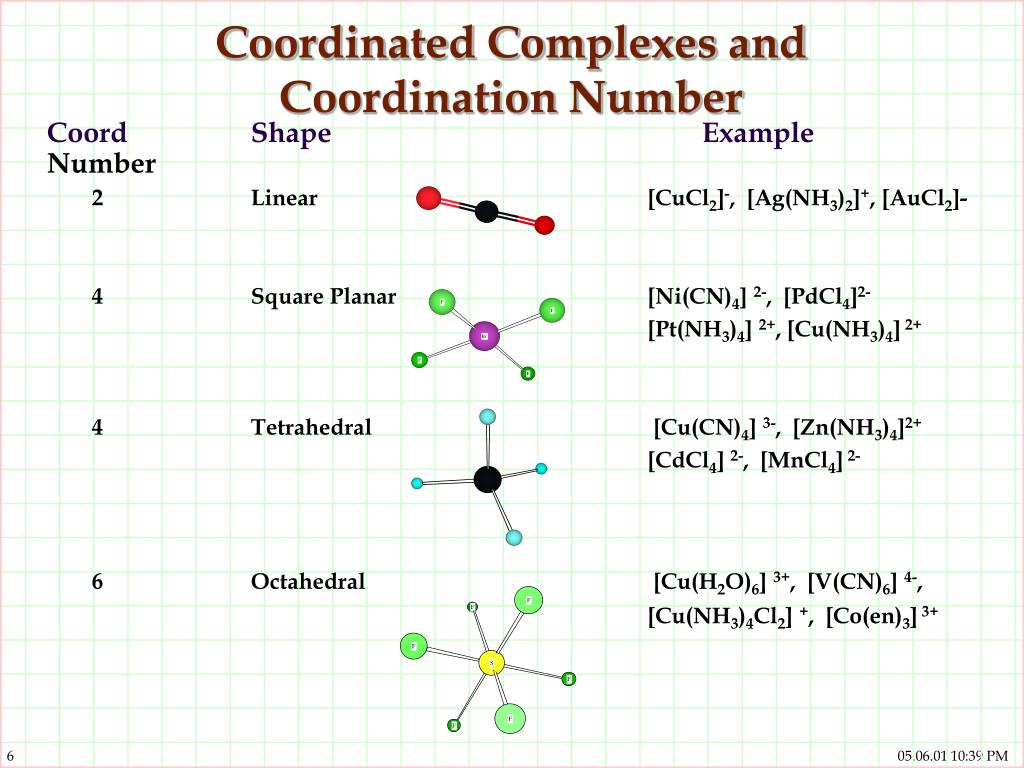
Coordination Number 2
- Uncommon
- Examples generally restricted to d10 ions [Cu(l), Ag(l), Au(l), and Hg(ll)]
- Arrangement of donor atoms around metal center: linear

Coordination Number 3
- Also Uncommon
- Arrangement of donor atoms around metal center: typically trigonal planar
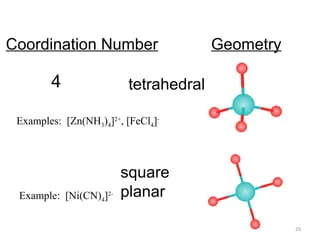
Coordination Number 4
- Common
- Tetrahedral geometry is most commonly observed
- Square planar geometry is more rare (less commonly observed) than tetrahedral geometry and is often associated with d8 configurations - [PdCl4]2- and [PtCl4]2-
Coordination Number 5
- Arrangement of donor atoms around metal center: Trigonal bipyramidal and square-based pyramidal
- Many structues lie between the two extremes

Coordination Number 6
- Arrangement of donor atoms around metal center: Typically and mainly Octahedral, but can be trigonal prism
- Octahedral coordination is found for electronic configurations from d0 to d10.

Coordination Number 7
Coordination Number 8
Coordination Number 9
Coordination Number 10
Coordination Number 11
Coordination Number 12