Hydrology Chapter 1
 Call Kai
 Learn
Learn Practice Test
 Spaced Repetition
 Match
Match Flashcards
 Knowt Play
1/25

Earn XP
Description and Tags
EES 210
Name | Mastery | Learn | Test | Matching | Spaced | Call with Kai | Chat |
|---|
No analytics yet
Send a link to your students to track their progress
26 Terms
What is hydrology?
The study of water, the occurrence, distribution, movement, and properties of all waters on Earth.
Why study hydrology?
It is essential to humans and other life to understand the source, distribution, movement, prediction, or protection of water.
What are the current challenges in hydrology?
The non-linearity of hydro-geologic processes, scaling issues, and a high degree of spatiotemporal variability in natural systems
How much of the water is fresh water?
3%
What is an open system?
A system that exchanges both energy and matter with its surroundings
What is a closed system?
A system that exchanges energy, but not matter with its surroundings
P=I+R+E+T+G
Precipitation = infiltration + runoff + evaporation + transpiration + groundwater
Inflow - Outflow =
change in storage

Hydrologic equation or budget
Volume/time = preciptation + surface water inflow + Groundwater Inflow + surface water outflow + Groundwater outflow + evapotranspiration
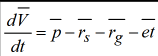
Catchment water budget
volume/time = precipitation rate - net rate of surface water - net rate of groundwater - rate of evapotranspiration

Residence time
Time = storage/flowrate
When is the first recorded instance of hydrology?
5,000-6,000 years ago when hydraulic engineers created canals, levees, dams, and subsurface water conduits along the Indus, Tigris, Euphrates, Hwang Ho, and Nile river.
What was hydrology doing 4,000 years ago?
Egyptians monitored the flow rates and yields of the rivers
What was hydrology doing 3,000 years ago?
The idea of a global hydrological cycle was conceptualized by early Greek philosophers
What was hydrology doing 2,400 years ago?
Rainfall measuring instruments were first utilized in India
What was hydrology doing in the 15th-16th century?
This is the period of observation. Leonardo da Vinci showed from field observations that the waters in rivers come from precipitation.
What was hydrology doing in the 17th century?
This is the period of measurement. Perrault proved by measurement that rain could account for streamflow.
What was hydrology doing in the 18th century?
This is the period of experiment. Substantial progress was made in applications of mathematics, fluid mechanics, and hydraulics by scientists like Bernoulli, Euler, Chezy, and other European professionals.
What was hydrology doing in the 19th century?
This is the period of modernization and the beginning of theoretical quantitative. Darcy, Poiseuille, DuPuit, Stokes, Manning, Reynolds, and others made substantial contributions to fluid mechanics, hydraulics, and sediment transport during this period.
What was hydrology doing in the 20th century?
This is the period of empiricism and theorization. Statistical applications of hydrologic data. Modeling groundwater and stream hydraulics, sediment transport, runoff, and infiltration.
What was hydrology doing now?
Hydrology has been facilitated by advances in the physical understanding and by the advent of modeling and computer simulation. Modeling of regional hydrology such as climate change, evapotranspiration rates, etc… however, the complete hydrogeological modeling outcome is limited primarily by the availability and quality of field data.
When did water usage peak in the U.S?
1980
How much of the water used in the U.S. is groundwater?
40%
How many gallons does the typical American use in a day?
100 gallons
Why are derivatives used in hydrology?
They measure how a function changes as its input changes. Many physical entities like velocity, acceleration, and force are defined as instantaneous rates of changes of some other quantity. It can give us a precise instantaneous value for that rate.
Why are integrals important in hydrology?
A vast number of physical problems involve such infinite sums in their solution.