Ecology Exam 3
 Call Kai
 Learn
 Practice Test
 Spaced Repetition
 Match
 Flashcards
 Knowt Play
1/19

There's no tags or description
Looks like no tags are added yet.
20 Terms
Richness
S= number of species
Evenness
E= equity of relative abundances
Inverse Simpson’s diversity index
1/D
Where D = Σpi² and pi is the proportion of individuals/biomass that are species i
Inverse Simpson’s evenness
E= 1/D/S
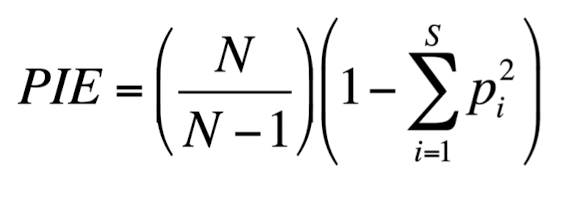
Probability of interspecific encounter: PIE
P(two individuals are both species i) = pi²
P(two individuals are the same species) = Σpi²
P(two individuals are not the same species = 1 – Σpi²
α–diversity
Diversity within a sample
β–diversity
Turnover in diversity between samples collected at different places or times
β = γ / α
γ–diversity
Diversity within all samples
Rarefaction
Interpolates to standardize comparisons of species richness to a common number of individuals
Asymptomatc estimators
Extrapolate to estimate numbers of undetected species
Species (taxonomic) diversity
Assumes all pairs of species are equally similar or dissimilar
Phylogenetic diversity
Accounts for evolutionary history (e.g., years since divergence) and genetic (dis)similarity
Functional trait diversity
Accounts for measurable differences between species, such as body mass/size or leaf mass per area
Approaches for estimating the number of species on Earth
Body size
Extrapolations of direct counts
Extrapolations of slowing rates of species identifications
8 million plants and animals
About 6 million insects
About 0.5 million plants
Less than 0.1 million vertebrates
About 2 million species undescribed
Big 5 mass extinction events

Ecosystem ecology
Studies the interactions between organisms (biotic) and their physical environment (abiotic) within a specified space and as an integrated system.
Ecosystem functions
Include the physiochemical and biological processes that occur within the ecosystem to maintain terrestrial life
Ecosystem services
The set of ecosystem functions that are directly linked to benefit human well-being