3. Electrical Signals
 Call Kai
 Learn
Learn Practice Test
 Spaced Repetition
 Match
Match Flashcards
 Knowt Play
1/35

There's no tags or description
Looks like no tags are added yet.
Name | Mastery | Learn | Test | Matching | Spaced | Call with Kai | Chat |
|---|
No analytics yet
Send a link to your students to track their progress
36 Terms
Electrically Excitable
Neurons can respond to a stimulus and change its voltage to create a fast electrical signal called an action potential
Electrically Excitable: Types
Neurons either communicate through graded potentials for short-distance communication and action potentials for long-distance communication.
Graded Potential
A change in membrane potential that develops in response to a stimulus; it can trigger an axon to produce a nerve impulse.
Action Potential
A rapid electrical signal that travels along an axon and can cause neurotransmitter release at a synapse.
Nervous System Function: Sensory Pathway: Step 1
Touching the pen stimulates sensory receptors in the skin of the fingers, causing a graded potential.
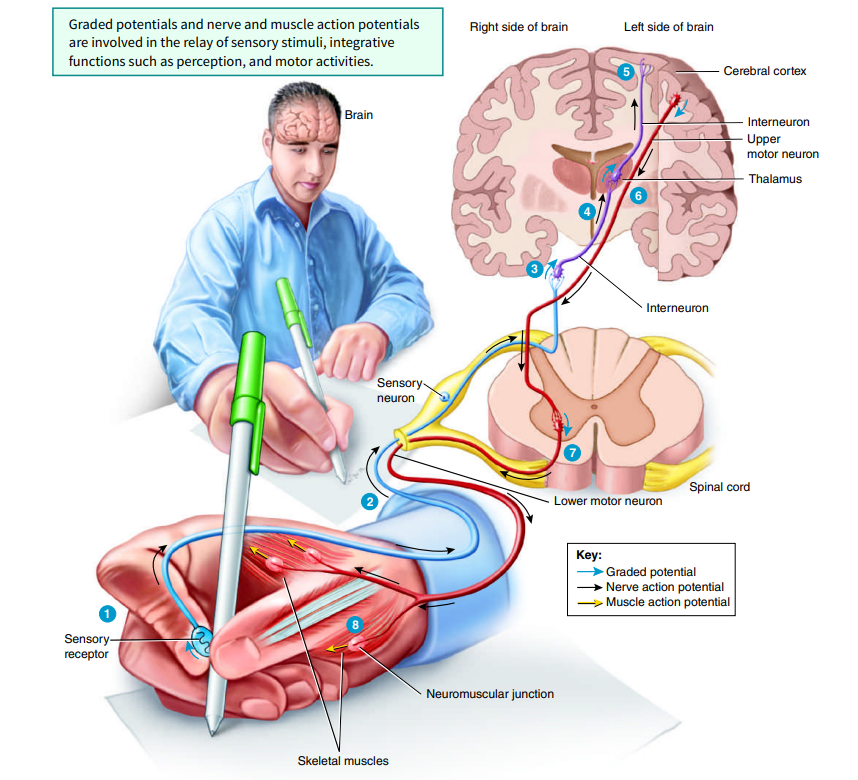
Nervous System Function: Sensory Pathway: Step 2
If the graded potential is strong enough, it triggers an action potential in the sensory neuron's axon, in which it travels into the CNS to release neurotransmitter
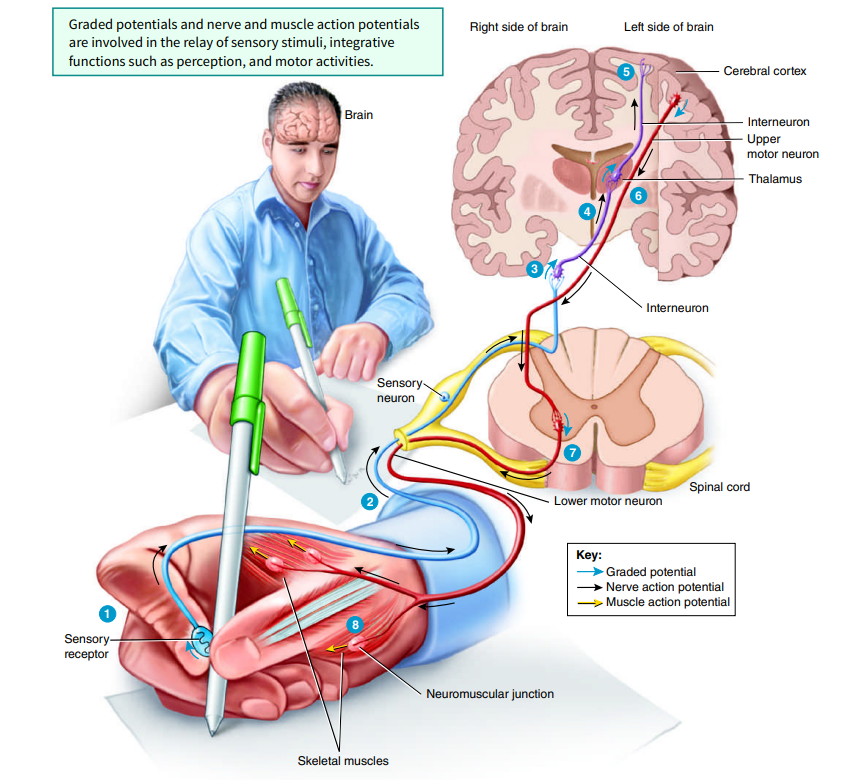
Nervous System Function: Sensory Pathway: Step 3
The neurotransmitter released by the sensory neuron stimulates an interneuron in the CNS, producing a new graded potential within the dendrites and cell body.

Nervous System Function: Sensory Pathway: Step 4
If the interneuron's graded potential is strong enough, it produces an action potential that travels along its axon and causes neurotransmitter release at the next synapse with another interneuron.

Nervous System Function: Sensory Pathway: Step 5
This cycle repeats until multiple interneurons activate higher brain regions (e.g., the thalamus and cerebral cortex), where conscious awareness of a sensation is achieved when interneurons reach and activate the cerebral cortex

Nervous System Function: Motor Pathway: Step 6
The stimulus in the brain produces a graded potential in the upper motor neuron that eventually synapses with lower motor neuron to contract the skeletal muscles.

Nervous System Function: Motor Pathway: Step 7
The lower motor neuron releases neurotransmitters at the neuromuscular junction, supplying skeletal muscle fibers, in which a graded potential becomes an action potential.
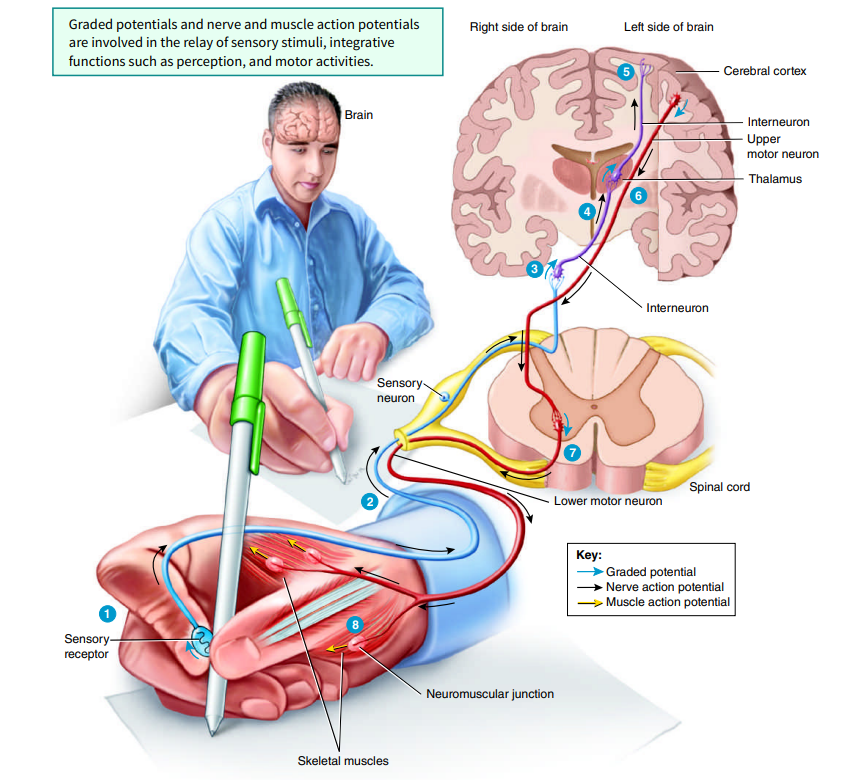
Nervous System Function: Motor Pathway: Step 9
The neurotransmitter released at the neuromuscular junction stimulates the muscle fiber to generate a muscle action potential that travels along the fiber, allowing you to write with a pen.

Nervous System Function: Sensory Pathway
Carries information from sensory receptors to the CNS, then the brain, so that a stimulus can be perceived.
Nervous System Function: Motor Pathway
Carries commands from the brain to motor neurons and then skeletal muscles.
Nervous System Function: Sensory Sequence
Nervous System Function: Motor Sequence
Need a resting membrane potential and specific types of ion channels to produce graded potentials and action potentials
Membrane Potential
Resting Membrane Potential
Electrical Current
The flow of charged ions across or through a cell membrane
Ion Channels
Pore-forming proteins in the plasma membrane that provide pathways for ions to move across the membrane.
Ion Channels: Function
Ion channels open or close in response to specific stimuli, allowing ions to move and changing the membrane potential across the electrochemical gradient
Electrochemical Gradient
The combined force of a chemical concentration difference and an electrical charge difference across a cell membrane
Electrochemical Gradient: Example
Positively charged cations move toward a negatively charged area
Negatively charged anions move toward a positively charged area
Ion Channel: Types
Leak Channel, Ligand-gated Channel, Mechanically Gated Channel, Voltage-gated Channel
Ion Channel: Leak Channel
An un-gated, passive protein channels that randomly open and close— commonly found in nearly all cells

Ion Channel: Leak Channel: Example
There are usually many more K⁺ leak channels than Na⁺ leak channels, and K⁺ leak channels are leakier and permeable
Ion Channel: Ligand-gated Channel
Channels that open or close when a specific chemical ligand binds to them— commonly found in dendrites of sensory neurons (e.g., pain receptors, interneurons, and motor neurons)

Ion Channel: Ligand-gated Channel: Chemical Ligands
Ligand-gated channels respond to chemical stimuli such as neurotransmitters, hormones, and certain ions.
Ion Channel: Ligand-gated Channel: Function
Mechanical force distorts the channel from its resting position, causing the gate to open.
Ion Channel: Ligand-gated Channel: Example
Acetylcholine can open cation channels, allowing Na⁺ and Ca²⁺ to move inward and K⁺ to move outward.
Ion Channel: Mechanically Gated Channel
Channels that open or close in response to vibration, touch, pressure— commonly found in auditory, touch, and pressure receptors

Ion Channel: Voltage-gated Channel
Channels that open or close in response to a change in the membrane potential— commonly found in the axons of all types of neurons

Ion Channel: Voltage-gated Channel: Function
They participate in the generation and conduction of nerve impulses along axons.