ASVAB Auto Information (Drive Systems)
 Call Kai
 Learn
Learn Practice Test
 Spaced Repetition
 Match
Match Flashcards
 Knowt Play
1/23

There's no tags or description
Looks like no tags are added yet.
Name | Mastery | Learn | Test | Matching | Spaced | Call with Kai | Chat |
|---|
No analytics yet
Send a link to your students to track their progress
24 Terms
Drive System
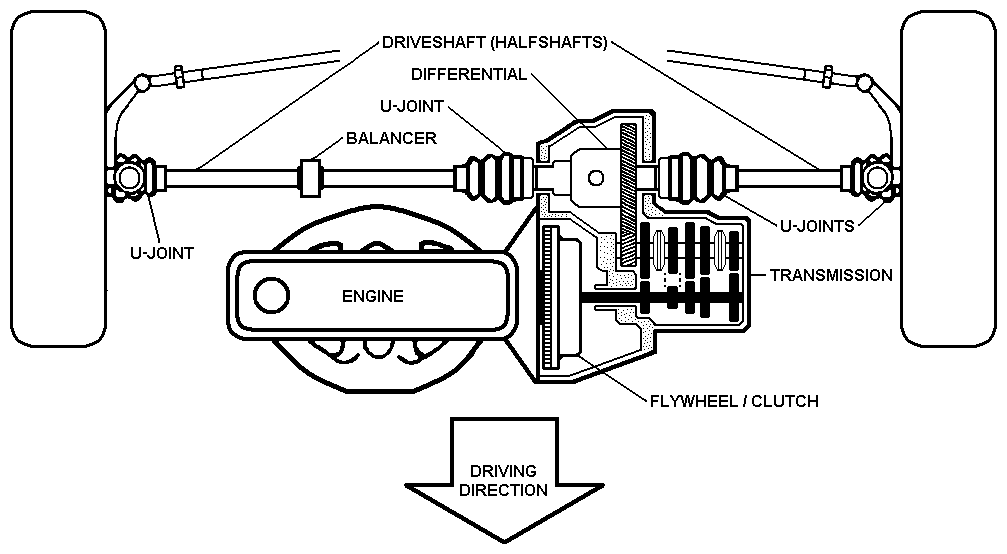
Transfers the power of the engine to the wheels to make the move. Cars have drivetrain systems that run on axles.
Axle
The shaft on which the wheels revolve.
Universal Joint
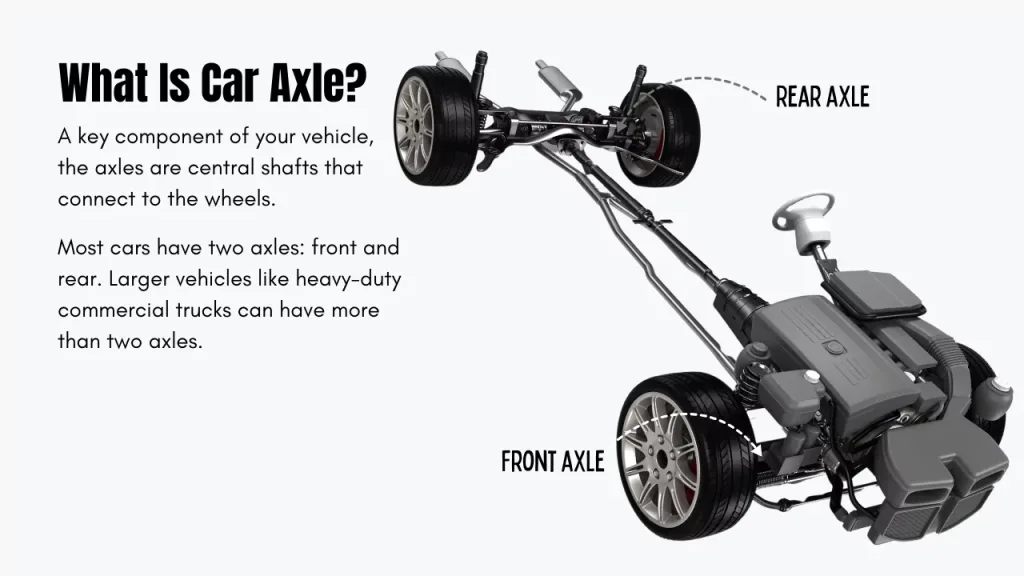
Allows the axle to move up and down without breaking the drive shaft.

Drive Shaft
The connecting component that carries torque and transmits rotation. Gears on the axle allow the vehicle to make turns. Axle shafts turns the wheels. The wheels on vehicles turn in three different ways. Rear-wheel drive, Front-wheel drive, and All-wheel drive (four-wheel drive).
Rear-wheel drive
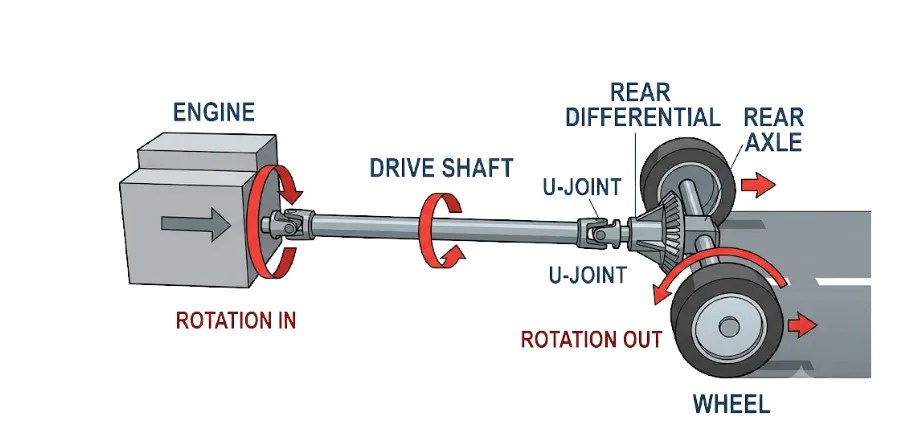
The rear wheels push the car. The drive shaft extends from the transmission to the rear axle.
Front-wheel drive
The front wheels pull the car. The drive shaft extends fro mthe transmission to the front axle.
All-wheel drive (Four-wheel drive)
All wheels push and pull the car at the same time. The drive shaft extends from the transmission to both axles.
Four-Wheel Drive Vehicles
Typically have locking differentials. The driver can choose to engage two wheels or all four. In all-wheel drive vehicles, which are common in SUVs, a computer controls braking and other functions to provide traction in slippery conditions.
Transmission
Increases torque as needed. Changes the speed of the engine in relation to the speed of the rear wheels (in rear-wheel drive), the front wheels (in front-wheel drive), or all the wheels (in four-wheel drive). Vehicles have two types: automatic or manual (stick shift).

Transmission (Gearbox)
Consists of several gears that allow the driver to control the amount of torque used. When the terrain is difficult, the wheels need more torque in order to move. You need less torque when you’re driving on slippery surfaces to help prevent your wheels from spinning. In an automatic, the torque change is automatic thanks to a torque converter. In a manual, the driver shifts the gears by compressing the clutch, which disconnects the engine from the drive shaft, and moving the gear shift inside the car by hand. Changing to a different gear requires temporarily disconnecting the engine. The clutch also allows the engine to run when the car isn’t moving.
Suspension System
Maximizes friction between the tires and the road surface by keeping the two in contact as much as possible, which gives a driver the ability to handle the car well. Without this, every little bump would transfer energy into the car’s chassis - and riding in a car would be a lot more like riding in a jerking, jolting old horse carriage. The springs and shock absorbers create a smoother ride as the vehicle rolls over bumps, potholes, and debris on the road.
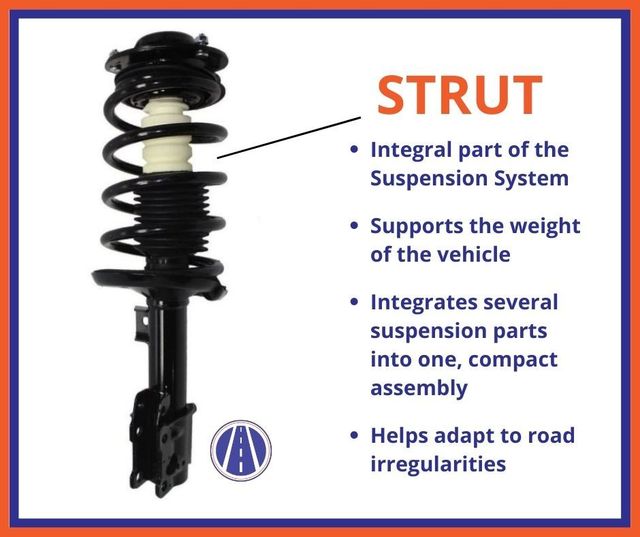
Struts
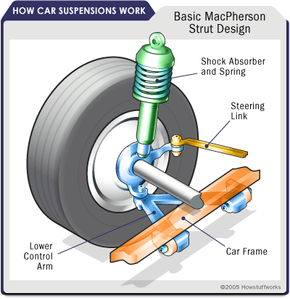
Support the weight of the vehicle and keep it from collapsing to the ground. Typically, a strut has an attached spring that helps the vehicle adapt to the irregularities in the road.
Shock Absorbers
Also simply called shocks, these handy gadgets are part of the struts in modern cars. They consist of a piston inside a hydraulic fluid-filled, sealed tube. When the tire hits a bump (or anything else), it pushes up the piston inside the tube instead of jolting the vehicle’s chassis.

Tires
A vehicle’s first - and hopefully only - contact with the road. The air inside the tires helps with stability and handling. The rubber creates traction caused by friction
Springs
Hold the chassis up and work with the shocks to let wheels move up and down smoothly.

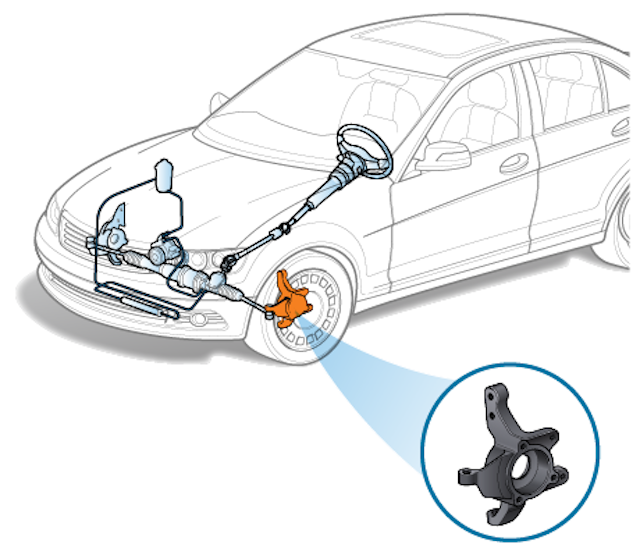
Steering Knuckle
The connection point between a tie rod and a wheel and it’s point that controls where the wheel turns.
Control arms
Also called A-arms, these long, metal pieces connect to the steering knuckle with ball joints and keep it vertical when the wheels move up and down. You find an upper and a lower arm on each steering knuckle.

Tie rods
Transfer force from the steering linkage or steering rack to the steering knuckle, which causes a wheel to turn.

Brake System
Stops the car from moving. Each wheel has a brake that applies friction to the wheel to stop its rotation. The friction takes motion energy and turns it into heat energy (which is why you shouldn’t ride your brakes — they’ll overheat and degrade)

Brake Pedal
Provides the connection between the driver and the braking mechanism.
Master Cylinder
On the other side of the brake pedal, and it’s job is to push brake fluid through brake lines that operate the brake assemblies at the wheels. (That fluid comes from — and goes back to — the fluid reservoir, which sits on top of the master cylinder.) What happens next depends on the type of brake.

Drum Brakes
The lines are connected to a hydraulic cylinder on each wheel. This cylinder contains pistons that move outward and force two brake shoes against the metal drum that rotates with the wheel. Usually installed on the rear wheels and consists of a rotating drum with shoes that expand to rub the inside of a drum.

Disc Brakes
In a disc-brake system, the master cylinder forces a caliper containing a piston or pistons, with brake pads on each side, to squeeze against a rotor disc in each wheel, thus stopping your car by using fluid and pressure on both sides of the rotor. Usually installed on the front wheels. Uses pads that pinch both side of a disc, effectively doubling the stopping power.

Antilock Brake System (ABS)
A four-wheel system (usually) that prevents the wheels from locking up. The system does this by automatically adjusting the brake pressure during an emergency stop. This enables the driver to maintain steering control and to stop in the shortest possible distance under most conditions. (Much better for emergency stop situations since wheels don’t lock up)
