unit 3 exam vocab
 Call Kai
 Learn
 Practice Test
 Spaced Repetition
 Match
 Flashcards
 Knowt Play
1/46

There's no tags or description
Looks like no tags are added yet.
47 Terms
Activation energy
the minimum amount of energy required to start a chemical reaction
Addition reaction
Two reactants combine to form a single product with no atoms left over.

Bond dissociation energy
energy required to break a covalent bond
Carbocation
An ion that contains a positively charged carbon atom
Electrophile
An electron pair acceptor (electron-poor site)

Elimination reaction
A single reactant splits into two products; essentially the opposite of an addition reaction.

Endergonic
requires/absorbs energy
Endothermic
Absorbs heat
Enthalpy change
heat of reaction, describes the net exchange of energy between the system and its surroundings

Entropy change
the difference between the entropy of the products and the reactants
Exergonic
releases energy
Exothermic
Releases heat
Gibbs free-energy change
determines whether a reaction is spontaneous or requires energy

Heat of reaction
The net change of chemical potential energy of the system
Initiation step
produces radicals (no radicals in reactants, radicals in products)

Nucleophile
An electron pair donor (electron-rich site)

Polar reaction
the reaction between a nucleophile and an electrophile
Propagation step
a radical, the halogen, and the alkane yield alkyl halide product plus more radical to carry on the chain (repeating cycle; radicals in reactants and products)

Radical
a neutral chemical species that contains an odd number of electrons and thus has a single, unpaired electron in one of its orbitals
Radical reaction
Processes that involve symmetrical bond-breaking and bond-making
Reaction coordinate
horizontal axis of reaction diagram
Reaction intermediate
the carbocation, which exists only transiently during the course of the multistep reaction; formed in first step and reacts with ion in second step; indicated by valleys on reaction diagram

Reaction mechanism
An overall description of how a reaction occurs
Rearrangement reaction
One reactant undergoes a reorganization of bonds and atoms to give an isomeric product.

Substitution reaction
Two reactants or components exchange parts to give two new products.
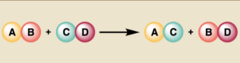
Regiochemistry
where the reaction takes place
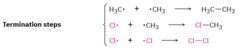
Termination step
The final step in a free-radical mechanism in which two free radicals react together to form a molecule
Transition state
the highest-energy structure involved in this step of the reaction; indicated by peaks on reaction diagram; unstable, cannot be isolate

Allylic
the saturated position adjacent to a carbon-carbon double bond

Carbanion
a species containing a negatively charged carbon
Gilman reagent (LiR2Cu)
lithium diorganocopper compounds
Grignard reagent (RMgX)
An organomagnesium halide. (alkyl halide, RX, reacts with Mg to yield alkylmagnesium halides, RMgX)
Organometallic
a compound that contains a carbon-metal bond
Anti periplanar
substituents are attached to parallel bonds on opposite sides of a molecule

Bimolecular
two molecules, nucleophile and alkyl halide, take part in the step whose kinetics are measured; Sn2 and E2 reactions
Deuterium isotope effect
A tool used in mechanistic investigations to establish whether a C-H bond is broken in the rate-limiting step of a reaction.
E2 reaction
a concerted elimination reaction involving a transition state where the base is abstracting a proton at the same time that the leaving group is leaving. The anti-coplanar transition state is generally preferred. Zaitsev orientation is usually preferred unless the base or the leaving group is unusually bulky.
Hoffman (anti-Zaitsev) product
the least substituted alkene formed as the major product during an elimination reaction
Leaving group
Atom or group that departs during a reaction.
Nucleophilic substitution reaction
-SN1 and SN2
-nucleophile forms a bond with a carbon and a leaving group leaves
Periplanar
A conformation in which a hydrogen atom and a leaving group are approximately coplanar.
Rate-determining step
the slowest step in a reaction mechanism
Rate-limiting step
the slowest step in a pathway
Second-order reaction
-rate is proportional to either the concentrations of 2 reactants or to the square of the concentrations of a single reactant
*Rate = k[A]1[B]1 or rate = k [A]2 or
rate = k [B]2
1/([A]) vs time line
slope = k
Sn2 reaction
-bimolecular nucleophilic substitution reactions
- only 1 step (concerted reaction)
-nucleophile attacks the compound at the same time as the leaving group leaves
-Nucleophile actively displaces the leaving group in a backside attack
for this to occur, nucleophile must be strong & substrate can't be sterically hindered
-concentrations of substrate & nucleophile have role in determining the rate --> rate = k[Nu][R-L]
-Position of the substituents around the substrate carbon is inverted
syn periplanar
The H and X atoms can be oriented on the same side of the molecule

Zaitsev's rule / Zaitsev product
In an elimination reaction where more than one alkene product is possible, the major product is the most substituted alkene (the alkene with the greatest number of alkyl substituents attached to the double bond carbon atoms).