Ecology
 Call Kai
 Learn
 Practice Test
 Spaced Repetition
 Match
 Flashcards
 Knowt Play
1/33

There's no tags or description
Looks like no tags are added yet.
34 Terms
Ecology
The study of how organisms interact with each other and with their physical environment.
Population
A group of organisms of the same species living in the same area at the same time.
Community
All the populations of different species living and interacting in the same area.
Ecosystem
A community of living organisms together with their nonliving physical environment.
Niche
The role an organism plays in its ecosystem, including what it eats and how it interacts with other organisms.
Biodiversity
The variety of living organisms in a given area, including genetic, species, and ecosystem diversity.
Producers (autotrophs)
Organisms that produce their own food using energy from sunlight or chemical reactions, such as plants and algae.
Consumers (heterotrophs)
Organisms that obtain energy by eating other organisms, such as herbivores, carnivores, and omnivores.
Decomposers
Organisms that break down dead organic matter and wastes into simpler substances, such as fungi and bacteria.
Detritivores
-Organisms that break down and absorb organic matter
-E.g., mites, earthworms, snails, crabs, vultures
Food chain
The pathway of energy or matter as it moves from one organism to another, starting with producers.
Food web
A network of interconnected food chains showing the many feeding relationships in an ecosystem.
Ecological pyramid
A diagram showing the energy content of each feeding level in a food chain, with producers at the base.
Energy transfer efficiency
The transfer of energy from one trophic level to the next, with only about 10 percent passed on and the rest lost mostly as heat.
Photosynthesis
Process by which green plants use sunlight to produce carbohydrates (glucose/sugars)
Cellular Respiration
Process which plants and animals use to obtain energy from glucose
Water cycle
The movement of water between the earth's surface, the atmosphere, and living organisms through evaporation, condensation, and precipitation.
Nitrogen fixation
The process by which plants and other organisms convert atmospheric nitrogen into compounds usable by living things.
Competition
Rivalry between organisms for the same limited resources in an ecosystem.
Carrying capacity
The maximum number of individuals of a species that an environment can support indefinitely given available resources.
Abiotic factors
Factors that affect an organism's survival, such as temperature, water availability, and sunlight, which are nonliving.
Biotic factors
Living factors that affect organisms in an ecosystem, such as predators, prey, and competitors.
Aquatic
Relating to or living in water, such as aquatic plants, animals, and ecosystems that depend on water environments.
Ecology
The study of the relationship between an organism and its environment
Biosphere
Relatively thin layer where life is found on earth
Made up of living things and the physical environment that supports them
Made up of 3 interacting abiotic components
The Atmosphere
The Lithosphere
The Hydrosphere
Lithosphere
The solid portion of earth, composed of rocks, minerals, and elements
Hydrosphere
All the water in Earth, whether it is present as liquid, water, water vapour, or ice. Only 3% of the world’s water is fresh water.
Atmosphere
Rising over 500 km from the surface and of the earth, it is a layer of different gases, including: Nitrogen (78.08%), Oxygen (20.95%), and other gases (0.97%)
The source of all energy for ecosystems
The Sun
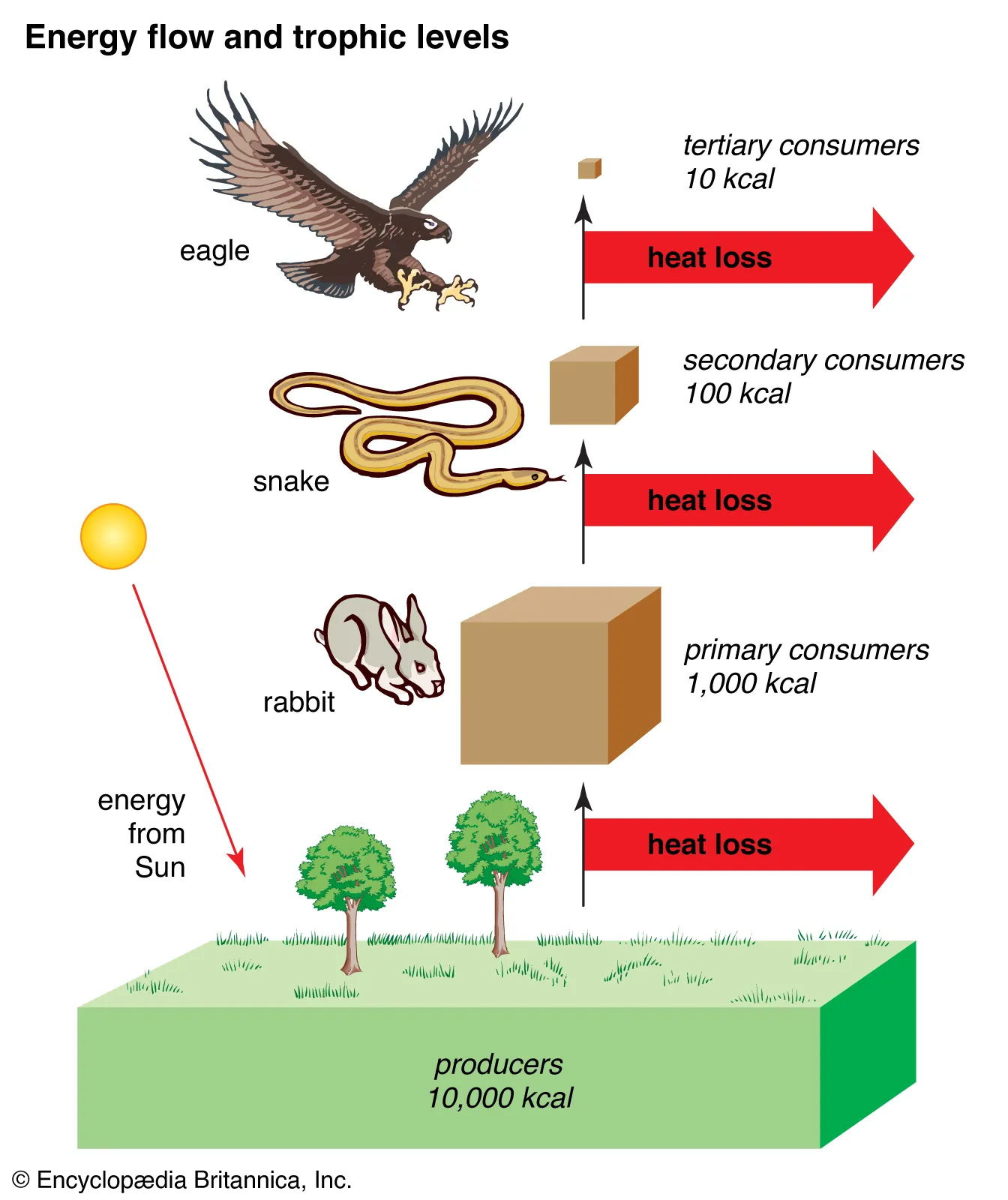
Trophic levels
The different levels organisms occupy in a food web, showing how energy flows through an ecosystem, Levels include: Producers/Primary Producers, Primary Consumers, Secondary Consumers, Tertiary Consumers,(and if there are any)Quaternary Consumers
The 3 explanations of why soil is our support system
Gives plants nutrients and a place to grow
The organisms on the soil are an important part of nutrient cycles
Human food production depends directly on soil
The 5 major elements in most organisms using SHPOC
Sulfur
Hydrogen
Phosphorus
Oxygen
Carbon
The 5 steps in the simplified Hydrologic Cycle?
Evaporation, Precipitation, Transpiration, Runoff, Condensation

Denitrification?
Process by which the bacteria in the soil return nitrogen gas back into the atmosphere, removing access to nitrogen for plants
