algorithms midterm
 Call Kai
 Learn
Learn Practice Test
 Spaced Repetition
 Match
Match Flashcards
 Knowt Play
1/67

There's no tags or description
Looks like no tags are added yet.
Name | Mastery | Learn | Test | Matching | Spaced | Call with Kai | Chat |
|---|
No analytics yet
Send a link to your students to track their progress
68 Terms
waterfall model
identify, design, implement, test, maintain
identify step
understand requirements, abstract idea of end result, follow software specifications
design step
considers low level requirements, determines data types and operations
implementation step
realization of an application, execution of a plan, idea, design, specification, selects language for coding procedure
testing/executing/debugging step
testing in real environments, finding and reducing bugs or errors in program
maintenance step
adding any modifications to handle new sw or hw components, cope with new problems or requirementst
three different abstractions
procedural abstraction, data abstraction, abstract data type
procedural abstraction
using subroutines, subfunctions, or submethods, writing subprograms as black boxes, hides details of process under a method name with parameters, breaks code into pieces, reusable
data abstraction
collections of data containing data + operations as abstract entities, uses class keyword to hide the detailed implementation, represents needed information without presenting details, abstract and extends keywords
abstract data type
separated object from an implementation, uses new keyword to create an object, considers one object whose behavior is defined by a set of data and operations
object oriented analysis
a method of analysis that examines requirements from the perspective of the classes and objects found in the problem domain, identifies and defines problem, requirements, and conceptual model of a software system, base model
object oriented design
process of planning a system of interacting objects for the purpose of solving a software problem, defines objects and interactions, can use UML to help model system
object oriented programming
software implementation technique to support analysis and design, supports inheritance and polymorphism, uses practice of abstraction and encapsulation
use case diagram
describes functional requirements of a system by showing the interactions between users (actors) and systems functionalities (use cases)
class diagram
represents classes, attributes, and methods, and the relationships between them, visually depicts encapsulation, inheritance hierarchies, and the static structure of a system
sequence diagram
illustrates dynamic interactions between objects over time, shows the ordering of messages exchanged between them, helps visualize how objects collaborate to achieve a specific functionality, demonstrates the flow of control and communication
encapsulation
grouping operations and attributes together into a single object, using classes
information hiding
hiding the details and implementation of data and methods for changing an objects state by presenting only an object’s behavior, using access identifiers
inheritance
a relationship among classes where one class shares the structure and/or behavior defined in one or more other classes, using derived classes (single, multiple, multilevel)
polymorphism
allows for a single interface to be used for different types of entities, allows an object to be treated as instances of their base class, overloading, overriding
constructor
used to initialize objects, ex: public class test {…}, every class inherently has a constructor
default/no argument constructor
constructor that takes no parameters
ex: class SRU {
int num;
string name;
}
SRU () {….}
paramterized constructor
a constructor that has parameters
ex: class SRU {
int num;
string name;
}
SRU (String name, int id) {..}
copy constructor
creates a new object by copying the field values of an existing object of the same class that is passed as an argument
ex: class Person {
Person (Person another_object) {
..}
…}
shallow copy
does not create a real object, set of the same memory location
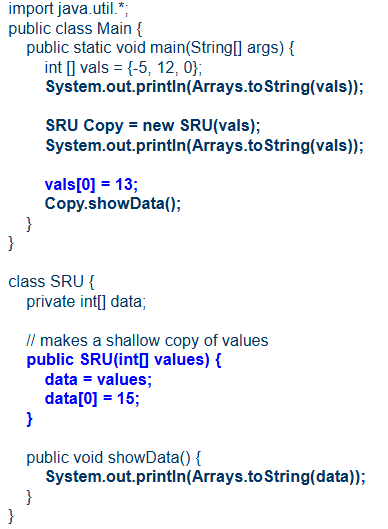
deep copy
the ability to copy a composed objects values to another new object, creates new memory space

static polymorphism
compile time, fast speed since already linked, less flexible since requires a certain load time, uses method overloading
method overloading
allows more than one method to have the same name but they have different parameters or different data types

dynamic polymorphism
anything that is created can be changed during runtime, flexible since links are dynamic, slower because of additional linking process, method overriding
method overriding
runtime polymorphism, a child class can access and inherit the implementation of methods provided by the parent class, for objects of same type method is invoked via parent reference

primitive data type
pre-defined types of data, int, float, character, boolean
non-primitive data type
not defined by the programming language but instead are created by the programmer/user, class, string, object, array
overflow
an error that occurs when there are not enough bits to express the value,
underflow
values too close to zero to be represented
negative overflow
very small integers, < -232
positive overflow
very large integers, > 232
negative underflow
a value is too small negative number to be stored, -2^-127 <= very small negative number < 0
positive underflow
a value is too small positive number to be stored, 0 < (very small positive number close to 0) <= 2^-127
round off error
most real numbers do not have final exact binary representations, may be compounded in a sequence of operations, (0.7)100000
class
user defined data type that is used to create objects, contains a set of properties and methods that are common and exhibited by all the objects of the class, body and members, class name, access modifiers, superclass
interface
a tool to achieve abstraction, and it can define abstract class without a method body, specifies a set of methods that the class has to implement, blueprint of a class
string
non-primitive, holds a sequence of characters in a single variable, a class and type that encapsulates a set of characters and provides additional feature
arrays
non-primitive, used to store elements of the same data type in a contiguous manner, users declare and intialize, stored in an indexed manner
pointer
a variable whose value is a memory address, used as an indirect reference
address operator
&, returns memory address of operand
*
indicates a variable is a pointer, dereferencing/indirection
typedef
reserved keyword to create an alias name for a specific data type
typedef syntax
typedef <existing_name> <alias_name>;
enum
A special data type that represents a group of constraints
enum example
enum Color = { RED, ORANGE, YELLOW,
GREEN, BLUE, INDIGO, VIOLET };
generic method
uses angle brackets to represent type parameters, specifically defined as a method that declares its own parameters, cannot replace a primitive data type
generic method syntax
public static <T> void methodName (T element)
{ ....... }
generic method with array
public static <E> void print (E[] list)
{ .....}
generic class
includes a type parameter in class declaration by < > syntax to specify the parameter type, looks like a normal class declaration, except that the class name is followed by a type parameter section < >
generic class syntax
ClassName <Type> obj = new ClassName <Type> ();
generic class with primitive data type
// client code
public class Generic {
public static void main(String[] args) {
Room <Integer> myRoom = new Room <Integer>();
...... }
// make a generic class
public class Room <T>
{ .........
.........
}
generic class with object
independent, Object as the type parameter, without relying on limiting yourself to wrapper classes such as Integer, double, character, string
ClassName <Object> obj = new ClassName <> ();
generic advantages
stronger type checks at compile time, elimination of cast, generic algorithms, code reuse
generic programming
allows one piece of data to have multiple data types rather than being dependent on a specific data type
stronger type check at compile time
allows errors to be detected at compile time rather than at runtime, Provide early information on program errors about whether an object is an acceptable type or not,
elimination of cast
no need for a type-casting process for object as required for Java
instead of this: String s = (String) list.get(0);
use this: String s = list.get(0);
generic algorithms
work on different types of objects, can be customized, and are type safe and easier to read
code reuse
can write a method, class, or interface once and use for any type again
array types
static arrays and dynamic arrays
static array
once the number of locations to store in the computer is specified, that number cannot be changed unless the instructions are changed. Compiler determines how memory is allocated at compile time
dynamic array
programmers designated the number of array locations as variable, which means that the memory allocations can be expanded or contracted at runtime
one dimensional array
simplest array structure, consists of one column of memory location, collection of similar data type, fixed size, stores value on basis of index value
two dimensional array
a block of memory locations associated with a single memory variable designated by “row” and “column” numbers, a table which has row and column number, row # is first then column #