4. Cell Adaptaion, Injury, and Death Pt. 4
 Call Kai
 Learn
Learn Practice Test
 Spaced Repetition
 Match
Match Flashcards
 Knowt Play
1/51

There's no tags or description
Looks like no tags are added yet.
Name | Mastery | Learn | Test | Matching | Spaced | Call with Kai | Chat |
|---|
No analytics yet
Send a link to your students to track their progress
52 Terms
What is direct interaction?
When a chemical damages particular organelles or critical cell molecules by focused influence
What is conversion to reactive toxic metabolites?
An indirect mechanism of chemical injury to cells
Where are toxic metabolites usually produced?
In the smooth endoplasmic reticulum of the liver by cytochrome P-450
What are toxic metabolites?
Free radicals or electrophiles forming adducts
How is acetaminophen detoxified in the body?
Conversion to glucuronide and sulfate conjugates which are water soluble and excreted in the urine
Acetaminophen can be converted (usually only small amounts) to what highly reactive metabolite by P450?
NAPQI
Which species is acetaminophen toxicity more common in?
Felines
What is the effect of NAPQI?
Neutralizing specifically depleting the glutathione stores leading to oxidative stress
What metabolitic molecule do dogs and cats appear to relatively produce more of?
Para-aminophenol
What does para-aminophenol do?
Oxidative damage to hemoglobin in RBCs
What is carbon tetrachloride (CCl4) toxicity? **
Grossly visible changes that are indicative of cell injury are immediately noticeable.
False, usually takes hours
You would lose function of heart muscle before you see myocardial necrosis with a coronary artery blockage.
True
What is the correct sequence with respect to time of heart muscle after a coronary artery blockage?
Biochemical changes → EM changes → LM changes → Gross changes
What is a major way that irreversible injury occurs?
Persistence of stimulus or severe stimulus from the start
What are the two features that characterize irreversibility?
Irreversible mitochondrial dysfunction and profound disturbances of membrane function
What are the cellular changes that are typically reversible?
Swelling and fatty change
What are the cellular changes that are irreversible?
Necrosis and apoptosis
What is the major hallmark of cellular swelling?
Loss of ion and fluid homeostasis
What is the uncut gross appearance of cellular swelling?
Swollen organ with rounded edges
What does the cut surface of cellular swelling look like?
Tissue bulges and wet/heavy

What is demonstrated by the kidney on the right given that the kidney on the left is normal?
Cellular swelling
What is the histological appearance of cellular swelling?
Enlarged cells with a pale cytoplasm but the nucleus remains in normal position
What is it called when there is mild cell swelling giving cytoplasmic staining of the cell a slightly washed out appearance?
Cloudy swelling/mild hydropic degeneration
What is it called when there is moderate cell swelling that leaves poorly delineated vacuoles appearing in the cytoplasm?
Hydropic (vacuoles) degeneration
What is it called when there is severe cell swelling that leaves poorly delineated vacuoles appearing in the cytoplasm?
Ballooning degeneration
What kind of cells is ballooning degeneration usually seen in?
Virus infected cells
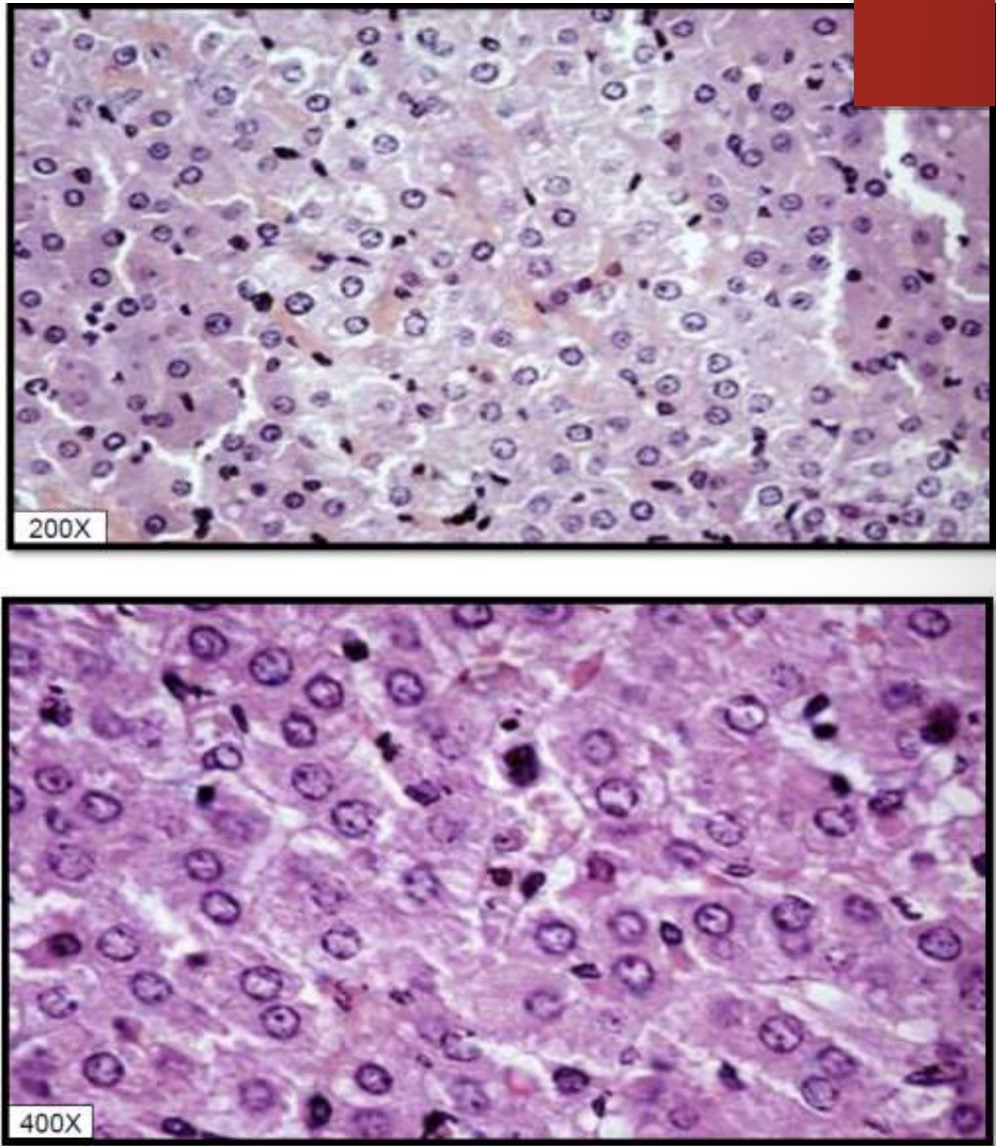
What is the example given by the pictures?
Cloudy swelling/mild hydropic degeneration

What example is given by the following images?
Hydropic (vacuoles) degeneration

What is shown in the images?
Ballooning degeneration
How long does it take affected heart muscle to stop contracting in the event of coronary occlusion?
60 seconds
How long can a myocardial cell go without oxygen before it is irreversibly injured?
20-60 minutes
What is lipidosis?
Fatty degeneration
What is the etiology and pathogenesis of lipidosis?
Occurs in various forms
Accumulation of lipids within the cell due to abnormalities of fat uptake, utilization, and/or mobilization
Where does lipidosis usually occur?
In cells highly involved with fat metabolism (i.e. liver)
What is the medical term for fatty liver?
Hepatic lipidosis
What can preceded or even accompany hepatic lipidosis?
Cellular swelling
What are the causes of hepatic lipidosis?
Increased uptake
Altered metabolism
Decreased export
What are the mechanisms of increased uptake of hepatic lipidosis?
Increase in dietary fat
Negative energy balance with increased mobilized fatty acids from body fat stores and decreased protein synthesis
What are some examples of negative energy balance that can cause hepatic lipidosis?
Starvation
Diabetes mellitus
Pregnancy toxemia
Etc.
What are the mechanisms of action of altered metabolism in hepatic lipidosis?
Hypoxia leading to decreased oxidation of fatty acids and decreased protein synthesis
What are the results of the decreased export mechanism of hepatic lipidosis?
Decreased protein synthesis
What is the gross appearance of the liver in hepatic lipidosis?
Diffusely yellow if all cells are affected
Reticular pattern if zones of hepatocytes are affected
Edges rounded and will bulge on cut section
Cuts easily and has a greasy texture
What can happen in severe cases of hepatic lipidosis?
Liver may float in fixative or water

What is demonstrated by the images?
Severe diffuse hepatic lipidosis
What are the histological changes due to hepatic lipidosis?
Presence of well delineated, lipid-filled vacuoles in the cytoplasm

What is demonstrated within the image on the right if the left is normal?
Hepatic lipidosis
What are the other names that lipidosis can go by?
All of these
What stain can you use to confirm that it is fatty change that is appearing histologically?
Oil Red O

What is being shown in the image?
Myocardial lipidosis

Assign normal or myocardial lipidosis to the following picture.
Left = normal; right = myocardial lipidosis