Chapter 9: DNA and Its Role in Heredity
 Call Kai
 Learn
 Practice Test
 Spaced Repetition
 Match
 Flashcards
 Knowt Play
1/46

47 Terms

Early evidence for DNA
Included:
DNA is present in the nucleus and in condensed chromosomes
DNA doubles in abundance during the S phase of the cell cycle
DNA is twice as abundant in the diploid than in the haploid cells of an organism
These were discovered through staining and extraction of DNA
Experimental evidence for DNA
Included:
DNA affected the development of organisms that take it up
DNA encodes information that affects cell responses
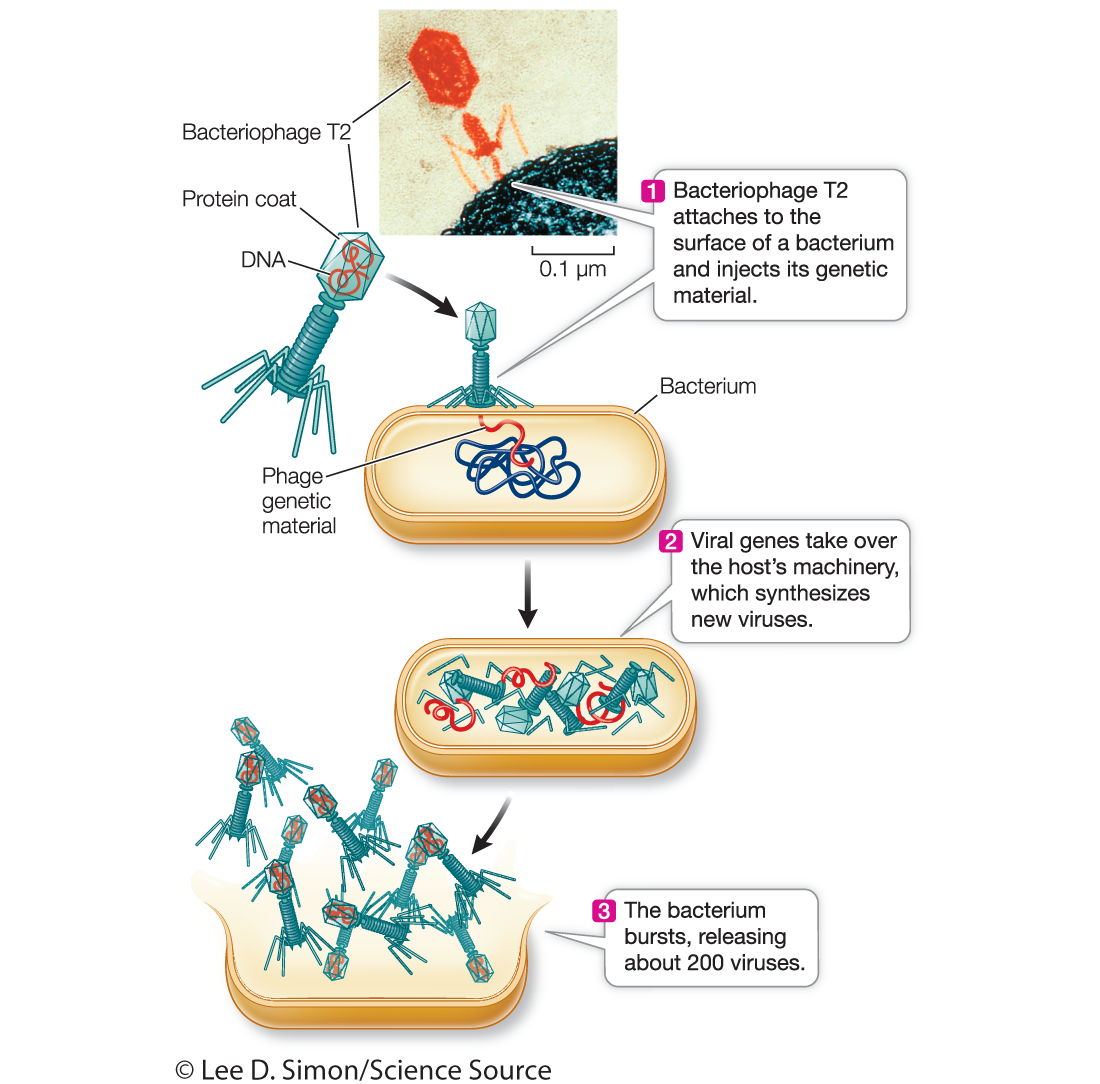
These were discovered through experiments with bacteria transformation and bacteriophages (viruses), using selective degradation and radioactive marking to determine effects respectively
Chargaff’s rules
States that:
The abundance of adenine is equivalent to the amount of thymine (A = T)
The abundance of guanine is equivalent to the amount of cytosine (G = C)
The relative abundances of the two groups to each other are not all equal

Rosalind Franklin
An English chemist who successfully imaged the shape and structure of DNA using X-ray crystallography, most importantly highlighting its helical, thin, and consistently thick shape

James Watson and Francis Crick
An American geneticist and English physicist pair that described the structure of DNA using chemical models, developing a structure that explained all its known properties
Sugar-phosphate backbone
The structure comprising the hydroxyl group on the 3’ carbon and phosphate group on the 5’ carbon, linking nucleotides together
Forms antiparallel with the other strand, building the 3’ and 5’ groups in opposite directions
Twists to form a clockwise (right-handed) helix every 10 nucleotides

Major and minor grooves
The wider and narrower sides of the helix, respectively, due to differences in sugar-phosphate backbone distance on each side
Combined with chemical differences in base pair orientations, these allow molecules to differentiate and bind to sequences, particularly from the wider side
Complimentary base pairs
The specific pairings of nucleotides with each other, explaining Chargaff’s rules and Franklin’s observed thickness
Adenine to thymine (A-T) with 2 hydrogen bonds
Guanine to cytosine (G-C) with 3 hydrogen bonds

Proposed replication methods
Included:
Semiconservative replication (each strand is used as a template for a new strand)
Conservative replication (strands remain together while two new strands are created separately)
Dispersive replication (strands are dispersed in the new daughter molecules)

Semiconservative replication
A proposed method of replication where each parental molecule strand serves as a template for a new strand

Conservative replication
A proposed method of replication where the parental molecule remains intact with two newly created strands

Dispersive replication
A proposed method of replication where daughter molecules are composed of new and original parental DNA

Meselson-Stahl experiment
An experiment performed by Matthew Meselson and Franklin Stahl that demonstrated the semiconservative replication of DNA, where:
Bacteria was grown in a 15N medium, and then transferred to a 14N medium
DNA was collected at different periods in time to allow for replication
DNA densities were measured in a salt gradient, finding that:
DNA was dense at first
The two DNA strands after replication were then intermediately dense
The four DNA strands after replication were then two intermediately and two light strands
DNA replication steps
Include:
Initiation (denaturation and separation of DNA molecules, synthesis of RNA primers)
Elongation (synthesis of new DNA molecules starting from RNA primers, using strands as templates)
Termination (stoppage of replication after completion)
Elongation
The second step of DNA replication, involving the synthesis of new DNA molecules starting from RNA primers, using strands as templates
Termination
The final step of DNA replication, involving stoppage of replication after completion
Initiation
The first step of DNA replication, involving denaturation and separation of DNA molecules and the synthesis of RNA primers
Origin of replication (ori)
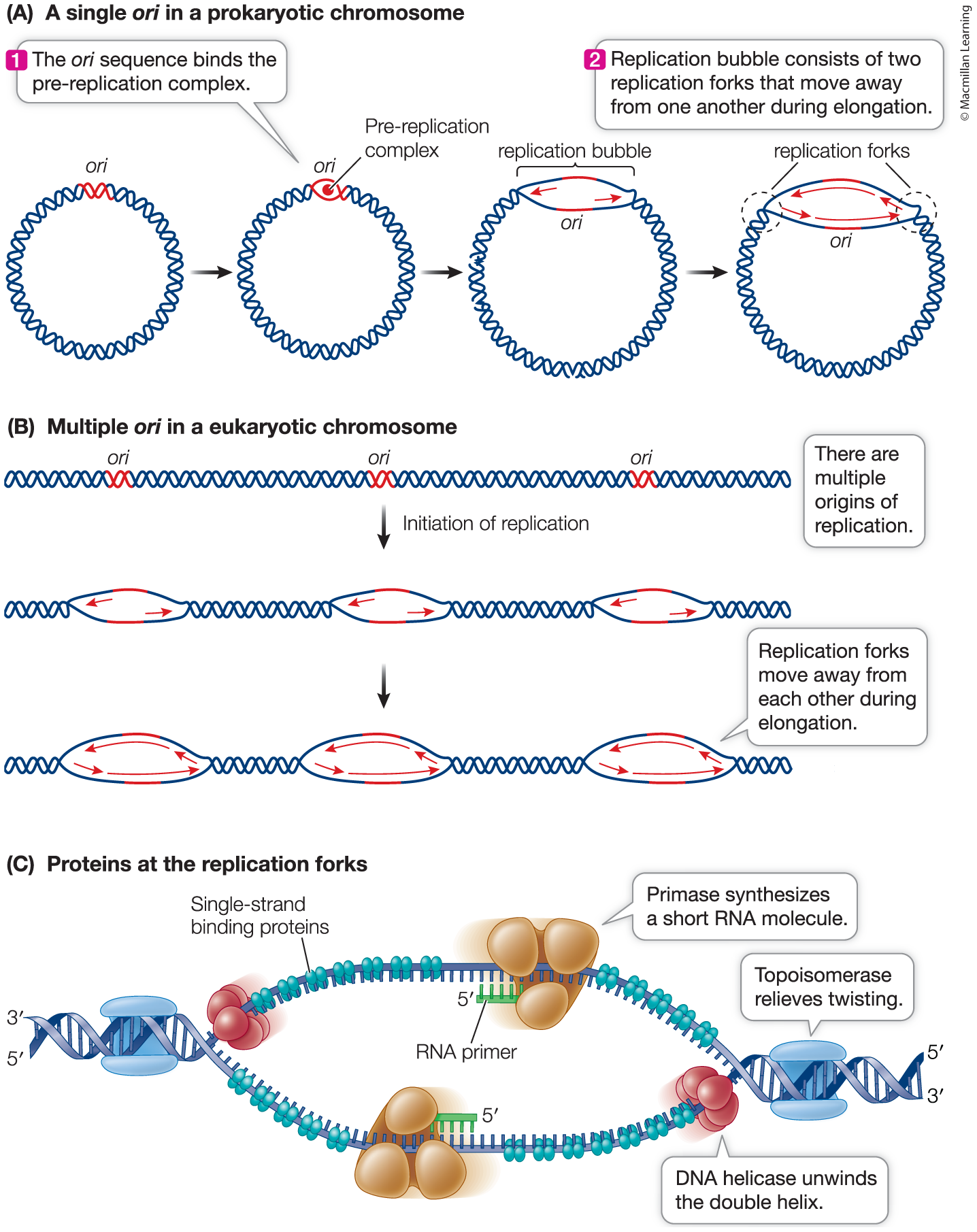
Where DNA synthesis is initiated, as two DNA helicase enzymes unwind the parent molecule and create an exposed replication fork for access to replication proteins
Additional twisting after unwinding is relieved by topoisomerase, which break and rejoin the backbone
Prokaryotes have one of these, eukaryotes have many due to large number of base pairs
RNA primer
A RNA signal synthesized by RNA primase after denaturation, complimentary to the template strand
Used by DNA polymerase to initiate DNA synthesis due to the need for a double-stranded molecule
DNA polymerase
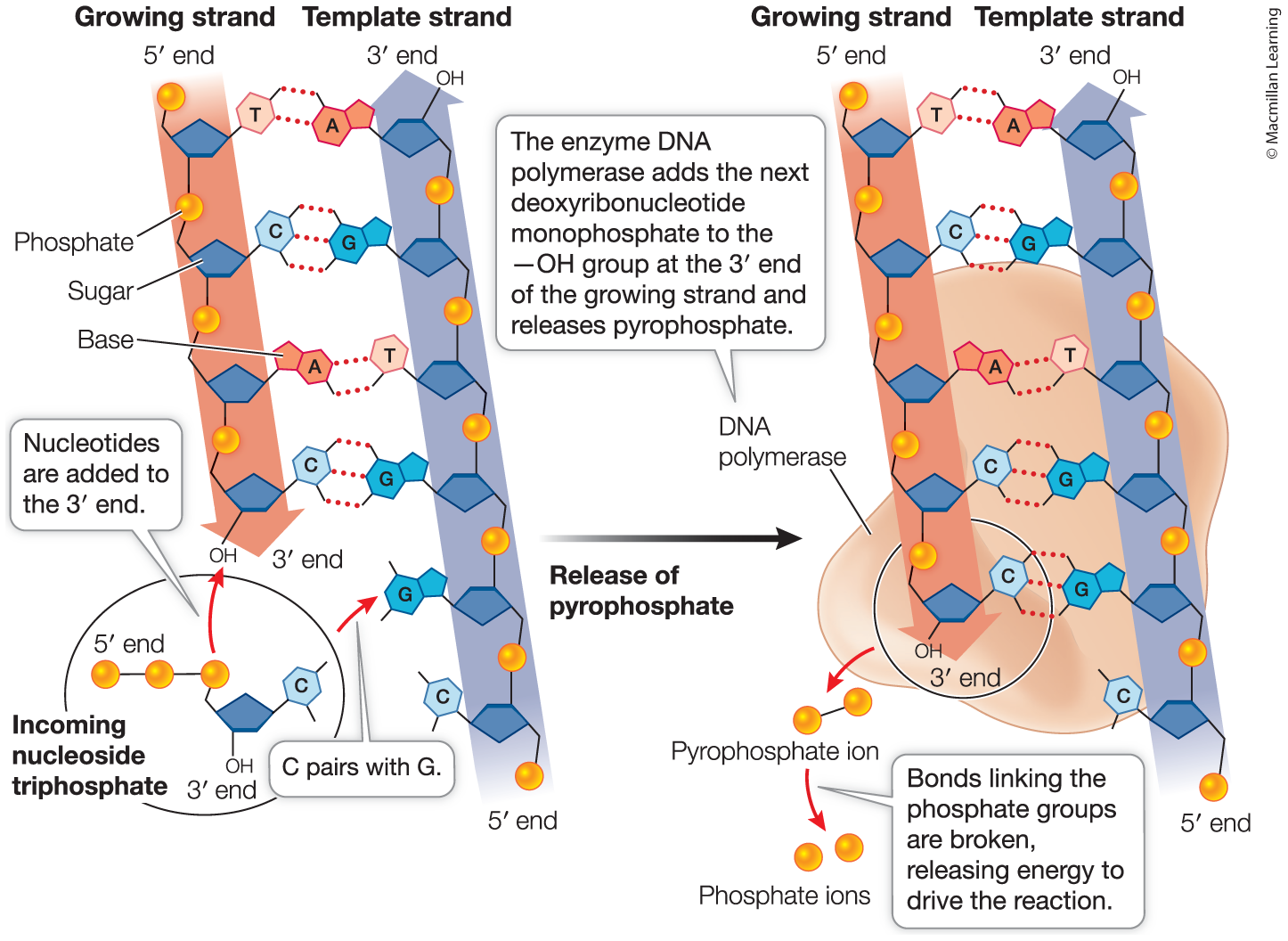
An enzyme that catalyzes the synthesis of DNA, initiated by an RNA primer and energized by a released pyrophosphate ion
Synthesizes DNA in the 5’ to 3’ direction, reading DNA in the 3’ to 5’ direction
5’ to 3’
The direction of DNA synthesis, requiring a reading of DNA in the 3’ to 5’ direction
Bases in the new strand are complimentary to the template strand
Phosphodiester bonds are added to form this link, releasing a pyrophosphate ion for energy

Leading strand
The template strand that can be synthesized continuously by DNA polymerase

Lagging strand
The template strand that is synthesized discontinuously, as replication must proceed in the opposite direction of the replication fork, leaving emptiness without the continuous addition of primers to make Okazaki fragments
These RNA primers must later be removed and replaced with DNA to complete replication, which is then joined by DNA ligase
DNA ligase
An enzyme that joins two DNA fragments on a lagging strand following the replacement of RNA primers with an unjoined DNA fragment
Okazaki fragments
Short strands of DNA that are synthesized discontinuously on the lagging strand, stopping before the next RNA primer
Terminal site (ter)
This is created when two replication forks meet, or when termination sequences occur (in prokaryotes)
Proteins prevent the further replication of DNA

End-replication problem
A problem present at the end of the lagging strand of DNA where, after removal of the RNA primer, no DNA can be synthesized by DNA polymerase due to the lack of a 3’ end to extend
Mitigated by the repeated addition of telomeres (which do not code for proteins) that can be replaced by telomerase, which synthesizes DNA using RNA as a template to allow DNA polymerase to finish

Telomeres
Non-coding end sections of DNA that protect coding sections of DNA from being lost to the end-replication problem and protect chromosome ends from being treated as chromosome breaks that need to be joined
Replaced by telomerase after loss due to DNA replication and repair
Incorporation error rate
The probability that an incorrect base will be inserted into a new strand of DNA, creating a mismatch
These are mitigated by proofreading (immediate removal and replacement) and mismatch repair (scanning by a complex for removal and replacement by cellular processes)

Proofreading
A function of DNA polymerases where mismatched nucleotides are removed immediately after being placed down

Mismatch repair
A function of a specialized complex where newly replicated molecules are scanned for helix irregularities, removing and replacing incorrect fragments when found
Point mutation
A mutation that substitutes, deletes, or inserts a single base pair in a DNA molecule

Base-pair substitution
A type of point mutation that leads to a change of a single base pair (A-T to G-C), created through:
Erroneous replacing of the original instead of the new strand
Lack of repair before the next round of DNA replication

Tautomers
The two structural isomeric forms of a base; having a rarer form present can result in the incorrect pairing of another base

Deamination
The removal of an amino group in a base, resulting in a different base form; this can result in mispairing that is passed down after replication
Spontaneous mutations
Mutations caused by polymerase errors or spontaneous chemical change in bases
Mutagens
Substances that chemically alter DNA and lead to induced mutations (unlike spontaneous mutations)
Commonly related to cigarette smoking, certain dietary components, and radiation; these can often be mitigated

Excision repair
The repair of damaged nucleotides with their replacement by normal ones
Involves proteins that remove the fragment for repair by DNA polymerase and ligase
Silent mutations
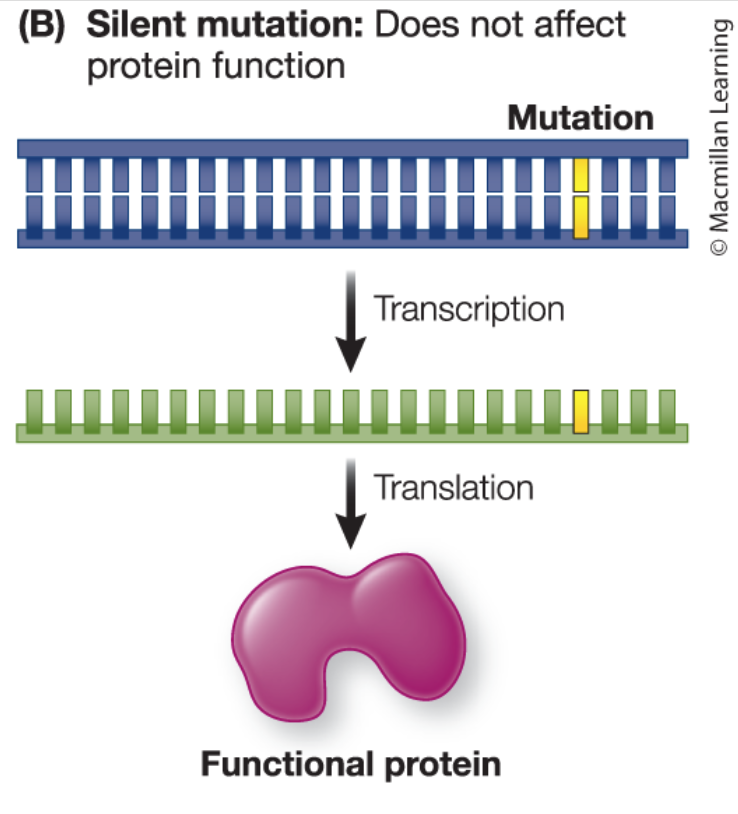
Mutations that do not change the amino acid sequence or function of the protein

Loss-of-function mutations
Mutations that occur due to low expression or nonfunctional protein production
Often recessively inherited, as a wild-type allele usually results in sufficient functional protein

Gain-of-function mutations
Mutations that lead to proteins with altered function
Often dominantly inherited, as the mutant allele results in a still functioning protein
Conditional mutations
Mutations that affect the phenotype only under certain environmental conditions
Often seen with temperature-sensitive traits, such as coat color in rabbits
Nonhomologous end joining
The joining of two broken ends without regard for homology, potentially joining separate pieces of DNA to cause chromosomal mutations
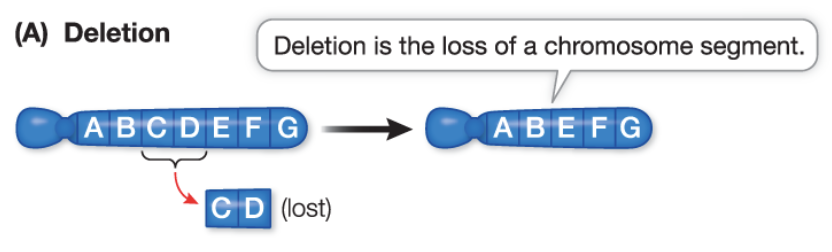
Deletion
The loss of a chromosome segment, typically with severe consequences due to gene absences

Duplication
The repetition of a chromosome segment, resulting in multiple copies of that segment
Occur due to crossing-over errors between homologous chromosomes, producing a deletion in the other chromosome
Typically have mild effects on phenotype due to over-expression of genes

Inversions
Mutations where a chromosome segment is reversed in sequence
Occur due to cutting out and rotation, resulting in a reversed sequence in the chromosome

Translocations
Mutations where non-homologous chromosomes exchange segments
Can potentially be harmless if break points do not interrupt genes, but otherwise can cause erroneous expression