Flashcards Nutrition Chapter 10: Water-Soluble Vitamins, B Complex, C & Choline
 Call Kai
 Learn
 Practice Test
 Spaced Repetition
 Match
 Flashcards
 Knowt Play
1/29

There's no tags or description
Looks like no tags are added yet.
30 Terms
What are vitamins?
Organic molecules that are essential and vary in structure, properties, and functions.
How are vitamins categorized?
Vitamins are categorized as water-soluble or fat-soluble.

Name two examples of water-soluble vitamins.
B vitamins and Vitamin C.
What are the fat-soluble vitamins?
Vitamin A, Vitamin D, Vitamin E, and Vitamin K.

How are water-soluble vitamins absorbed?
They are absorbed in various ways, with transporter numbers adjusted based on body need.
What can impair the absorption of fat-soluble vitamins?
Very low fat diets.
What is bioavailability?
How well a nutrient in food can be digested, absorbed, and used by the body.
What factors affect bioavailability?
Form of vitamin, type of food, storage conditions, food processing, and cooking.
Where can fat-soluble vitamins be stored?
In the liver and adipose tissue.
How are vitamins and their metabolites excreted?
Mostly in urine or feces.
What is the function of vitamins in the body?
Promote and regulate body processes, including making coenzymes and acting as antioxidants.
What are coenzymes?
Small, nonprotein, organic molecules necessary for enzyme function.
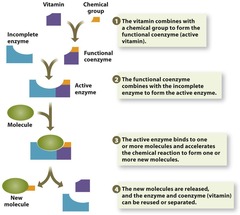
What is the recommended intake for Thiamin (B-1) for adults?
1.2 mg.
What is the deficiency associated with Thiamin?
Beriberi, which can cause anorexia, lethargy, and neuropathy.
What is the coenzyme form of Riboflavin (B-2)?
FAD (Flavin adenine dinucleotide).
What deficiency is associated with Niacin (B-3)?
Pellagra, characterized by the 3Ds: Dermatitis, Diarrhea, and Dementia.
What are the symptoms of Niacin toxicity?
Flushing, rash, nausea/vomiting, and liver abnormalities.
What is the primary function of Vitamin B6?
Amino acid metabolism and neurotransmitter synthesis.

What is the deficiency associated with Folate?
Anemia and neural tube defects.
What is the main source of Vitamin B12?
Foods from animals, such as meat, poultry, fish, milk, and cheese.

What is the function of Vitamin C?
Acts as an antioxidant, aids in collagen synthesis, and improves iron absorption.
What deficiency is associated with Vitamin C?
Scurvy, leading to bleeding gums, bruising, and poor wound healing.
What is the primary function of choline?
Used to make acetylcholine and phospholipids.
What can result from choline deficiency?
Fatty liver, muscle damage, and poor fetal brain development.
What is the UL for Vitamin C?
2000 mg.
What is the UL for Niacin from supplements?
35 mg.
What is the EAR for Vitamin B6?
1.1 mg.
What is the RDA for Folate expressed in?
Dietary Folate Equivalents (DFE).
What is a common source of biotin?
Produced by intestinal bacteria and widespread in foods.
What is the toxicity level for Pantothenic Acid?
None reported (No UL).