C1.2
 Call Kai
 Learn
 Practice Test
 Spaced Repetition
 Match
 Flashcards
 Knowt Play
1/8

Earn XP
Description and Tags
Respiration
9 Terms
What is the energy in ATP used for?
synthesizing things
transporting stuff
motor proteins
Draw ATP

Respiratory Quotient
Step 1: Write down the respiration equation
C6H12O6 + O2 → CO2 + H2O
Step 2: Balance the equation
C6H12O6 + 6O2 → 6CO2 + 6H2O
Step 3: Use the RQ formula
RQ = CO2 ÷ O2
RQ = 6 ÷ 6
RQ = 1.00

Draw a mitochondria

Glycolysis:
Location: cytoplasm
Anaerobic
In anaerobic (low O2) conditions the pyruvate from glycolysis cannot enter the next phase of respiration in the mitochondria.
As such the pyruvate is used as an electron and H+ acceptor to recycle reduced NAD (NADH) and regenerate NAD.
The NAD can then be used as an electron acceptor to oxidise glucose in glycolysis and so generate 2 ATP over all.

Link Reaction

Respiratory Substrates
Carbs can be broken down into monosaccharides like glucose which can be used in glycolysis
Proteins can be broken down into amino acids and can be used in the Krebs cycle
Lipids can be broken down into a glycerol and 3 fatty acids which can be turned into Acetyl CoA for the Krebs cycle. Gram for gram lipid produce twice as much ATP than carbs due to O2 in fatty acids
Neither lipids or proteins go through gylcolysis they can only be turned into Acetyl CoA for the Krebs cycle.
Krebs Cycle
Occurs in the matrix
In the Krebs Cycle Citrate is decarboxylated to a 5C compound. CO2 is released.
Whenever a decarboxylation occurs you always get a dehydrogenation so NADH is formed.
The 5C compound also undergoes a Decarboxylation and Dehydrogenation.
Two more dehydrogenations occur in a double oxidation step. This reduces the electron carriers, NADH and FADH2, to regenerate the 4C Oxaloacetate.
The entire Krebs Cycle only forms 2 ATP per glucose molecule.

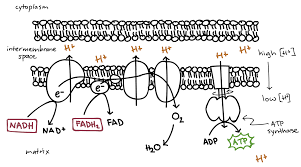
Electron Transport Chain
ETC occurs in the mitochondrial inner membrane/cristae.
Energy from the movement of electrons is used to pump hydrogen ions into the intermembrane space
the inner membrane is impermeable to hydrogen ions and so this builds up an electro-chemical gradient
At the end of the ETC the electrons are picked up by oxygen (last electron acceptor) to form water
hydrogen ions diffuse through the ion channels associated with ATP synthase.
The flow of hydrogen ions is called chemi-osmosis
As hydrogen ions pass through the ATP synthase ion channel, the energy released is used to join ADP + Pi to form ATP
The electrons are passed to final electron carrier, oxygen, called oxidative phosphorylation