Final Exam- Microbiology
 Call Kai
 Learn
 Practice Test
 Spaced Repetition
 Match
 Flashcards
 Knowt Play
1/835

Earn XP
Description and Tags
Exam 1, 2, 3, 4
836 Terms
What are the 7 major types of species interactions?
Mutualistic, commensalism, amensalism, parasitism, altruism, competition, and neutralism
Describe a competition symbiotic relationship?
both species are harmed
Describe a mutualistic symbiotic relationship?
both species benefit(ex.gut bacteria)
Describe a commensalism symbiotic relationship?
one benefits while the other is unaffected
Describe a amensalism symbiotic relationship?
one species is harmed while the other is unaffected
Describe a parasitism symbiotic relationship?
one species benefits at the expense of the other
Describe a altruism symbiotic relationship?
one sacrifices itself to benefit another
Describe a neutralism symbiotic relationship?
no significate interaction
What are the 3 types of infection reservoirs?
Human(spread most effectively), animal, environmental(nonliving)
What are 4 portals through which pathogens invade the body?
skin, mucous membranes, placenta(rare), parenteral route
What are adhesion factors?
specialized structures that facilitate attachment to host cell
What are biofilms?
sticky web of bacteria and polysaccharides that adhere to surface within a host.
Define infection?
successful invasion by pathogenic microorganisms
Define disease?
a disorder form or function that has a known cause and a distinctive set of objective signs and subjective symptoms.
Define morbidity?
overall incidence/prevalence of a disease in a population(# of affected people)
Define pathogenicity?
the potential ability to cause disease
Define virulence?
the severity/harmfulness of a disease
Define virulence factor?
the variety of traits that enable pathogens to enter a host, adhere to host cell, gain access to nutrients, and escape immune system detection.
What are virulent pathogens?
have one or more virulence factors that nonvirulent microbes lack. Virulence is a spectrum more virulence factor= greater potential for serve infection.

What are the 3 main categories of bacterial virulence factors?
A. Extracellular Enzymes
B. Toxins
C. Antiphagocytic factors
How antiphagocytic factors affect virulence?
They help pathogens to evade the immune system
How microbial extracellular enzymes affect virulence?
They break down host tissues, promoting the spread of infection.
Blank may disrupt normal flora in both humans and animals, potentially increasing the spread of zoonotic diseases by allowing antibiotic-resistant pathogens to thrive.
Broad-spectrum antibiotics

What are the 5 stages of infectious disease?
Incubation period= time between exposure and first symptoms
Prodromal period= vague early symptoms
Invasion period= full blow illness(includes acme(disease peak)
Decline phase= symptoms begin to subside
Convalescence period= body begins repairing damage
Sequelae = remaining symptoms/damage that body can’t repair(in some cases)

What are 3 methods of transmission?
Contact transmission, vehicle transmission, and vector transmission.
How is disease passed via contact transmission?
spread of pathogens through direct physical contact, indirect contact(body fluids, surfaces fomites), or respiratory droplets withing 1m.
How is disease passed via vehicle transmission?
vehicle fomites (food, water, air, or medical products)
How is disease passed via vector transmission?
arthropods transmit disease through either biological vector(transmit and serves as host for pathogen) to mechanical vectors(transport contact without hosting the pathogen).
Define epidemiology
study of where and when diseases occur and how they are transmitted within a population.
What is the difference between incidence and prevalence of a disease?
Incidence refers to the number of new cases of a disease in a specific time period, while prevalence indicates the total number(new and existing) of existing cases at a given time.
What is a subacute disease?
A disease that has a duration and severity between acute and chronic diseases.
What is a latent diseases?
appears a long time after infection
What is a communicable vs a noncommunicable disease?
A communicable disease is caused by infectious agents and can be transmitted from one host to another, while a noncommunicable disease is not transmissible and is often due to genetic, environmental, or lifestyle factors.
What is a local infection?
It is an infection localized in one area that can spread pathogens to other parts of the body.

Label the 4 types of epidemiology infection spread.
A. Endemic= constant pressure of a disease in a region.
B. Sporadic= scattered, irregular cases.
C. Epidemic= sudden/unusual increase in cases above normal levels in a specific area.
B. Pandemic= a worldwide spread of a new disease.
What are 3 types of healthcare-associated(nosocomial) infections(HAI’s)?
Exogenous= cause by pathogens acquired from the healthcare environment.
Endogenous= arise from patients own normal microbiota that becomes pathogenic (ex. immunocompromised due to chemo)
Latrogenic= “doctor induced” infection that directly results from treatments like cathedra, invasion diagnostics, or surgery.
Blank is the single most effective way to reduce Healthcare-associated infections(HAI’s)?
effective handwashing
A new disease outbreak occurs in a population of 10,000 individuals. In the first week, 50 new cases are reported. In the second week, 100 new cases are reported.
What is the incidence rate of the disease during the second week?
What is the disease prevalence during the second week?
Formula for incidence rate= New cases/total population.
To find during second week subtract first week from total poupulation(10,000-50= 9950). Then 100/9950= 1%
To find prevalence, use the total number of cases (first week + second week) over the total population. Thus, prevalence = (50 + 100)/10,000 = 1.5%.
As of 15 March 2023, the 7-day average of new COVID-19 cases in the United States was 21,422. This means that 21,422 new cases were reported during this week. This number represented a decrease of 19.7% compared with the previous 7-day average of 26,685. A total of 103,801,821 COVID-19 cases had been reported in the U.S. as of 15 March 2023. Assuming the U.S. population was 332 million, what was the incidence of COVID-19 per 100,000 people during this week?rounded to two decimal places.
To calculate the incidence of COVID-19 per 100,000 people, use the formula: Incidence = (New cases / Total population) X 100,000. Therefore, incidence = (21,422 / 332,000,000) \times 100,000 \approx 6.45.
Why aren't the body's skin and mucous membrane barriers significant factors in your resistance to infection by hyperthermophiles?
Hyperthermophiles are not a significant threat to the body's skin and mucous membrane barriers as they are primarily found in extreme environments.
Which of the following is a physical defense mechanism provided by the epithelium of mucous membranes?
Secretion of mucus to trap and prevent pathogen entry
Lysozyme is an enzyme that is found in a variety of bodily fluids, such as tears, saliva, mucus, and breast milk, as well as in certain white blood cells. Which of the following statements best explains why lysozyme released in tears does not harm a person's eyes?
Lysozyme is only active against bacterial cell walls and does not harm human cells
Differences between innate and adaptive immunity?
Innate immunity is the body's first line of defense, providing immediate but non-specific responses to pathogens(major cell types: phagocytes(monocytes, macrophages, neutrophils, dendritic cells), natural killer cells, innate lymphoid cells, epithelial and endothelial cells), while adaptive immunity is a slower, specific response that develops over time and involves memory cells for future protection(major cell types: T-cells, B-cells, and antigen-presenting cells).
What is a solid physical barrier that is acidic and constantly replaced in humans?
Skin
What are 2 chemical barriers of the skin that prevent pathogen entry?
Perspiration secreted by sudoriferous(sweat) glands and sebum produced by sebaceous(oil) glands.
What 3 substance make up sweat?
Salt=inhibits pathogen growth
Antimicrobial peptides= act against microorganisms
Lysozyme= destroy bacterial cell walls
Blank are below the epithelium capturing and present antigens to T cells.
Dendritic cells(Langerhans cells)
What is the purpose of sebum in skin?
keeps skin pliable/decreases skin breaks and decreases skin pH to inhibit bacterial growth
What is the mucous membrane? What are the 2 layers?
A protective barrier lining all body cavities that open to the environment (like the GI and respiratory tract).
Epithelium= a superficial layer of tightly packed epithelial cells forms a protective barrier preventing pathogen entry, while shedding cells help remove microorganisms. Dendritic cells, goblet cells, and ciliated cells also capture/remove invaders.
Connective tissue layer= supports epithelium by producing chemicals to defend against pathogens
What is the lacrimal apparatus?
Produces and drains tears protecting the eyes by removing debris and delivering antimicrobial enzymes. Consists of nasolacrimal duct, lacrimal canal, lacrimal gland duct, and lacrimal gland.
Blank is all the microorganisms that inhabit a particular environment. It works by competing with pathogens for nutrients and space, inhibiting attachment, and generating antimicrobial compounds. It also supports the immune system for health and provides vitamins.
Microbiome
What are Antimicrobial peptides (AMPs)? What are two types of AMPs?
small defense proteins that inhibit or destroy pathogens by disrupting membranes, blocking attachment, and restricting nutrients like iron (ex. defensins, lysozymes).
What are two types of AMPs?
Host-derived= produced by skin, mucous membrane, neutrophils, and epithelial cells.
Microbial-derived= produced by beneficial microbes to compete against pathogens
What are the 8 digestive system secretion/activities + function as 1st line of pathogen defense?
Saliva= a antibacterial enzyme that contains lysozymes and washes microbes from teeth, gums, tongue, and palate.
Stomach acid= digests and/or inhibits microorganisms
Gastroferritin= sequesters iron being absorbed making it unavailable for microbial use
Bile= inhibitory to most microorganisms
Intestinal secretions= digests and/or inhibits microorganisms
Peristalsis= moved GI contents through GI tract constantly eliminating potential pathogens.
Defecation= eliminating microorganisms
Vomiting= eliminating microorganisms.
What is the role of urinary system in secretion + function as 1st line of pathogen defense?
Urine= contains lysozymes urine’s acidity inhibits microorganism, may wash microbes from ureters/urethra during urination
What are the 3 Reproductive system secretion/activities + function as 1st line of pathogen defense?
Vaginal secretions= acidity inhibits microorganisms; contains iron-building proteins that sequester iron, making it unavailable for microbes.
Menstrual flow = cleanses the uterus and vagina
Prostate secretion= contains iron-building proteins that sequester iron, making it unavailable for microbes.
What are the 2 Cardiovascular system secretion/activities + function as 1st line of pathogen defense?
Blood flow= removes microorganism from wound
Coagulation(blood clotting)= prevents entrance of many pathogens.
The differentiation of hemopoietic(blood) stem cells into blank stem cells results in the production of RBC. While the differentiation of hemopoietic(blood) cells into blank stem cells results in the production of WBC.
erythroid; myeloid
What are the 3 major components of blood?
Plasma, Erythrocytes (RBCs), and Leukocytes(WBCs). Plasma is the liquid component that carries cells and proteins, while RBCs transport oxygen and WBCs are involved in immune response.
What are the 2 categories of Leukocytes(WBC)?
Granulocytes(basophils, neutrophils, eosinophils) and Agranulocytes(monocytes, lymphocytes, macrophages).

Label the centrifuged blood figure.

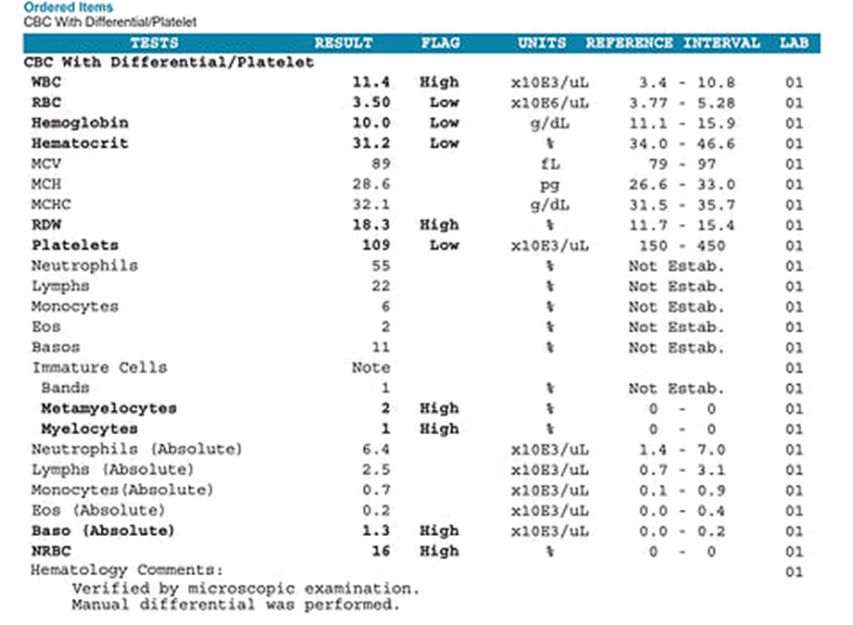
Use the information provided in the normal and abnormal Complete Blood Count (CBC) reports to interpret various blood components and identify potential health conditions.
Given the Complete Blood Count (CBC) results, how would you interpret the findings of the abnormal report, specifically focusing on the white blood cell (WBC) count and hemoglobin levels?
The WBC count is elevated, suggesting an infection or inflammation, and the hemoglobin levels are low, indicating anemia.

The differential count in the abnormal report shows elevated levels of band cells(immature WBCs released by the bone marrow into the bloodstream) and myelocytes. What condition might this suggest about the patient’s bone marrow activity?
The bone marrow is responding to an acute bacterial infection by producing immature white blood cells.
What is a specific challenge that phagocytes face during the adhesion and ingestion stages of phagocytosis?
Preventing the escape of pathogens that possess a glycocalyx.
A patient is diagnosed with a parasitic helminth infection. Blood tests reveal elevated levels of eosinophils. What is the most likely role of these eosinophils in the patient's immune response?
Adhering to the helminths and secreting toxins that weaken or kill them.
Explain the roles of phagocytes in innate immune defense?
Phagocytes protect the body by engulfing, destroying, and removing invading microorganisms via the innate immune system.
What are 3 nonphagocytic killing mechanism that destroy pathogens/abnormal cells without engulfing them?
Eosinophils= attack helminths(parasitic worms) with toxins
Neutrophils= release toxic enzymes and create NETs(neutrophil extracellular traps), which are webs of DNA + proteins that trap and kills bacteria
Natural Killer(NK) cells= induces apoptosis in infected/ cancerous cells by releasing toxic substances onto the surface of the infected cells.
Changes in White blood cell levels can help diagnose infections, immune disorders, anemia, and even some cancers, as they indicate the body's blank?
immune defense

What are the 6 stages of phagocytosis?
1. Chemotaxis - movement towards the pathogen
2. Adherence - attachment of the phagocyte to the pathogen
3. Ingestion - engulfing the pathogen into a phagosome
4. Phagosome formation/maturation - fusion with lysosomes to form a phagolysosome
5. Digestion - destruction of the pathogen
6. Exocytosis - expulsion of debris.
*think Cat And Iguanas Play During Evening
What are the components of a complete blood cell count(CBC) and their clinical significance?
WBC(white blood cell count)= total # of WBC(high=infection/inflammation, low=immunodeficient)
RBC(red blood cell count)= total # of RBC(high=dehydration, polycythemia, low= anemia)
Hemoglobin(Hgb)= o2 carrying proteins in RBCs (low= anemia)
Hematocrit(Hct)= % of blood volume made of RBCs(high=dehydration, low= anemia)
MCV(mean corpuscular volume)= average size of RBCs(high=macrocytic(B12/folate defiency), low=microcytic(iron defiency))
MCH(mean corpuscular hemoglobin)= average amount of hemoglobin per RBC(high=macrocytic anemia, low=microcytic anemia)
MCHC(mean corpusular hemoglobin concentration)= average concentration of hemoglobin in RBCs(high= sperocytosis, low=hypochromia(pale RBCs))
RDW(red cell distribution width)= variation in RBC size(high=mixed anemia or early nutrient defiency)
Platelets= cell fragments that help with blood clotting(high=clooting risk(thrombosis), low=bleeding risk
What does a complete blood count(CBC) with differentials show? Label these cells that it tests.
a. combat bacterial infection
b. combat viral infections and are involved in adaptive immunity
c. help clean up debris
d. fight parasitic infections and involved in allergic reactions
e. release histamine during allergic responses.
Shows a % breakdown of WBC types that helps to identify bacterial vs viral infection vs allergy. This breakdown helps determine the specific immune response and can guide treatment decisions.
a. Neutrophils
b. Lymphocytes
c. Monocytes
d. Eosinophils
e. Basophils
Define Toll-like receptors(TLRs)?
Proteins that recognize pathogen-associated molecular patterns (PAMPs) to activate innate immune defenses, inflammation, and apoptosis.

Label the natural microbial binding partners of Toll-like receptors(TLRs).(membrane bound)

Examples of Toll-like receptors(TLRs) in the cytoplasmic membrane and their PAMPs?
TLR1=Triacylated lipoproteins
TLR2=petidoglycan and Triacylated and diacylated lipoproteins, lipoteichoic acid (gram-positive bacteria)
TLR4= LPS(lipopolysacchrides)(gram-negative bacteria)
TLR5=Flagella
TLR6=dicyclated lipopeptides
TLR10= Unknown component of influenzavirses
Examples of Toll-like receptors(TLRs) in the phagosome membrane and there PAMPs?
TLR3= dsRNA
TLR7=ssRNA
TLR8=ssRNA
TLR9=CPG DNA
What are 2 types of nonspecific chemical defenses against pathogens?
NOD proteins: Cytosolic proteins that bind PAMPs to trigger inflammation and apoptosis.(in cytoplam)
Interferons: Host proteins that inhibit the spread of viral infections.
What are 2 types of interferons?
Type I interferons, such as interferon-alpha (IFN-α) and interferon-beta (IFN-β), enhance the antiviral response and activate immune cells. Type II interferon, specifically interferon-gamma (IFN-γ), plays a crucial role in activating macrophages and neutrophils in adaptive immunity.
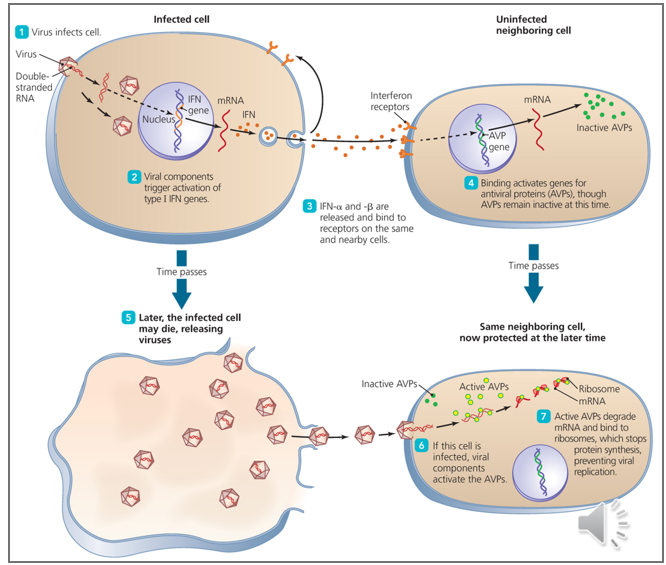
What are the 7 actions of the interferon-alpha (IFN-α) and interferon-beta (IFN-β)?
Virus infects cell
Viral components trigger activation of type 1 IFN genes
IFN-α and IFN-β are released and bind to receptors on the same cell or neighboring cells
IFN binding activates genes for antiviral proteins(AVPs), but AVPs remain inactive
Initially infected cells may die and release viruses
IFN-activated cells now possess antiviral proteins
Active antiviral proteins degrade mRNA and bind ribosomes, preventing viral replication.
What is diapedesis?
Phagocytes squeeze between endothelial cells to reach the infection/injury site.
What is chemotaxis?
movement of immune cells toward chemicals released at an infection site.

What are the 3 activation pathways of the complementary system?
Classical pathway = initiated by binding of complement proteins to antibodies that are attached to pathogens or pathogen-infected cells.
Alternative pathways= activated spontaneously on microbial surfaces by C3b in the absence of antibodies, relying on the continuous low-level activation of complement proteins.
Lectin pathways= triggered by binding of mannose-binding lectin(MBL) or ficolins to specific carbohydrate patterns on pathogen surfaces.
*All 3 lead to C3 activation and can ultimately result in MAC formation.
*all are serum(in blood) proteins procuduced by liver
What is the process of membrane attack complex(MAC) formation during the complement cascade?
activated when antibodies attach to pathogens in the classical pathway, leading to the formation of a pore in the pathogen membrane that facilitates lysis.

What are the 6 steps to classical pathway of complement cascade?
C1 complex binds to antigen-antibody complexes, activating C1.
Activated C1 cleaves C4 and C2;
C4b and C2a form C3 convertase.
C3 convertase cleaves C3 into C3a and C3b; C3b serves as an opsonin.
C5 convertase forms from the C3b complex and cleaves C5 into C5a and C5b.
C5b initiates MAC formation with C6, C7, C8, and C9, causing pathogen lysis.
* Don't need to memorize; just know how to interpret what would happen if we break parts of it.
*C4a, C5a, C3a trigger inflammation
What is opsonin?
a substance that coats pathogens and makes them easier for phagocytes to recognize and engulf them.(C3b)
What is MAC?
membrane attack complex it creates pores in pathogens membrane causing cell lysis.

What is inflammation? What are it’s benefits to the 2nd line of defense(innate immunity)?
A nonspecific immune response of body tissue to harmful stimuli such as pathogens, damaged cells, or irritants, characterized by redness, swelling, heat, pain, and loss of function. Benefits include vasodilation that increases blood vessel permeability, migration of phagocytes, and delivery of extra nutrients and O2 to repair tissues.

How do humans produce a fever in response to a infection? What are the benefits and risks of fevers?
Humans develop a fever(temp above 37 C) when pyrogens trigger the hypothalamus to raise the body's temperature. This elevated temperature can enhance immune function and inhibit pathogen growth. Fever benefits include enhanced effects of interferons, inhibition of microorganism growth, and possible enhancement of phagocytes, cell-specific immunity, and tissue repair. Risks of fever include denaturation of important proteins and disruption of nerve impulses.
Which of the following best describes the relationship between NOD proteins and PAMPs?
NOD proteins bind to PAMPs and trigger an inflammatory response

Blank is a potent inflammatory mediator produced by the cleavage of C5 during
complement activation.
C5a

The binding of C1 to antigen/antibody complexes on foreign invaders causes C1 to become an active blank that catalyzes the splitting of C2 and C4 molecules.
enzymes
A genetic study identifies a population with a mutation in the gene encoding for complement protein C9. This population exhibits a higher rate of Neisseria meningitidis infections. Given the role of C9 in the complement system, what is the most likely explanation for this increased susceptibility?
The mutation leads to a lack of C9, which is essential for membrane attack complex
(MAC) formation, resulting in decreased lysis of Neisseria.
John has a sprained ankle that has become swollen. Which of the following processes is responsible for the accumulation of fluid in the affected area?
Blood vessel dilation
What are the 5 distinct characteristics of adaptive immunity?
1. Specificity: acts against only one particular molecular shape called an antigen.
2. Inducibility: antigen-containing pathogens activate adaptive response.
3. Clonality: once induced, adaptive immune cells proliferate to make many clones.
4. Unresponsive to self: does not act against normal body cells.
5. Memory: has immunological memory for specific pathogens; responds faster in later encounters with the same pathogen
What are 2 types of lymphocytes(wbc) involved in adaptive immunity? Where they mature? What’s their actions?
1.B lymphocytes (B cells)= mature in the bone marrow, mainly associated with antibody production.
2. T lymphocytes (T cells)= mature in the thymus, act against intracellular pathogens.
What are 2 types of adaptive immunity?
Antibody immune response (Humoral Immunity): B lymphocytes produce antibodies that target extracellular pathogens. Ex. B-cells
Cell-mediated Immunity: T lymphocytes directly destroy infected or cancerous cells intracellularly, without antibodies. Ex.phagocytes, T-cells, cytokines.
What are the lymphatic vessels function?
one-way system that conducts lymph from tissues and returns it to the circulatory system
What is lymph?
Liquid with similar composition to blood plasma that arises from fluid leaked from blood vessels into surrounding tissues
What are the primary lymphoid organs and the importance in adaptive immunity?
Red bone marrow= site of B-cell production and maturation.
Thymus= site of T-cell maturation.
What are the secondary lymphoid organs and the importance in adaptive immunity?
Lymph nodes= filter lymph and trap pathogens
Spleen= filters blood, removes old rbc, and detects blood-borne pathogens.
Tonsils= protected against inhaled and ingested pathogens.
Mucosa-associated lymphoid tissue (MALT)= guards mucosal surfaces by trapping pathogens(e.g. digestive, respiratory tracts).
What is a antigen?
any substances that causes the immune system to produce antibodies against it.