Microbio. Exam 1
 Call Kai
 Learn
Learn Practice Test
 Spaced Repetition
 Match
Match Flashcards
 Knowt Play
1/234

There's no tags or description
Looks like no tags are added yet.
Name | Mastery | Learn | Test | Matching | Spaced | Call with Kai | Chat |
|---|
No analytics yet
Send a link to your students to track their progress
235 Terms
Microbes
Life forms to small to see with the naked eye
Divided into two groups: Acellular (prions, viruses), cellular (prokaryotes, eukaryotes)
Genus, species
Escherichia (_______); coli (______)
Sp.
One unspecified species in a genus
Spp.
Multiple species in a genus
Leeuwenhoek
Figure of microbiology discovery
Described microrganisms using microscopes
Pasteur
Figure of microbiology discovery
“Pasteurizing” means getting rid of harmful microbes
Koch
Figure of microbiology discovery
Linked specific microbes to specific diseases
Infectious disease
Illness caused by pathogen itself
Microbial intoxication
Illness caused by toxin the pathogen released
Indigenous microbiota
Coexists during normal human life
Can cause disease when normal conditions change - sterile site compromised
Weakened defense
Colon/GI Tract
Where in the body is there the most microbes?
Contamination
Introducing unwanted, foreign microbes to a new environment
Colonization
Microbes living and multiplying in host
No signs or symptoms
Positive screen, but infection can still be avoided
Antagonism
Microbe versus microbe relationship
Synergism
Microbes interact that positively combine affects
Vagina microbes help one another grow
Magnification
How big can you make an image appear?
Resolution
Determines how clearly details can be distinguished
Simple lens - Low
Compound microscope - High
Transmission electron microscope (TEM)
Electron microscope used to see through microbes
Scanning electron microscope (SEM)
Electron microscope used for external detailing
Light microscope
Can produce colored images unless artificially stained
Lower resolution
No, No, Smaller, Not in Nucleus, Binary Fission
Prokaryotes
True nucleus: _____
Membrane bound organelles: _______
Ribosomes: __________
DNA: ___________
Reproduction: __________
Yes, Yes, Bigger, In nucleus, Mitosis/meiosis
Eukaryotes
True nucleus: _____
Membrane bound organelles: _______
Ribosomes: __________
DNA: ___________
Reproduction: __________
Peptidoglycan
Found in prokaryotic cell wall
Prevents lysing and provides shape, selective barrier
Microbacteria disrupts ______
Gram-positive bacteria
Thick peptidoglycan layer, one inner cell membrane
Gram-negative bacteria
Thin peptidoglycan layer, both an inner and outer membrane layer
Prokaryotic capsule
Part of bacterial
Allows bacteria to live longer in cells
Resists phagocytosis
Highly organized
Plasmid
Hold extrachromosal DNA
May carry antimicrobial genes
MRSA
A drug‑resistant staph bacterium that often causes skin infections but can also lead to serious invasive disease.
Methicillin-Resistant Staphyloccocus Aureus
Fimbriae
Allows bacteria to adhere and invade different parts of the body
Peritrichous bacteria
Identify this flagellar arrangement

Amphitrichous bacteria
Identify this flagellar arrangement

Lophotrichous bacteria
Identify this flagellar arrangement
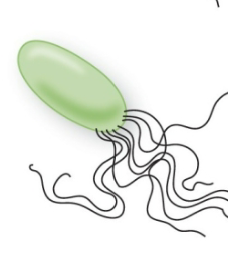
Monotrichous bacterium
Identify this flagellar arrangement

Sex pilus
Role: Transfers DNA and spreads microbacterial resistant genes
Spreads virulence factors
Increases genetic diversity in bacteria
Helps bacteria adapt quickly to environmental pressures
Endospores
Highly resistant survival structures that fight disinfectants and conditions
Not a reproductive structure, but helps bacteria persist in environments
Ex. C dificile. B anthracis
Slime layer
Loosely attached to glycocaylyx
Forms biofilm which allows bacteria to attach to medical devices - catheters, endotracheal tube
Leads to contamination
DNA replicates, cell divides, two daughter cells
Three steps of binary fission
Probiotics
Healthy microbes
Support gut, immune system, microbial balance
Diarrhea
C. Difficile infection causes _____
Week 1 takeaways
1. Microbes include cellular organisms and acellular agents; not
all microbes are pathogens.
2. Microbiota vary by body site; microbial presence does not
automatically mean infection.
3. Interpret microbiology findings using the organism, body site,
patient findings, and specimen quality.
4. Magnification enlarges an image; resolution determines how
clearly details can be distinguished.
5. Prokaryotic/eukaryotic differences and bacterial structures
influence identification, disease, treatment, and prevention.
Physiology
Explains how microbes either survive or die in certain conditions; virulence changes and supports lab identification.
Phototroph
Uses light as an energy source (e.g., algae, cyanobacteria).
Chemotroph
Uses chemicals as an energy source (most human pathogens fall into this category).
Autotroph
Uses CO₂ as a carbon source; environmental producers
Heterotroph
Uses organic compounds as a carbon source (e.g., animals, fungi, protozoa).
Chemoheterotrophs
Human infectious agents are…
Catabolism
Breakdown of large molecules to make/release ATP.
Anabolism
Building up molecules, requiring energy.
Aerobic Respiration
Oxygen is the final electron acceptor; produces high ATP.
Fermentation
Occurs without oxygen; produces low ATP and characteristic end products that help in lab identification.
Lysogenic Conversion
A temperate bacteriophage (a non-living, acellular virus) introduces phage genes into a bacterium, changing its phenotype (e.g., increased virulence).
Transduction
A bacteriophage accidentally transfers DNA from one bacterium to another.
Transformation
Bacterial cells incorporate free ("naked") DNA from disintegrated cells into their own genotype.
Conjugation
A donor bacterium makes direct contact with a recipient bacterium; a plasmid is transferred from one cell to another and may carry antimicrobial resistance genes.
Factors Affecting Microbial Growth
Nutrients
Moisture — Dry conditions decrease growth.
Temperature
pH — Affects enzyme function.
Osmotic Pressure — Increased solute concentration decreases growth.
Atmosphere — O₂ and CO₂ needs vary by organism.
Psychrophiles
Prefer cold temperatures; environmental organisms.
Psychrotrophs
Grow at refrigerator temperatures; pose a food spoilage risk. (Refrigeration slows but does not inhibit all growth.)
Mesophiles
Prefer moderate/body temperature; human pathogens.
Thermophiles
Prefer high temperatures; found in hot springs and heat-tolerant environments.
Water
_____ is required for metabolism and growth
Endospores, protozoan cysts
___________ and __________ survive in dry environments better than other cells
Plasmolysis
Cytoplasm and cell membrane shrinks away from the cell wall in a hypertonic environment; explains why high salt/sugar environments inhibit growth.
Enriched, selective, differential, selective-differential
Four types of culture media
Lag Phase
Cells adjust to the environment.
Log Phase
Rapid, exponential growth.
Stationary Phase
Growth rate equals cell death rate.
Death Phase
Cells die faster than they grow.
Sterilization
Removal of all microbial life, including endospores.
Disinfectant
Reduces pathogens on inanimate objects.
Antisepsis
Reduces microbes on living tissue.
Sanitation
Reduces microbes to public health standards.
Aseptic Technique
Prevents contamination and maintains asepsis (absence of disease-causing microorganisms).
Autoclaving, pasteurization
Two heat inhibition methods (one that sterilizes, then one that inhibits)
Desiccation
Dry inhibition method.
Radiation
Damages microbial DNA.
Filtration
Physically removes microbes from fluid or air.
Time, temperature, concentration, type of microbe (presence of spores), organic matter
Factors Affecting Growth-Control Effectiveness
-Cidal
Suffix that means kills the target microbe
-Static
Suffix that means inhibits microbe growth
Chemotherapy
A chemical/drug used to treat disease.
Antimicrobial Agent
Medication used to treat infection.
Antibiotic
Antibacterial drug used to treat bacterial infections.
Selective Toxicity
Targeting the pathogen while minimizing harm to human cells. Requires:
Proper site
Effective concentration for extended time
Best when targets differ between pathogen and host
Cell wall, ribosomes
What two structures of bacteria cell are used as targets for antimicrobials?
Weakens bacterial cell-wall formation
Damages membrane integrity
Blocks DNA/RNA production
Blocks ribosomes
Blocks essential metabolism steps
Name 5 Antimicrobial Agent Mechanisms
Can harm indigenous microbiota
Why can broad-spectrum antibiotics be negative?
Intrinsic resistance
Inherent resistance characteristic of a microbial species
Acquired Resistance
Develops through gene transfer or mutation. (Note: patients don't become antibiotic resistant — microorganisms do.)
Altered drug-binding site
Method of bacterial resistance
Drug doesn’t fit target
Reduced permeability
Method of bacterial resistance
Ineffective drug entry.
Drug-inactivating enzyme
Method of bacterial resistance
Drug destroyed/modified
Efflux pump
Method of bacterial resistance
Drug pumped out of the cell
New gene acquisition
Method of bacterial resistance
Resistance trait spreads through gene transfer.
B-lactamase
Enzyme that inactivates antibiotics via enzymatic deactivation; break the β-lactam ring.
Empiric Therapy
Treatment starts before the exact pathogen is identified; therapy is reassessed and adjusted once lab tests identify the pathogen.
Susceptibility Testing
Determines how vulnerable a microbe is to specific antimicrobial drugs (Susceptible or Resistant).
Negative Effects of Antimicrobial Drugs
Allergic reactions and drug toxicities
Broad-spectrum agents disrupt indigenous microbiota
Resistant organisms survive and repopulate
Viruses don't have the organized structures that antibiotics target.
Why would you not use antibiotics on influenza virus?
Prions
Infectious proteins; not cells, but infectious particles/agents