DSG325-Design for Additive Manufacturing
 Call Kai
 Learn
 Practice Test
 Spaced Repetition
 Match
 Flashcards
 Knowt Play
1/25

Earn XP
Description and Tags
Lecture 16
26 Terms
What is the rule of thumb for self-supporting parts?
many parts can be printed with no additional support structure required
overhangs - max of 40-45 degrees from vertical
How can a hole be modified in a self-supporting part so no supports are needed?
horizontal holes can be altered to remove steep areas
additional allowance of 1 layer thickness above or below hole can compensate for anticipated sagging - teardrop hole
What is the rule of thumb for bridges ?
can support horizontal bridging over short distances
bridge must be parallel to build plate and connect to struts on either side
How can vertical holes be achieved on a self-supporting part?
clever application of bridges
two extruded cut steps - rectangles that are tangent to hole

What is the rule of thumb for wall thickness around perimeter of the part?
at least two walls thick (depends on nozzle diameter
.4mm nozzle - .8 mm minimum wall thickness
What is the rule of thumb for thin features?
same as for wall thickness but no infill between walls so at least four walls thick
.4mm nozzle - 1.6mm minimum wall thickness
What is “elephant footing”?
an issue most prevalent in FFF< can happen in SLS
can be a product of poor Z height calibration, over extrusion, temperature issues etc.
pushes features to MMC in XY plane
What is the rule of thumb to prevent elephant footing in the XY plane?
add chamfer of ~ 2x layer height to bottom perimeter
How does elephant footing affect holes and internal feature sizing?
over extrusion in XY plane - internal features smaller than expected
anticipate that internal features will have to be oversized by about .2mm
What is the rule of thumb for warping and peeling?
material and environment dependent
most prevalent around sharp corners - consider adding fillets to reduce occurrence of walls that go from very thick to very thing
at least 4mm radius
What is a rule of thumb for mating features?
clearance of at least .2mm between mating parts
consider adding a taper or compliant features to “fudge” fits

What is the rule of thumb for threads?
modeled threads: no smaller than M5 or #10
What are some alternatives for threads?
model solid hole, tap manually after print
model solid hole, use self-tapping fastener
model solid hole, insert heat-set metal insert
How do you prepare an STL file with mesh resoultion?
must find balance between high resolution and minimized file size
Deviation: How far can STL be from model
Angle Tolerance: angle between adjacent triangle faces, smaller # = smoother transition
What is the rule of thumb when deciding on mesh quality?
avoid long thin triangles in meshes, triangles should be as uniform as possible
How should a part be orientated for best adhesion in FFF printing
if self-supporting, place flat, broad face on build plate to maximize adhesion
if using support structure, tilting the model can help supports release easier
orientation can also impact where support witness marks appear
How should a part be orientated for adhesion/drainage in SLA printing
require part to be tilted, even if there is a flat base
reduces cross-section at any given layer, reduces suction and chance of part getting pulled off bed
tilting also helps reduce cupping that would otherwise collect resin in cavities with no drainage

How can you improve the bed contact of a part?
consider splitting it in half
can also be done for parts that need strength of sideways orientation (Ex: threads)
What is an alternative way to print threads?
crop thread body to have flat face - they will still function the same
What does anisotropic mean?
material properties not the same in all orientations
part orientation has a big impact on the strength of parts
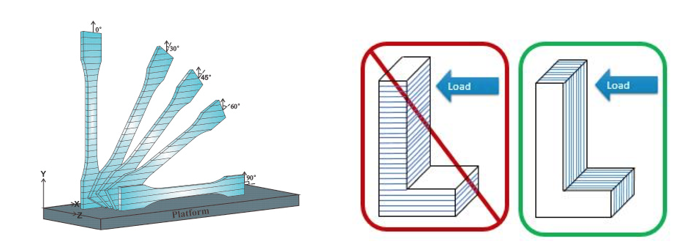
what does Isotropic mean?
material properties are the same in all directions
What do rafts and brims do?
help adhesion
how does a brim work?
increases surface area in contact with build plate, better adhesion. Bottom of model still contacts build plate
What is the difference between a raft and a skirt?
raft - complete bottom structure that sits under part, on top of build plate. can be helpful for parts that don’t have sufficient contact with bed
skirt- primes nozzle, gets plastic flowing
What is not a good way to increase slicing strength?
infill
pattern - 2D vs 3D
infill percentage - density
What is a better way of increasing strength for slicing?
shell and celling/floor layer #
increasing number of walls can provide more strength than increasing infill in many cases
temperature, speed, extrusion rate settings, exposure - layer fusion, strength of lamination