CHE 4341 Enzyme Kinematics
 Call Kai
 Learn
Learn Practice Test
 Spaced Repetition
 Match
Match Flashcards
 Knowt Play
1/36

There's no tags or description
Looks like no tags are added yet.
Name | Mastery | Learn | Test | Matching | Spaced | Call with Kai | Chat |
|---|
No analytics yet
Send a link to your students to track their progress
37 Terms
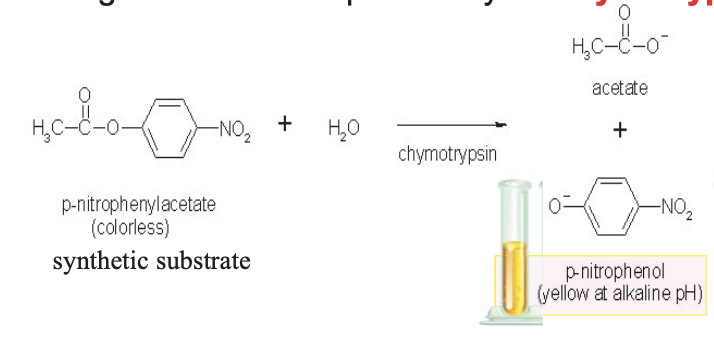
Example of an Assay
Hydrolysis of p-nitrophenylacetate by chymotrypsin
Assay tests for activity of enzyme which can be measured by looking at
disappearance of Substrate [S] or appearance of product [P] over time
The amount of p-nitrophenol released / time can be measured using
Beer’s Law (A = cl) w/ Spectrophotometric Analysis!
disappearance of Substrate [S] or appearance of product [P] over time also provides a measure of
RATE of enzymatic reaction
1.0 Unit of E activity is the amount of E causing a defined transformation of
1.0 µmol of substrate per minute at 25ºC under optimal conditions
1 Katal is that catalytic activity which will raise the
rate of reaction by one mole per second in a specified assay system
Activity is proportional to
amount of target protein that is being purified (more activity = more purified protein)
Total Protein
total # of protein present in mixture → can do this spectrophotometrically using Beer’s Law (A=εlc)
All proteins have UV absorbance at
280nm
Indirect Assay
Absorbance shift of dye binding to protein → uses Coomassie Blue → measures protein concentration at absorbance max. of 595
Specific Activity (SA)
measure of enzyme purity and increases during purification (maximal and constant when enzyme is pure)
SA formula
activity / total protein (units/mg)
In example, RATE (kinetics) of chymotrypsin can be measured by
looking at appearance of p- nitrophenol / time
Slanted k is to do with
RATE
k1
rate for E + S binding to substrate; formation of enzyme-substrate complex
k-1
reverse rate constant for the dissociation of the enzyme-substrate complex (ES) back into free enzyme (E) and substrate (S)
k2
the rate-limiting step where the enzyme-substrate complex converts into product and free enzyme
Steady State
d[ES]/dt = 0
Pre-Steady state vs Steady State
steady state should equal 0 because b/c rate of ES formation = rate of ES breakdown

Michaelis-Menten Plot

Michaelis-Menten Kinetics
Michaelis-Menten Equation

Hyperbolic =
non-allosteric enzyme
Michaelis-Menten Kinetics Assumptions
Assumes ES complex
Assume there is much more [S] than [E]
Assume steady state: d [ES] / dt = 0 (rate of ES formation = rate of ES breakdown)
Rate (vo = k2[ES])
Assume k2 is smallest rate constant!
![<ol><li><p>Assumes <strong>ES complex</strong></p></li><li><p>Assume there is<strong> much more [S] than [E]</strong></p></li><li><p>Assume<strong> steady state: d [ES] / dt = 0</strong> (rate of ES formation = rate of ES breakdown)</p></li><li><p>Rate (v<sub>o</sub> = k<sub>2</sub>[ES])</p><ul><li><p>Assume<strong> k<sub>2</sub> is smallest rate constant!</strong></p></li></ul></li></ol><p></p>](https://assets.knowt.com/user-attachments/6ece978f-1d1d-4c12-a1e0-932943ef518b.png)
The maximum rate (Vmax) can be reached at
saturating (maximum) substrate concentration → all enzyme is complexed with substrate
Since vo = k2[ES], 1st solve which eqn to find [ES]:
k1 ([Et ] - [ES]) [S] = k -1 [ES] + k2 [ES]
What is [Et]?
total enzyme conc
Find [Et] using
[E] + [ES]
KM has the same units as
[S]
KM has
Vmax /2
High KM = large k-1 or small k1 =
breakdown of ES favored
Low KM = large k-1 or small k1 =
formation of ES favored
KM measures
affinity of enzyme for substrate
KM has an INVERSE proportional relationship with enzyme affinity for substrate
A low Km means high affinity; a high Km means a low affinity.
What is the formula for Km?
Km = [S] at ½ Vmax
The turnover number
Vmax = k2 [Et]
When the velocity = Vmax
k2 = kcat = turnover number → k2 = kcat = Vmax / [Et]