Bio Quiz 8 - Photosynthesis
 Call Kai
 Learn
 Practice Test
 Spaced Repetition
 Match
 Flashcards
 Knowt Play
1/125

There's no tags or description
Looks like no tags are added yet.
126 Terms

Photosynthesis
The energy conversion process that converts sunlight into chemical energy stored in sugars and other organic molecules.
6CO2 + 6H2O + light → C6H12O6 + 6O2
The oxygen gas released during _ comes from water, NOT carbon dioxide.
There are three important parts:
Sunlight: Provides the original energy.
Conversion: The organism transforms light energy into chemical energy.
Sugars and other organic molecules: Store that chemical energy so the organism can use it.
plants use _ to produce sugars that can later be used for energy and to build other molecules. plants CANNOT turn sunlight directly into food energy that they immediately use, they instead convert light energy into chemical energy stored in molecules.
_ supports almost the entire food supply of the biosphere.
Directly: An organism eats a plant
Indirectly: An organism eats another organism that depended on a plant.
During _:
Water is split.
Electrons are removed from water.
Those electrons are transferred along with hydrogen ions.
The electrons eventually help reduce carbon dioxide-derived molecules into carbohydrate.
transfers electrons from water toward carbon dioxide-derived molecules
Biosphere
All regions of Earth where life exists; includes all living organisms and their environments. It includes:
Land.
Oceans.
Freshwater.
The atmosphere where organisms live
Photosynthesis is important to the _ as photosynthesis provides the organic molecules that almost all living organisms ultimately depend on.
Organic compounds
Carbon-containing molecules associated with living organisms, such as sugars, proteins, and lipids. Contain C-H bonds. Organisms need these molecules for two major reasons:
Energy- Organic molecules can be broken down to release energy that cells can use.
Carbon skeletons - Organisms need carbon-containing molecules to build their own structures and other molecules.
Inorganic materials
Materials such as water, carbon dioxide, and minerals that are not classified as organic compounds. No C-H bonds
Autotroph
An organism that produces organic molecules from inorganic raw materials (CO2, water, and other minerals) obtained from its environment.
Think: self feeder, producers (the ultimate sources of organic compounds for all non-autotrophic organisms). they produce organic molecules that other organisms depend on.
An _ does not need to eat another organism to obtain the organic molecules it needs. Instead, it takes simple inorganic materials from its environment and uses them to build organic molecules.
Ex: plants
Autotrophic nutrition
A nutritional method in which an organism produces its own organic molecules from inorganic materials
Heterotroph
An organism that cannot produce all the organic molecules it needs from inorganic raw materials alone, and obtains organic molecules by consuming other organisms or organic material.
consumers (other feeder).
depend on organic compounds that have already been produced by other organisms.
ex: humans, dogs, cats, birds, most fungi, most bacteria
Heterotrophic nutrition
A nutritional method in which organisms obtain organic compounds from other organisms or organic material.
An animal eating another organism (consumer)
Consuming the remains of dead organisms and organic waste (decomposers)
Producer
An organism, usually an autotroph, that produces organic molecules that support other organisms.
Consumer
An organism that obtains organic molecules by consuming other organisms or organic material.
Photoautotroph
An organism that uses light energy to produce organic molecules (light self feeder).
ex: plants, algae, certain protists, some prokaryotes (cyanobacteria)
Decomposer
An organism that breaks down dead organisms and organic material to obtain nutrients
ex: most fungi, many types of prokaryotes, including bacteria.
Organic litter
Dead organic material and waste that accumulates in the environment
fallen leaves- when leaves fall from trees and die, they become organic material that can be broken down by decomposers.
feces- waste materials released by organisms (poop). They contain organic material that decomposers can use.
Prokaryote
An organism whose cells lack a nucleus
Eukaryote
An organism whose cells contain a nucleus and membrane bound organelles
Protist
A diverse group of mostly single-celled or simple eukaryotic organisms
Carbon dioxide (CO2)
An inorganic gas that provides carbon atoms used in photosynthesis that will eventually become part of organic molecules. _ enters the plant through the stomata.
Oxygen (O2)
A gas released as a by-product of photosynthesis (during the light reactions stage) and used by many organisms during cellular respiration. It exits the leaf through the stomata.
This means photosynthesis supports life in two major ways:
It provides the organic molecules that support food chains.
It releases _ that many organisms need for cellular respiration.
The oxygen released by plants comes from water (H2O is oxidized).
Cellular respiration
The process cells use to extract usable energy from organic molecules. During _:
Glucose is broken down.
Electrons associated with hydrogen are transferred through electron carriers.
These electrons eventually move to oxygen (losing PE, which helps power ATP synthesis)
Oxygen receives the electrons and hydrogen ions and forms water.
The electron movement releases energy.
The mitochondrion captures some of this energy (the lost potential energy as electrons move down the ETC) and uses it to help produce ATP.
transfers electrons from sugar-derived molecules toward oxygen
Fossil fuels
Energy-rich fuels, including coal, oil, and natural gas, formed from ancient organic material.
formed from remains of organisms that died hundreds of millions of years ago over extremely long periods of time
Photosynthesis process:
Ancient organisms existed: millions of years ago, plants and other organisms lived on Earth
Photosynthetic organisms captured sunlight: Ancient photosynthetic organisms used sunlight to produce organic molecules. Those molecules stored chemical energy.
Organisms died: Some of their organic material accumulated in environments where it could eventually contribute to fossil fuel formation
Fossil fuels formed: Over millions of years, geological processes transformed some of this ancient organic material into fossil fuels
Humans use fossil fuels today: When fossil fuels are burned, their stored chemical energy is released and can be used
Carbon skeleton
The carbon framework of an organic molecule that can be used to build other molecules
Chemical energy
Energy stored in the arrangement of atoms and electrons in molecules.
By-product
A substance produced during a process that is not the process's main intended product
Chloroplast
an organelle found in photosynthetic eukaryotic organisms that absorbs energy from sunlight and uses it to help synthesize organic compounds from carbon dioxide and water.
the part of a plant cell where photosynthesis takes place. It takes in the materials needed for photosynthesis and uses light energy to help produce organic molecules. Found in:
green leaves
green stems
unripened fruit
Leaves are the major sites of photosynthesis in most plants because leaves are generally structured to capture sunlight and exchange gases with the environment.
Chloroplast envelope
the 2 membranes of a chloroplast that surround the internal contents of the chloroplast make up the _.
A chloroplast has two outer membranes:
Outer membrane.
Inner membrane.
Together, these form the _

Stroma
dense fluid-filled region inside the chloroplast’s inner membrane that surrounds the thylakoids.
where the Calvin cycle occurs.

Thylakoid
Flattened membrane-bound sac inside the chloroplast
Thylakoid membrane
Membrane surrounding a thylakoid; location of the light reactions
Thylakoid space
Internal compartment interior of a thylakoid sac. the thylakoid membrane separates the stroma from the _ inside the sacs.

Granum (plural, grana)
A stack of thylakoids
Chlorophyll
the green pigment located in the thylakoid membranes of chloroplasts that absorbs light energy. light energy absorbed by chlorophyll drives the synthesis of organic molecules in the chloroplast.
Sunlight reaches the leaf.
_ absorbs light energy.
That energy helps power the light reactions.
The light reactions produce ATP and NADPH.
ATP and NADPH help power the Calvin cycle.
The Calvin cycle produces carbohydrate.
responsible for the green color of leaves
Light reactions
First stage of photosynthesis. Located in the thylakoid membranes. Requires direct light. Main purpose is to capture light energy and converts it into chemical energy. The process is:
Chlorophyll absorbs sunlight: the solar energy drives the movement of electrons through the light reactions
Water is split: provides electrons, hydrogen ions (H+), and oxygen, released as O2 (by-product). Electrons are necessary as they’re transferred through the light reactions and eventually help reduce NADP+ into NADPH
Electrons and hydrogen ions are transferred to NADP+: NADP+ acts as an electron acceptor during light reactions, receiving electrons from another molecule, and being reduced, and receives a hydrogen ion, forming NADPH. NADP+ gains electrons and becomes NADPH
NADPH is formed: the reduced form of NADP+, which carries high-energy electrons that can be used in other reactions. NADPH provides reducing power as it can allow other molecules to become reduced by donating its electrons.
Also produces ATP through photo-phosphorylation: the process of using light-driven energy to add a phosphate group. to ADP, producing ATP
Main inputs: Light, water, ADP, inorganic phosphate (Pi), NADP+
Main outputs: ATP, NADPH, O2
Calvin cycle (aka dark reactions, light-independent reactions)
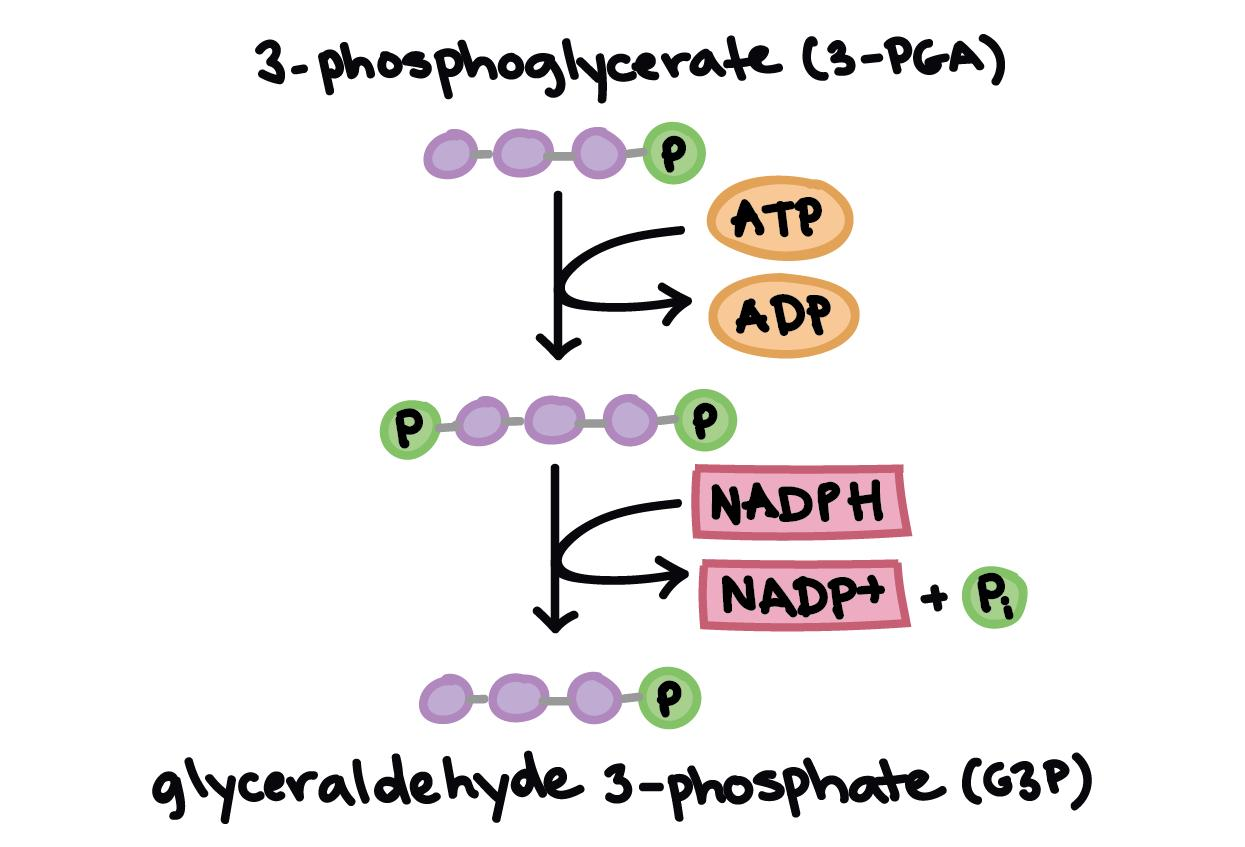
Second stage of photosynthesis. Located in the stroma of the chloroplast. Does not require direct light. Main purpose is to use chemical energy (CO2, ATP, and NADPH) to produce carbohydrates (anabolic). Process is:
Carbon fixation: the initial incorporation of carbon from inorganic CO2 into organic molecules. Inorganic carbon dioxide enters the leaf through the stomata. The plant requires carbon as carbohydrates contain carbon. The _ takes carbon from CO2 and incorporates it into organic molecules.
Reduction of fixed carbon: After carbon fixation, the _ must reduce the carbon-containing molecules to produce carbohydrate. These electrons will come from NADPH, delivering electrons to the _, which is used to reduce the fixed carbon. NADPH supplies electrons for reduction.
Also uses energy from ATP to provide the chemical energy needed to convert CO2 into carbohydrate. CO2 from the atmosphere is used to supply carbons for carbohydrates, while ATP supplies the chemical energy required.
Main inputs: CO2, ATP (energy), NADPH (electrons)
Main outputs: Carbohydrate (Glyceraldehyde 3-phosphate), ADP, phosphate, NADP+
The _ relies on the ATP and NADPH made during the light reactions. The Calvin cycle generally occurs during daylight in most plants because that is when the light reactions can provide the ATP and NADPH it requires. The Calvin cycle doesn’t require direct light to function on its own, but it depends on the products of the light reactions.
Organelle
Specialized structure inside a cell that performs a particular function.
ex:
The nucleus stores most of the cell's DNA.
Mitochondria are involved in cellular respiration.
Chloroplasts are responsible for photosynthesis
Enzyme
Biological molecule that speeds up chemical reactions
Pigment
a substance (molecule) that absorbs visible light. When light hits a pigment, three things can happen:
Absorption: The pigment takes in the light energy.
Reflection: The light bounces off the pigment.
Transmission: The light passes through the pigment.
Different _ absorb different wavelengths of light. one pigment might absorb blue and red light, while another absorbs blue and green light.
Examples include:
Chlorophyll a absorbs mainly blue and red light, reflects and transmits green light (which makes the leaf appear green visually)
Green light is reflected/transmitted.
Chlorophyll b and carotenoids are accessory pigments.
Carotenoids provide photo-protection.
A _’s color is generally the color of light it reflects or transmits, NOT the color it absorbs.
If a _ absorbs all wavelengths, it appears black.
Biological membrane
Thin lipid-and-protein boundary that separates or organizes different regions of a cell.
Important because photosynthesis involves multiple chemical reactions that need to happen in a specific sequence. Grouping the necessary molecules together in a membrane allows these reactions to occur efficiently.
Each station has a specific job.
Materials move from one station to another.
Each step contributes to the final product.
photosynthetic molecules are organized so that energy and electrons can move through the necessary reactions. Photosynthesis depends on the organization of specialized molecules within membranes
Plasma membrane
Membrane surrounding a cell. It separates the inside of the cell from the outside environment.
Endosymbiont theory
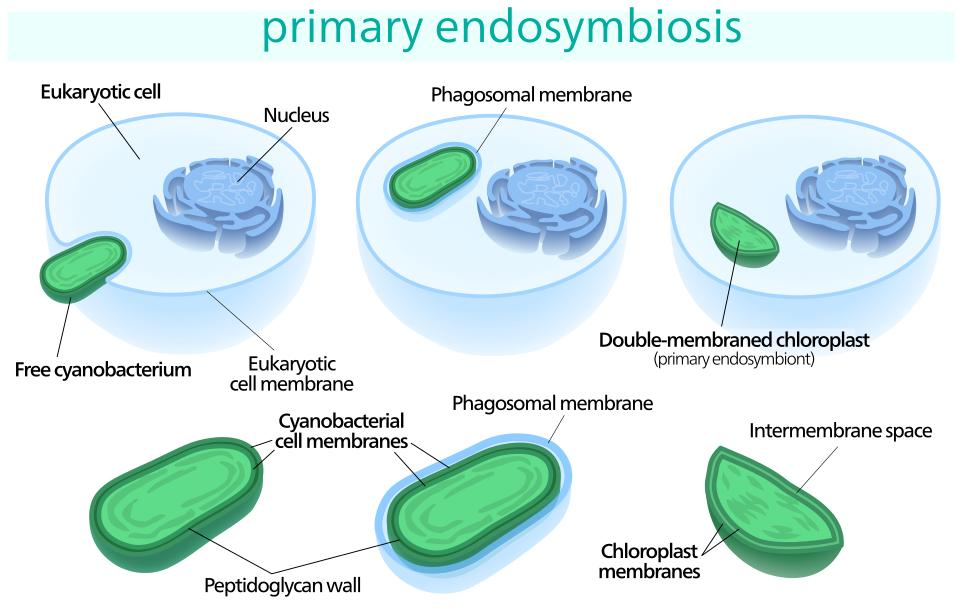
Theory that certain eukaryotic organelles originated from free-living prokaryotes that began living inside ancestral eukaryotic cells. an explanation of evolutionary origin
explains origin of chloroplasts (cyanobacteria) and mitochondria
The basic sequence (for chloroplast origin) is:
A photosynthetic prokaryote existed independently.
An ancestral eukaryotic cell incorporated that prokaryote.
The prokaryote continued living inside the larger cell.
Over evolutionary time, it became an organelle: the chloroplast.
The internal photosynthetic membranes found in certain bacteria function similarly to the internal membranes of chloroplasts. the chloroplast's photosynthetic machinery has an evolutionary connection to photosynthetic bacteria

Mesophyll
Tissue located in the interior of a leaf containing many photosynthetic cells (cells that carry out photosynthesis). The _ is located inside the leaf, between its outer protective layers. chloroplasts are found mainly in the cells of this tissue.
Approximately 500,000 chloroplasts can be found in a piece of leaf with a top surface area of 1 mm².
A typical _ cell contains approximately 30–40 chloroplasts.
Each chloroplast measures approximately 2–4 μm by 4–7 μm.
Leaves contain enormous numbers of chloroplasts because they are major sites of photosynthesis.
Stomata (singular, stoma)
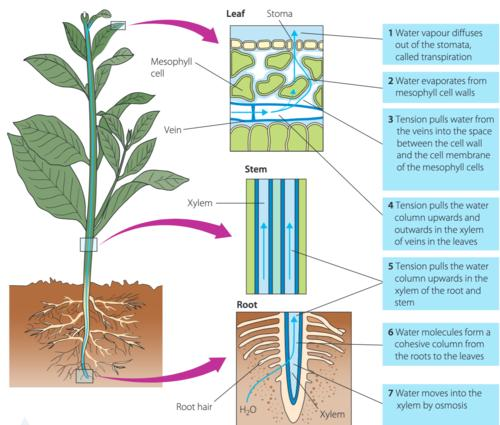
Microscopic pores on leaf surfaces that allow gas exchange (into and out of the leaf) and water vapor loss
Important for photosynthesis as photosynthesis requires carbon dioxide and plants obtain carbon dioxide from the atmosphere. Carbon dioxide enters the leaf through the _. Oxygen produced during photosynthesis (as a by-product) can exit through these pores
Veins
Structures in leaves that transport water and sugars. water absorbed by the roots is delivered to the leaves through _. Water comes by:
Roots absorb water from the soil.
Water travels upward through vascular tissue in the plant.
_ in the leaves distribute the water.
The water becomes available for photosynthesis.
Sugar also transports through _. leaves use _ to export sugar to roots and other non-photosynthetic parts of the plant. The leaves are major sites of photosynthesis, so they produce sugars. But not every part of the plant performs photosynthesis.
Roots are underground.
Some stems are not green.
Certain other plant tissues do not contain chloroplasts.
These parts still need organic molecules. Therefore, sugars produced in the leaves must be transported to other parts of the plant, via _.
water travels to leaves
sugars are transported from leaves to other parts of the plant
Carbohydrate
Organic molecule composed of carbon, hydrogen, and oxygen; includes sugars.
Isotope
form of an element that has a different number of neutrons than other forms of that same element (same # protons, diff # of neutrons)
Tracer
a detectable substance used to track atoms or molecules through a process. Scientists used oxygen-18 as a _ to determine whether the oxygen gas released during photosynthesis came from carbon dioxide or water.
Oxygen-18
Heavy isotope of oxygen containing eight protons and ten neutrons. _ behaves chemically like ordinary oxygen, but its extra mass allows scientists to distinguish it.
was included in water, used as a tracer. The oxygen gas released by the plants contained _, proving that the oxygen gas released by photosynthesis came from water.
When carbon dioxide contained _ and normal water, the _ did NOT appear in the released oxygen gas, proving that the oxygen atoms from carbon dioxide were not the source of the oxygen gas released during photosynthesis.
Hydrogen sulfide (H2S)
Compound used as a hydrogen source by certain photosynthetic bacteria.
NADP+
Electron acceptor that becomes NADPH when reduced (during light reactions)
NADPH
Reduced electron carrier that supplies electrons for the Calvin cycle.
Molecule that carries high-energy electrons to the Calvin cycle
ATP
Energy-carrying molecule used to power cellular processes.
Molecule that supplies energy for cellular reactions.
Supplies energy to the Calvin cycle
ADP
Molecule that can receive a phosphate group to become ATP
Photophosphorylation
Light-driven production of ATP from ADP and phosphate.
Production of ATP using energy from light reactions
Occurs inside chloroplasts
Uses light energy.
Produces ATP.
Uses chemiosmosis.
use ATP synthase and a proton gradient
Chemiosmosis
Movement of hydrogen ions down their concentration gradient through a membrane protein, helping power ATP production.
In chloroplasts:
The electron transport chain is in the thylakoid membrane.
H+ is pumped from the stroma into the thylakoid space.
The thylakoid space becomes the H⁺ reservoir.
H+ flows back into the stroma through ATP synthase.
ATP is produced in the stroma
Thylakoid space → stroma
Carbon fixation
the initial incorporation of carbon from inorganic CO2 into organic molecules. Inorganic carbon dioxide enters the leaf through the stomata. The plant requires carbon as carbohydrates contain carbon. The Calvin cycle takes carbon from CO2 and incorporates CO2 into organic molecules. This process is known as _.
Reducing power
Ability to donate electrons to another molecule, reducing it.
Metabolic process
A series of chemical reactions occurring within an organism or cell (catabolic and anabolic)
Electromagnetic energy
Energy that travels through electric and magnetic fields as waves (aka light)
Electromagnetic radiation
Another name for electromagnetic energy
Wavelength
the distance between two consecutive crests (the highest points) of a wave.
A shorter distance means a shorter _.
A longer distance means a longer _.
_ is usually measured in nanometers (nm) when discussing visible light
1 nm = 10 ^-9 meters
Electromagnetic spectrum
The _ includes every possible wavelength of electromagnetic radiation.
It ranges from:
Gamma rays: extremely short wavelengths.
X-rays.
Ultraviolet radiation.
Visible light.
Infrared radiation.
Microwaves.
Radio waves: extremely long wavelengths.
(“raging Martians invaded Venus using x-ray g*ns”)
Visible light
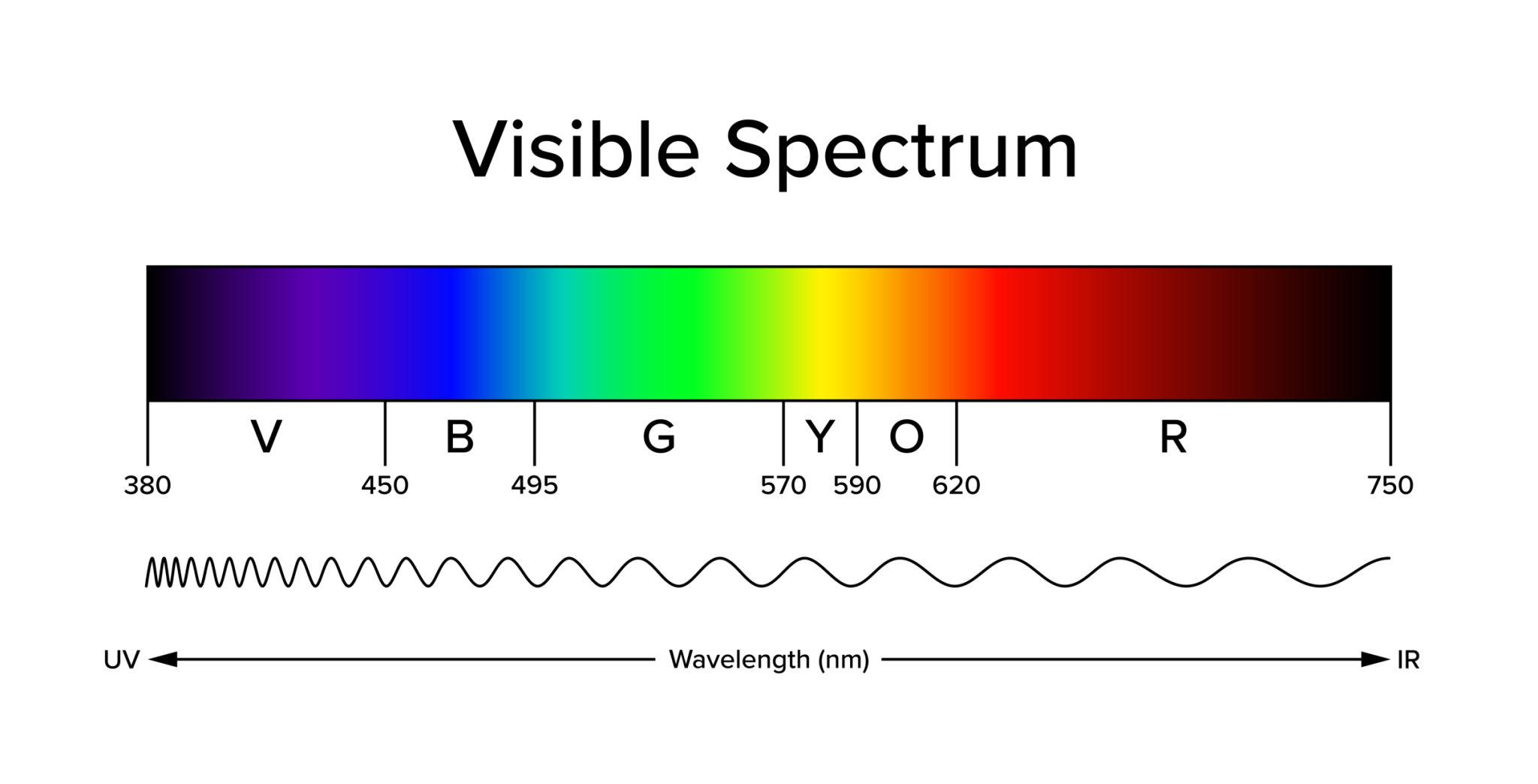
the portion of the electromagnetic spectrum that the human eye can detect. Its wavelengths range approximately from 380 nm - 750 nm.
Red has the longest wavelength, while violet has the shortest.
_ is the radiation that drives photosynthesis. Earth's atmosphere allows _ to pass through while filtering out a substantial amount of other radiation.
Photons
Light can travel as waves. However, it also behaves as though it is made of tiny individual packets of energy called _, or as a particle.
A _ is not a tiny physical object like a grain of sand. It is a discrete packet of light energy. Each photon carries a specific amount of energy.
The shorter the wavelength, the greater the energy of each _ (i.e violet light)
The longer the wavelength, the lower the energy of each _ (i.e red light)
energy and wavelength are inversely related
A _ of violet light carries nearly twice as much energy as a _ of red light.
Pigments absorb _, and that energy can be used to excite electrons during photosynthesis.
Ground state
The normal, lowest-energy state of an electron in a molecule (the electron's resting position)
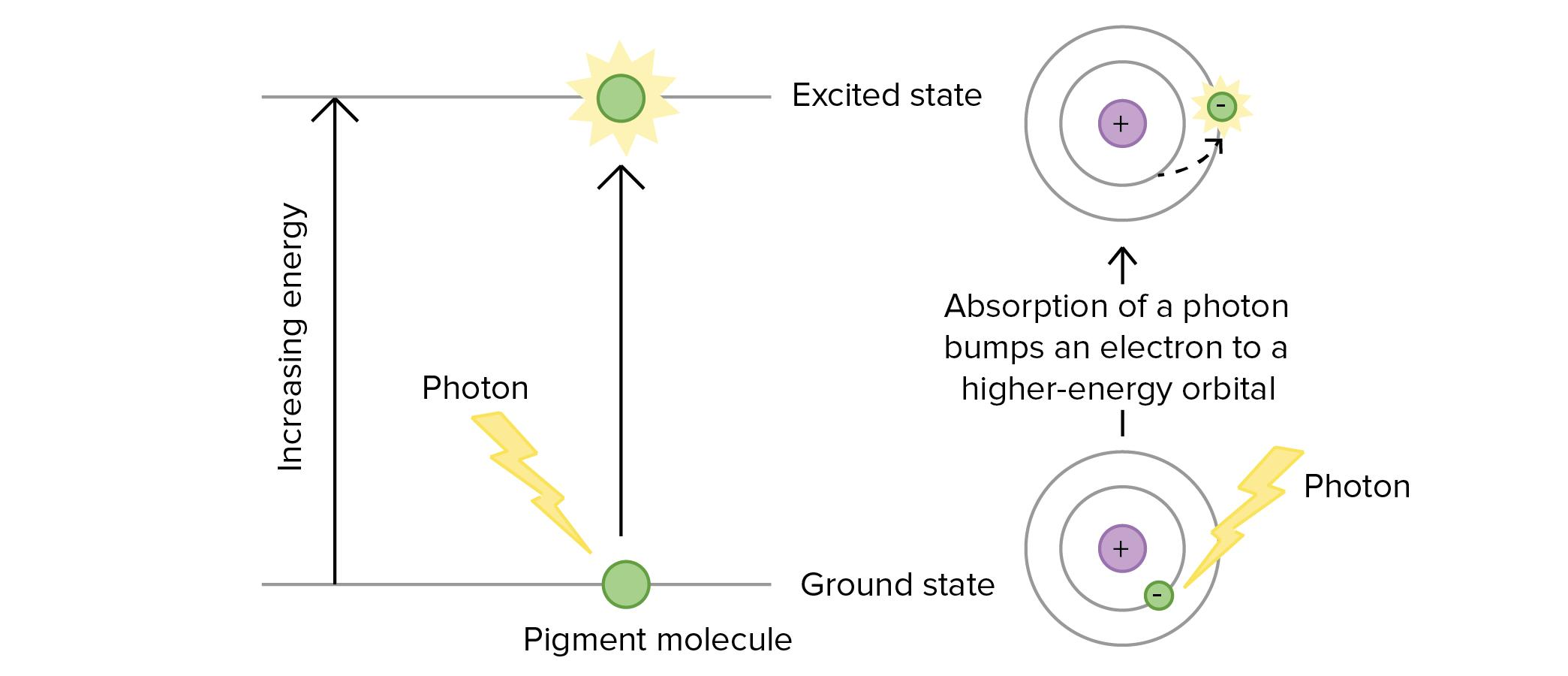
Excited state
A higher-energy state an electron enters after absorbing energy
When a pigment absorbs a photon (light energy), the photon provides energy to an electron. That electron moves to a higher-energy level and the molecule is now in an _.
the sequence is:
A pigment absorbs a photon.
The photon transfers energy to an electron.
The electron moves to a higher-energy level.
The pigment molecule enters an _
However, an electron cannot absorb just any random amount of energy and move to an _. The photon must have exactly the amount of energy needed for the electron to move between its available energy levels. Different molecules have different energy differences between their ground and excited states. Therefore, different pigments absorb different wavelengths. This explains why chlorophyll a and chlorophyll b have different absorption spectra.
An _ is unstable. The electron cannot stay at that higher-energy level for long. In isolated pigment molecules, the excited electron usually falls back down to its ground state extremely quickly. When it falls back down, the excess energy is released as either:
Heat: The electron returns to its ground state and releases the extra energy as heat. This is why objects exposed to sunlight can become warm.
Fluorescence: Some pigments, including chlorophyll, can release energy as light. the emitted light is called fluorescence
When isolated chlorophyll absorbs light:
It absorbs a photon.
An electron becomes excited.
The electron returns to its ground state.
The molecule releases energy as light and heat.
The emitted light is in the red-orange part of the spectrum.
This is why a solution of isolated chlorophyll can fluoresce when illuminated with ultraviolet light.
Excitation
The process of raising an electron to a higher energy level
Chlorophyll a
Main light-capturing pigment that participates directly in the light reactions. It is especially important because it is found in the reaction centers of photosystems.
Its absorption spectrum shows that it absorbs primarily:
Violet-blue light.
Red light.
It absorbs relatively little green light.
Chlorophyll b
Accessory pigment that helps capture additional wavelengths of light that the main pigment might not absorb as effectively.
If _ absorbs some additional colors that chlorophyll a didn’t absorb, the plant can capture energy from a broader range of visible light. That means the plant can use more of the available sunlight.
Chlorophyll a and _ have slightly different molecular structures, and even though the difference is small, it changes which wavelengths they absorb.
Carotenoids
Yellow/orange accessory pigments that absorb violet and blue-green light
Another group of accessory pigments. They are hydrocarbons, meaning they are molecules made of carbon and hydrogen. They appear yellow or orange because they absorb violet and blue-green light. _ have 2 important functions:
Broaden the range of light absorbed: _ absorb wavelengths that help expand the range of colors available for photosynthesis.
photoprotection: protection from damage caused by excessive light. Sometimes a plant absorbs more light energy than it can safely use. Too much light energy can damage chlorophyll or interact with oxygen to form dangerous reactive oxidative molecules. _ help protect the plant by absorbing and dissipating excess light energy. They are a protective system that helps prevent too much light energy from damaging the photosynthetic machinery.
Accessory pigment
A pigment that helps capture wavelengths beyond those absorbed effectively by the main pigment (i.e chlorophyll b)

Photoprotection
Protection against damage from excessive light energy
Spectrophotometer
Instrument used to measure how much light passes through a pigment solution, and which wavelengths a pigment absorbs. A _:
Directs light of a particular wavelength through a solution containing a pigment.
Measures how much light passes through the solution.
Repeats this process using different wavelengths.
This tells scientists which wavelengths are absorbed and which pass through.
Absorption spectrum
Graph showing how much light a pigment absorbs at different wavelengths
Ex: for chlorophyll a, the graph shows:
High absorption in violet-blue light.
High absorption in red light.
Low absorption in green light.
And, we know that chlorophyll reflects/transmits green light
wherever it’s lowest is what pigment it is, or the color that’s being reflected
Action spectrum
Graph showing how effective different wavelengths are at driving photosynthesis (identifies which colors of light actually drive photosynthesis most effectively).
how effective wavelengths are at driving photosynthesis.
Scientists can measure photosynthetic activity by looking at things such as:
How much CO₂ is consumed.
How much O₂ is released.
For example, if blue light causes a high rate of oxygen release, blue light is effective at driving photosynthesis.
The _ is broader than chlorophyll a’s absorption spectrum alone, because If chlorophyll a were the only pigment involved, photosynthesis would depend entirely on the wavelengths chlorophyll a absorbs. But chloroplasts contain other pigments, too, namely chlorophyll b and carotenoids. These accessory pigments absorb additional wavelengths. They help capture light energy that can then be transferred toward the photosynthetic reaction centers. plants can use a wider range of colors for photosynthesis than chlorophyll a alone would suggest.
Fluorescence
Light released by a pigment after it absorbs energy
Red limit
The lower energy boundary for light that can support photosynthesis.
Researchers grew a cyanobacterium called Chroococcidiopsis thermalis under only far-red light with a wavelength of 750 nm. They concluded that chlorophyll f was functioning in place of chlorophyll a, allowing the cyanobacterium to grow in very shaded conditions. Higher wavelengths have lower energy. This finding showed that photosynthesis could occur using light with less energy than scientists had previously thought. This extending the lower energy limit for photosynthesis is the _.
Chlorophyll d is another chlorophyll form that can absorb higher-wavelength light (along with chlorophyll f).

Photosystems
Chlorophyll is organized into structured called _, located in the thylakoid membrane. A _ is a group of proteins and pigment molecules organized into 2 main parts:
Several light-harvesting complexes
a reaction-center complex
PS II → PS I
PS II = P680 works first.
PS I = P700 works second.
Light-harvesting complexes transfer energy to the reaction center.
Primary electron acceptor receives excited electrons
Reaction-center complex
the central part of a photosystem. It contains proteins, a special pair of chlorophyll a molecules, and a primary electron acceptor. The reaction-center chlorophyll a molecules are special because their surrounding molecular environment allows them to do something different from isolated chlorophyll. They can use light energy to excite an electron and transfer that electron to another molecule. That other molecule is the primary electron acceptor
Light-harvesting complex
Group of pigments and proteins that captures light energy and transfers it toward the reaction center
each contain different pigment molecules attached to proteins, which may include chlorophyll a, chlorophyll b, and carotenoids. Their job is to absorb light and transfer its energy toward the reaction center. Having many different pigments allows the photosystem to absorb more wavelengths of light than one pigment could absorb alone. Energy travels through the process in which:
A pigment absorbs a photon.
Its energy is transferred to a nearby pigment.
That pigment transfers the energy to another pigment.
The energy continues moving through the complex.
Eventually, the energy reaches the reaction-center chlorophyll a molecules
ENERGY is what travels between pigments, not the same electron
Primary electron acceptor
a molecule that accepts an electron and becomes reduced.
Important as the electron is no longer simply falling back to its ground state and releasing energy as heat or fluorescence.Instead, the electron has been transferred to another molecule. The energy is now being captured in a chemical process.
This is one of the first steps in converting solar energy into chemical energy.
Photosystem II (PS II)
First photosystem in linear electron flow; contains P680
The reaction-center chlorophyll a in photosystem II is called P680 because it absorbs light most effectively at a wavelength of 680 nm.
P = pigment
680 - wavelength in nanometers
_ functions FIRST, but was discovered second.
Photosystem I (PS I)
Second photosystem in linear electron flow; contains P700
The reaction-center chlorophyll a in photosystem I is called P700 because it absorbs light most effectively at a wavelength of 700 nm.
_ functions SECOND, but was discovered first
P680
Reaction-center chlorophyll a of PS II; absorbs light most effectively at 680 nm
P700
Reaction-center chlorophyll a of PS I; absorbs light most effectively at 700 nm
Linear electron flow
Movement of electrons from water → PS II → an ETC → PS I → NADP+ (which is reduced to NADPH)
Electrons originate from water.
Water splitting releases O2 (a by-product)
The first electron transport chain helps pump H+
ATP synthase produces ATP.
The second chain transfers electrons through ferredoxin.
NADP+ is reduced to NADPH.
Purpose is to use light energy to produce ATP and NADPH
H2O → PS II → PS II → NADPH
Electron transport chain
Series of molecules that transfer electrons and release energy
Plastoquinone (Pq)
Electron carrier in the first electron transport chain
Cytochrome complex
Protein complex involved in electron transfer and proton pumping
Plastocyanin (Pc)
Protein that carries electrons toward PS I
Ferredoxin (Fd)
Protein that receives electrons from PS I and transfers them toward NADP+
NADP+ reductase
Enzyme that helps transfer electrons to NADP⁺ to form NADPH
Redox reaction
Chemical reaction involving the transfer of electrons
Oxidation is the loss of electrons
Reduction is the gain of electrons
Occur together, if one molecule loses electrons, another molecule must receive them.
Proton gradient
Difference in H+ concentration across a membrane
Proton-motive force
Potential energy stored in the proton gradient
ATP synthase
Protein complex that uses energy from H⁺ movement to make ATP (transport protein)
Oxidative phosphorylation
Production of ATP using energy from electron transport in mitochondria
Occurs in the mitochondria
Uses energy from electrons extracted from food molecules.
Produces ATP.
Uses chemiosmosis.
use ATP synthase and a proton gradient
Intermembrane space
Space between the inner and outer mitochondrial membranes
Mitochondrial matrix
Fluid-filled interior of the mitochondrion
pH
a measurement related to the concentration of hydrogen ions (H⁺) in a solution.
More H+ = lower pH
Less H+ = higher pH
shorter, longer
The _ the wavelength, the higher the photon energy
the _ the wavelength, the lower the photon energy
Visible light = approximately 380–750 nm.
Catabolic
reactions that break down larger molecules into smaller ones