Government Interventions - Subsidies, Tax on Monopoly
 Call Kai
 Learn
 Practice Test
 Spaced Repetition
 Match
 Flashcards
 Knowt Play
1/69

There's no tags or description
Looks like no tags are added yet.
70 Terms
Specific subsidy
A fixed dollar mount on each unit sold or bought.
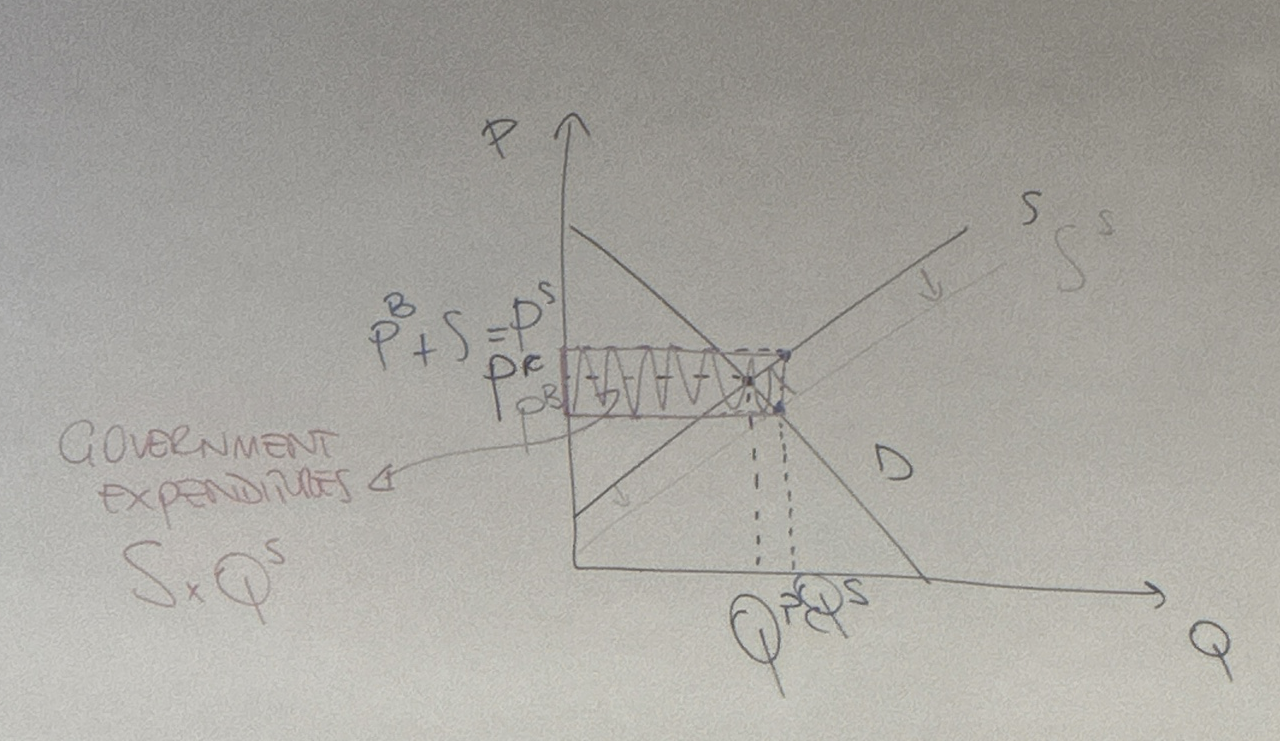
What happens to price and quantity due a specific subsidy?
Quantity traded increases, increasing DWL
PB < PPC
PS > PPC
QS>QPC
PB-PS = S paid by govt per unit
Is a subsidy paid completely by one side or shared?
It does not matter who initially receives the subsidy, because the subsidy is shared between demand and supply, depending on relative elasticities.
Welfare analysis of subsidies
Perfect competition:
CS = A+B
PS = G+H
Govt. Rev. = 0
Total Surplus = A+B+G+H
DWL = 0
Subsidy:
CS = A+B+G+F+E
PS = G+H+B+C
Govt. Rev. = -B-C-D-G-F-E
Total Surplus = A+B+G+H-D
DWL = -D
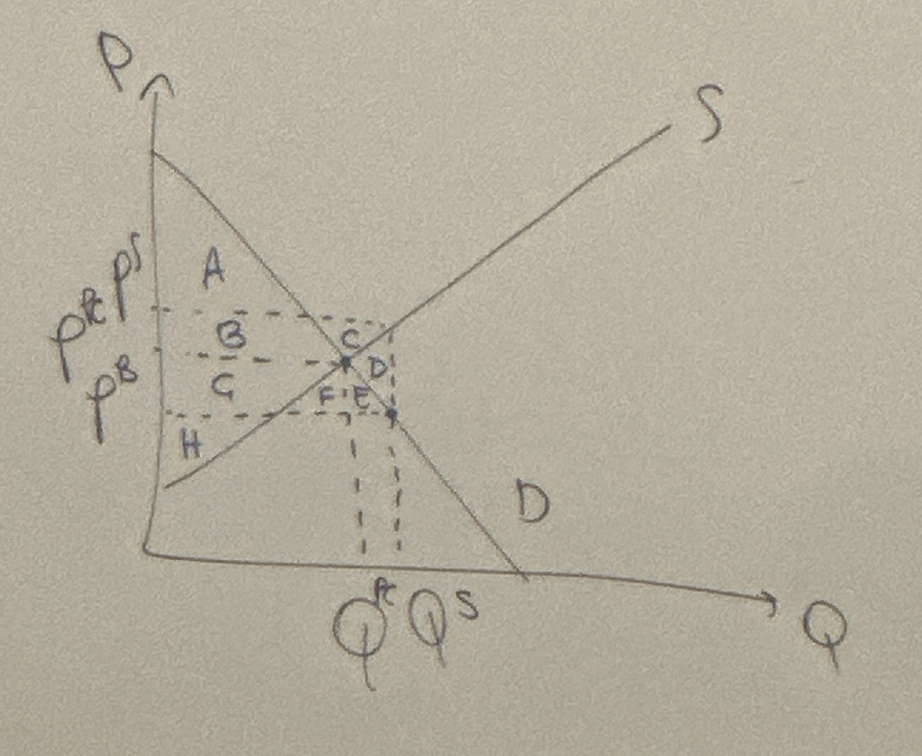
How dose a subsidy affect CS, PS, and DWL?
CS increases
PS increases
DWL shows that the units between QS - QPC are too costly
How does tax on monopoly affect quantity?
QM < QPC
What is changed by tax on monopoly?
The variable cost increases, marginal cost increases, this drives up the monopoly price and down the quantity, increasing DWL.

Tax on Monopoly - Welfare analysis
Monopoly:
CS = A+B+C
PS = D1+D2+E
Govt. Rev. = 0
Total Surplus = A+B+C+D1+D2+E
DWL = -F
Tax on Monopoly:
CS = A
PS = B+D1
Govt. Rev. = D2
Total Surplus = A+B+D1+D2
DWL = -C-E-F

Why is taxation not a good idea to fight monopolies?
A monopoly already produces too little compared with the socially efficient quantity: QM<QPC.
Some consumers are willing to pay more than the cost of producing an extra unit, but the monopolist does not supply it. This creates deadweight loss. A per-unit tax raises the monopolist’s marginal cost: MR=MC+t. It therefore produces even less and charges a higher price, increasing deadweight loss. This decreases efficiency.
Per-unit subsidy
A per-unit subsidy lowers its effective marginal cost. MR=MC-s. It therefore produces more, moving output towards QPC and reducing deadweight loss. This increases efficiency.
Does anyone gain surplus / revenue from taxes on monopolies?
Consumers: lose CS as the price rises and fewer units are purchased.
Producers: lose PS as they pay the tax and seller fewer units; the higher price does not fully compensate.
Government: gains tax revenue, receiving t x Q after tax
Types of policies to support price on a market (to protect supply)
Price floor, Production quota, and Price support
Price floor
Minimise the price at which a good can be traded on a market (the good cannot be traded at a lower price, e.g. minimum wage)
Production quota
Limit on the quantity that firms can produce (if you restrict supply, you will increase price)
Price support
The government directly buys the good on the market, creating additional demand (demand increases, and price therefore also increases)
Price floor results
Generates excess of supply

Welfare analysis of price floor
Perfect Competition:
CS = A+B+C
PS = D+E
Total Surplus = A+B+C+D+E
DWL = 0
Price floor:
CS = A
PS = B+D
Total Surplus = A+B+D
DWL = C+E
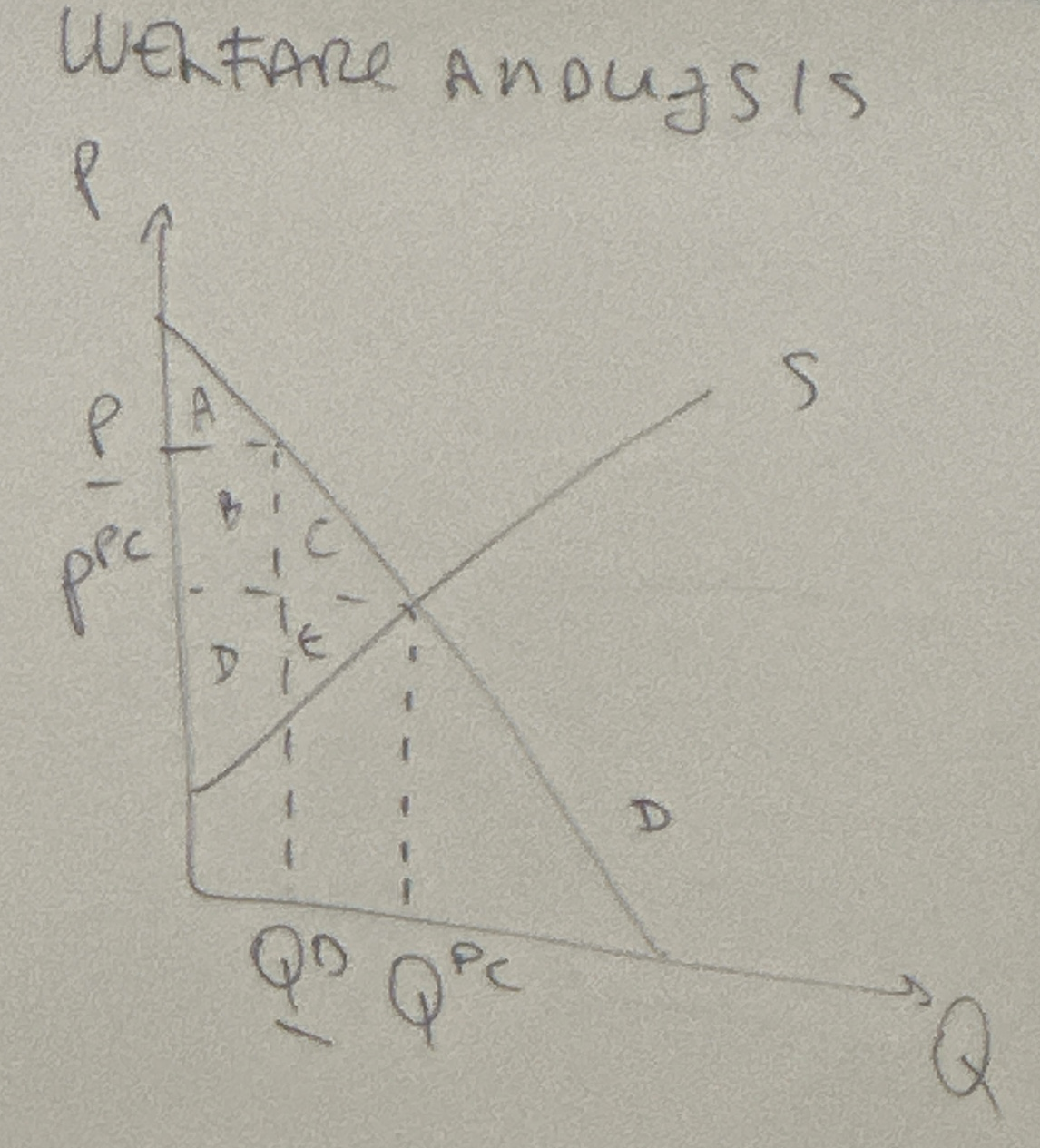
When does PS increase as a result of a price floor?
PC PS = D+E
PF PS = B+D
When B>E, PS increases.

Why would a government introduce a price floor?
A government introduces a price floor to prevent market prices from falling too low. It sets a legal minimum price above the natural market equilibrium to support specific producers or workers.
Production quota results
Limits to production to increase price. Same welfare analysis as with a price floor, however, here it is not because a price has a minimum, but because quantity has a maximum.

What is voluntary reduction with regards to a production quota?
When the government pays firms not to produce more than Q. The price paid by the government corresponds to the red section.

Why do governments introduce production quotas?
Governments introduce production quotas to limit the total output of goods and prevent overproduction from driving down market prices. These restrictions help stabilise prices, protect domestic producers, and maintain sustainable incomes or resource levels (pollution etc.).
How much is price paid by government equal to in voluntary reduction for a price quota?
The profit firms give up by agreeing not to produce the extra units between Q and QS. The government compensates them for that loss. For each unit they agree not to produce:
They lose the selling price P.
But they save the cost of producing it, shown by the supply curve S=MC.
Restricting output raises the price to PS. At that higher price, firms would want to produce QS, which exceeds the original competitive quantity. The government must compensate them for the profit they could earn on all units between Q and QS, so the red triangle extends beyond the original equilibrium.
Price support results
Government buys some of the goods to increase demand, increasing both price and quantity. The government purchases increase demand, so the demand curve shifts right. The higher supported price encourages firms to produce more, while private consumers buy less. The government buys the difference: QG = QS - QD

Welfare analysis of price support
Perfect competition:
CS = A+B+C
PS = D+E
Govt. Rev. = 0
Total Surplus = A+B+C+D+E
DWL = 0
Price support:
CS = A
PS = D+B+E+C+F
Govt. Rev. = -C-F-E-G-I-H
Total Surplus = A+B+D-G-I-H
DWL = -C-D-E-G-I-H

Does CS increase or decrease after price support?
Decrease
Does PS increase or decrease after price support?
Increase
Does Govt. Rev. increase or decrease after price support?
Decrease, it has to pay for P x (QS-QD)
Does DWL increase or decrease after price support?
Increase, there is an excess of demand paid by the government. Consumers buy less: the higher price prevents some purchases whose benefit exceeds their production cost. Firms produce more: government purchases encourage extra units whose production cost exceeds their value to private consumers.
Government spending is not all DWL—some transfers surplus to producers. The waste comes from the lost beneficial trades and extra production, assuming the government-bought goods have no useful value.
Why does a price support decrease the quantity bought by buyers?
A price support decreases the quantity bought by buyers because it forces the market price above the free-market equilibrium price, which triggers the law of demand. The government will force the firm into overproduction, and is inefficient. It only increases PS. If it does not distribute what it buys, it is useless and the units are not redistributed and simply lost funds (VERY INEFFICIENT).
Price cap
A policy to decrease price and protect demand bye setting a maximum to the price price at which a good can be sold. It is a legal maximum price sellers can charge.

If price cap is above the equilibrium price…
it has no effect, because the market price is already below the cap.
If the price cap is below the equilibrium price, then…
it forces the price down and changes how much people want to buy and sell.
If price is forced down by a price cap how do quantity demanded and supplied change?
Quantity demanded increases (lower price)
Quantity supplied decreases (lower price)
This creates an excess of demand (a shortage) as consumers want more than producers offer.
Results of price cap for consumers
Consumers who obtain the good benefit from the lower price. Meanwhile, consumers who do not obtain the good due to limited supply lose access. CS increases if the increase in surplus due to lower price > the decrease in surplus due to less units bought.
Results of price cap for producers
Producers generally lose: they receive a lower price and sell fewer units. Over time, they may reduce investment or quality.
Does a price cap create DWL?
Society loses some total surplus: trades that would have benefited both buyers and sellers no longer happen. This creates deadweight loss.
welfare analysis of price cap
Perfect competition:
CS = A+B
PS = C+D+E
Total Surplus = A+B+C+D+E
DWL = 0
Price Cap:
CS = A+C
PS = C+D+E
Total Surplus = A+B+E
DWL = B+D
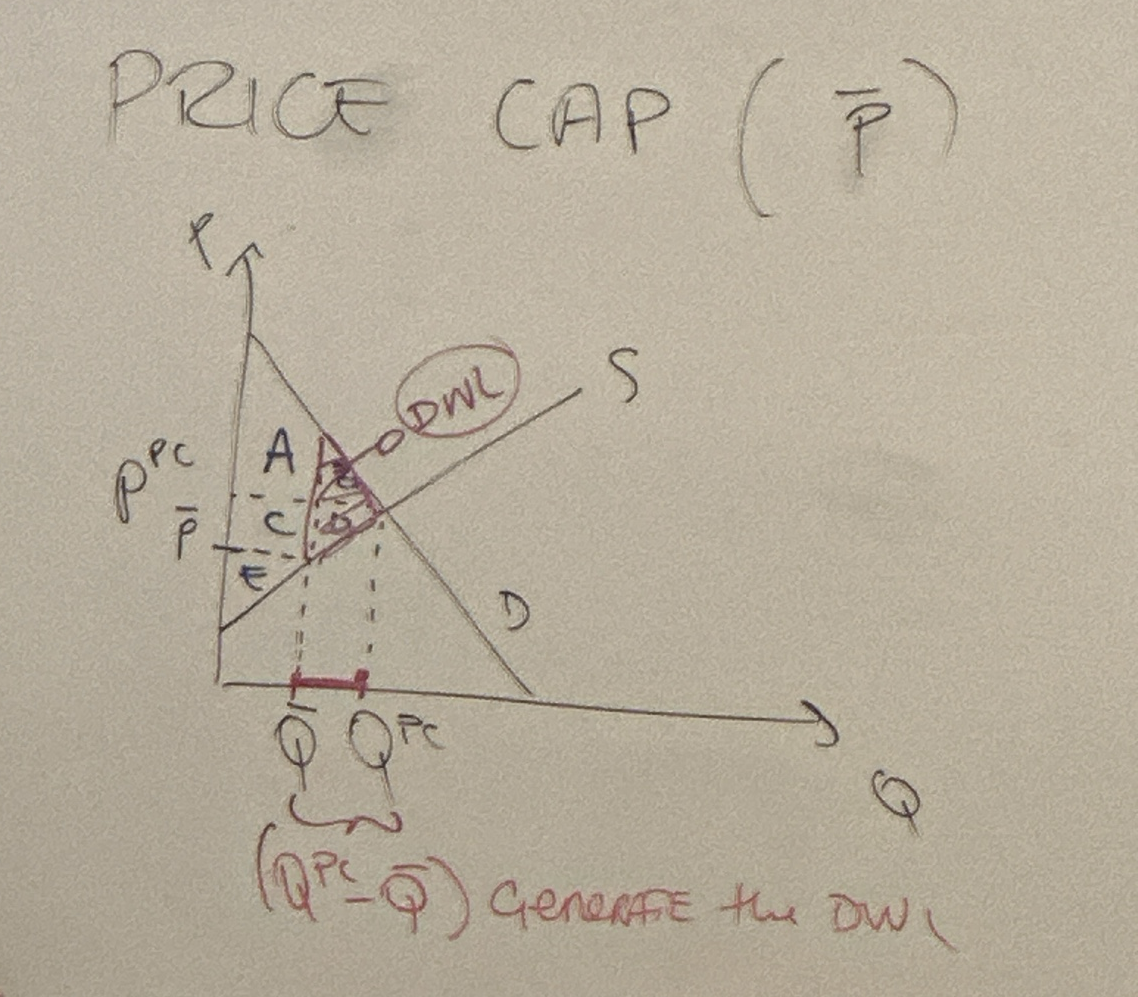
How is a price cap in a monopoly different to a price cap in PC?
In PC: a cap below equilibrium reduces quantity supplied (reduces output) and creates a shortage.
In a monopoly: A cap below the monopoly price can encourage the monopolist to increase output, reducing its markup.
Efficiency effect of price cap monopoly v PC
PC: A binding cap generally creates deadweight loss as we are producing below efficient quantity.
Monopoly: A suitable cap reduces deadweight loss as it increases output and makes it closer to the efficient output; setting it at the competitive price can eliminate DWL all together.
Results of price cap in a monopoly
A monopoly normally restricts output to keep its price high, selling the amount at which MR = MC, so after that selling more does not increase profit, even though consumers value extra units more than they cost to produce. If price is capped, the monopolist can increase profit by selling more units, even though this profit is less than what it would be at monopoly quantity. Those extra units increase profit as long as the capped price exceeds their marginal cost, so output rises. Deadweight loss falls because more mutually beneficial trades happen: consumers receive extra units whose value to them exceeds the cost of producing them.
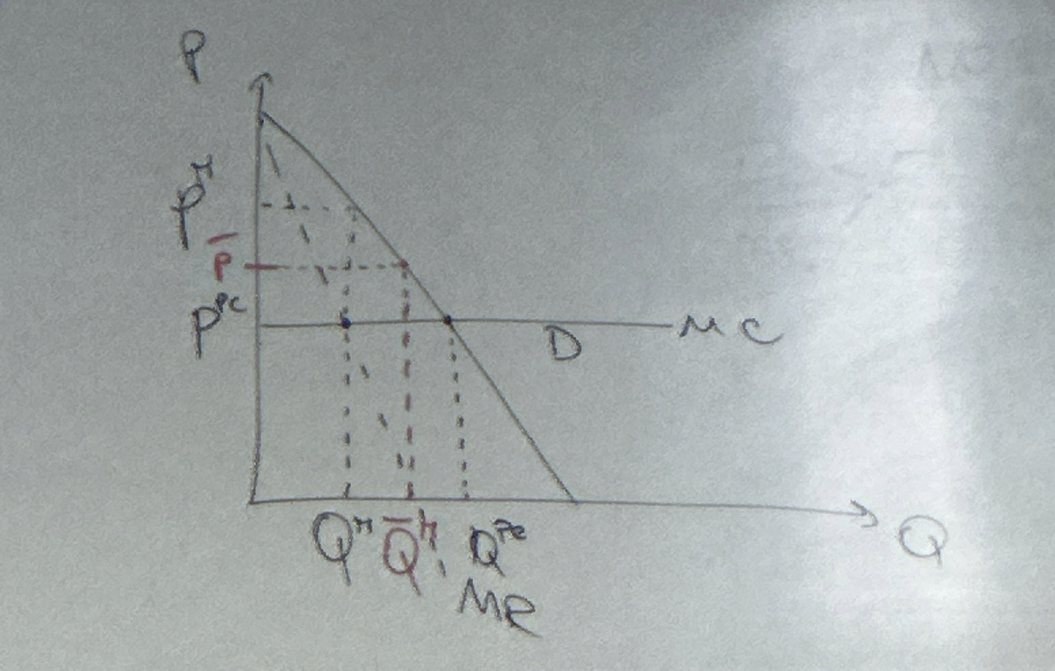
Why does MR decrease?
Because selling more means price per unit decreases, decreasing MR.
What happens if a price cap is set too low for a monopolist?
f the price cap is too low, producing additional units becomes unprofitable because their marginal cost exceeds the capped price. The monopolist then reduces output, producing where P=MC, provided it remains worth operating. At this low price, consumers want more than the firm produces, so a shortage appears.
Different changes to ouput for price cap on monopoly
But below the original monopoly price isn’t enough to imply \(P=MC\):
Between the competitive and monopoly prices: it produces the quantity consumers demand at the cap, increasing output; generally P>MC.
At the competitive price: +MC, giving the efficient quantity.
Below the competitive price: it reduces output to where P=MC creating a shortage.
Three ways to regulate monopolies
Price cap (decreases inefficiency and also market power), nationalise monopolies, and restore competition by supporting new entrants in the market
How does nationalising monopolies work?
Nationalising a monopoly means the government takes ownership of it. The aim may be to maximise social welfare by providing affordable services and producing an efficient quantity.
Problems with nationalising monopolies
The problem is that the managers running the firm may pursue different objectives from the government or the public. For example, they may prefer higher salaries, more staff, prestige, or less effort rather than controlling costs and improving services. Because the government cannot perfectly monitor their decisions, managers may operate inefficiently. If they expect the government to cover losses, they may also face less pressure to avoid waste. This is a principal–agent problem: the government/public (the principal) wants one outcome, but the manager (the agent) has different incentives.
Why do natural monopolies usually have to produce on a large scale?
FCs are very high, while MC is low and constant. Therefore, at higher quantities, AC is lower. atural monopolies need to produce on a large scale to spread their very high fixed costs over many units, making each unit cheaper on average. One firm serving the whole market can therefore produce more cheaply than several smaller firms, each paying to build its own network.

When will a firm generate profits?
Only if the price is above the AC.
How does introducing a second firm on a market instead of having a monopoly change demand?
If two firms share the market equally, each gets only half the customers at every price. So each firm faces demand D/2/ But each still has to pay the full fixed cost. With fewer units over which to spread that cost, each firm has a higher average cost. In some cases, each firm’s demand curve D/2 now lies below its AC curve everywhere. That means no price and quantity on its demand curve allows it to cover all its costs: P<AC. Profit is negative and both firms would stop producing.

Internal vs World market supply and demand
Assuming a small country with free trade, the domestic price equals the world equilibrium price QW, determined by the intersection of world supply and world demand.
At this price, QS is the number of units sold by domestic firms, QD that bought by domestic consumers. If QD>QS, world price is below domestic price, therefore there is an excess of demand and the country imports the difference.

World price usually lies below equilibrium internal price
False, it can be below or above the domestic equilibrium price without trade.
World price below domestic price: the country imports, because buying abroad is cheaper.
World price above domestic price: the country exports, because producers can sell at a higher price abroad.
When world price lies below domestic price, there is an excess of demand, what is done?
The excess demand units are imported from international firms.

Import tax
A tax on each unit bought from foreign firms
PW + T
To whom is the higher price paid in import tariffs
If the good is one that is imported (to cover excess demand), then the T portion of the higher price P = PW +T is paid to the government
If the good is one that is domestic, then the portion T of the higher price P = PW + T is paid to domestic firms.
Why do domestic firms gain money due to import taxes?
Domestic firms can charge the higher price because competing imports now cost P = PW+T. They do not pay the import tariff themselves.
How does an import tariff affect the supply and demand graph of domestic firms with price above the world price?
It increases Price by T, this decreases the excess demand, as quantity supplied increases and quantity demanded decreases as the price is closer to the equilibrium price of the domestic firm. AKA: the import tariff increases the price paid, decreasing the amount of imports.
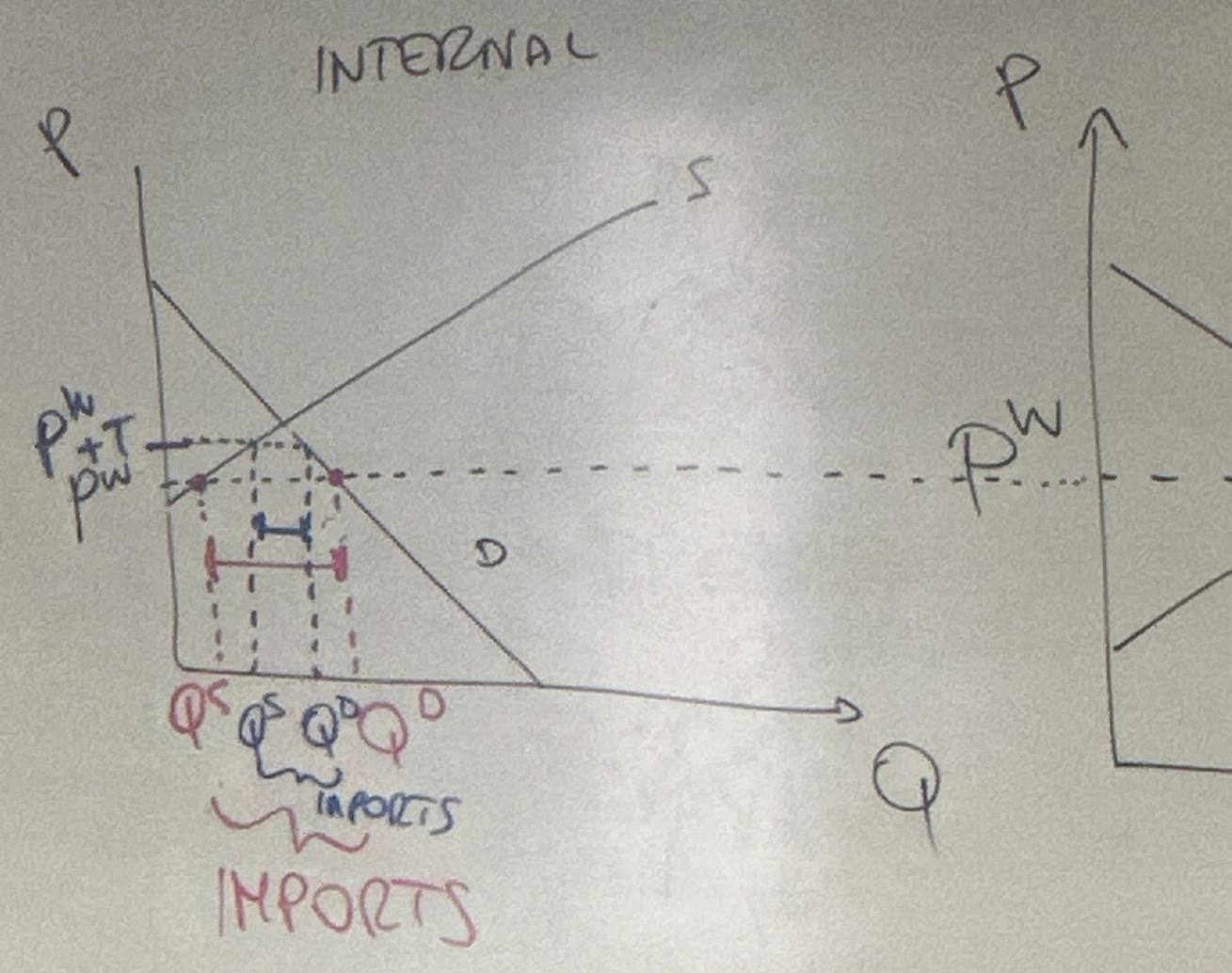
Welfare analysis of import taxes
Perfect competition:
CS = A+B+C+D+E+F
PS = G
Govt. Rev. = 0
Total Surplus = A+B+C+D+E+F+G
DWL = 0
Import tax:
PS = A+C
PS = B+G
Govt. Rev. = E (tax x no. of imports)
Total Surplus = A+C+B+G+E
DWL = D+F

What increases and decreases in welfare analysis due to import taxes?
CS decreases, PS increases, Govt. Rev. increases, Total Surplus decreases, DWL increases
Externalities
If the consumption or production of a good causes a benefit or cost to agents external to the transaction, that good produces an externality. This externality is:
positive, if it increases the benefit of external agents
negative, if it decreases the benefit of external agents
Why does trading externality goods on competitive markets make the market inefficient?
Because buyers and sellers consider their own costs and benefits, but ignore costs or benefits affecting other people. These external effects are therefore missing from the market price. Negative externality, such as pollution: producers ignore the harm imposed on others, so production looks cheaper than it really is for society. The market produces too much. Positive externality, such as education: buyers ignore some benefits their education gives others, so the benefit looks smaller than it really is for society. The market produces too little.

Without externalities how is the PC equilibrium?
Without externalities, supply, S = MC = MSC and P = MB = MSB. Because in PC, P = MC, MC = MSC = P = MB = MSB. The optimality condition P = MC also means that MB = MSC, therefore it also give us social efficiency by private incentives.

MSC
Marginal Social Cost : the total cost to a society of producing one additional unit of a good or service, or taking an extra action in the economy.
MB
Marginal benefit for the consumer from consuming that unit of the good. NOT THE SAME AS MR as that is for firms. The demand curve shows the maximum price consumers are willing to pay for each additional unit—its marginal benefit.
Why is P = MB?
The consumer therefore stops where MB=P: the benefit of the last unit purchased equals its price. Earlier units can have MB>P. If MB>P, buying another unit gives more benefit than it costs, so the consumer buys more.If MB<P, that unit costs more than its benefit, so they don’t buy it.
MSB
Marginal Social Benefit : the total benefit to society of producing one additional unit of a good or service, or taking an extra action in the economy.
Negative externality
Creates an external cost EC(!)
Marginal external cost
MEC(Q) = dEC/dQ
extra cost from producing or consuming one additional good
MSC(Q) equation
MSC(Q) = MC(Q) + MEC(Q) > MC(Q)
as MEC(Q)>0
MC(Q) is private production cost
MEC(Q) is the cost for third parties
Social optimality condition with negative externalities
MSB = MB = P = MC < MSC
Therefore, in equilibrium, MSB < MSC, so Q is too high and there is an excess of supply. To get efficiency MSB = MSC, so quantity needs to be reduced.