ch10 visual attention
 Call Kai
 Learn
Learn Practice Test
 Spaced Repetition
 Match
Match Flashcards
 Knowt Play
1/12

There's no tags or description
Looks like no tags are added yet.
Name | Mastery | Learn | Test | Matching | Spaced | Call with Kai | Chat |
|---|
No analytics yet
Send a link to your students to track their progress
13 Terms
attention
taking away attention from something in order to effectively focus attention on focus item, used to alert us, inhibit info, monitor a goal set, etc.
orienting reflex
turning or preparing to take in a lot of info in response to an unexpected S- reticular activation system and magnocellular pathway involved
reticular activation system
helps you pay attention to specific tasks or environmental cues and decides which sensory inputs need immediate attention
magnocellular pathway
where pathway projections from occipital to parietal lobe, where in space is S coming from and we orient body towards unexpected S
habituation
tendency for attention to a S to decrease over time due to repeated exposure to it
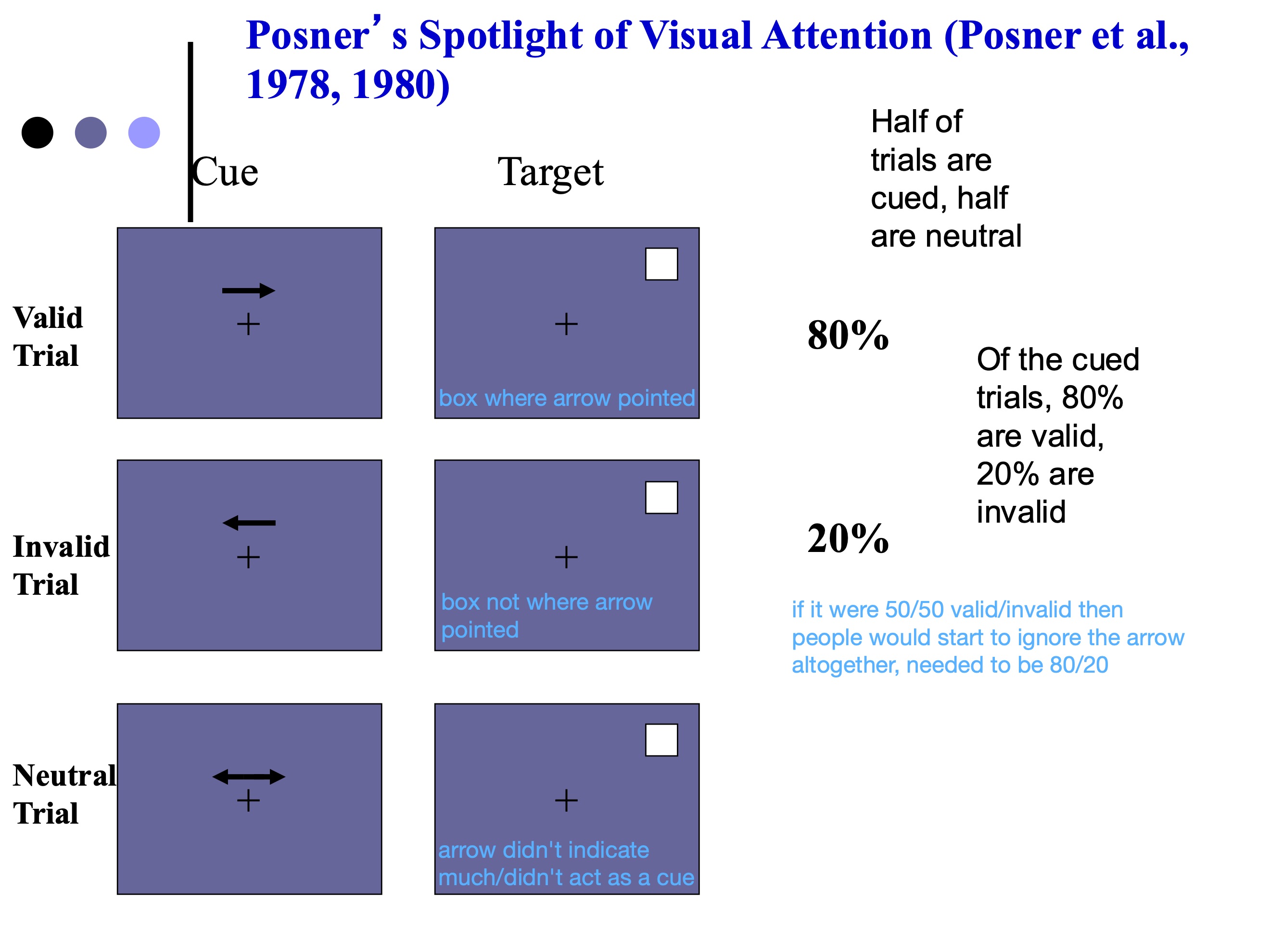
posner’s spotlight of visual attention (1978, 1980)
Ps look at screen with plus sign, told look at plus sign and keep eyes on plus sign, second screen had arrow pointing right or left but look only at plus sign, third screen had target box and click button indicating if box is on right or left side, half of trials are cued and half are neutral, 80% cued trials are valid and 20% invalid to ensure people trusted the arrow system, RT greatly differed for invalid vs. valid trials
where in the brain is the action in the spotlight of visual attention task? (eason et al. 1969)
occipital cortex, low level early processing/detecting allocation of attention (attention allocation is fast and malleable), Ps watched for light flashes appearing in either their right or left visual field and researchers recorded brain electrical activity and measured how quickly Ps responded with a button press, found that changes in brain wave amplitudes depend on the mix of general arousal level and where a person's visual attention is directed
featural search
looking for specific features that ID an object, ie. black clothes when looking for a black shirt
feature singleton
the object you are trying to ID is the only one of its kind, ie. only black shirt in closet
conjunctive search
looking for two or more features at once, ie. looking for both black clothing and tshirts
distracters
other items in search set
similar distracters
cause most people to serial search (ie. look for letters by analyzing one letter/row at a time), much slower RT
dissimilar distracters
cause most people to parallel search/look for dissimilarities, much faster RT