CPSC 253 - Lecture 4: Advanced Encryption Standard
 Call Kai
 Learn
Learn Practice Test
 Spaced Repetition
 Match
Match Flashcards
 Knowt Play
1/31

There's no tags or description
Looks like no tags are added yet.
Name | Mastery | Learn | Test | Matching | Spaced | Call with Kai | Chat |
|---|
No analytics yet
Send a link to your students to track their progress
32 Terms
Features of AES bit sizes
Block cipher with a block size of 128 bits.
Allows for three different key lengths: 128, 192, and 256 bits, can be more.
Mostly assume that the key length is 128-bit.
For a key length other than 128 bits,the main difference is how the key schedule is generated from the key
Key schedule determines handling
How does AES encryption round amounts change based on key size?
10 rounds of processing for 128 bit keys
12 rounds for 192 bit keys
14 rounds for 256 bit keys
Identical rounds excluding the last round which has a different key, put everything back to 128 buts
Steps in AES processing rounds for encryption
1) 1 single-byte based substitution step(Byte level)
2) Row-wise permutation(Word level permutation)
3) Column wise mixing step(Word level)
4) Addition of a round key(XoR operation, use with input block)
Order is different for encryption and decryption
Word: 4 bytes,
Processing steps in 1 round(AES)
After a 1st block goes through all the rounds, the processing goes block by block, column by column
16 bytes * 8 bits = 128 bits
The 128 bit block is a 4×4 matrix of bytes
1st 4 bytes occupy the 1st column and so on
State Array
4×4 bytes matrix of bytes/a block
Input for AES
Each block is repped by a 4×4 matrix, columns numbered starting at w0

AES Words
4 bytes/32 bits = 1 word
Each column/row of the state array is a row
Each processing round takes the inout state array and produces an output state array
This output is rearranged into a 128-bit output block
Substitution
Confusion: Relationship between key and ciphertext being obscured is the goal
Permutation
Diffusion: Influence of 1 plaintext symbol is spreadover many ciphertext symbols with the goal of hiding statistical properties of the plaintext (original message)
MixColumns/InvMixColumns
Step 3 in encryption
Step 4 in decryption
Mixes up bytes in each column seperately
Goal is to scramble up 128 bit input block
Expanding the Encryption Key
If the key size is larger or smaller than 128 bits
Assuming a 128-bit key, the key is also arranged in the form of a matrix of 4 × 4 bytes. As with the input block, the first word from the key fills the first column of the matrix, and so on.
The four column words of the key matrix are expanded into a schedule of 44 words. Each round consumes four words from the key schedule.
Decryption Steps
Inverse shift rows
Inverse substitute bytes
Add round key
Inverse mix columns
SubBytes/InvSubBytes
1st step in encryption
2nd step in decryption
Goal is to reduce correlation between input and output bits at byte level
Bit scrambling ensures substitution can’t be described in simple math function
1 single-byte-based substitution (Byte level), byte by byte using a rule that stays the same for all rounds
8 bit binary numbers
Uses a 16×16 lookup table to find a replacement byte for the given one in the input state array(traditional way)
Traditional way
16×16 lookup table
Divide input byte by 2 4-bit patterns to find substitution bytes to get a value between 0-15
Repped by hex values between 0-F
1 value is the row index and the other is the column index for the table
Always use 4 bit binary numbers
Results in 256 byte state array/lookup table
Lookup table
Substitution step(confusion) is done to reduce correlation between input and output bits at the byte level
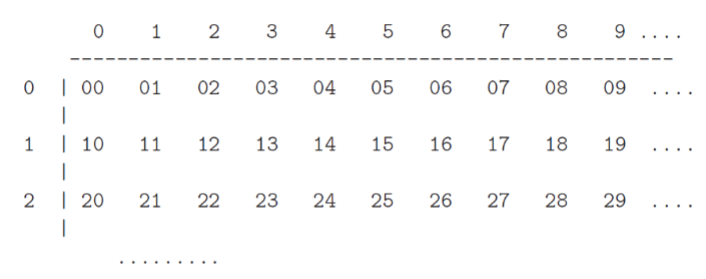
Construction of a 16×16 lookup table for AES encryption/decryption with Byte Substitution
Hexadecimal numbers, 4 bits each
GF(2^8) Unique 8 bit binary numbers based on multiplicative inverse
For 0×00 there’s no multiplicative inverse, it replaces itself
Bit scrambling to destroy bit-level correlations in each byte
The 16×16 table made is called the S-box, same for all bytes in the state array
Steps that go into this are reversed for the decryption table
1st use reverse of bit scrambling to each byte and then use multiplicative inverse
slide 28
0×95: 10010101, inverse is 0×84: 10000100

Bit scrambling for encryption
0×00 byte is changed with this, use XoR operation on right column with a column of 0s
This transformation is applied to each bit b of the byte stored in a lookup table
ci is the ith bit of a byte c with hex calue 0×63
4 of the digits represent 6, other rep 3 for the far right column
Breaks correlation between bits before and after substitution
Bytes c and d are choosen so the S-box(substituion box) has no fixed points
A=00001111
a complement is = 11110000
Can lead to weakness in the system
Implementation of AES in python
statearray = [[0 for x in range(4)] for x in range(4)]
Thanks to the nature of substitutions and permutations in AES, it can be implemented quickly as software
AES vs. Rijndael cipher
Rijindael works with any block and key size that’s a multiple of 32 & > 128
AES needs a 128 bit block size
The state array for the different block sizes still has only four rows in the Rijndael cipher.
However, the number of columns depends on size of the block. For example, when the block size is 192, the Rijndael cipher requires a state array to consist of 4 rows and 6 columns.
How does substitution for AES and DES differ?
AES uses a substitution-permutation network in a more general sense.
Each round of processing in AES involves byte-level substitutions followed by word-level permutations.
Speaking generally, DES also involves substitutions and permutations, except that the permutations are done by dividing the input block into two halves, processing each half separately, and then swapping the two halves.

What is being portrayed in this image?
Four words of the original 128-bit key being expanded into a key schedule consisting of 44 words.
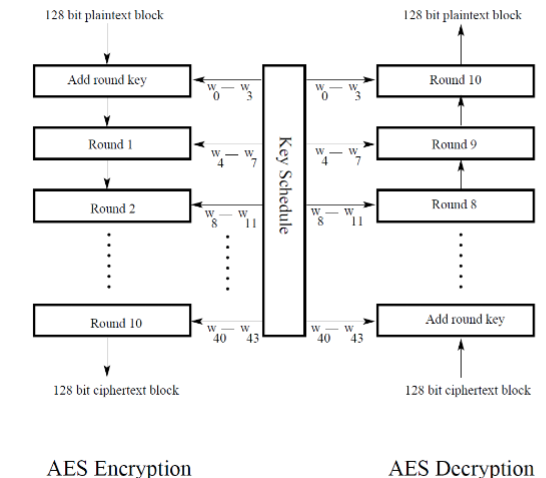
What is this image depicting?
Overall structure of AES for a 128 bit encryption key
Goes through 10 rounds
4 words
w0-w3: Input and key block added
Round 1: Take the 4 w’s and repeat until the end, 44 w’s
AES Pre processing step
Input state array is XORed w/ the 1st 4 words of the key schedule
Also happens during decryption except you use the ciphertext state array with the last 4 words of the key schedule
Steps in AES processing rounds for dencryption
1) Inverse shift rows
2) Inverse substitute bytes
3) Add round key
XOR the output of the previous 2 steps
4) inverse mix columns

What is this figure depicting?
1 round of AES encryption
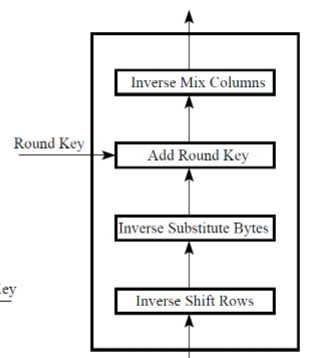
What is this figure depicting?
1 round of AES decryption

ShiftRows/InvShiftRows
Aims to scramble the byte order in each 128-bit block for AES
For encryption this is the 2nd step
For decryption it’s the 1st
Affects state array
1st row is unshifted
2nd is shfited 1 byte to the left
3rd is 2 bytes to the left
4th is 3 bytes to left
Array is written column wise
In decryption, same shifts but to the right
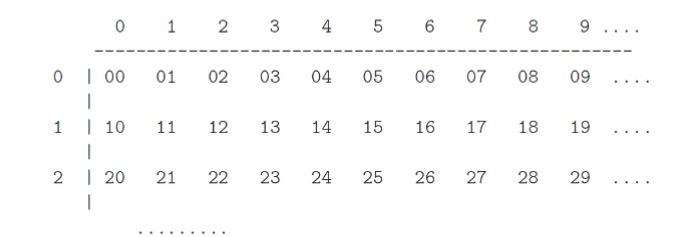
Understanding a lookup table
For a cell located at (2,7) you place hex 0×27 in that cell
Replace the next value in each cell with its multiplicative inverse in GF(2^8)
The byte stored in (9,5) is the multiplicative inverse of 0×95 which is 0×8A
IT stores 10001010 implying the MSB(b7 is 1 and b0 is 0

Importance of the c byte(value: 0×63)
For byte substitution to be invertible the byte-to-byte mapping by the 16 × 16 table must be one-to-one.
For each input byte, there must be a unique output byte. And, each output byte must correspond to only one input byte.
No input byte should map to itself, would make the cipher weak
Multiplicative inverses gives unique entries for each input byte(excluding 0×00)
Without this, the bit scrambling step would also leave the input byte 0x00 unchanged. With the affine mapping shown above, the 0x00 input byte is mapped to 0x63. At the same time, it preserves the one-to-one mapping for all other bytes.
c7…..c0 = 01100011
Used in encryption

Bit scrambling for decryption
After transforming each cell:
di is the ith bit of a specially designated byte d with hex value 0×05(d7 d6 d5 d4 d3 d2 d1d0 = 00000101)
Replace the byte in the cell with its GF(2^8) multiplicative inverse
Purpose of c and d bytes
No fixed points in S-box
Ex: S_box(a) = a should not be true
Ex: S_box(a) = ā indicates a fixed point with a bitwise complement, also undesirable