Diagnostic Approach to Cardiorespiratory Patient: From Dyspnea to Cough
 Call Kai
 Learn
 Practice Test
 Spaced Repetition
 Match
 Flashcards
 Knowt Play
1/26

There's no tags or description
Looks like no tags are added yet.
27 Terms
Describe the diagnostic approach for dogs and cats with lower respiratory tract diseases.

Describe the important first steps when faced with a patient in respiratory destress.
• Oxygen (flow by, mask, chamber)
• Sedative with anxiolytic effect
Butorphanol
• History
Acute or chronic?
Breathing pattern? Paradoxical?
Other clinical signs?
Vaccination/Worming
Appetite?
Other diseases?
• Signalment
Small dogs: Tracheobronchomalecia
Large dog with stridor: Laryngeal paralysis
Small dog with loud left sided heart murmur: Congestive heart failure
Dobermann: DCM?
Older animal: Neoplasia?
What is Adspection?
Adspection is a close or thorough inspection or observation, typically of an animal.
Describe possible breathing patterns?
**Try to define whether it is an inspiratory or expiratory breathing pattern
Mixed?
Any noises: stridor or stertor?

What are important parts of the physical exam for a respiratory focused issue?
• Listen to the lungs
Adventitial lung sounds?
• Listen to the heart
Murmurs? Arrhythmia? Heart rate?
• Mucous membranes
Cyanosis?
• Pulse quality
If the patient is cyanotic, what is the diagnostic approach?
Cyanosis - erythrocytes deficient of oxygen
Central Cyanosis
Mechanism: Caused by low arterial oxygen saturation (hypoxemia) or abnormal hemoglobin variants (such as methemoglobinemia) where the blood leaving the heart is already deoxygenated.
Peripheral Cyanosis -
Mechanism: Arterial oxygen saturation is normal, but local blood flow is slowed or constricted, causing tissues to extract more oxygen than usual from the stagnant blood.
What are some differential diagnosis considering dyspnoea.
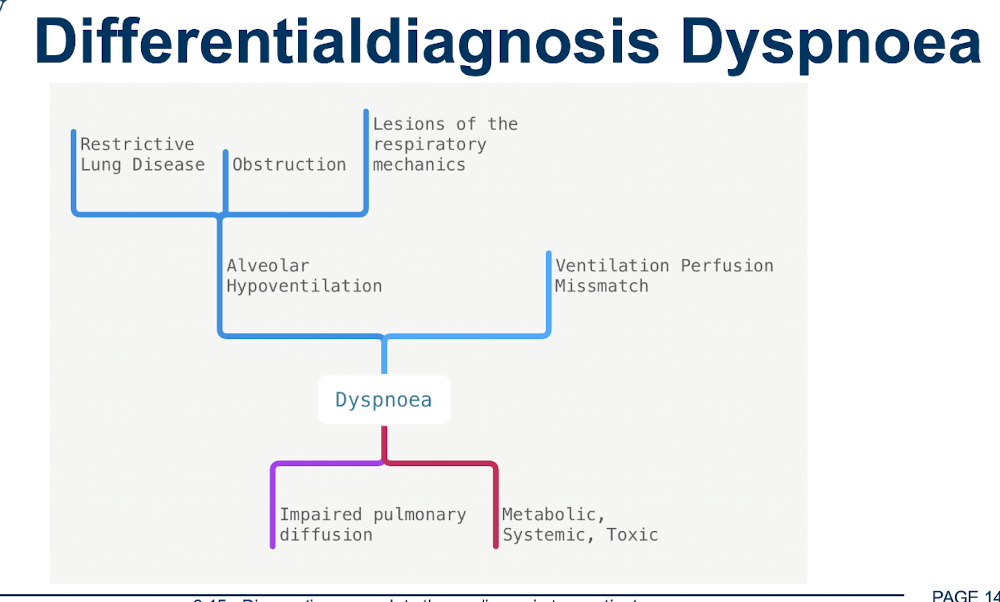
Describe this cause of Dyspnoea.
Alveolar Hypoventilation
→ Air does not reach the lungs
• Respiratory mechanics problem
Broken ribs, Diaphragm paralysis, Myopathies
• Obstruction of the airways
Nose, Larynx, Trachea, Bronchial, Asthma (cats!)
• Restriction of the lung's expansion
What are the main features of feline lower airway disease (FLAD)?
• This is an umbrella term encompassing all diseases primarily affecting the bronchi and bronchioles of cats — both inflammatory and non-inflammatory.
• Cat airways are much more reactive and prone to bronchoconstriction than those of dogs!
Feline Asthma
Dogs do not get asthma
Feline chronic bronchitis
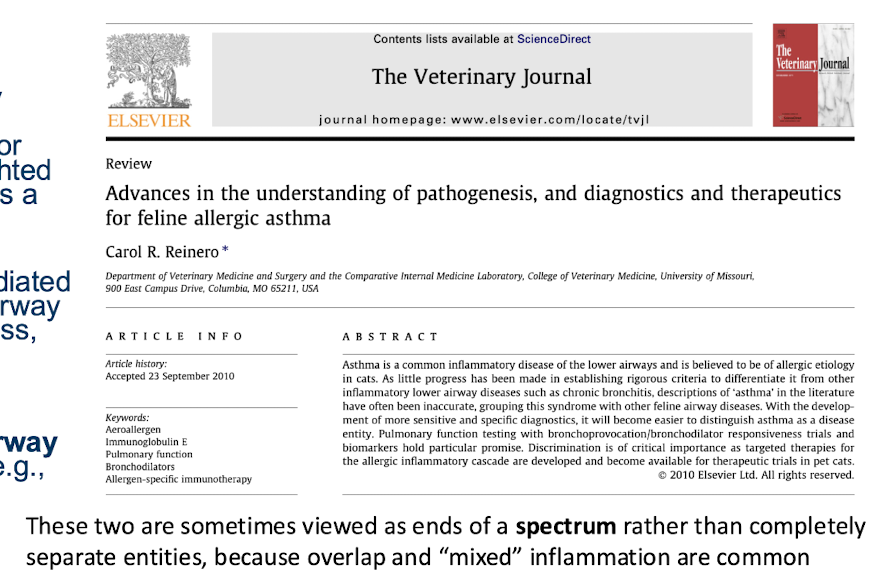
Are feline asthma and chronic bronchitis separate entities?
• Distinguishing asthmatic bronchitis from non-asthmatic bronchitis remains challenging.
• It is uncertain whether feline asthma and chronic bronchitis are truly separate entities or two facets of the same disease.
Allergic asthma is framed as an aeroallergen0driven, Th2/IgE-mediated disease leading to eosinophilic airway inflammation, hyperresponsiveness and remodelling → ALLERGIC
Few facilities have capability to differentiate
Improved diagnostics (pulmonary function with bronchoprovocation/bronchodilator trials and biomarkers) are highlighted as key to differentiating asthma as a distinct entity.
Chronic bronchitis: Often non- allergic, with neutrophilic inflammation and irreversible airway changes, smoke, chronic irritation
How does Feline Asthma present?
Auscultation
History
Signalment
Typical presentation: chronic or recurrent cough (Often mistaken for hairballs), expiratory dyspnea or wheezing
Acute crises: episodes of open-mouth breathing, tachypnea, cyanosis, or status asthmaticus, sometimes triggered by stress or allergens.
Auscultation: expiratory wheezes and increased bronchovesicular sounds; may be normal between episodes.
History clues: exposure to smoke, aerosols, perfumes, dusty litter, or other irritants; often indoor cats with intermittent symptoms → bronchitis?
Signalment: typically young to middle- aged cats (2-8 years), sometimes Siamese or Oriental breeds.
Owner misinterpretation: coughing bouts frequently described as vomiting or retching attempts to clear "hairballs."
What are common differentials associated with Feline Asthma?
• Airway parasites (e.g. Aelurostrongylus abstrusus) can mimic asthma and cause eosinophilic airway inflammation; diagnose with a faecal Baermann test or BAL examination, and empirically treat with anthelmintics.
• Heartworm-associated respiratory disease (HARD) results from death of immature L5 Dirofilaria immitis in pulmonary arteries, provoking eosinophilic inflammation in lungs and airways
In non-portected cats, a positive heartworm antibody test with compatible clinical or imaging findings supports HARD diagnosis
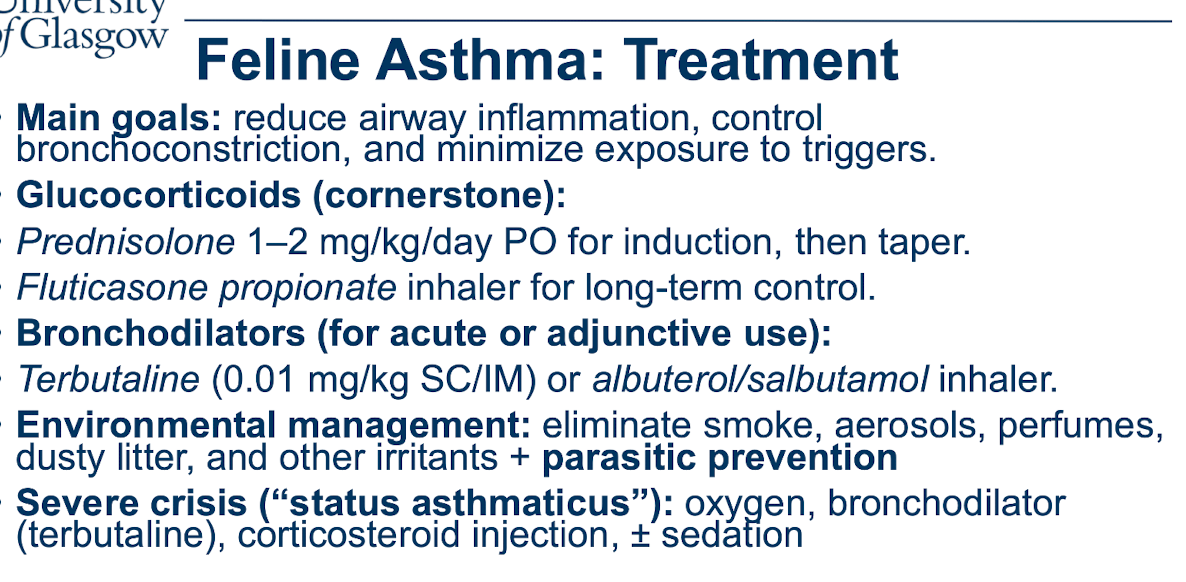
What are the main treatment options for feline asthma?
Inhaler use - must be trained to use
Describe this cause of Dyspnoea.
Restriction of Lung Expansion

Describe this cause of Dyspnoea.
Idiopathic Pulmonary Fibrosis

Describe this cause of Dyspnoea.
Pleural Effusion
Pneumothorax

Describe this cause of Dyspnoea.
Impaired Pulmonary Diffusion
Describe this cause of Dyspnoea.
Infectious Pneumonia

Describe this cause of Dyspnoea.
Aspiration Pneumonia

Describe this cause of Dyspnoea.
Fungal

Describe this cause of Dyspnoea.
Parasitic

Describe this cause of Dyspnoea.
Eosinophilic Bronchopneumopathy

Describe this cause of Dyspnoea.
Interstitial Pneumonia

Describe this cause of Dyspnoea.
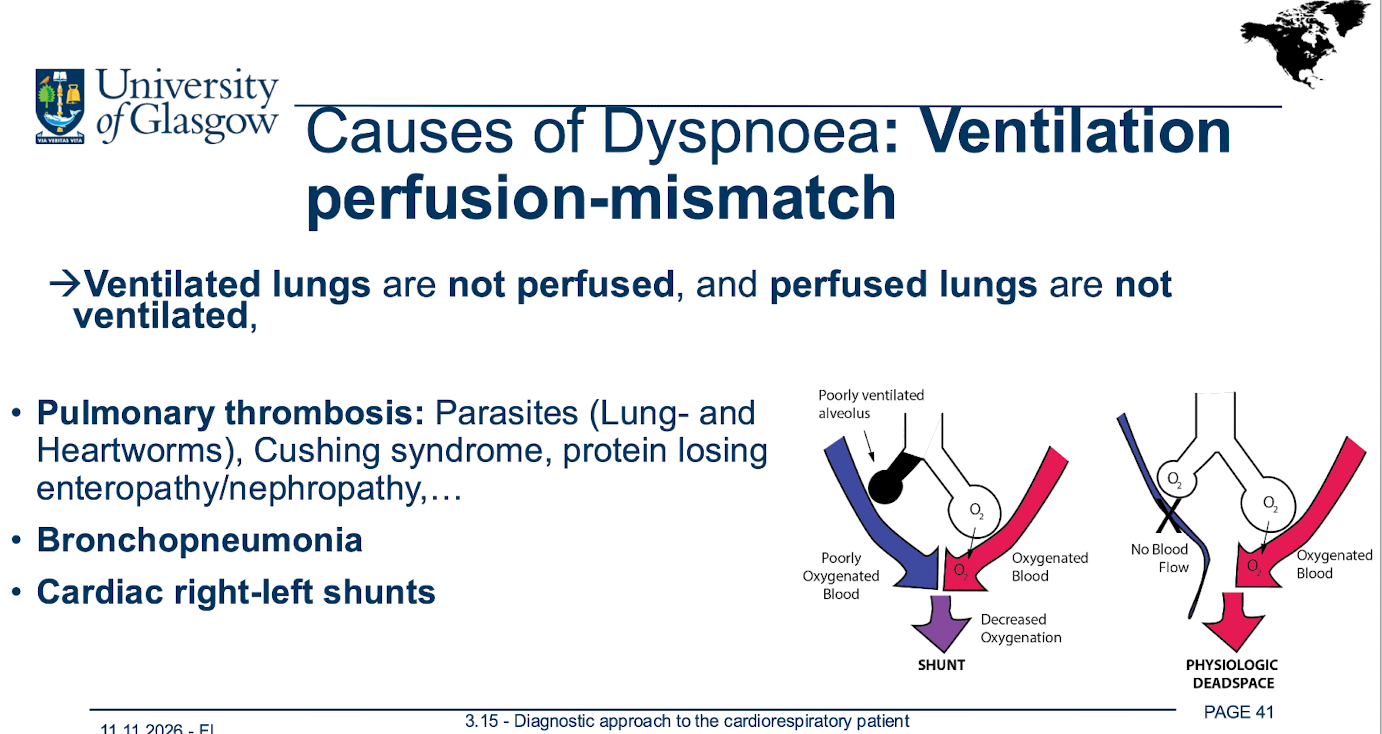
Ventilation/Perfusion Mismatch
Describe this cause of Dyspnoea.
Metabolic, Systemic Toxic

Describe the following causes of cough:
Respiratory Problem
Cardiovascular Problem
Intrathoracic
→ The respiratory apparatus is the problem
• Obstructive problems (BOAS, Larynx paralysis)
• Tracheobronchomalacia (Tracheal collapse)
• Inflammatory ("-itis", feline Asthma, pulmonary fibrosis)
• Irritation (Aspiration pneumonia, foreign body)
• Infectious
• Neoplastic
• Non-cardiogenic lung oedema
• Pulmonary bleeding
→ The cardiovascular apparatus is the problem
• Left atrial enlargement + airway problem
• SEVERE Pulmonary oedema
Remember where are the cough receptors!
→ Causes of Cough: intrathoracic
• Pleural effusion
• Mass (Abscess, Neoplasia)
Summarize the causes of cough:
