Ch 27 Anatomy- Yui Hisanaga
 Call Kai
 Learn
 Practice Test
 Spaced Repetition
 Match
 Flashcards
 Knowt Play
1/26

There's no tags or description
Looks like no tags are added yet.
27 Terms
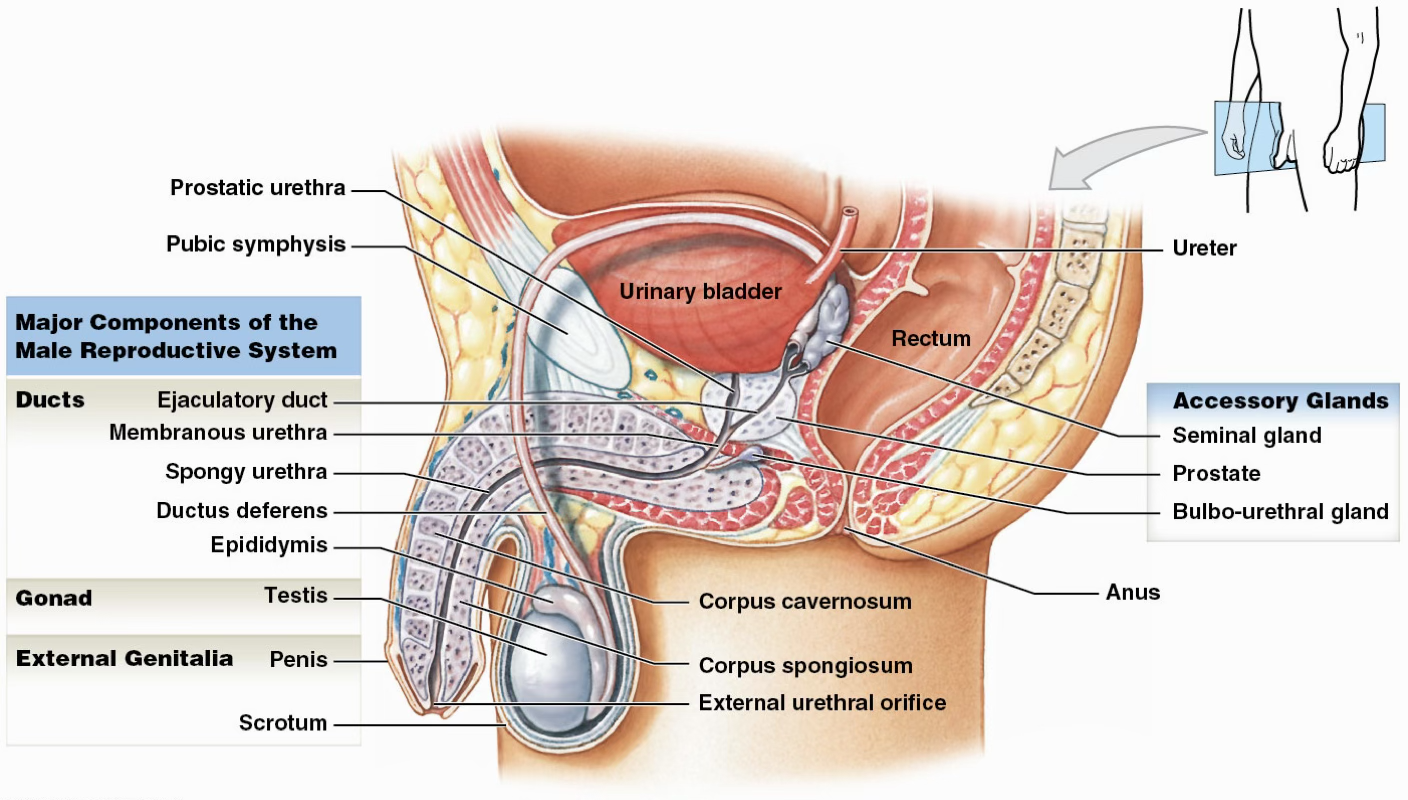
What are some of the major components of the male reproductive system, and some accessory glands?
Major Components:
Ducts:
Ejaculatory Duct
Membranous Urethra
Spongy Urethra
Ductus Deferens
Epididymis
Gonads:
Testis
External Genitalia:
Penis
Scrotum
Accessory Glands:
Seminal Gland
Prostate
urethral gland
What are the Testes suspended in?
Where is the anatomical location of them?
Testes: Suspended within the Scrotum
Suspended within a sac of skin and superficial fascia that’s anterior to perineum (diamond-shaped region between the thighs (containing the anus and external genitals)

What 2 structures help regulate temperature within the testes?
Dartos Muscle (wrinkles scrotum)
Cremaster Muscle (elevates testis)

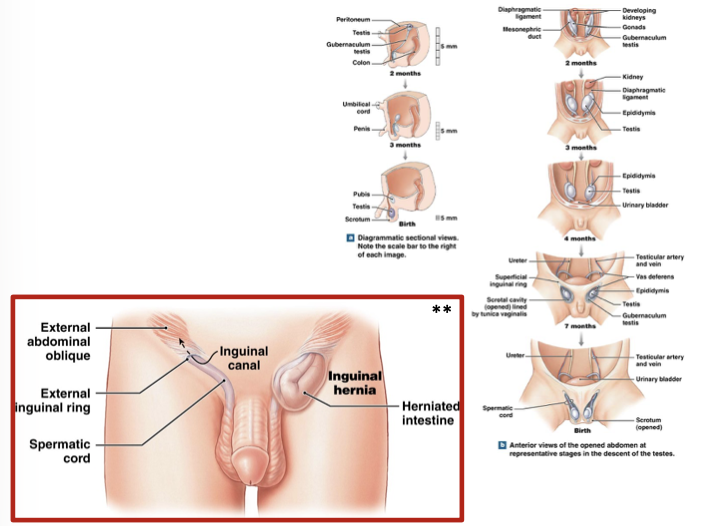
Where do testes begin their development?
Where do they typically descend before birth?
What is it called when they do not descend properly?
What is an inguinal hernia, and why is it so much more likely to occur in men than women?
Testes begin their development adjacent to the kidneys.
Testes descend from peritoneal cavity to scrotal chambers through inguinal canals.
When testes don’t descend properly, it is called cryptorchidism. This can cause the testes to get stuck int he abdomen or inguinal canal. This is relatively common in baby boys, especially those born prematurely. In many cases, the testes will descend on its own within the first months of life. However, if it does not descend by 6 months of age, doctors can perform a minor surgical procedure to gently move the testicle into the scrotum and secure it. This is very important because the scrotum provides a cooler environment than the rest of the body, which is necessary for healthy sperm development and long-term testicular health.
Inguinal Hernia: An inguinal hernia occurs when a portion of tissue pushes through a weak spot or tear in abdominal wall muscles. This creates a visible bulge in the groin or scrotum which can cause discomfort, aching, or pain. It is more common in males because the testes have to pass through the inguinal canal, which can be weak. Additionally, the spermatic cord can be vulnerable to stretching or tearing under pressure.
Where is the Spermatic Cord?
What are the 6 things that it contains? How do the associated blood vessels help to keep the testes cool?
The spermatic cord passes through the inguinal canal.
Testicular Artery
Pampiniform Plexus: The testicular artery will bring warm arterial blood, however it is immediately surrounded by a network of veins so heat is transferred from the warm arterial blood into the cool veins before blood even reaches testicle.
Cremaster Muscle: Body can physically move testes closer to or further away from the warm body core.
Vas Deferens
Nerves
Connective Tissue
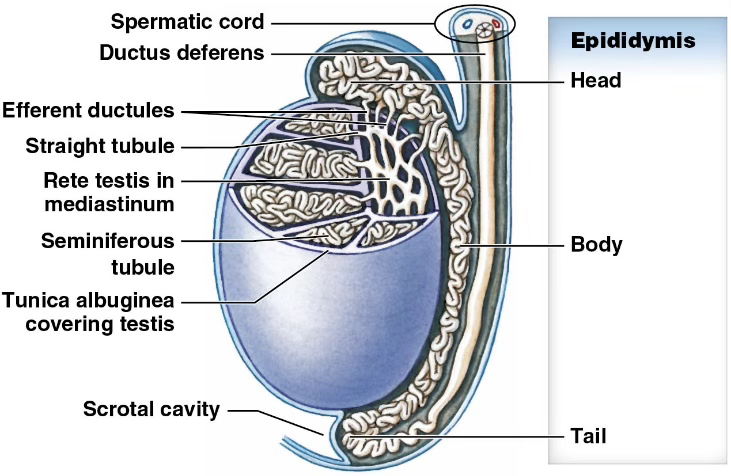
What is the internal structure of testis?
How is it divided?
What connects tubules and ductules and seminiferous tubules?
What kinds of cells produce sex cells?
What are nurse cells?
The testes is divided into about 250 lobules containing a total of about 800 seminiferous tubules.
Series of tubules and ductules connect seminiferous tubules to epididymis. (The epididymis is a long, tightly coiled tube attached to the back of the testes where sperm mature and gain ability to swim, then stored in tail.)
Interstitial Endocrine Cells: produce androgens (eg. testosterone)
Nurse Cells: secrete hormones, support sperm development/maturation, and maintain the blood-testis barrier.
How are sperm cells produced?
How is a spermatid different from a mature sperm? What are some of the unique features of a mature sperm?
Sperm cells are produced through a process called spermatogenesis. Meiosis produces haploid cells called spermatids.
Spermatids will undergo spermiogenesis to produce mature sperm
A mature sperm contains a head, acrosome (cap filled with specialized enzymes that helps the sperm break through an egg's protective barrier during fertilization), tail, etc.

What kind of epithelium lines the Epididymis?
What are it’s 2 key roles?
The epididymis is lined with pseudo stratified ciliated columnar epithelium.
Houses developing sperm for 14-20 days
Recycles damaged sperm and cellular debris
What kind of epithelium lines the Ductus Deferens/Vas Deferens?
What structures does it form to form what?
Lined with pseudo stratified ciliated columnar epithelium.
Goes through the inguinal canal and passes superior to the ureter before expanding to form the ampulla (sperm is stored here right before ejaculation)
How is the ejaculatory duct formed?
What structure does it pass through?
Formed through fusion of vas deferns and duct from seminal gland.
Passes through the prostate.
What function does the urethra play in the reproductive tract?
Carries sperm to the urethral meatus.
What are the 4 different sections of the male reproductive tract?
Epididymis
Ductus Deferens/Vas Deferns
Ejactulatry Duct
Urethra
What are the 4 different accessory glands in male reproductive tract?
Seminal Glands/Seminal Vesicles
Prostate
Bulbo-Urethral Glands
Semen
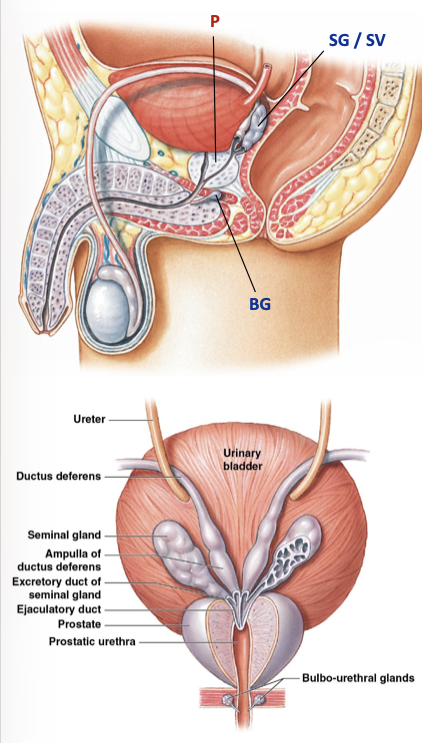
What us the fluid containing made in seminal glands/seminal vesicles? How do they contribute to semen?
Fluid contains prostaglandins, fructose, and other substances to enhance sperm motility
Comprises up to 60% of semen volume
What is the fluid containing made in prostate glands? How do they contribute to semen?
Fluid contains enzymes and seminalplasmin
Comprises up to 30% of semen volume
What is the fluid like that are made in bulbo-urethral glands? How do they contribute to semen?
Clear alkaline mucus that helps to lubricate glans penis and neutralize traces of urine in urethra
Comprises about 5% of semen volume
What is semen? What is the typical sperm count?
Mixture of seminal fluid and sperm
Typically 2-5 mL per ejaculate
Typical sperm count ranges from 20-100 million per mL. (makes up about 5% of semen volume)
What exactly is done when a male patient undergoes a vasectomy? Why is it typically performed?
What impact would a vasectomy have on sperm and semen production?
Is it possible to reverse a vasectomy?
When a male patient undergoes a vasectomy, the doctor cuts and seals the vas deferens. This causes a physical roadblock that prevents sperm from mixing with rest of fluid during ejaculation. This is typically performed as a permanent male contraception and as a alternative to female sterilization.
Vasectomy does not stop your body from making sperm or semen, it just blocks it from exiting the body. Sperm is safely reabsorbed and broken down by body’s immune cells. Semen production is still functioning because the majority of it is from seminal glands and prostate glands, it just won’t contain any physical sperm.
A vasectomy can be reserved but success is not guaranteed especially if it has been a long time since the vasectomy was performed due to scar tissue. A vasectomy is treated as a permanent and irreversible procedure.

What 3 structures consist of the penis?
Root
Body/Shaft
Gland Penis which is covered by foreskin/prepuce.
What are the 2 spongy erectile tissue that make up the penis? How are they both involved in an erection?
2 Coroposa Cavernosa
Corpus Spongiosum: which surrounds the spongy urethra and expands distally to form glans penis.
The 2 coroposa cavernosa fill with high pressure blood to provide main stiffness and rigidity of an erection, while the corpus spongiosum swells more gently to keep the internal passageway open to protect the urethra.

What controls the erection reflex? What causes emission and ejaculation to occur?
Parasympathetic NS controls the erection reflex
Sympathetic NS coordinates emission (semen is moved out of storage sites and into urethra) and ejaculation
What are some of the major structures and accessory glands of the female reproductive system?
Major Structures:
Ovary
Uterine Tube
Uterus: Perimetrium, Myometrium, Endometrium
Cervix
Vagina
External Genitalia: Labium minus, labium majus, clitoris
Accessory Glands:
Urethral Glands
Greater vestibular gland

What are the ovaries responsible for?
How are they stabilized?
The ovaries are responsible for producing oocytes and secreting hormones.
They are stabilized in the peritoneal cavity by multiple mesenteries/ligaments.

What are primary oocytes? What are they surrounded by?
How do they develop?
What does recent research suggest?
Primary Oocytes are immature egg cells found in female reproductive system.
They are surrounded by follicular cells to form primordial ovarian follicles.
They are developed in utero, so a female is born with all of her eggs. .
There are 500k-2m present at birth, and only 400K remain at puberty.
However, recent research suggest that stem cells contribute to normal ovarian function in adults and may be able to produce new oocytes.

What does FSH trigger?
Then what do they end up developing to become?
When follicular cells divide, what do they become?
How are estrogens (estradiol) produced?
FSH triggers several primordial follicles to develop into primary ovarian follicles.
A few primary follicles develop into secondary ovarian follicles, and one of which will develop into a tertiary follicle.
Follicular cells divide rapidly to become granulosa cells (form a protective layer around the developing oocyte inside a structure called an ovarian follicle. They pass nutrients, regulatory signals, and chemical messages back and forth to help the egg grow and mature properly.)
Thecal endocrine cells work with granulosa cells to produce estrogens (drive thickening of uterine lining).

What does a rapid increase in LH cause in the ovarian cycle? (2 things)
Tertiary follicles rupture and release oocyte into the peritoneal cavity (ovulation)
Ruptured follicle develops into the corpus luteum which secretes progestrone to maintain endometrium.

What happens in the ovarian cycle if fertilization does not occur?
The corpus leteum stops secreting hormones, and becomes the corpus albicans.
