Valuing Stocks : Finance
 Call Kai
 Learn
 Practice Test
 Spaced Repetition
 Match
 Flashcards
 Knowt Play
1/12

There's no tags or description
Looks like no tags are added yet.
13 Terms
Common Stock
Common stock (also known as ordinary shares in the UK) represents ownership in a company.
Also known as ordinary shares in the UK.
Shareholders are part-owners of the business.
Usually carry voting rights.
May provide dividends and capital gains.
Dividends are not guaranteed.
Common shareholders have a residual claim on company assets.
Generally carry limited liability.
Stock Exchanges
A stock exchange is a regulated marketplace where investors can buy and sell shares and other financial securities.
Marketplace where shares and other securities are bought and sold.
Allows companies to raise capital by issuing shares.
Provides liquidity by allowing investors to trade securities.
Helps determine share prices through supply and demand.
Provides a regulated and organised trading environment.
Examples include the LSE, NYSE and NASDAQ.
Preferred Stock
Preferred stock (also known as preference shares in the UK) is a type of share that gives shareholders priority over ordinary shareholders when receiving dividends and when company assets are distributed during liquidation.
Usually pays fixed dividends.
Dividends are paid before ordinary shareholders receive theirs.
Have priority over ordinary shareholders during liquidation.
Generally have limited or no voting rights.
Usually lower risk than common stock but higher risk than bonds.
Stock Index
A stock index is a measure that tracks the performance of a selected group of shares from different companies.
Measures the performance of a selected group of shares.
Provides an indication of overall stock market performance.
Can track specific markets, industries or company sizes.
Often used as a benchmark to compare investment performance.
Can be weighted by market capitalisation or other methods.
Examples include FTSE 100, S&P 500 and NASDAQ Composite.
Stock Trading Terminology : Price
Bid price: Highest price a buyer is willing to pay for a share.
Ask price: Lowest price a seller is willing to accept.
Bid-ask spread: Difference between the ask price and bid price.
Narrow spread: Generally indicates higher liquidity.
Wide spread: Generally indicates lower liquidity.
Stock Trading Terminology : Order Types
Market order: Buy or sell immediately at the best available price. Execution is likely, but the exact price is not guaranteed.
Limit order: Buy only at or below a set price, or sell only at or above a set price. The order may not be executed.
Key difference: Market orders prioritise speed; limit orders prioritise price control.
Bull & Bear Market
Bull market: A period when share prices are generally rising, driven by investor confidence and optimism.
Bear market: A period when share prices are generally falling, driven by investor pessimism and reduced confidence.
Basic Stock Valuation
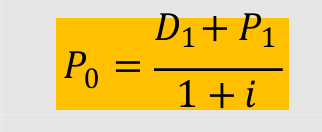
Stock valuation is the process of estimating the intrinsic (true) value of a company's shares to determine whether they are overvalued or undervalued compared with their current market price.
P0 = Stock price today
D1 = Expected dividend in one year
P1 = Expected selling price in one year
i = Discount rate (reflects risk and time value of money
Basic Stock Valuation : N Years
For a holding period of n years, • The value of a stock is measured by the present value of dividends over the n years plus the eventual sale price

Dividend Discount Model (DDM)
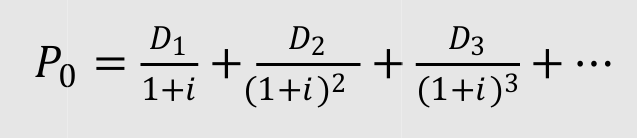
The Dividend Discount Model (DDM) assumes that a stock’s value is the present value of all future dividends with no expected selling price 𝑃n, assuming we hold it forever and don’t sell
Zero-Growth DDM
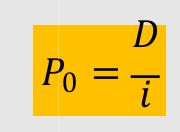
The Zero-Growth DDM values a share by assuming that the company will pay the same dividend every year indefinitely, with no expected dividend growth.
P0 = Current intrinsic value of the share.
D = Annual dividend per share.
i = Discount rate
The Constant Growth DDM (Gordon Growth Model)
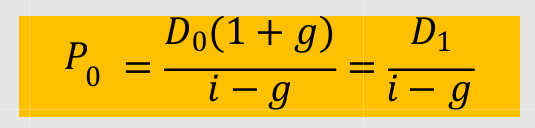
The Constant Growth DDM values a share by assuming that the company will pay dividends that grow at a constant rate indefinitely.
Variable Dividend Growth DDM
The Variable Dividend Growth DDM values a share by assuming that dividends grow at different rates over time, rather than at one constant rate. For instance, high growth is not sustainable over the long term because of product life cycle, competition, etc.