Orgo 2 Chapter 9 questions
 Call Kai
 Learn
Learn Practice Test
 Spaced Repetition
 Match
Match Flashcards
 Knowt Play
1/127

There's no tags or description
Looks like no tags are added yet.
Name | Mastery | Learn | Test | Matching | Spaced | Call with Kai | Chat |
|---|
No analytics yet
Send a link to your students to track their progress
128 Terms
How many distinct alkynes exist with a molecular formula of C4H6?
2
How many distinct alkynes exist with a molecular formula of C4H8?
0

Give the IUPAC name for
pent-1-yne
Draw an acceptable structure for acetylene

How many distinct terminal alkynes exist with a molecular formula of
How many distinct terminal alkynes exist with a molecular formula of C5H8
2
How many distinct internal alkynes exist with a molecular formula of C6H10
3

Give the IUPAC name for
6,6,6-trichlorohex-1-yne

Provide the IUPAC name for the compound below.
3-ethylhex-4-yn-3-ol
Provide the IUPAC name for Cl3C(CH2)2C≡CH.
5,5,5-trichloro-1-pentyne
Provide the IUPAC name for (CH3)2CHCH2CH(OH)CH2C≡CCH3.
2-methyl-6-octyn-4-ol

Name the compound shown below.
6,6-dimethyl-3-heptyne
Draw and name all terminal alkynes with molecular formula C5H8.
CH3CH2CH2C≡CH, 1-pentyne or pent-1-yne; (CH3)2CHC≡CH, 3-methyl-1-butyne or 3-methylbut-1-yne

Provide the IUPAC name for the compound given, including stereochemical designators as appropriate.
(E)-hept-4-en-2-yne
Give the IUPAC name for CH3CH2C≡CCH(OH)CH3.
hex-3-yn-2-ol
Draw an acceptable structure for (R)-5,5-dimethylhept-6-yn-3-ol

Draw an acceptable structure for 3-sec-butylhept-1-yne

Draw an acceptable structure for (S)-5-phenyloct-2-yne.


What is the correct IUPAC name for the following structure?
(E) 1-cyclopentyl-3,6-dimethylhept-3-en-yne
Draw an acceptable structure for hepta-3,6-dien-1-yne


Provide the IUPAC name for the compound below.
1-chloro-4-methylpent-2-yne

The correct IUPAC name for the following structure is ________.
(E)4-isopropyl-4-hepten-2-yne
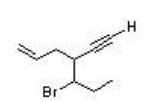
What is the correct IUPAC name for the following compound?
3-(1-bromopropyl)-5-hexen-1-yne

Give the IUPAC name for
octa-2,4-dien-6-yne
Which of the following improperly describes the physical properties of an alkyne?
insoluble in most organic solvents
Which of the following alkynes has the lowest boiling point?
3,3-dimethyl-1-butyne
The pi bond of an alkyne is ________ and ________ than the pi bond of an alkene.
shorter; weaker
How many moles of oxygen are required in the complete combustion of 1 mole of acetylene?
2.5
Write the complete, balanced equation for the combustion of 2-pentyne.

How many moles of water are produced when one mole of propyne undergoes complete combustion?
2
The carbon-carbon triple bond of an alkyne is composed of ________.
one σ bond and two π bonds
In trans-hept-4-en-2-yne the shortest carbon-carbon bond is between carbons ________.
2 and 3

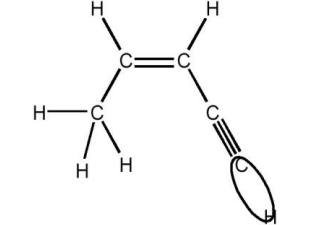
Circle the shortest bond in the compound below.
Which of the species below is less basic than acetylide?
CH3ONa
Among the compounds water, but-1-yne, but-2-yne, and ethane, which are stronger acids than ammonia?
water and but-1-yne
To a solution of propyne in diethyl ether, one molar equivalent of CH3Li was added and the resulting mixture was stirred for 0.5 hour. After this time, an excess of D2O was added. Describe the major organic product(s) of this reaction
CH3C CD + CH4
What is the pKa of a terminal alkyne?
25

Explain why the synthetic route shown below would be unsuccessful.
Sodium methoxide is not a sufficiently strong base to deprotonate the intermediate terminal alkyne.

Provide the major organic product of the reaction below.

Why are terminal alkynes more acidic then other hydrocarbons?
The carbanion which results upon deprotonation of a terminal alkyne has the lone pair of electrons in an sp hybrid orbital. The greater % s character of this orbital gives this orbital a significantly lower energy.

Provide the structure of the major organic product(s) in the reaction below.


Using pKa values, determine whether or not the following reaction will proceed to completion.
Yes, this reaction will go to completion because methane is a weaker acid.


Using pKa values, determine whether or not the following reaction will proceed to completion.
No, this reaction will not go to completion. The pKa of the alkyne is 25, while methanol is ~15.

Using pKa values, determine whether or not the following reaction will proceed to completion.
Yes, this reaction will go to completion because hydrogen is a weaker acid.

Which of the following bases are sufficiently strong to deprotonate a terminal alkyne with an equilibrium constant greater than 1? 1) sodium methoxide 3) n-butyl lithium 2) lithium diisopropyl amide 4) phenylmagnesium bromide
2, 3 and 4

Provide the structure of the major organic product(s) in the reaction sequence below

Describe a sequence of reactions by which hept-3-yne can be straightforwardly prepared from acetylene.
1) NaNH2 2) CH3CH2Br 3) NaNH2 4) CH3CH2CH2Br
Describe a sequence of reactions by which butylbenzene can be straightforwardly prepared from phenylacetylene.
1) NaNH2 2) CH3CH2Br 3) H2, Pt

Explain why the synthetic route shown below would be unsuccessful
The tert-butyl bromide would not undergo SN2 when treated with the intermediate alkynide because the steric hinderance in the halide is too great. Instead, the alkynide would deprotonate the tertiary bromide via an E2 mechanism.

Provide the major organic product of the reaction shown below.


What's the problem with the synthetic approach shown below?
The bromide is tertiary and therefore too hindered to undergo SN2. An E2 reaction would occur instead.

Fill in the missing reagent.


Provide the structure of the major organic product(s) in the reaction below.
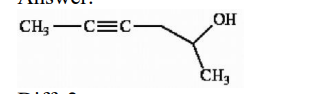

Provide the structure of the major organic product(s) in the reaction sequence below


Provide the structure of the major organic product(s) in the reaction below.

Describe a sequence of reactions by which 1-propylcyclohexan-1-ol can be straightforwardly prepared from propyne.
1) NaNH2 2) cyclohexanone 3) H+, H2O 4) H2, Pt

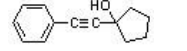
Describe a sequence of reactions by which the compound shown below can be straightforwardly prepared from acetylene.
1) NaNH2 2) CH3CH2Br 3) NaNH2 4) cyclopentanone 5) H+, H2O
Name the product which results when CH3C CLi reacts with CH3CH2COCH2CH3 followed by addition of water.
3-ethylhex-4-yn-3-ol
What conditions could be used to isomerize hept-2-yne to hept-1-yne?
1) NaNH2, 150°C 2) H2O
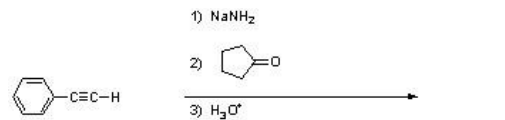
Provide a correct structure for the product of the following reaction.
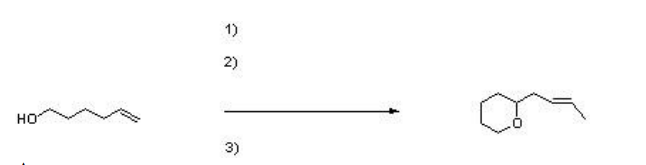
Complete the short synthesis below by providing the necessary reagents.

Describe a sequence of reactions by which (E)-5-bromopent-2-ene can be straightforwardly prepared from propyne.
1) NaNH2 2) ethylene oxide (oxirane) 3) H+, H2O 4) Na, NH3 5) PBr3
Why is a terminal alkyne favored when sodium amide (NaNH2) is used in an elimination reaction with 2,3-dichlorohexane?
The strong base deprotonates the terminal alkyne and removes it from the equilibrium.

Provide the major organic product of the reaction below.

When 2,2-dibromobutane is heated at 150°C in the presence of molten KOH, what is the major organic product?
but-2-yne
Describe a sequence of reactions by which hept-1-yne can be straightforwardly prepared from hept-1-ene.
1) Br2 2) NaNH2, heat
Treatment of hex-2-yne with mercuric sulfate in dilute sulfuric acid yields a mixture of two ketones. Similar treatment of hex-3-yne produces a single ketone instead of a mixture. Explain.
The two carbons of the triple bond in hex-3-yne are equivalent, and only 3-hexanone results. In the case of hex-2-yne, the two carbons of the triple bond are not equivalent, and a mixture of 2- and 3-hexanone results.
Which of the following describes an unsymmetrical addition reaction?
propyne with 1 mole HBr
Which of the following reagents will convert 1 mole of 3-methylpent-1-yne into 3- methylpentane?
2 moles H2, Ni and heat

Give the product of the following reaction:

Describe a sequence of reactions by which trans-pent-2-ene can be straightforwardly prepared from propyne.
1) NaNH2 2) CH3CH2Br 3) Na, NH3

Na, NH3

H2, Lindlar's catalyst
A mixture of hept-1-yne, hept-2-yne, and hept-3-yne was hydrogenated in the presence of a platinum catalyst until hydrogen uptake ceased. If one assumes that the hydrogenation went to completion, how many different seven-carbon hydrocarbons were produced?
1
_____is produced when 1 equivalent of HBr is added to hex-1-yne in the presence of peroxides.
A mixture of E and Z isomers of 1-bromohex-1-ene
Which of the alkyne addition reactions below involve(s) an enol intermediate?
D) both A and B
hat is the major organic product that results when 3-heptyne is hydrogenated in the presence of Lindlar's catalyst?
(Z)-3-heptene
What is the major organic product that results when 3-heptyne is subjected to excess hydrogen and a platinum catalyst?
heptane
What is the major organic product that results when 3-heptyne is treated with sodium metal in ammonia?
(E)-3-heptene
) What is the major organic product that results when 1-heptyne is treated with 2 equivalents of HBr?
2,2-dibromoheptane
What class of organic product results when 1-heptyne is treated with a mixture of mercuric acetate in aqueous sulfuric acid?
ketone
What class of organic product results when 1-heptyne is reacted with disiamylborane followed by treatment with basic hydrogen peroxide?
aldehyde
What major organic product results when 1-octyne is treated with sodium metal in liquid ammonia?
1-octene, you can't call it E or Z
Name the compound which results when pent-1-yne is treated with sodium in liquid ammonia.
pent-1-ene

Provide the major organic product of the reaction shown below.


Provide the major organic product of the reaction shown below.


Provide the major organic product of the reaction shown below.


Provide the major organic product of the reaction below


Provide the major organic product of the reaction below


Provide the major organic product of the reaction below.
(CH3)2CHCH2CH2CH2CHO

Provide the structure of the major organic product(s) in the reaction below


Provide the structure of the major organic product(s) in the reaction below.


Provide the structure of the major organic product(s) in the reaction below.


Provide the structure of the major organic product(s) in the reaction below.
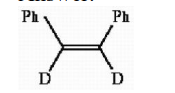

Provide the major organic product of the reaction shown below.


Provide the major organic product of the reaction shown below.


Provide the major organic product of the reaction shown below.


Provide the major organic product of the reaction shown below


Provide the major organic product of the reaction shown below.


Provide the major organic product of the reaction shown below.
