Business Growth and Challenges
 Call Kai
 Learn
 Practice Test
 Spaced Repetition
 Match
 Flashcards
 Knowt Play
1/13

There's no tags or description
Looks like no tags are added yet.
14 Terms
Autocratic Leadership Style
• Description: Leader makes decisions alone with minimal input from employees. Top-down communication only. Suits quick decisions or unskilled/new workforces. • Pros: Fast decision making, clear direction, useful in crises or with inexperienced staff. • Cons: Low staff morale/motivation, no employee input, high staff turnover, stifles creativity. • Examples: Coach Carter, Army, Chefs, Coaching, Billionaires.
Participative (Democratic) Leadership Style
• Description: Leader involves employees in decision-making (leader retains final say). Two-way communication encourages ideas and feedback. • Pros: Increased motivation, job satisfaction, better quality decisions (more input), improved teamwork. • Cons: Slower decision making, potential for conflict, not ideal in emergencies. • Context: Used by most businesses (includes Laissez-faire and Delegation).
Situational Leadership Style
• Description: Adjusts leadership style to circumstances (task, skill level, urgency). Flexible, not fixed—no single best style (e.g., switches between autocratic in crisis and participative with educated staff). • Pros: Highly adaptable, matches needs of situation and people. • Cons: Requires highly skilled leader who can accurately judge situations; can seem inconsistent if poorly managed. • Key Factors: Level of staff experience, different cultures.
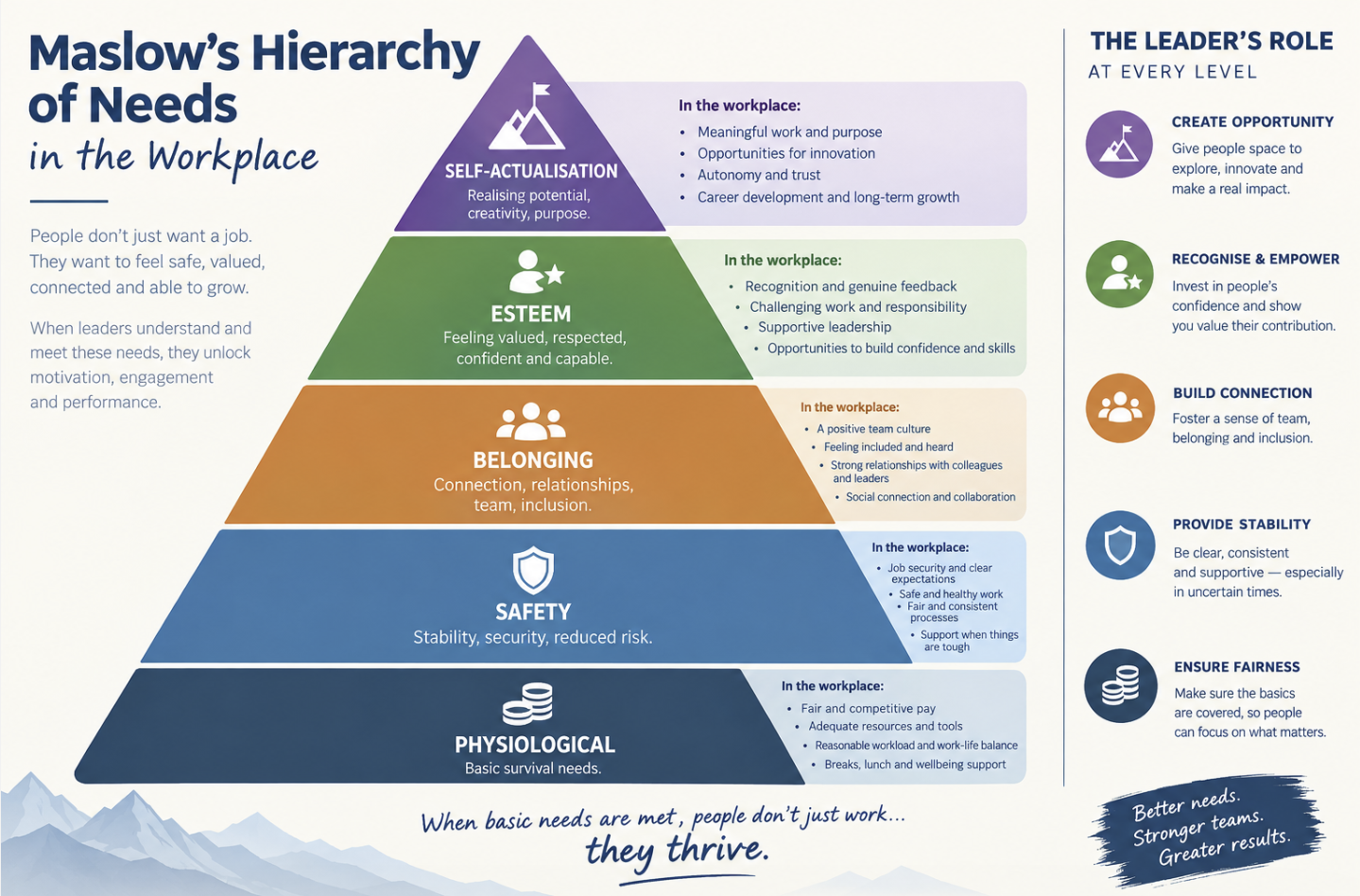
Maslow's Hierarchy of Needs
• Mnemonic: PSBEA ("Private Schools = Best Edu Always") • Physiological (Physical): Fair & competitive pay (salary/wage) • Safety (Physical): Job security + clear expectations (training) • Belonging (Spiritual): Positive team culture (induction) • Esteem (Spiritual): Meaningful work + purpose, recognition and genuine feedback (promotions) • Self-Actualisation (Spiritual): Autonomy + trust, career development + long-term growth, opportunities for innovation (delegation)
Herzberg's Motivation-Hygiene Theory
• Overview: Two distinct levels needed for effective leadership. • Hygiene Factors (Fair pay & benefits, job security): Must be met first; if not met, dissatisfaction grows and motivation drops. Meeting them alone does not create motivation. • Motivators (Meaningful work, responsibility): Create enthusiasm, engagement, trust, independence, and long-term performance.

Vroom's Expectancy Theory
• Formula: Motivation = Expectancy × Instrumentality × Valence • Expectancy ("Will effort lead to performance?"): Leader provides clear goals, right tools, and training. • Instrumentality ("Will performance lead to rewards?"): Leader is clear about how performance is measured and follows through. • Valence ("Do I value the reward?"): Leader understands what team values (money, growth) and offers a range of rewards.

Adams' Equity Theory
• Core Concept: People are motivated when treated fairly compared to others (Inputs = Outputs). • Inputs: Time/effort, skills/experience, ideas/initiatives, loyalty, personal sacrifice. • Outputs: Pay/financial rewards, recognition/praise, career development, support/relationships. • Imbalances: Under-reward causes frustration/lower effort; Over-reward causes guilt/conflict. • Leader Application: Be transparent, recognize effort, listen/check in, create fair systems, encourage open criticism.

Motivation in Business
• Definition: Motivation is the internal drive or external influence that encourages employees to work towards achieving personal and business goals. This can be done through a combination of rewards and penalties to influence employee behaviour and performance. • Example of Reward: A salesperson receives a bonus for exceeding their sales target. • Example of Penalty: An employee receives a formal warning for repeatedly arriving late to work. • Benefits of Motivated Employees: Higher productivity, efficiency, quality, loyalty, profitability, and lower absenteeism and staff turnover. • Indicators of Low Motivation: Grievances, poor response rates, labour turnover, lateness, absenteeism, accidents, and poor performance.
Financial Incentives Definition
• Definition: A monetary reward or benefit given to an employee to encourage a specific action, behaviour, or performance.
Financial Incentive Example: Sales Bonuses
• Description: Additional payment given to an employee for achieving or exceeding a sales target or other performance objective. • Drawback: May undermine teamwork. • Example: A car salesman receives regular salary + $2000 bonus for selling 20 vehicles in a month.
Financial Incentive Example: Share Schemes
• Description: Allows employees to acquire shares in a business as a reward, often at a discounted price or as part of a remuneration package. • Benefit: Scheme can provide long-term motivation if business performance improves over time.
Non-Financial Incentives Definition
• Definition: Workplace practices, rewards, recognition, or career opportunities that boost employee motivation, engagement, and job satisfaction without altering direct or indirect cash compensation.
Non-Financial Incentive Example: Skill Improvement Training
• Description: Providing employees with learning opportunities to develop their knowledge, abilities, and competence in their roles. • Benefit: Win-win for employer.
Non-Financial Incentive Example: Recognition and Reward
• Description: Acknowledging employees' contributions, achievements, or positive behaviour. Can be formal or informal recognition without involving money. • Examples: Public acknowledgement of good performance through awards, eg: employee of the month, at staff meetings, newsletters, or annual awar