PPAR Lec Colligative Properties
 Call Kai
 Learn
Learn Practice Test
 Spaced Repetition
 Match
Match Flashcards
 Knowt Play
1/44

There's no tags or description
Looks like no tags are added yet.
Name | Mastery | Learn | Test | Matching | Spaced | Call with Kai | Chat |
|---|
No analytics yet
Send a link to your students to track their progress
45 Terms
Physical Properties of Substances
drug molecules have properties that are often divided into additive, constitutive, and colligative.
additive properties
depend on the total contribution of the atoms in the molecular or on the sum of the properties of the constituents in a solution.
molecular weight
constitutive properties
depend on the arrangement and to a lesser extent on the number and kind of atoms within a molecule
refractive index, optical rotation, solubility, surface and interfacial properties
colligative properties
depends mainly on the number of particles in a solution.
osmotic pressure, vapor pressure lowering, freezing point depression, boiling point elevation
colligative properties
On adding a solute to a solvent, the properties of the solvent are modified.
Vapor pressure = DECREASES
Freezing point = DECREASES
Boiling point = INCREASES
Osmosis is possible (osmotic pressure)
These changes are called _______.
They depend only on the NUMBER of solute particles relative to solvent particles, not on the KIND of solute particles.
vapor pressure
is the pressure of the saturated vapor above a liquid resulting from the escape of the surface liquid.
the vapor pressure of an ideal solution is dependent on the vapor pressure of each chemical component and the mole fraction of the component present in the solution.
When a nonvolatile solute is combined with a volatile solvent, the vapor above the solution is provided solely by the solvent.
The solute reduces the escaping tendecy of the solvent, and on the basis of Raoult’s Law.
vapor pressure
the vapor pressure of an ideal solution is dependent on the ________ of each chemical component and the mole fraction of the component present in the solution.
reason of vapor pressure lowering
Solute particles obstruct or reduce the likelihood of evaporation, leading to fewer molecules changing from liquid to gas phase.
The solution is more stable than a pure solvent, resulting in lower evaporation rate.
Solute particles occupy surface area, reducing the space for solvent molecules to evaporate.
Solute particles get in the way of solvent particles escaping into the vapor.
The number of solvent molecules on the interface between vapor and solution is reduced in a solution.
Raoult’s Law
The vapor pressure of a solution containing a nonvolatile solute is lowered proportional to the relative number of the solute molecules.
Vapor pressure of a solution is less than that of the pure solvent, as expressed in _______
lowering of the vapor pressure
According to Raoult’s Law, the vapor pressure of a solvent over a dilute solution is equal to the vapor pressure of the pure solvent, times the mole fraction of solute in the solution.

manometer
used and the difference of the vapor pressure between the solution and the pure solvent.
For dilute aqueous solutions, however, the vapor pressure lowering is so slight as to produce a serious error in the measurement.
determination of the vapor pressire of solution
Accurate differential manometers: small differences in vapor pressure.
The isopiestic method is used frequently for the precise determination of vapor pressures.
isopiestic method
This method is used frequently for the precise determination of vapor pressures.
boiling point
Is the temperature at which the vapor pressure of the liquid becomes equal to the external atmospheric pressure
boiling point elevation
__________ is the increase in the boiling point of a solution over that of a pure solvent.
The boiling point of a solution of a nonvolatile solute is higher than that of the pure solvent, (solute lowers the vapor pressure of the solvent).
boiling point
the phenomenon that the _______ of a liquid (a solvent) will be higher when another compound is added, meaning that a solution has a higher ______ than a pure solvent.
This happens whenever a non-volatile solute, such as a salt, is added to a pure solvent, such as water.
The _______ can be measured accurately using an ebullioscope.
ebullioscope
the boiling point can be measured accurately using ______.

Cottrell boiling point apparatus
In the _______, the vapor and the boiling solvent are pumped by the force of ebullition through a glass tube and sprayed over the thermometer bulb to obtain an invariant equilibrium temperature.
determination of boiling point elevation
freezing point
the phenomenon in which the _______ of a liquid (a solvent) is depressed when another compound is added, meaning that a solution has a lower _______ than a pure solvent.
This happens whenever a non-volatile solute is added to a pure solvent, such as water.
freezing point
The phenomenon may be observed in sea water, which due to its salt content remains liquid at temperatures below 0°C (32°F), the ________ of pure water.
The triple point of air-free water, at which solid, liquid, and vapor are in equilibrium, lies at a pressure of 4.58 mm Hg and a temperature of 0.0098 °C.
4.58 mmHg and 0.0098°C
The triple point of air-free water, at which solid, liquid, and vapor are in equilibrium, lies at a pressure of _____ and a temperature of _____.
escaping tendency or vapor pressure
If a solute is dissolved in the liquid at the triple point, the _____ or _____ of the liquid solvent is lowered below that of pure solid solvent.
The temperature must drop in order to reestablish equilibrium between the liquid and the solid
freezing point depression
________ is the difference in the melting points of pure water and a solution.
The freezing point of a solution is LOWER than that of the pure solvent

beckmann and the equilibrium method
Methods for the Determination of Freezing Point Lowering
B
E
beckmann method
It consists of a jacketed tube with a sidearm through which the test material may be introduced. A _____ thermometer is supported in the tube and extends into the test solution.
A glass stirrer passes through a tube in the stopper and is operated manually or by means of a motor.
The tube and jacket are supported in a vessel containing mixture of salt and ice.

Beckmann method
In carrying out a determination, the temperature is read on the _____ differential thermometer at the freezing point of the pure solvent, water.
A known weight of the solute is introduced into the apparatus, containing a given weight of solvent, and the freezing point of the solution is read and recorded.
liso value
is determined by the ionization properties of the solute.
Nonelectrolytes
1.8
weak electrolyte
2.0
di-divalent (divalent cation and divalent anion)
2.0
uni-univalent electrolyte (single charge on each)
3.4
uni-divalent electrolyte
4.3
di-univalent electrolyte
4.8
osmotic pressure
is the pressure which needs to be applied to a solution to prevent the inward flow of water across a semipermeable membrane.
The phenomenon of _______ arises from the tendency of a pure solvent to move through a semipermeable membrane and into a solution containing a solute to which the membrane is impermeable.
All aqueous solutions of non-volatile solutes exert an ______.
osmosis
is the movement of solvent through a semi-permeable membrane that allows only solvent to move through it.
always takes place in the direction of that will equalize
the conc’n of all the components on both sides of the
membrane
isoosmotic
When osmotic pressure is equal on both sides of the membrane, the system is _____. In biological fluids, this equilibration is termed isotonic.
osmotic potential
is the opposite of water potential, which is the degree to which a solvent tends to stay in a liquid.
osmotic pressure osmometer
it is based on the principle of thistle tube.
Van’t Hoff Equation
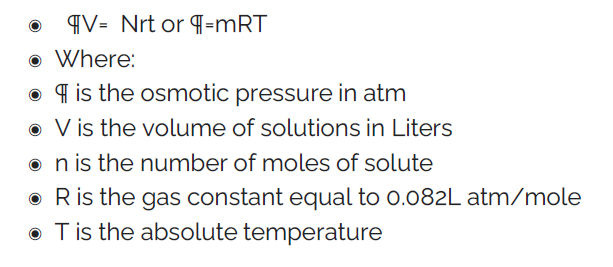
Van’t Hoff
He concluded that there was an apparent analogy between solutions and gases and that the osmotic pressure in a dilute solution was equal to the pressure that the solute would exert if it were a gas occupying volume.
Corresponded to the equation for ideal gas.
Morse Equation
¶= RTm
osmoregulation
is the homeostasis mechanism of an organism to reach balance in osmotic pressure.
hypertonicity
is the presence of a solution that causes cells to shrink.
hypotonicity
is the presence of a solution that causes cells to swell.
isotonic
is the presence of a solution that produces no change in cell volume.
colligative properties of biological fluids
