8.2 and 8.3- Free energy and ATP
 Call Kai
 Learn
 Practice Test
 Spaced Repetition
 Match
 Flashcards
 Knowt Play
1/51

There's no tags or description
Looks like no tags are added yet.
52 Terms
Energy Change (Δ)
what is needed to determine spontaneous and non spontaneous reactions
J Willard Gibbs
defined a function called the free energy of a system (without considering the surroundings)
A living systems free energy (G)
a portion of energy in the cell that can do work when temp and pressure is uniform
∆G
The change in free energy
∆H
change in enthalpy (in biological systems this is equivalent to total energy)
∆S
change in entropy
T
temperature in Kelvin
∆G = ∆H – T∆S
Formula
When ∆G is negative
(negative change in free energy) the process is spontaneous
For there to be a negative ∆G
the system either gave up some total energy (H decrease) or it gave up order and S (+T∆S) increases. Both can happen
Because of their negative ∆G
these spontaneous reactions can be harnessed to preform work
another way to think of ∆G
it is the difference between the free energy of the final products and the energy of the initial (reactants) ∆G = G products – G reactants
-∆G only occurs
when the process involves a loss of free energy during the change from reactants to products
every spontaneous process
decreases the systems free energy
Free energy is a measure
of a systems instability, its tendency to change into a more stable state
unstable systems
Higher G
More stable systems
lower G
As the free energy decreases (-∆G)
the stability of a system increases
Equilibrium
in the state of maximum stability
A process is spontaneous and can preform work only when
it is moving towards equilibrium ( G is decreasing )

What is this image showing
More free energy, less stable, and greater work capacity. Energy is released in this process.

What is this image showing
Less free energy, more stable, less work capacity. falling does not need any energy, neither does diffusion
Exergonic Reaction
(energy outward) proceeds with a net release of free energy to its surroundings and is spontaneous
Endergonic reaction
(energy inward) proceeds with net absorption of free energy form its surroundings and is nonspontaneous
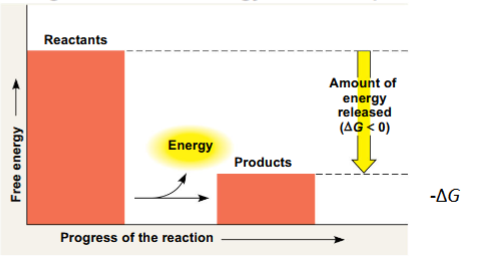
What type of reaction is this
Exergonic Reaction (energy is released and spontaneous)

What type of reaction is this
Endergonic Reaction (energy required, nonspontaneous)
reactions in an isolated (closed) system eventually
reach equilibrium and then do not work
Living cells are not in equilibrium
because they are open systems and are in a constant flow of materials in and out
metabolism is
never at equilibrium (it is death)
catabolic pathway in a cell
releases free energy in a series of reactions

what type of system is this
closed hydroelectric system
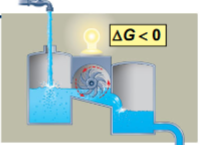
what type of system is this
an open hydro electric system

what type of system is this
multistep open hydroelectric system
the cell does three kinds of work
chemical
transport
mechanical
Chemical work
pushing endergonic reactions
transport work
such as pumping substances across membranes against gradients
mechanical
such as contraction of muscle cells
Energy coupling
the use of exergonic process to drive an endergonic process
what mediates most energy coupling
ATP
ATP is composed of
one ribose (sugar), one adenine (nitrogen base), and three phosphate groups
The bonds of the phosphates on ATP
can be broken by hydrolysis
free energy is released when
ATP is hydrolyzed to from ADP and inorganic phosphate
the release of energy comes from
the change to a state of lower free energy not from the phosphate bonds themselves

what is this
the structure of ATP

what is this
they hydrolysis of ATP
the energy from the exergonic chemical reaction and ATP hydrolysis
can be coupled with and used to drive an endergonic chemical reaction
Overall the coupled chemical reactions
are exergonic
ATP drives endergonic reactions
by phosphorylation
phosphorylation
the transferring of a phosphate group to some other molecule such as reactant in a chemical reaction
the recipient molecule with the phosphate group attached to it
is less stable with more free energy and is now called phosphorylated intermediate
ATP is renewable and is regenerated by
the addition of a phosphate group to ADP
the energy to phosphorylate ADP to make ATP comes from
catabolic reactions in the cell