Wrist and Hand Examination
 Call Kai
 Learn
 Practice Test
 Spaced Repetition
 Match
 Flashcards
 Knowt Play
1/64

There's no tags or description
Looks like no tags are added yet.
65 Terms
what is an important problem post-immobilization regardless of pathology?
hypomobility- hand may develop adherent scar tissues or contracture that restricts the joint and tendon that is not always at the injury site: decreased ROM, tendon adhesions, decreased muscle performance
what are the principles for hand intervention?
movement and function perspective
specific tissue knowledge
timing
practice patterns
individual needs within an understanding of guidelines
collaboration
what are the healing timeframes?
see image

what are wrist/hand specific patient history questions that should be asked?
hx of past injury/problem
age of patient
repetitive movements (occupations/sport/hobbies)
onset (sudden/gradual/insidious)
accompanying symptoms (numbness/tingling, paresthesias)
movements or position that alleviate symptoms
pain/problems anywhere else in the upper quarter
past injuries/surgeries anywhere else in the upper quarter
hand dominance
what part of the visual inspection needs to be made?
look for deformities- esp atrophy, contracture, congenital, and acquired w
what are sympathetic changes that might occur in the hand with nerve damage?
vasomotor
sudomotor
pilomotor (goosebumps)
tropic function (nails, skin, fat pad)
what are the common hand deformities?
bouchards and hederden’s nodes
mallet finger
claw hand
wrist drop
hand of benediction
boutonniere deformity
ulnar drift
swan neck deformity
what landmark should you observe to see the general direction of the fingers?
scaphoid tubercle
what is important to note when doing the examination of the wrist and hand?
need to screen the NECK too! should be ruling in and ruling out conditions. considerations include C7, median nerve entrapment elsewhere, peripheral neuropathy (idiopathic or secondary). MUST know dermatomes, myotomes, nerve roots!
what are the typical motions for the forearm and thumb?
see image

what are the typical finger motions?
see image

what is the purpose of tendon gliding as an assessment?
differentiation of the tendon mobilities- look at FDP, FDS, and the lumbricals
what position causes the maximum differential glide between FDP and FDS?
hook fist
which fist position creates the maximum glide of FDS in relation to the tendon sheath?
straight fist
which fist position creates maximum glide of the FDP?
full first
what might extrinsic tightness cause?
loss of passive composite motion- as you gradually increase stretch across the digit, then you passively move the wrist in the same direction, you should see decreased PROM of the distal joint (ie the PIP joint)
how might you identify intrinsic tightness?
if you start with the MCP in neutral and measure the PIP joint flexion, then place the MCP in flexion and you have more passive PIP flexion, then this indicates tightness in the intrinsics
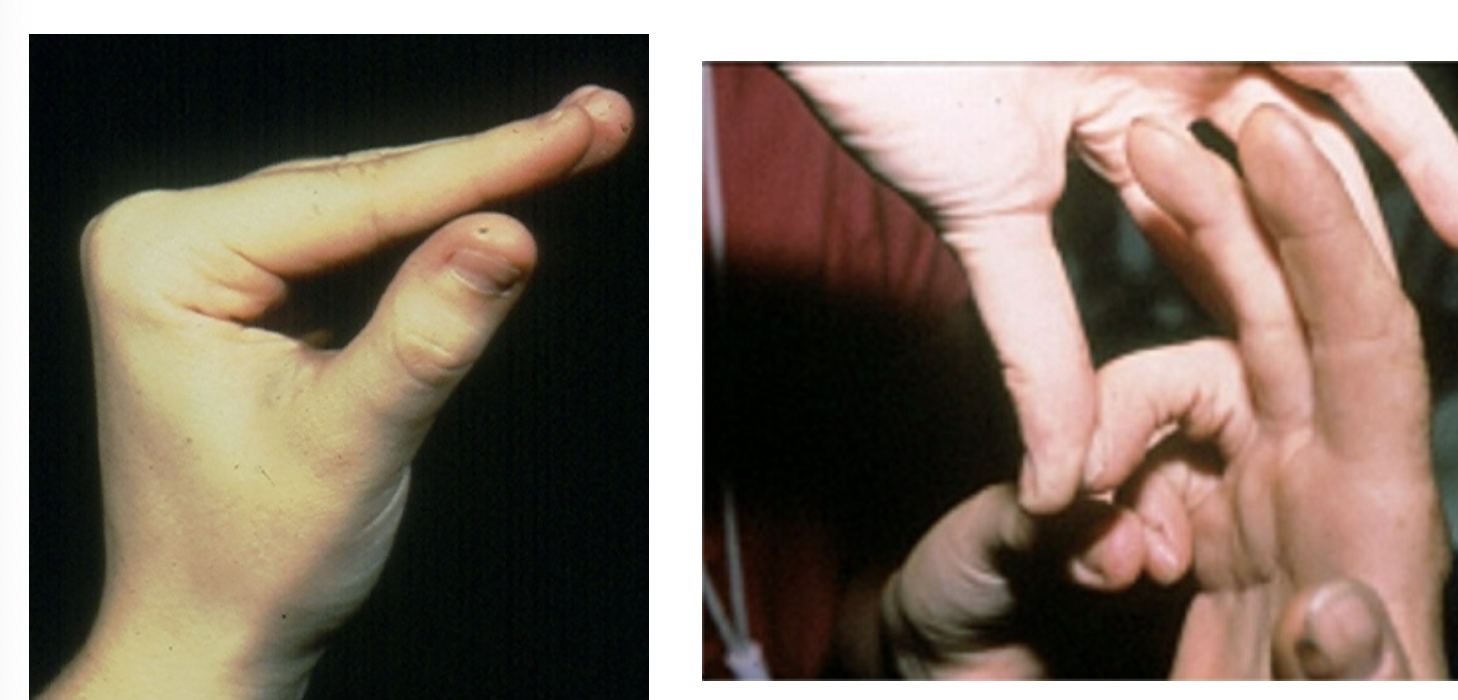
which image demonstrates shortened intrinsics vs lengthened intrinsics?
the left is shortened, the right is lengthened
what is the normal end feel for wrist flexion/extension?
flexion- tissue stretch, extension- firm/hard
what is the normal end feel for radial deviation and ulnar deviation?
radial- firm/hard, ulnar deviation- firm/hard
what are the end feels for the digits?
generally all firm, may see hard end feel with MCP flexion or IP flexion
what is the end feel for the motions of the thumb?
generally all firm, may also feel soft for CMC flexion or opposition due to tissue
what is the resting position of the radiocarpal joint?
neutral with slight ulnar deviation
what is the closed packed position of the radiocarpal joint?
extension
what is the capsular pattern of the radiocarpal joint?
flexion and extension equally limited
what is the resting position of the midcarpal joint?
neutral or slight flexion with ulnar deviation
what is the closed position of the midcarpal joint?
extension with ulnar deviation
what is the capsular pattern of the midcarpal joint?
flexion and extension equally limited
what is the resting position of the carpometacarpal joint?
for thumb: midway between abduction and adduction, flexion/ext
for finger: mid flex/ext
what is the closed packed position of the carpometacarpal joint?
thumb: full opposition
fingers: full flexion
what is the capsular pattern of the CMC joint?
thumb: abduction, extension. fingers: equal all directions
what is the resting position of the MCP joint?
slight flexion
what is the closed packed position of the MCP joint?
thumb: full opp. fingers: full flexion
what is the capsular pattern of the MCP joint?
flexion, then extension
what is the resting position of the IP joint?
slight flexion
what is the closed packed position of the IP joint?
full extension
what is the capsular pattern of the IP joint?
flexion, extension
how should you perform MMTs of the wrist and hand (what is considered best practice)?
assess an extrinsic and intrinsic of the same nerve, for example for radial nerve assess the wrist extensors (ECRL/ECRB) and the digit extensors (ED or EPL), or median nerve assess FCR or FDS and the thenar muscles, or for ulnar nerve assess FCU or FDP (IV, V) and the interossei
what position should the arm be in for handheld dynomometry?
arm at side, elbow bend 90 degrees, slight wrist extension
handle in mid position depending on patient’s hand size
what is a normal discrepancy between the dominant and non dominant HHG dynamometry?
5-10%
greater than what percentage discrepany in test retest should lead to question of the patient’s effort?
20%
how many trials of grip or pinch dynamometry should be taken?
take three and then take average
what are the different types of grip?
see image; includes hook, cylinder, fist, spherical

what are the different types of pinch?
see image, but include chuck/three fingered, tip (tip to tip prehension), and lateral/key pinch (lateral prehension)

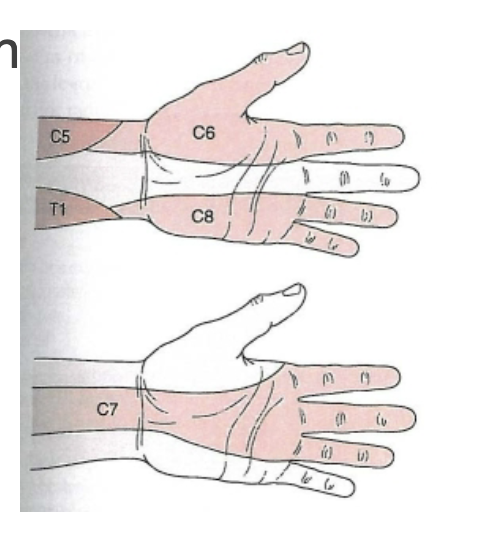
what is the peripheral cutaneous distribution of the hand ?
see image

what is the dermatomal distribution of the hand?
see image
what is a normal value for a static 2 point discrimination for the sensory exam of the hand?
less than 6 mm
what is considered fair and poor for the static 2 point discrimination of the hand?
7-10 mm and 11-15 mm respectively
describe the figure of 8 method
start at the ulnar styloid
across the volar wrist crease
dorsal to the 5th MCP
around to the volar 2nd MCP
dorsal back to ulnar styloid
what should be part of the screen for carpal tunnel syndrome?
hx: assess symptom duration, severity of night symptoms, + phalens, muscle wasting (thenar)
intrinsic factors: obesity, female, age > 50
occupation: forceful hand exertions
what are the instrinic risk factors of carpal tunnel syndrome?
obesity > 30kg/m2
age > 50
female (1.5 x > male)
what are the secondary intrinsic risk factors of carpal tunnel syndrome?
DM
OA
estrogen replacement therapy
CV risk factors
hypothyroidism
lack of physical activity
wrist ration > 0.7
what are the occupational risk factors of carpal tunnel syndrome?
forceful hand exertions
vibration (weaker)
repetitive in nature (weaker)
high psychological demand (weaker)
what are the differential diagnoses for carpal tunnel syndrome?
cervical radiculopathy
thoracic outlet syndrome (TOS)
diabetic neuropathy
peripheral nerve entrapment (pronator teres)
central nervous system degenerative disorder (ALS, MS)
what tests and measures should be taken with CTS is suspected?
see image

when would a patient with CTS be appropriate for therapy but also benefit from a referral to a clinician?
see image
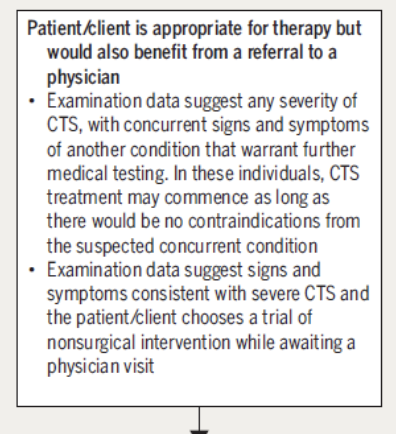
when would a patient not be appropriate for therapy and require referral to another provider?
see image

what are the recommended primary interventions to be used for CTS ?
pts should be instructed in the use of a neutral positioned wrist orthosis for night wear. treatment should also include counseling on pathology, risk identification, symptom self management, and postures/activities that aggravate symptoms. duration of orthosis may be increased to include daytime wear, or the metacarophalangeal joints may be included if nighttime wrist-neutral positioning along does not provide sufficient relief
what are the CPG exam recommendations for carpal tunnel syndrome?
see image

what are the components of the clinical prediction rule for CTS?
“do your symptoms feel better when you shake your hands?”
wrist-ration index > 0.67
symptom severity score > 1.9
reduced median sensory field of first digiti
age > 45
which outcomes measures can be used for the hand/CTS?
DASH
symptom severity scale
boston carpal tunnel questionnaire
upper quarter closed kinetic chain test (for higher level function/athletic)
describe the scoring of the Quick DASH and DASH
full dash is out of 150 points, a higher score means higher disability. consists of a work module and sports module

what outcome measure is shown in the image?
symptom severity scale
what functional assessments can be used for the hand/wrist?
jebsen-taylor hand function test (can be lengthy, assessment of fine and gross motor)
box and block test (gross dexterity)
moberg’s pick up test
purdue peg board test
9 hole ped test
what are the norms for the purdue pegboard by age and dominant vs nondominant hand?
see image
