The Endocrine System - Part 2
 Call Kai
 Learn
 Practice Test
 Spaced Repetition
 Match
 Flashcards
 Knowt Play
1/27

Earn XP
Description and Tags
Comprehensive vocabulary flashcards covering the neuroendocrine regulation, hormonal axes (thyroid, cortisol, growth hormone, and sex hormones), feedback systems, and exercise responses discussed in the lecture.
28 Terms
Posterior Pituitary Gland
A neural extension of the hypothalamus consisting of axons that pass down the infundibulum to terminate and secrete oxytocin and vasopressin directly into circulation ~(these hormones are synthesised in the pituairty gland), it receives direct impulse to release hormones

Hypothalamo-Hypophyseal Portal Vessels
A specialized vascular bed connecting the hypothalamus and the anterior pituitary gland, through which hypophysiotropic hormones are delivered to regulate anterior pituitary hormone release.
Anterior Pituitary Hormones
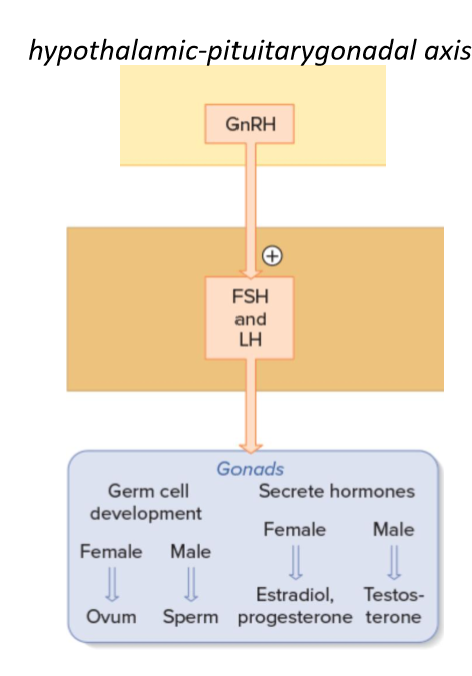
Six primary peptide hormones synthesized and released by the anterior pituitary: growth hormone (GH), thyroid-stimulating hormone (TSH), adrenocorticotropic hormone (ACTH), prolactin, follicle-stimulating hormone (FSH), and luteinizing hormone (LH). secretion of anterior pituraity gland hormones is mainly controlled by hypophysiotrophic hormones from the hypothamulus (as these act on other hormones in the body) via the portal vessels
Three-Hormone Endocrine Cascade
A sequential signaling sequence where a hypothalamic hypophysiotropic hormone (hormone 1) controls an anterior pituitary hormone (hormone 2), which in turn regulates the secretion of a hormone by a third peripheral endocrine gland (hormone 3).

Short-Loop Negative Feedback
A regulatory mechanism in which an anterior pituitary hormone (hormone 2) acts directly back on the hypothalamus to inhibit further secretion of its corresponding hypophysiotropic releasing hormone (hormone 1). (A hormone released by the pituitary gland (the intermediate level) acts directly back on the hypothalamus to inhibit further release of the upper-level releasing hormone.)
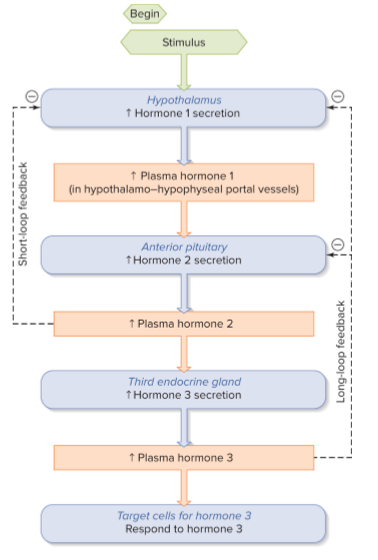
Long-Loop Negative Feedback
A control loop in which the final hormone secreted by a third endocrine gland (hormone 3) exerts inhibitory feedback on both the anterior pituitary gland and the hypothalamus. (The final peripheral hormone produced by the target gland travels back to inhibit both the anterior pituitary and the hypothalamus.)

Triiodothyronine (T3)
The major biologically active thyroid hormone containing three iodine atoms, largely converted from thyroxine in peripheral tissues, which increases metabolic rate, oxidative substrate metabolism, and mitochondrial enzyme activity. required for normal production of growth hormone from the anterior pituitary gland and is a very important development hormone for the nervous system
Thyroxine (T4)
A thyroid hormone containing four iodine atoms produced by follicular epithelial cells that circulates and undergoes enzymatic conversion into T3 within target tissues.

Goiter
An enlargement or hypertrophy of thyroid tissue that can develop as a result of excessive, chronic exposure of the thyroid gland to thyroid-stimulating hormone (TSH). TSH production is controlled by the negative feedback action of T3 and T4 on the anterior pituitary gland
Permissive Action of Cortisol
A non-stress physiological role of cortisol that facilitates smooth muscle cell responsiveness to epinephrine and norepinephrine (permissive action), thereby maintaining normal systemic blood pressure. involved in metabolic homeostaiss and maintains certain enzyme conc. has anti-inflammatory and anti-immune functions

Cortisol Diurnal Rhythm
The 24-hour biological cycle of cortisol secretion in which circulating concentrations peak in the early morning between 6:00 AM and 9:00 AM (to try and wake you up) and decline to a minimum around midnight. also it decreases throughout the day as you have started your normal daily routine
Stress-Induced Fuel Mobilization - cortisol
The metabolic actions of elevated cortisol during stress, including: protein catabolism in bone, muscle and other + stimulation of liver uptake of amino acids and conversion into glucose + triglyceride catabolism with release of glycerol and fatty acids + maintenance of plasma glucose levels.
improved cardiovascular performance
inhibition of inflammation and specific immune responses (so as stress goes away you may become sick)
inhibition of nonessential functions (reproduction and growth)

Farrell et al. (1983) Study
An investigation evaluating blood cortisol before and after 20-minute treadmill runs at 65%, 80%, and 100%V˙O2max, demonstrating a statistically significant cortisol increase (p<0.05) only at 100%V˙O2max.
RESULTS: when exercise is more intense you have a greater release of cortisol
Synergistic Stress Response
The synchronized activation of the sympathetic nervous system (releasing epinephrine) and the endocrine system (releasing cortisol from adrenal gland) that produces amplified increases in fuel breakdown, cardiac output, and ventilation.
Insulin-Like Growth Factor 1 (IGF-1)
A hormone produced primarily by the liver and target cells in response to growth hormone stimulation that acts systemically and locally to promote cell division, bone growth, and muscle hypertrophy.

Growth Hormone Somatic Actions
major stimulus of postnatal growth
stimulates the release of IGF-1 from the liver and many other cells
IGF-1 acts locally and as a circulating hormone to stimulate cell division and protein synthesis
growth hormones secretion is highest during adolescence
Testosterone
An anabolic steroid hormone produced primarily in the testes (and in small amounts by ovaries and the adrenal cortex) that promotes male sexual characteristics, bone strength, and muscle protein synthesis.
oestrogens protective effects
Progesterone and oestrogen have protective effect on the cardiovascular system and so protect females and reduce the risk of heart attacks until menopause but then after menopause the levels of these hormones reduce

Dehydroepiandrosterone (DHEA)
An adrenal cortex steroid hormone and androgen precursor for testosterone and estradiol that circulates in native and sulfated form (DHEAS) and exhibits purported anti-aging properties., peaks at age 20-30 then declines with age

Aldred et al. (2009) Study
An exercise physiology study demonstrating that circulating concentrations of DHEA and DHEAS increase significantly following low- and moderate-to-high intensity exercise in young individuals, but fail to increase in older adults.

hormone replacement therapy
in women oestrogen containing HRT improves muscle function, maintains muscle mass and prevents fat infiltration into the muscle compartment
in men testosterone containing HRT seems to preserve muscle tissue and offset age related muscle loss rather than cause significant gains
what 2 hormones does the thyroid gland secrete?
what is its location in the body?
what are the effects of the hormones on the body general?
which hormone is more major?
T3 and T4
in the neck in front of the trachea
have diverse and widespread effects like protein synthesis in follicular epithelial cells and increase DNA replication and cell division
T3

control of thyroid function

what are increased/high levels of T3 and T4 associated with?
high oxidative substrate metabolism and mitochondrial enzyme activity so high carb and lipid metabolism and so overall a high metabolic rate
what do massages do to the cortisol levels?
increase cortisol at rest resuting in inhibiting immune system and the inflammatory response as well as decreasing capillary permeability in injured areas
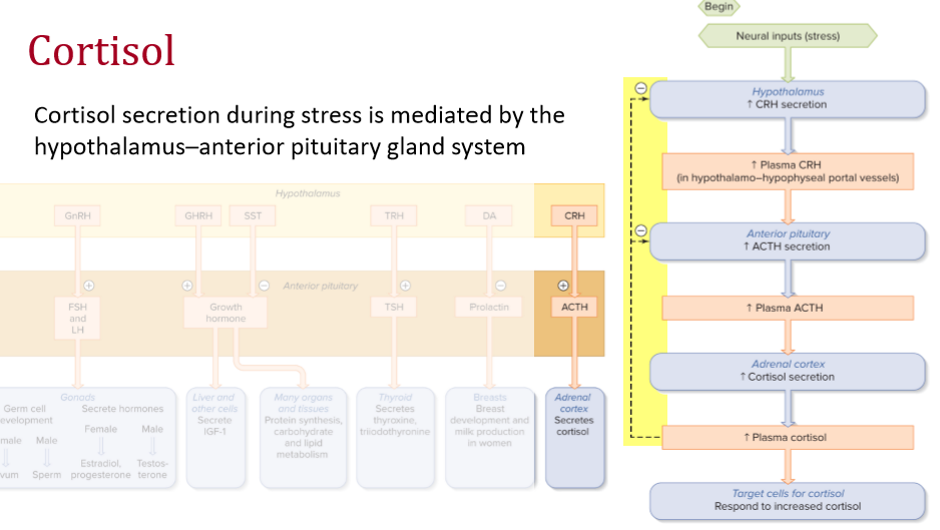
cortisol in the hypothalamus -anterior pituitary gland system
oestrogen and progesteron
produced in the ovaries
levels fluctuate during the month and this can affect exercise levels/performance
oestrogen can be produced in small amounts by other tissues (liver, pancreas..)
oestrogen is produced in males when FSH binds to FSH receptors

Results of fluctuating in female sex hormones across menstrual cycle on endurance and strength training?
Primarily oestrogen and progesterone influence metabolism, body temperature and perceived exertion during the menstrual cycle
At early follicular stage (menstruation) (both E and P are low) - experience low energy, cramping or fatigue
Late follicular phase and ovulation (E peaks while P stays low) - high E promotes glucose availability and glycogen storage so higher peak strength, energy and aerobic/anaerobic capacity
Luteal phase (P rises along with secondary rise and fall of E - body temp increases, P acts antagonistically to E and promotes protein breakdown, elevated temp and cardiovascular strain can make endurance exercise feel harder and max strength/time to exhaustion may dip slightly
