Module 2 - ch and textbook notes
 Call Kai
 Learn
 Practice Test
 Spaced Repetition
 Match
 Flashcards
 Knowt Play
1/76

There's no tags or description
Looks like no tags are added yet.
77 Terms
Speech perception diagram
Acoustic signal → | nuero auditory represent tion (nuerogram) → | Nuero phonological representation (phonological sketch) - figure out what you are hearing
| Lexical item
|

Cocktail party problem
how can you understand people - one word or sound when you are surrounded by noise
Signal differences
Sound aplitude (dB) - Speech enverlope - captures, vowels, melodies, a periodic noise
Frequency - time(s)
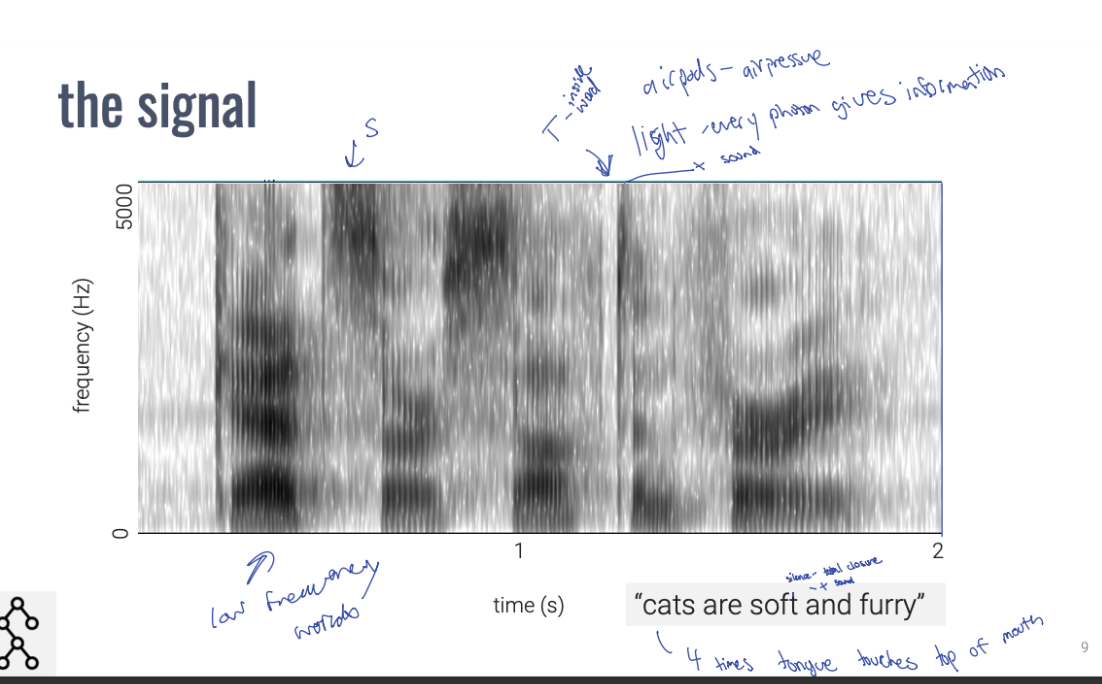
Can find S concentrated in high frequencies - at the top
Low frequencies - at the bottom
Vocal cords hitting each other osscillatory periodic noise
Light and dark - maps amplitude - amplitude frequency time
Signal example/ frequency spectrum
Signal - hearing like vision
Every photon gives information
Low frequency words on the bottom
S on the top - higher frequency and fricative
T - gap between the words/shading - voice onset time
T sound - Silence - total closure
4 times tongue touches top of mouth
Cochlea
Hammer - connected to lever → hits another membrane → connected to vacuum sealed lever in membrane
Cochlea configuration
Sound/frequencies travels through cochlea
Base of cochlea - narrow - tuned for high frequencies
Apex of cochela - wider - lower pitch frequencies
Frequencies and place in cochlea
High frequency: 8000 Hz
In the front/base: 5mm
High frequencies resonate with top hairs and die off
Low frequency: 250 Hz
In the bottom/back: 25mm
Low frequency activate at bottom/back - end
Tonotopy - linear gradient we get for free bc auditory cortex
Parts in primary auditory cortex respond to base or apex of cochlea
Get sounds from auditory cortex & lay out in line
High pitch → low pitch
Linear mapping
Direct
High pitch to low pitch
Connected in a linear way
Gradient
connected to nerve fibers in cochlea
blanketed into auditory cortex

Top down processing Ex: cats are soft and furry
once you have expectation about what you are going to hear → actually affects what you hear
Ex: vocoded voice
Once you hear something you can’t unhear it
phonemes are feature bundles ex
phoneme /k/
[+consonantal](it is a consonant)[-sonorant](it is an obstruent, not a vowel, glide, or nasal)[-voiced](vocal cords do not vibrate)[+velar]or[+high, +back](articulated at the soft palate/velum)[+stop](airflow is completely blocked momentarily)
Cats are soft and fury ex - tracking
Study tracking 2 things/streams
Speech envelope
Phonemes
Speech envelope
Know that its your turn to say something
Rhythm - low level auditory tracking of speech envelope - can tell you where you are in a conversation
Speech envelope
Outline of speech
Rythym, prosody
Dont have high level information
Cochlear implants
Ex: 20 channels - speech becomes able to understand
|
Nuerogram
Tonotopy - responding to pitch
Shape
Periodotopy - linear spatial arrangement of speech envelope
Right hemisphere tracking speech - you know where you are at a discourse level - of speech
Phonotopy
not currently agreed on whether there is a phonological mapping of features in the brain - phonotopy
Barton et al - textbook part
How is temporal info from speech envelope encoded in auditory cortex? Barton, Brener, et al.(2012)
An experiment mapping how different parts of auditory cortex responded to diff frequencies
Experiment: When mapping how different parts of auditory cortex respond to sounds at different frequencies → tonopic patterns - shared
Periodic stimuli → diff parts of auditory cortex responds to diff kinds of periodic stimuli → in a gradient
↑ new spatial code called periodotopy
(Neurons responding to 2Hz stimuli adjacent to those responding to 4Hz next to 8Hz)
Arrangement of this response - nueeonds responding to periodotopy
Changes 90° offset from those responses to frequency changes

phonemic receptive fields - mesgarani et al (2014)
While patients listened to the continuous natural speech - spoken sentences, researchers recorded real-time, high-resolution neural activity from the electrodes covering the STG—a major high-order auditory processing hub in the brain. [1]
Instead of looking for electrodes that just responded to specific words, they analyzed how individual electrodes responded to the microscopic building blocks of those words: phonemes (distinct units of sound) and their acoustic properties
areas of neurons in the auditory cortex that are tuned to select, process, and differentiate distinct speech sounds (phonemes).
Different groups of phonemes (dipthongs + vowels, nasal, plosives) have different activations of neurons - phonemic receptive fields
Was found that electrodes at different sites respond to different phonemes
Nemo Mesogarani- shows that populations of neurons in STG have phonemic receptive fields
1 electrode may be sensitive to class of stop consonants, not specific phones

Analysis by synthesis ex - phonemic receptive fields
Takes info in a neurological way and maps it to cochlea
Generally goes forward
take information about sensory event and you build upwards - what do you think is true about phonology of word - can build upwards in this
Top down thingy
Info filters backwards and can influence what you hear/know
Breaking something down to understand it
Break it down by building it up
Figure out what words are by figuring out what parts are made of - figure out what parts are made of by figuring out what words are

multi voxel pattern analysis
How to get from continuous acoustic spectra to categorical representation
phone to phoneme
Continuous acoustic spectra
populations of features that respond to things like classes
Chang study
Natural speech - in form of like audio books - see if you can correlate patches to different phonemens
See if they respond selectively to different phonemess
Neural populations that respond to individual phonemes
chang study
Kinds of discrete representations we see in brain and what to look for
Categorical representation
Activate different features - abstract features of speech sounds
Manner
Place - in IPA - based on where your articulators - lips - come into contact
Voice - is it voiced or not
Sound
Dedicated areas that are respondent to and tracking speech sounds that are not really reducable to just physics
Ganong effect
Voice onset time experiment
Result
|
Speech sampling rate ex
Speech sampling rate ex:
Audio file, chopped into segments, with each segment reversed.
Listen to file and try to decipher what it says
200 ms
4 per sample
wrong order
100 ms
2 samples per chunk
wrong order
50 ms
Sampling once every chunk
Doesnt matter that much - its reversed
20 ms
So small that its below speech sampling rate
0 ms
The rate at which we sample speech is pretty low
Meaning fewer data points transmitted per second
Temporal windows of integration
How fast phonemes come in
Speech envelope thing happening
Short window 25-40 ms
| Long window 200-300 ms
|
2 windows of integraton + hemispheres
2 windows - dissociate in hemispheres - different patterns of resolution
Right hemisphere - long window
Left hemisphere - short window

2 levels of categorical perception
top down
Acoustic auditory encoding - perception
perception - continuous clues - what you hear
Acoustic space carved into categories - cognition
cognition - categories
The big claim: The auditory percept is changed or warped by the category labels. Whatever you hear changes based on the category you put on it |
Mismatch negativity
phonological features
A way to organize speech sounds:
Phonological features
ex: t
+ coronal
- voiced
+obs
underspecification
Featurally Underspecified Lexicon (FUL) uses three values.
Explains why sometimes certain sounds change in their environment, but the change is not symmetric |
Sound
Manner
Voice


In certain environment things get underspecified - t to d
Walk Vs Walked [wak←t]
| Greet Vs greeted
[griea←d]
|
In certain environment things get underspecified - t to z - plurals
Plurals - only turn into s in certain environment (is it not this environment?) Cat → catz | dog → dogz |
The environment the phoneme/word was found in changes it

Eulitz & Lahiri (2004)
standard stimuli create a central sound representation that is more abstract than the sum
Linking theory
Fill in the feature values as you hear something over & over again
1st time you hear something - represented the way it is
Hear over & over - brain gets lazy do you get representation thats underspecified

Underspecfied sounds in language - Eulitz & Lahiri (2004)
1st time you hear it - deviant
Deviant - features in acoustic signal
5th time you hear it - standard
Standard - features in the memory rep.
Only one (one more time) should lead to mismatch
Clash in negativity
Types of sounds
Coronal - tip of tongue
Labial - lips rounded
Dorsal - back of tongue
O -standard
O crossed out - deviant
Matters because of linking theory

Underspecfied sounds in language - Eulitz & Lahiri (2004) MMN
Non conflict cases - MMN amp/latency does not vary.
mismatch negativity
conflict cases - MMN significantly earlier and larger when there is
conflict [o vs ø] compared to non conflict [ø vs o].
Hestvik & Durvasula (2016)
Did experiment to compare t vs ds
Take all information & lay out lineralty → represent linearly in brain responses
Phonotopy - is there an abstract phonological layer
Yes - underspecified features are more specivied than phonemes


Standard vs deviant compare t and ds - Hestvik & Durvasula (2016)
Compare d’s- big difference
Compare t’s - nothing

Sound is gradient but perception is categorical.
Auditory perception + linguistic theory
Using EEG we can see
Gradient acoustic encoding.
Categorical symbolic representations.
Decomposing features of symbolic representations.
Dual stream model
2 pathways sound goes down
2 routes we take when doing the phonological processing of words
Dorsal pathway
|
Ventral pathway
|
Temporal windows of integration (again)
Short window 25-40 ms
| Long window 200-300 ms
|
IFG - Broca’s area is part of the dorsal steam that maps speech sounds to articulatory representations.
How does this fit withe what we know about Broca’s aphasia?
Fits with what we know about Broca’s area because broca’s area is used for production, said to be where language is localized for comprehension so it would make sense that it has to do with articulatory representations and actually articulating parts of language
Speech waveform/envelope
shows slow changes in loudness following speach intensity envelope
Shows syllabic information
Grey line


Spectral information -
fine structure detail that shows phoneme features.
rapid change from [f] to [t]
Shows more air coming our vs not
How is sound represented in auditory cortex?
Look at:
1. tonotopy - cortical spatial code for sound
different parts of auditory cortex respond selectively to different frequencies
In spatial code created in cochela perseved in auditory cortex
Could also say neurons in primary auditory cortex have different frequencies
2. receptive field of neuron - connection between a certain stimulus and the response of a given neuron
Recognizing speech
(frequency information not always important for understanding)
Speech envelope - outline of the peaks (loud moments) and troughs (soft moments) in waveform - gives speech patterns of syllables & stress
→ neurons with similar tuning are adjacent to each other
Fine structure - rapid sound vibrations making up speech energy at different frequencies
- has narrow bands of energy-distinguish things like vowels
- broad band- sibilants, fricatives
→ speech comprehension good even when little fine structure & only speech envelope provided
→ testing fine structure
noise vocoding- speech envelope extracted from an utterance, fine stricture replaced with white noise - speech stull understandable
Brain needs to represent
spectral signature of speech - frequency info
Changes in loudness over time - temporal info
tracks it speech envelope in much detail
entrainment
match between brain activity & perceptual input.
⬇
Locks onto things you focus attention on
- speech we comprehend only a fraction of what we hear
link found to fluctuation of brain activity & temporal lobe |
Cocktail party effect
2 ways to navigate chaos of real life acoustic inputs
1 - hear all of it at early stages (including overlapping acoustic input from multiple sources) → rely on higher level inguistic processing to sort out words to attend to | 2 - Early perceptual processing being more selective → we only hear what acoustic input we consider important |
Data more consistent with #2
Toscano et al (2010)
Toscano - would think things on one side of threshold would have a cutoff and one thing would have something else
Tells us
VOT - looks like a kind of tonotopy
Linear distribution of a certain kidn of feature
EEG - amplitude of the signal
Getting a linear spread of the feature
Feature not present in tonotopy - all of the pitch information coming out of the cochlea - continuous
Voice onset time - temporal measure between tow events
The amount fo time that happens between he burst and the voicign
Tonotpy does not get this - to get info you have extract it over time
Already this is more abstract than tonotpy - but not phonotoy

Kuhl & Miller (1978)
Categorical perception is task dependent
meaning that
a person showing categorical perception—perceiving continuous physical changes as distinct categories rather than a smooth gradient—depends on how you test or ask them to process the stimuli
tested categorical perception in chinchillas and found that it was just like humans
If you tell people to sort out sounds into categories they can do it
Chinchillas can also do it

Eulitz & Lahiri (2004) test
used an auditory "oddball" paradigm + Event-Related Potential (ERP) recordings to measure - Mismatch Negativity (MMN)—to understand how the brain processes standard versus deviant phonological features
The Stimuli: Participants were presented with pairs of spoken vowels (such as
[e]and[o]). [1]The Reversal Technique: The researchers flipped which vowel served as the standard (the repetitive background sound) and which served as the deviant (the rare, unexpected sound) across different blocks. [1]
Brain Tracking: While participants passively listened to the sounds, their automatic, pre-attentive brain activity was monitored using EEG/MEG to track the MMN response—an electrical brain wave triggered when the brain automatically notices a change in an auditory patter
Eulitz & Lahiri (2004) predictions + results
test to see designed to see if the brain relies on fully detailed representations or underspecified representations (where some default linguistic features are omitted from long-term memory)
The Prediction: If the mental lexicon tracks every feature symmetrically, reversing the standard and deviant would yield the exact same MMN response. However, if the lexicon is underspecified, the MMN would be asymmetric. [1, 2]
The Result: They discovered a clear asymmetry. When the standard vowel lacked a specified feature (like a specific "place of articulation") in the listener's mental lexicon, the incoming deviant sound did not trigger a strong mismatch. When the roles were reversed and the standard was fully specified, the deviant triggered a significantly larger and faster MMN. [1, 2, 3]
Mismatch Negativity (MMN)
—to understand how the brain processes standard versus deviant phonological features
Hestvik & Durvasula (2016) tested
underspecification theory,
numarked phonemes are stored sparsely in long-term memory without certain features (e.g., /d/ is underspecified for voicing),
marked phonemes are fully specified (e.g., /t/ is specified as [spread glottis] or voiceless)
Mismatch Negativity (MMN) auditory event-related potential (ERP) to test if presenting an underspecified phoneme as a rare "deviant" among specified "standards" causes a different brain reaction than the inverse
Phonemic vs. Phonetic Processing: They introduced a new experimental modification to see if changing the paradigm to encourage short-term phonetic acoustic memory traces (rather than abstract phonemic lexical memory traces) would alter this effect.
Hestvik & Durvasula (2016) results
Underspecification Asymmetry: They successfully demonstrated an underspecification-driven asymmetry in the brain's automatic response to contrasts in English. The brain reacted differently depending on the direction of the phoneme change, confirming that some speech sounds are represented more sparsely in long-term memory than others.
Context-Dependent Disappearance: Crucially, they found that the asymmetry disappears when the MMN paradigm is modified to force the brain to form acoustic/phonetic memory traces instead of relying on underlying phonemic traces. [1, 2]
Neurobiological Proof: This provided direct neurobiological evidence that long-term phonological representations in the mental lexicon are highly abstract and sparsely coded compared to the fully specified phonetic processing of immediate acoustic inputs
Ding & Simon (2013)
participants tisten to speech from audiobook mixed with noise
Moderate levels - participants could understand the speech even though strongly distorted
Temporal processing in auditory cortex
found that we can turn up volung selectively tune in out of diff speech sounds from other acoustic inputs
Sound is characterized by 2 patterns
spectral pattens- sound energy at different frequencies
temporal patterns - loudness varying over time
2 pieces of evidence that speech perception can’t be understood using just continuous info
mainly be speech signals vary greatly & variation handled with ease
Evidence 1 - categorical perception
Categorical perception - phenomenon stating that if you have speech sounds that have been artificially altered & start with 1 syllable, then
change incrementally to another, listeners don't perciere a smooth change
Ganong effect - If hearing ambiguous sound between [s] vs [ʃ] (sh sound) they'll percive whichever one makes more sense in a word
- more likely to hear [s] for a male voice : “said”
-more likely to hear [ʃ] for a female voice : “shed”
Ganong effect different from McGurk
Shows that continuous acoustic info not enough to explain brain recognition of phonemes & words
Was found that electrodes at different sites respond to different phonemes
Nemo Mesogarani- shows that populations of neurons in STG have phonemic receptive fields
1 electrode may be sensitive to class of stop consonants, not specific phones
2 pieces of evidence that speech perception can’t be understood using just continuous info
mainly be speech signals vary greatly & variation handled with ease
Evidence 2 - all or nothing
Evidence 2 : Best evidence that brain responses categorical
electrodes that show classic non- linear response associated with categorical perception
Specitic electrode responds in an "all or nothing" way when a consonant is voiced
one responds in "all or nothing" when consonant unvoiced
one responds to stops regardless if voiced or not
Even carry responses show categorical, not continuous features
Categories can’t fully be understood as summaries of acoustic differences
How does the brain transform a continuous neurogram to a categorical representation of speech sounds?
Input:
neurogram
Transformation:
- occurs rapidly (100-200 ms after speech starts)
- in superior temporal lobe, in vicinity ot primary auditory cortex
Output: need
- Phoremic features
Speech reversal thing
Temporal window of integration
Brain has sampling rate for speech sounds - takes a "snapshot" of acoustic info at fixed windows, everything during snapshot is in 1 chunk of info → info used to pick out phonemes
⬇
Speech reversal -
participants couldn’t understand reversed speech spanning large segments (grains) - 200 - 300 ms
Could hear some - less than 200 ms
100% accuracy - 30-50 ms
McGurk effect
auditory & visual information combined and don’t match
alters what participants hear
Top down spech processing
We make predictions about what person will say next
internally synthesize upcoming speech → helps in analysis of speech signal when it comes
The phonological sketch is refined by
a series of feedback loops between acoustic input and linguistic knowledge called analysis by synthesis.
The outcome of these interlocking processes is a representation suitable for identifying words.
Point of speech perception
point depends on listener's task (what they were asked to do)
1 type of task - finding meaning
In speech perception - identify words, phrases, sentences to understand speaker's message
repeat/ shadow something you're just heard
2 - phoneme Monitoring task
- lab setting, push button if you hear certain thing
Dual stream model
Ventral stream - understanding
Place: temporal & frontal lohe Role: transfom from acoustics → phonemes → lexial items → meanins of sentences |
Dorsal stream - processing
Place: temporal → superion regions of frontal lobe Role: Map acoustic input to representations of articulation |
Turkish vowel study
Researchers tested if there was a “nuetral vowel space”
Particiopants asked to press button when hearing a cerain consonant among sounds
Evoked brain response - M100 response - auditiory cortex peaks about 100 ms after vowel begins
Researchers reasoned - if there was a spatial code for phonemes - like there are for neurograms - the location of M100 peak would differ systematically for diff Turkish vowels
Results -
source locations fall along systematic axes:
Front vowels - inferior - superior plane
Back vowels - anterior to posterior plane
Results - there is a vowel map in the STG
Distinctive features map to separate axes in space
Phoneme confusability experiment
Adults listened to a series of syllables that begun with different consonstants
Measured similarity in terms of phoneme confusability
Multi VOXEl pattern analysis
Used to understand the nural representations that matter to a particular set of voxels in the brain
Results
Stimuli lead to distinct patters of activation
Voxels discriminate between these kind of stimuli
Nueral population in these voxels have receptive fields for whatever feature(s) separate the 2 stimulus types
Superior temporal cortex represents phonological detail in a spatial code (phonemic receptive fields)
Code is not organized in a phonotopic gradient with similar phonoemes activating adjacent nueronal populations
Mismatch response (MMR)
Used to understand whether different stiumuli match or not
If 2 ppl with different sounding voices make the same speech sound - does it activate the same or differnt mental representations in a listener?
Oddball design
In odd ball experiment there are
Standards - Certain stimuli are presented frequently - 80% of time
Deviants - some stimuli presented rarely - 20%
MMR - a signal that emerges around 200 ms after hearing a deviant item - relative to hearing the same stimulus when it is prenesnted as a standard
Sensitive to phonemic difference, not just acoustic differences
Expected since brain has rapid sensitivity - less than 200 ms for phonemic features
Underspecified
- If phonemes include defaults then you don’t need to store every featural detail separately
Mental representation only needs to track when phoneme differs from the default
Feauture that is underspecified
CORONAL feature - captures the articulation of consonants with the tongue tip
Ex [t], [d], [s]
Contrasts with DORSAL feature - [k]
[ta] is standard
There is no explicite expectation for CORONAL (its the default)
Then [ka] deviant will not show as strong a mismatch (rememebr that the acoustics are different so there will be at least some mismatch)
IMportant point about MMR
Feature understpefication predicts that MMR is asymmetric
[ta] will bne a large mismatc against standard [ka], but [ka] will be a smaller mismatch against a standard [ta]
Pullvermuller et all
Participants engaged in speech tasks while fMRI scans
First task - produce [ta] and [pa] syllables
Observed separate patterns of activation along motor cortex when participants produce a bilabial [pa] syllable (closure of lips) compared to alveolar (tongue tip) [ta]
Participants listened to those 2 types of sounds
Results -
activation in auditory cortex and motor cortex
Spatially separated according to articulators
Tongue region activated postivielt for [ta] but not [pa]
Lip redion activated for [pa] but not [ta]
Evidence that motor cortex activation → successful speech perception
Mottonen Watkins (2009)
Thought that
If motor cortex is actively involved in speech perception - discrimination between phonemens that differ in one feature will be harder if activation is inhibited
Inhibt activation of motor cortex using rTMS technique
Results
When rTMS inhibition targeted lip region patients found it harder to distinguish bilabial [pa] or [ba] segments from alveolar [ta] or [da] segments
Specific to lip motor cortex
rTMS did not affect ability to discriminate between phonemic pairs not involving lip articlators
Brain regions involved in controlling articulation may also play active role when simply listening to speech
Evidence that
Speech perception may use motor system but doesn’t depend on it
Classical characterization of brocas area
Experiment - Rogalsky & Hickok (2011)
5 case studies
Successful speech production doesnt depend on speech comprehension
Al patients sufferend from left hemisphere lesions that impacted speech fluency
All performed wll on speech comprehension tasks
Critique - brain may compensate for url trauma
Wada Procedure
Anethetia injected inoto major artery for one brain hemisphere
- puts one side of prain to sleep
Patient not able to produce speech - affected hemisphere on that side is dominant for language
Patient usually can comprehend speech just fine though
Data indicate - motor systems involved in speech production not necessary for successful comprehension
Motor Systems engaged during speech perception but not necessary for success
summary kinda
|