CMB- transcription
 Call Kai
 Learn
 Practice Test
 Spaced Repetition
 Match
 Flashcards
 Knowt Play
1/49

There's no tags or description
Looks like no tags are added yet.
50 Terms
Central Dogma
Transcription and translation

Chemical Structure of DNA
Ribose instead of deoxyribose
U instead of T
Base pairing rules (used in transcription)
Read and derive the complementary sequences
Only one strand on DNA is used
Differential expression

coding, sense, +
In DNA the top strand is called, _____, ______, and ______ strand
Template, antisense, (-)
In DNA the bottom strand is called, _____, ______, and ______ strand
RNA:DNA hybrid

RNA
Single-stranded, have secondary structures
mRNA, rRNA, miRNA, tRNA’s and other small RNA’s like snRNAs
What are the types of RNAs
mRNA (messenger RNAs)
Code for proteins (translation)
rRNA (ribosomal RNAs)
Form the core of the ribosome and catalyze protein synthesis
miRNA (micro RNAs)
Regulate gene expression
tRNA (transfer RNAs)
Serve as adapters between mRNA and amino acids during protein synthesis.
snRNAs (Other small RNAs)
Used in RNA splicing, telomere maintenance, and many other processes.
Complementary lines of RNA code bond together through H-Bonds
What is happening in this pictures

RNA Polymerrse in Prokaryotes
Binds to promoter of genes
Able to unwind DNA, starts transcription without primer
Only transcribes one of two DNA strands
Adds ribonucleotides to the growing 3’ end of an RNA chain, i.e. synthesis proceeds in 5’ to 3’ direction
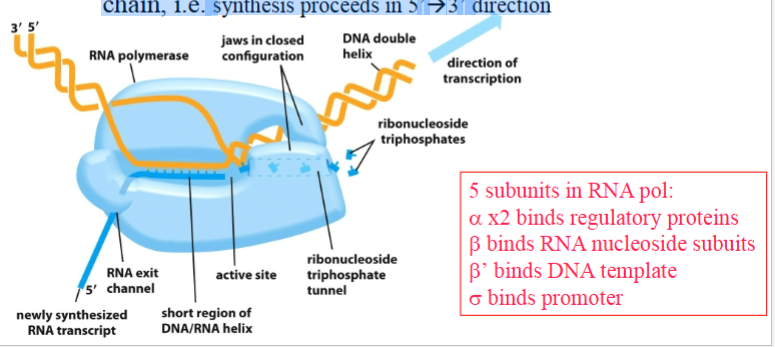
RNA Polymerase 5 subunits
2 α binds to regulatory proteins
β binds RNA nucleoside subunits
β’ binds DNA template
σ binds to the promoter
regulatory proteins
nucleoside subunits
DNA template
promoter
2 α binds to _______
β binds to ________
β’ binds to the _______
σ binds to the ______
Transcription in Prokaryotes
The process starts at RNA polymerase binding sites, called promoters, on the DNA template strand.
– RNA polymerase begins to unwind the DNA helix.
Promoter (start signal)

Terminator (stop signal)

Start and Stop of transcription in Prokaryotes
Promoters; -35 & -10 sequences
Terminator: a stretch of GC that forms into a hair-pin structure
Multiple initiations
Both DNA strands could be coding strands.
-35 and -10
Promoters are at ____ and ____ sequences
Terminator
A stretch of GC that forms into a hair pin structure.
GC hairpin

multiple
In transcription in Prokaryotes are are _____ initations
both
In transcription in Prokaryotes ____ DNA strands could be coding strands
Transcription in Prokaryotes.
Look at the diagram.

How does eukaryotic transcription differ from prokaryotic transcription?
Three RNA polymerase enzymes
Initiation complex forms at the promoter & enhancers
RNAs are modified after transcription
One mRNA makes one type of protein (monocistronic)
Transcription in Eukaryotes
Three RNA polymerases
Transcription Factors
Monochronic
RNA modifications
RNA Polymerase I
RNA Polymerase II
RNA Polymerase III
In Transcription in eukaryotes there are three polymerases, _______, _____, and______
rRNA
In transcription in eukaryotes, polymerase I is for what RNA(s)?
protein-coding, mRNA, and Small nuclear RNA
In transcription in eukaryotes, polymerase II is for what genes?
tRNA and Small RNA
In transcription in eukaryotes, polymerase III is for what RNA(s)?
Transcription Factors
1. First, TFIID complex containing TBP (TATA-box binding protein) binds to the promoter
2. joined by TFIIB, then TFIIE, and others. The last factor is TFIIH.
3. TFIIH phosphorylates RNA polymerase II and initiates transcription
bind to the promoter
What does TFIID, TFIB, and TFIIH do? (They do so in the order listed)
phosphorylates RNA polymerase II and initiates transcription
What does TFIIH do after bonding to promoter?
Monocistronic
one mRNA for on peptide
bacterial mRNA
This is _______ because it is polycistronic (codes multiple proteins)

RNA capping and polyadenylation

5’ cap
7-methylguanosine, 5’-5’ triphosphate bridge

Poly-A tail
150-250 As

150-250
Only the poly-A tail and enzyme adds _____ A’s
RNA Modification (Only in Eukaryotic transcription)
1. 5’ cap (7-methylguanosine, 5’-5’ triphosphate bridge)
2. 3’ poly-A tail (150-250 As)
3. splicing
Splicing
Removing sections of RNA
Spliceosome
The enzyme that carries out splicing, it contains snRNA & snRNP
lariat
Intermediate structure in splicing
Alternative splicing
combinations of different exons from the same primary RNA to generate tissue-specific versions of protien’s.
Exon
Coding part of RNA kept after splicing in the mature mRNA
Intron
Noncoding part of RNA removed during splicing