Lab 7: Intro to muscles
 Call Kai
 Learn
Learn Practice Test
 Spaced Repetition
 Match
Match Flashcards
 Knowt Play
1/73

There's no tags or description
Looks like no tags are added yet.
Name | Mastery | Learn | Test | Matching | Spaced | Call with Kai | Chat |
|---|
No analytics yet
Send a link to your students to track their progress
74 Terms
Origin
The place where Muscle is attached to the non moveable part/bone
When that specific muscle is pulling, that part doesn't move
Tendon
A band of fibrous connective tissue that connects muscle to bone or muscle to muscle
Dense regular connective tissue proper
Interstion
The place where the muscle is attached to the moveable bone
Aponeurosis
A sheet like tendon rather than band like CT
A thin membrane like sheet
Connects muscle to bone or muscle to muscle
Agonist
The muscle that is providing the majority of the force for a movement
Eg. Biceps brachii when you are flexing your arm
Antagonist
Muscle that must be relaxed or extended when the agonist is active
Eg. triceps brachii when you are flexing your arm
It is the muscle that becomes active in order to reverse the flexion the bicep brachii
If you want a smooth movement when you are extending your arm you don't just completely relax the agonist you have to contract the antagonist and partially relax the agonist
****NO muscle is always the agonist for every movement, eg. when you are extending the arm the biceps brachii becomes the antagonist
Synergist
A muscle that assists the agonist
Can do so in 2 ways (its doing OR not both)
1) Add power to the movement to make sure you add power to the movement
2) Stabilize/immobilize the origin
A Fixator
Fixators
If it stabilizes the origin it is also known as the origin
It is a smaller group within the synergist

frontal belly of epicranius

orbicularis oris

orbicularis oculi

Zygomaticus

pectoralis major

pectoralis major

pectoralis major

pectoralis minor

D
pectoralis minor

1
pectoralis major

internal intercostal

A
Frontal belly of epicranius
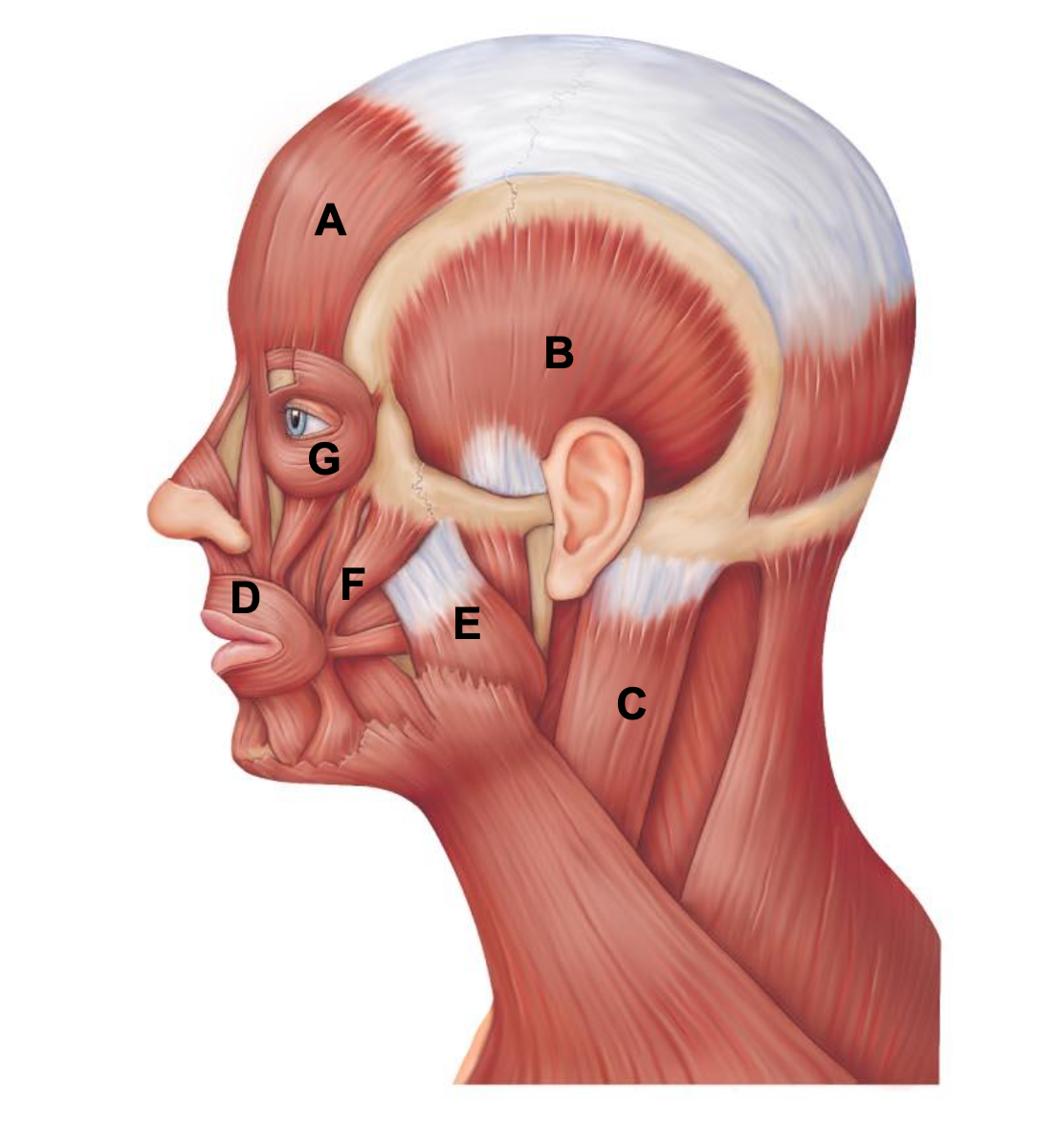
D
Orbicularis oris

G
Orbicularis oculi

E
Masseter

B
Temporalis

F
Zygomaticus
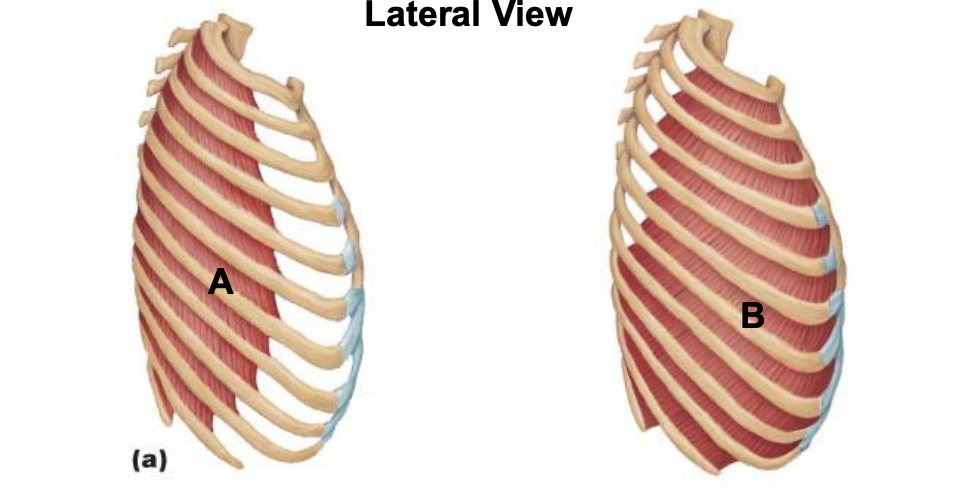
A
External intercostal

internal intercostal

Diaphragm
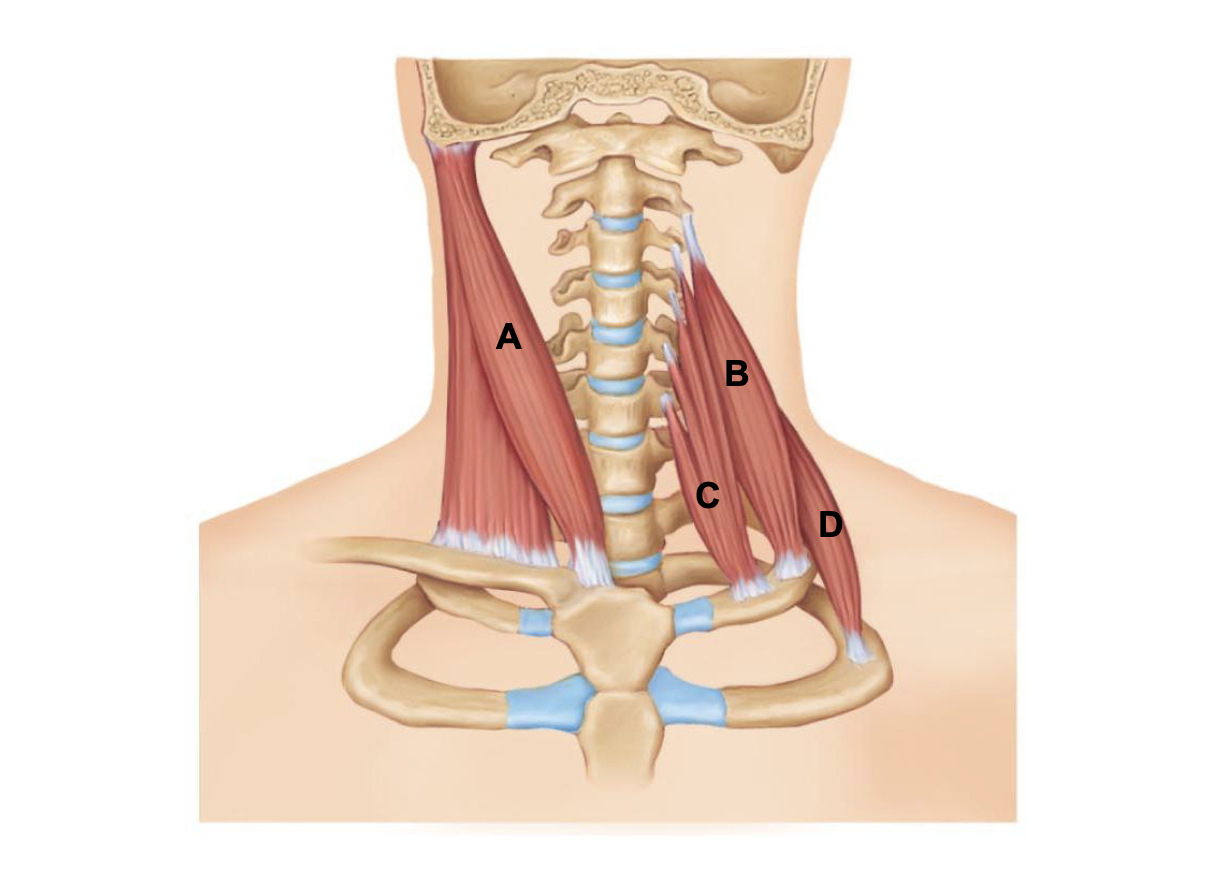
A
SternoCleidoMastoid

B
Middle Scalenes

C
Anterior scalenes

D
Posterior scalene

A
Transverse abdominis

B
External oblique

C
Transverse abdominis

D
internal oblique

E
Linea Alba

A
External oblique

B
Rectus abdominis

C
Pectoralis major

D
pectoralis minor

A
pectoralis major

B
pectoralis minor

A
External oblique

B
Transverse abdominis
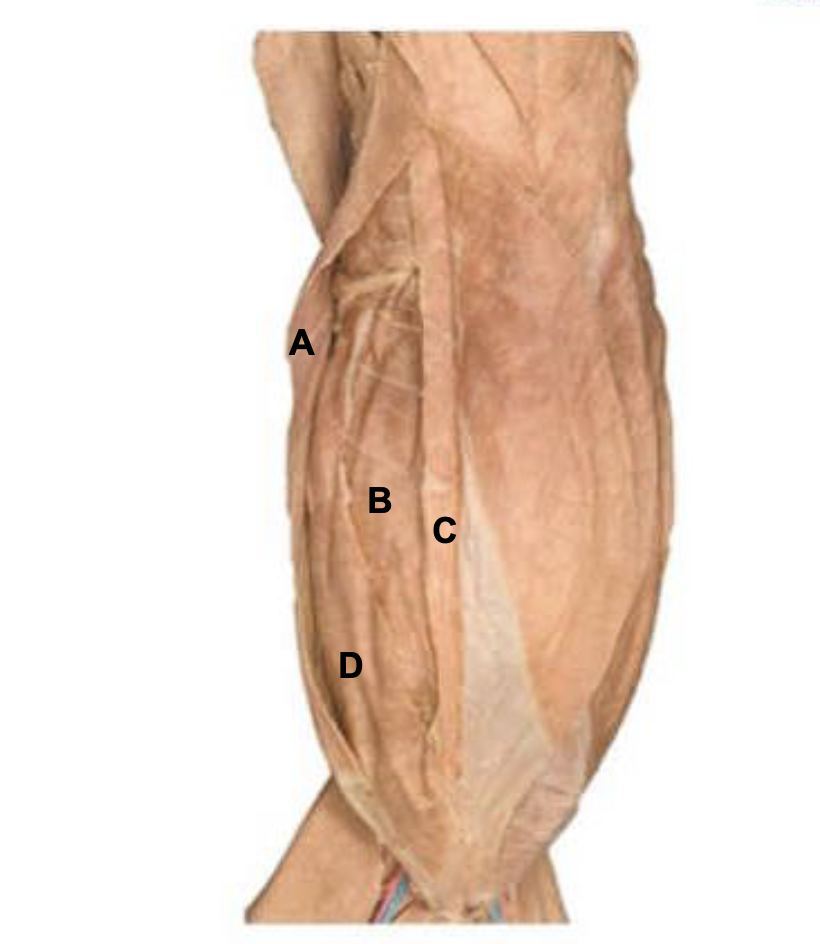
C
Rectus abdominis

D
Internal oblique
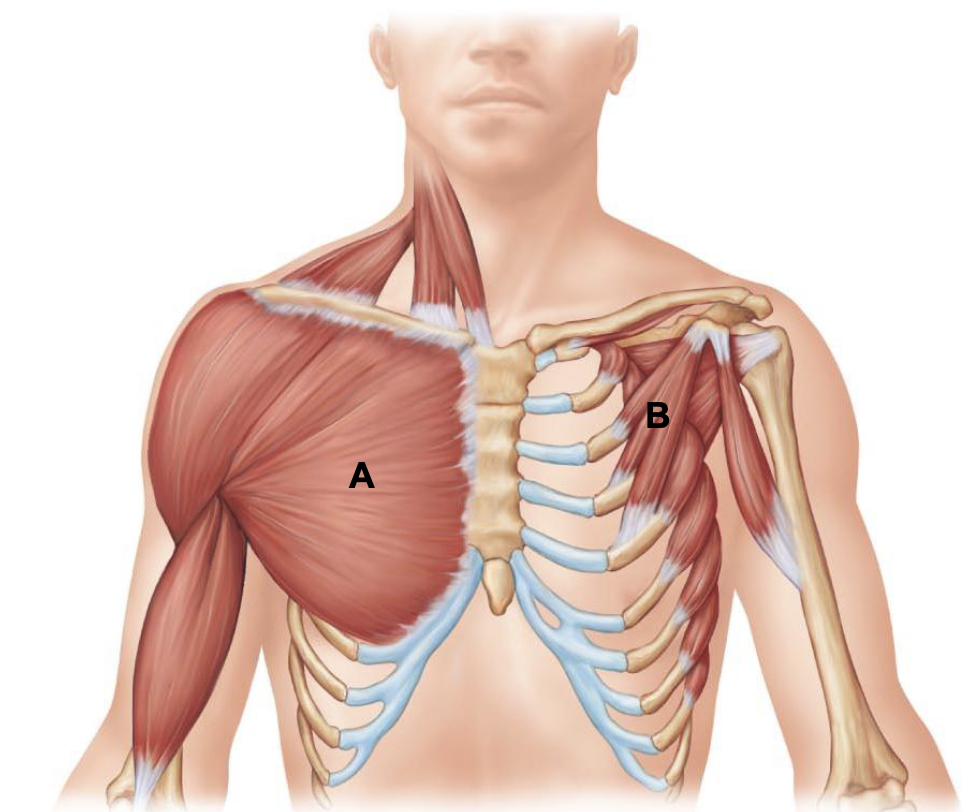
A
pectoralis major

B
pectoralis minor

Origin, Insertion, action of Pectoralis Major
Origin: Sternum
Insertion: Greater tubericle of humerus
Action: Adducts and medially rotates arm
Origin, Insertion, action of Pectoralis Major
Origin: Sternum
Insertion: Greater tubericle of humerus
Action: Adducts and medially rotates arm

Origin, Insertion, action of Pectoralis Minor
Origin: Anterior surfaces of ribs 3-5
Insertion: Coracoid process of scapula
Action: With ribs fixed, pulls scapula forward and downward
Origin, Insertion, action of Pectoralis Minor
Origin: Anterior surfaces of ribs 3-5
Insertion: Coracoid process of scapula
Action: With ribs fixed, pulls scapula forward and downward

Origin, Insertion, action of Rectus abdominis
Origin: Pubic crest
Insertion: Xiphoid process
Action: flex and rotate lumbar region of vertebral column
Origin, Insertion, action of Rectus abdominis
Origin: Pubic crest
Insertion: Xiphoid process
Action: flex and rotate lumbar region of vertebral column

Origin, Insertion, action of External obliques
Origin: Fleshy strips from outer surfaces of lower 8 ribs
Insertion: Lina alba
Action:
flex vertebral column
compress abdominal wall
trunk rotation and lateral flexion
Origin, Insertion, action of External obliques
Origin: Fleshy strips from outer surfaces of lower 8 ribs
Insertion: Lina alba
Action:
flex vertebral column
compress abdominal wall
trunk rotation and lateral flexion

Origin, Insertion, action of internal obliques
Origin: Iliac crest
Insertion: Linea alba
Action:
flex vertebral column
compress abdominal wall
trunk rotation and lateral flexion
Origin, Insertion, action of internal obliques
Origin: Iliac crest
Insertion: Linea alba
Action:
flex vertebral column
compress abdominal wall
trunk rotation and lateral flexion

Origin, Insertion, action of transverse abdominis
Origin: iliac crest
Insertion: linea alba
Action: compresses abdominal contents
Origin, Insertion, action of transverse abdominis
Origin: iliac crest
Insertion: linea alba
Action: compresses abdominal contents

Origin, Insertion, action of sternocleidomastoid
Origin: Manubrium of sternun
Insertion: mastoid process of temporal bone
Action: flexes and laterally rotates the head
Origin, Insertion, action of sternocleidomastoid
Origin: Manubrium of sternun
Insertion: mastoid process of temporal bone
Action: flexes and laterally rotates the head

Origin, Insertion, action of anterior scalenes
Origin: Transverse process of the cervical vertebrae
Insertion: Anterolaterally on first rib
Action: elevates first 2 ribs
Origin, Insertion, action of anterior scalenes
Origin: Transverse process of the cervical vertebrae
Insertion: Anterolaterally on first rib
Action: elevates first 2 ribs
Origin, Insertion, action of middle scalenes
Origin: Transverse process of the cervical vertebrae
Insertion: Anterolaterally on first rib
Action: elevates first 2 ribs
Origin, Insertion, action of posterior scalenes
Origin: Transverse process of the cervical vertebrae
Insertion: Anterolaterally on first 2 ribs
Action: elevates first 2 ribs
2 differences between the human and cat muscle groups
1) Sternocleidomasoid not connected to clavical in the cat but it is in humans and is called sternomastioid in cats
2) Pectoralis Major and Minor has different shapes in cat and the sizes are different

sternomastoid

sternomastoid
Major Structural features of skeletal muscle
Striations: Yes
Nucleus: Multiple nuclei
Intercalated discs: None
Shape:
Long cylinder
Striated
Multi-nuceated
Major Structural features of cardiac muscle
Striations: Yes
Nucleus: 1-2
Intercalated discs: Yes
Shape:
Branched shape
1-2 nucleus
Strations
Looks like x’s and y’s
you can see white spaces between the cells
Major Structural features of smooth muscle
No Striations
Nucleus
Intercalated discs: None
Shape:
Spindle shape
No striations
1 nucleus per cell
Stacked on top of each other